 Hypno
HypnoHypnobirthing Techniques: What Actually Works During Labor
The hypnobirthing techniques that make the biggest difference during labor. Breathing methods, visualization, and relaxation practices explained step by step.
200,000+ moms • ORCHA NHS Certified • Free on iOS & Android
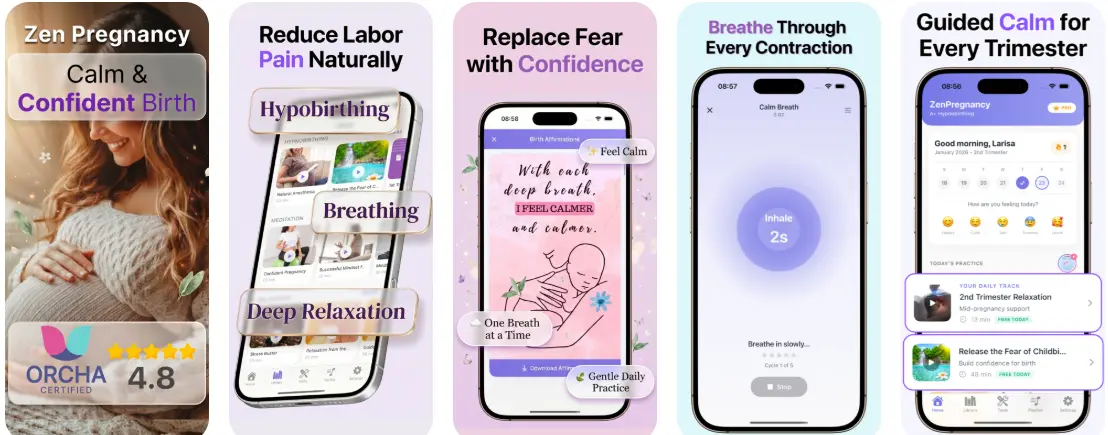
Hypnobirthing techniques are practical labor coping tools that use breathing, relaxation, visualization, affirmations, and self-hypnosis to help you stay calmer and more focused during birth. They work best when practiced before labor, so the techniques feel familiar when contractions begin.
Who is this guide for?
Good fit if you
- You want simple hypnobirthing techniques you can practice during pregnancy and use in labor
- You are looking for breathing, visualization, relaxation, and affirmation tools in one place
- You want calmer birth preparation without a rigid birth plan or one-size-fits-all method
- You prefer guided audio support for building confidence and practicing consistently
- You want a free hypnobirthing option that is easy to use at home or on the go
May not be enough if you
- You are looking for medical advice or a replacement for guidance from your midwife, doctor, or birth team
- You want a guaranteed pain-free labor or a promise of a specific birth outcome
- You prefer only in-person classes with live teacher feedback
- You do not want to practice regularly before labor
Why Labor Coping Skills Matter Before Contractions Start
Labor coping skills matter because your brain and body respond to birth as both a physical and emotional event. When fear spikes, many people tense their jaw, shoulders, belly, and pelvic floor without realizing it, which can make each contraction feel harder to meet.
The goal is not to pretend birth is easy. The goal is to give your body repeated signals of safety: slow breathing, soft muscles, familiar words, and support from your partner, doula, midwife, or clinician. Many parents start practicing in the third trimester, but even a few weeks of steady practice can help. This is not medical advice. Always ask your healthcare provider how any birth preparation method fits your pregnancy, especially if you have a high-risk condition, planned induction, VBAC, or cesarean birth.
How Hypnobirthing Works in the Nervous System
Hypnobirthing works by shifting attention away from panic and toward predictable cues that calm the autonomic nervous system. In practice, this usually means self-hypnosis, breathing patterns, relaxation training, visualization, and repeated positive suggestions.
During stress, the sympathetic nervous system can increase adrenaline, muscle tension, and racing thoughts. During calm focus, the parasympathetic system is more active, and the body is better positioned to release oxytocin and endorphins that support labor rhythm and coping. Research is mixed on whether hypnosis changes epidural or cesarean rates for everyone, but studies suggest it may reduce fear and improve satisfaction for some birthing people. A Cochrane review on hypnosis for labor pain notes that evidence varies by study quality and program type.
Breathing Techniques for Labor Contractions
Breathing is often the quickest way to lower tension during contractions because it gives your mind one simple job. The most useful labor breath is usually a small, easy inhale followed by a longer, slower exhale.
Try inhaling through your nose for four counts and exhaling for six to eight counts while relaxing your jaw. In active labor, avoid gulping air or forcing huge breaths; many people feel steadier with quiet inhales and long sighing exhales. If you want to train this before your due date, build a daily routine with pregnancy breathing techniques for labor preparation. Practicing when you are calm teaches your body what to do when contractions become intense, especially around transition when many parents briefly think, “I can’t do this.”

How to Practice Birth Breathing Step by Step
- Choose one daily time. Practice for 5 to 10 minutes after waking, before sleep, or after a bathroom break so it becomes routine.
- Soften your face first. Unclench your jaw, rest your tongue, lower your shoulders, and let your hands open.
- Breathe out longer than in. Inhale gently for four counts, then exhale for six to eight counts without straining.
- Add a cue word. Say “soft,” “open,” or “release” silently on each exhale to reduce decision-making in labor.
- Practice with movement. Try the same breath while leaning over a birth ball, walking slowly, or swaying with a support person.
- Use it in real stress. Try it during blood draws, Braxton Hicks, or anxious moments so your body recognizes the pattern under pressure.
Visualization for Birth Focus and Confidence
Visualization helps during labor when it is simple, sensory, and easy to repeat. The best images are not complicated scenes; they are quick mental anchors that keep you from chasing every worried thought.
Some parents imagine a wave rising, peaking, and falling. Others picture a flower opening, a cervix softening, warm light moving down, or a baby working with them. Pick one image and rehearse it with the same music, scent, or hand placement if that feels good. If your mind wanders, that is not failure; gently return to the image on the next exhale. For longer guided practice, many parents pair visualization with hypnobirthing meditation for pregnancy and labor, especially from 28 weeks onward.
Relaxation Techniques for Labor Pain Management
Relaxation techniques support labor pain management by reducing unnecessary muscle guarding. They do not remove all sensation, but they can make contractions feel less chaotic and help you recover between surges.
Start with a body scan: forehead, jaw, shoulders, hands, belly, thighs, pelvic floor, feet. Notice where you are gripping, then release that area on the exhale. Progressive relaxation also works well: tense one muscle group for two seconds, then let it melt. In labor, your support person can say, “Drop your shoulders,” or place a warm hand on your upper back as a cue. If pregnancy anxiety has been high, combine this with pregnancy stress relief practices so calm feels familiar before the big day.
Self-Hypnosis Scripts and Birth Affirmations
Self-hypnosis scripts and birth affirmations work best when they feel believable, specific, and repeated often. A phrase like “I can meet one contraction at a time” usually lands better than something your body does not trust.
Good scripts include a relaxation cue, a focus image, and a short suggestion: “With every exhale, my shoulders soften. My body knows how to open. I can ask for support when I need it.” You can record your own voice or listen to guided audio. If affirmations feel cheesy, make them practical: “I can change plans and still be safe,” “My baby and I are a team,” or “I can use medicine and still birth with power.” For more options, see hypnobirthing affirmations for pregnancy and birth.
How to Use Hypnobirthing Techniques by Labor Stage
The most effective plan changes with the stage of labor. Early labor usually needs rest and distraction, active labor needs rhythm, transition needs reassurance, and pushing or birth needs clear support.
- Rest in early labor. Eat lightly if approved, hydrate, nap, and use slow breathing only when needed.
- Create rhythm in active labor. Use swaying, counterpressure, low sounds, and long exhales through each contraction.
- Reduce words in transition. Ask your team for short phrases like “breathe out,” “soft jaw,” and “you are safe.”
- Follow your care team during pushing. Use breathing, bearing down, or open-glottis pushing as appropriate for your body and setting.
- Keep tools for changes. Use the same breath during monitoring, induction steps, epidural placement, or cesarean preparation.
Guided Meditation for Pregnancy Practice
Guided meditation gives you a repeatable practice when you are too tired to invent one yourself. In late pregnancy, this matters because sleep is lighter, worries can get louder, and your body may feel unfamiliar from week to week.
A good session should use a calm voice, slow pacing, birth-safe language, and enough silence for your body to settle. You can listen sitting upright, lying on your side, or resting with pillows under your knees. If you want audio support, a can help you repeat the same cues until they feel automatic. You can also explore guided meditation for pregnancy if your main need is anxiety relief, bonding, or sleep.
Labor Mindfulness When Plans Change
Labor mindfulness is the skill of returning to the present moment without shaming yourself for being scared. It is especially useful when birth shifts away from the plan you imagined at 30 weeks.
Induction, back labor, epidural decisions, slow dilation, assisted birth, and cesarean birth can all bring a rush of grief or fear. A mindful response sounds like: “This is hard, and I can take the next step.” Ask for information in small pieces: what is happening, what options exist, what happens if you wait, and what your provider recommends. The NHS guidance on signs of labor can also help you understand early labor patterns, though your own clinician’s advice comes first.
Contraction Timing Without Anxiety Spirals
Contraction timing is useful when it helps you see a pattern, not when it makes you stare at your phone in fear. Track the start time, end time, length, and spacing, then put the screen down between contractions.
Many hospitals and midwives give a call-in guideline such as contractions around five minutes apart, lasting one minute, for one hour, but your instructions may differ. Call sooner for bleeding, reduced baby movement, ruptured membranes with concerns, fever, severe pain between contractions, or anything that feels wrong. If timing helps you feel organized, use a and let your partner manage it. For a deeper look, see contraction timer meditation for calmer labor tracking.
Partner Cues for Calm Birth Support
A support person can make hypnobirthing more effective by reducing decisions and repeating familiar cues. Their job is not to control labor; it is to protect calm, comfort, communication, and consent.
Before birth, choose three phrases you actually like: “loose jaw,” “long exhale,” “one wave at a time,” or “I’m right here.” Practice counterpressure, hip squeezes, slow touch, and helping you change positions. During labor, partners should watch for tension, offer water, dim lights if possible, and speak to staff when you need a pause. They can also help you remember your preferences without treating the birth plan like a contract. If you are preparing for a first birth, hypnobirthing for first-time moms can help you map out realistic support roles.
Hospital, Home, Birth Center, and Cesarean Preparation
These methods can fit many birth settings: hospital, home, birth center, induction room, operating room, or postpartum recovery. The core skills are portable because your breath, attention, and support cues go with you.
In a hospital, you might use headphones during monitoring, a cue word during cervical checks, or slow breathing during epidural placement. At home or in a birth center, you might pair breath with water, movement, or dim lighting. For a planned or unexpected cesarean, calming scripts, affirmations, and breath pacing can help while you wait, receive anesthesia, and meet your baby. This is not medical advice. Discuss birth location, pain relief, monitoring, and surgical plans with your healthcare provider. If surgery is possible or planned, read about hypnobirthing for C-section preparation.
When to Start Prenatal Practice
The best time to start prenatal practice is when you can repeat it often enough for your body to recognize it. Many parents begin between 24 and 34 weeks, but starting earlier can help with sleep, anxiety, and confidence.
If you are already 36 weeks or more, it is not too late. Choose two skills: long-exhale breathing and a short relaxation script. Practice them daily for 10 minutes and use them during normal discomforts, like Braxton Hicks or pelvic pressure. If you have months ahead, add weekly birth education, partner practice, visualization, and affirmations. Keep it small enough to maintain; five calm minutes every day usually teaches more than one long session you never repeat.
Hypnobirthing App Comparison for Practice Support
A hypnobirthing app can support daily practice, but the best choice depends on whether you want birth hypnosis, meditation, education, or a structured course. Compare features, tone, and how often you will realistically listen.
| App or program | Best fit | Notable difference |
|---|---|---|
| HypnoBirth App | Parents wanting free guided birth meditation, breathing, affirmations, and contraction timing | Combines pregnancy relaxation tools with labor tracking in one mobile app |
| Expectful | Parents focused on pregnancy meditation, sleep, and postpartum mindfulness | Broader maternal wellness library, less specifically centered on hypnobirthing practice |
| Hypnobabies | Parents wanting a more formal hypnosis-based childbirth course | More course-like structure and terminology, often requiring deeper time commitment |
| GentleBirth | Parents wanting mindfulness, sports psychology, and breathing practice | Strong mindset training, with a different teaching style from classic hypnobirthing |
Where a Birth Preparation App Fits
A birth preparation app fits best as a daily practice companion, not a replacement for medical care or skilled birth support. It can help you repeat breathing, meditation, affirmations, and contraction timing often enough that the tools feel familiar when labor begins.
HypnoBirth App is especially helpful if you want one place for short sessions during pregnancy and practical tools during labor. Use it while resting on your side, commuting as a passenger, stretching, or winding down before sleep. Then bring the same tracks, cue words, and breathing patterns into your hospital bag or birth space. For help choosing app-based support, compare features in our guide to the best hypnobirthing app for birth preparation.
Limitations and Safety of Birth Hypnosis
Birth hypnosis is a coping tool, not a medical treatment or a promise of a specific outcome. It can support calm and confidence, but it cannot control every part of labor, birth, or recovery.
- It does not guarantee a pain-free birth, unmedicated birth, vaginal birth, or shorter labor.
- It should not replace prenatal care, fetal monitoring advice, emergency guidance, or treatment for anxiety, trauma, depression, or panic.
- Some people dislike hypnosis language, long audio tracks, or inward focus during intense contractions, and that is valid.
This is not medical advice. Consult your healthcare provider about your symptoms, birth plan, and pain relief options.
Evidence-Based Takeaway for Calmer Labor
The strongest takeaway is simple: practice one breath, one relaxation cue, one mental image, and one phrase until they feel boringly familiar. Boring is good in labor because your brain can find the pattern when everything else feels big.
Hypnobirthing techniques are most useful when they are flexible. Use them with an epidural, without one, during induction, with a doula, with a partner, in a birth pool, under bright hospital lights, or before a cesarean. Birth is not a test of whether you stayed perfectly calm. It is a human experience that asks for support, information, courage, and self-compassion. Your tools are there to help you return to yourself, one exhale at a time.
This guide was written for educational birth preparation and reviewed for safety language. It does not replace advice from your midwife, OB-GYN, GP, or maternity unit.
Frequently Asked Questions
Do hypnobirthing techniques really reduce labour pain?
Hypnobirthing techniques can reduce perceived labour pain for some people, but they do not guarantee pain relief. They work mainly by lowering fear, tension and panic, which may make contractions feel more manageable. Medical pain relief, including gas and air, opioids or an epidural, remains a valid choice.
When should I start practising hypnobirthing techniques for labour?
The ideal time to start practising hypnobirthing is often between 24 and 34 weeks of pregnancy. This gives you time to build breathing, relaxation and visualisation into a habit before labour begins. Short daily practice of 5 to 10 minutes is usually more effective than occasional long sessions.
Can I start hypnobirthing at 38 weeks pregnant?
Yes, you can start hypnobirthing at 38 weeks pregnant. You may not master every technique, but simple breathing, cue words, affirmations and relaxation practice can still help you feel more prepared. Focus on a few easy tools you can repeat daily rather than trying to learn everything at once.
Can I use hypnobirthing techniques with an epidural?
Yes, you can use hypnobirthing techniques with an epidural. Breathing, relaxation, visualisation and affirmations can help before the epidural is placed, during monitoring, while changing positions and during pushing. Hypnobirthing does not conflict with choosing medical pain relief.
Can hypnobirthing help with pregnancy anxiety before birth?
Yes, hypnobirthing can help some people manage pregnancy anxiety before birth. Slow breathing, guided relaxation and realistic affirmations can calm the nervous system and create a sense of control. If anxiety feels severe, persistent or overwhelming, speak with your midwife, doctor or mental health professional.
Does hypnobirthing work for first-time mums?
Yes, hypnobirthing can be useful for first-time mums. It gives practical coping skills for contractions, decision-making and staying calm in an unfamiliar birth environment. First-time parents may also benefit from practising with a partner or support person before labour.
Can I use hypnobirthing if I am being induced?
Yes, you can use hypnobirthing during an induction. Breathing and relaxation can support you during cervical ripening, cannula placement, monitoring, contractions and waiting periods. Ask your healthcare team what to expect from your specific induction plan.
Does hypnobirthing help during a C-section?
Yes, hypnobirthing can support calm breathing and anxiety management before and during a caesarean birth. It does not replace anaesthesia, surgical care or medical monitoring. Discuss your birth preferences, support person and theatre procedures with your healthcare team in advance.
How long should hypnobirthing practice sessions be?
Hypnobirthing practice sessions are usually effective at 5 to 20 minutes. Short, repeated practice is easier to maintain in late pregnancy and helps techniques feel familiar during labour. You can practise breathing, visualisation or relaxation separately if a full session feels too long.
What should I do if hypnobirthing affirmations feel fake?
You should replace fake-feeling affirmations with believable, practical phrases. Useful examples include “I can take the next breath,” “I can ask questions,” or “I can take the next step.” Affirmations should steady and support you, not make you feel pressured to be positive.
Can my birth partner learn hypnobirthing techniques too?
Yes, a birth partner can learn hypnobirthing techniques too. Partners can practise cue words, calm touch, counterpressure, breathing reminders, timing contractions and asking staff for clear information. This can help them feel useful and help you feel supported during labour.
Is a hypnobirthing app as good as a hypnobirthing class?
A hypnobirthing app can be helpful, but a class usually offers more personalised guidance. Apps are useful for daily breathing, relaxation tracks and reminders, while classes can teach technique, answer questions and involve your birth partner. Choose the option that fits your budget, schedule and need for support.
Guides in this topic
Best Hypnobirthing Techniques App for Labor Practice
HypnoBirth App helps you practice the core hypnobirthing techniques that can support calmer labor preparation, including guided relaxation, breathing, visualization, and affirmations. It is free to use, trusted by 200k+ users, and ORCHA NHS certified, making it a practical companion for building confidence before contractions start.
Best for
- Guided hypnobirthing practice during pregnancy
- Learning breathing, relaxation, and self-hypnosis techniques for labor
- Building a consistent birth preparation routine at home
- Parents who want calm, accessible audio support
Limitations
- It does not replace medical advice or care from your birth team
- It cannot guarantee a particular labor experience or birth outcome