 Hypno
HypnoHypnobirthing for VBAC: Positive Birth Prep
200,000+ moms • ORCHA NHS Certified • Free on iOS & Android
What Hypnobirthing for VBAC Means
Hypnobirthing for VBAC means using calm breathing, guided relaxation, and positive mental rehearsal while preparing for a vaginal birth after cesarean. The goal is not to force a particular outcome; it is to help your body and mind feel safer during labor.
After a previous cesarean, fear can be very specific: fear of another emergency, fear of being overruled, fear of scar pain, or fear of losing control again. Hypnobirthing gives you repeatable tools for those moments, including slow exhalations, grounding cues, and birth affirmations. VBAC eligibility and monitoring should always be discussed with your maternity team; NHS guidance on vaginal birth after cesarean explains common considerations. This is not medical advice. Consult your healthcare provider.
Why VBAC Birth Preparation Feels Different
VBAC preparation often feels different because you are not only preparing for labor; you are also carrying the memory of a previous birth. Even if your cesarean was calm or medically necessary, the next pregnancy can bring up questions about safety, choice, pain, and trust.
A good VBAC calm plan makes room for both hope and caution. You can want a vaginal birth and still prepare emotionally for a repeat cesarean if it becomes the safest option. Many parents find it helpful to revisit cesarean feelings gently before labor, especially with practices similar to hypnobirthing for C-section preparation. The emotional work is not about pretending fear is gone. It is about having a plan for what to do when fear appears.
How Hypnobirthing Works During VBAC Labor
Hypnobirthing works during VBAC labor by training the nervous system to respond to contractions with steadier breathing, lower muscle tension, and more useful thoughts. Repeated practice pairs labor sensations with cues such as a long exhale, relaxed jaw, soft shoulders, and phrases like “one wave at a time.”
When anxiety rises, the sympathetic stress response can make breathing shallow and muscles tighter. Slow breathing and guided imagery may support parasympathetic activity, which is associated with calmer body responses. Research on hypnosis and childbirth suggests possible reductions in fear and pain medication use for some people, though results vary; see this Cochrane review abstract on hypnosis for childbirth. For VBAC, the key mechanism is rehearsal: you practice before labor so the cue feels familiar when contractions become intense.

How to Practice VBAC Calm at Home
A simple home routine works best when it is short enough to repeat. Ten minutes a day from about 28 to 36 weeks can build familiarity without making preparation feel like another pregnancy chore.
- Confirm your VBAC plan with your midwife or doctor, including hospital policy, monitoring, and reasons a repeat cesarean may be recommended.
- Choose one track in HypnoBirth App and listen at the same time daily for seven days.
- Practice one breath: inhale for 4, exhale for 6 to 8, and relax your jaw.
- Write three cue words, such as soft, open, steady.
- Rehearse early labor with dim lights, headphones, and your birth partner nearby.
- Repeat weekly and adjust as your birth preferences become clearer.
If you are new to this, start with how to start hypnobirthing step by step, or try a on iPhone and a on Android.
VBAC Breathing Techniques for Contractions
The most useful VBAC breathing technique is usually a longer exhale than inhale, because it gives the body a clear safety signal during each contraction. A common pattern is breathing in for 4 seconds and out for 6 to 8 seconds while keeping the mouth, hands, and pelvic floor soft.
For early labor, use slow breathing while walking, resting, or leaning over a birth ball. For active labor, add a phrase on the exhale, such as “down,” “soft,” or “open.” If pushing becomes part of your plan, follow your provider’s guidance and your body’s cues rather than forcing a single method. You can build the basics with pregnancy breathing techniques for each trimester, then move into more labor-specific practice with a labor breathing exercises app.
Birth Affirmations After a Cesarean
Birth affirmations after a cesarean should feel believable, not sugary or unrealistic. The strongest VBAC affirmations acknowledge your history while reminding your body that this birth is happening in the present.
Examples include: “This is a new birth,” “I can ask questions and take time,” “My body and my baby are being watched with care,” and “I can be calm and still change plans.” These phrases are helpful because they interrupt fear spirals without denying medical reality. If the word “natural” feels loaded after a prior surgical birth, skip it. Your birth is valid whether it is vaginal, assisted, induced, medicated, unmedicated, or cesarean. For more options, save a few tracks from a birth affirmations app and adapt them to your own VBAC language.
VBAC Hypnobirthing App Comparison
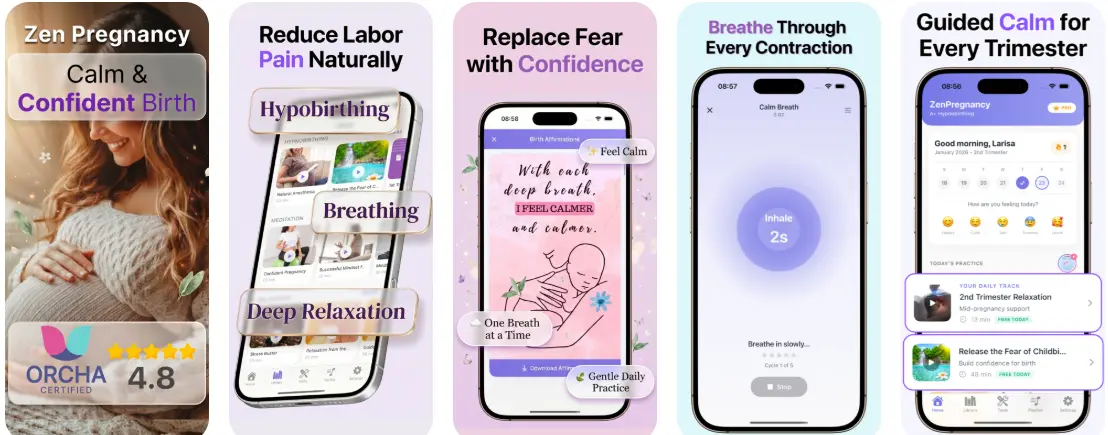
A VBAC-friendly app should include more than general relaxation. Look for structured hypnobirthing sessions, labor breathing, affirmations, and tools you can use when contractions start. HypnoBirth App is a hypnobirthing app that provides guided meditation, breathing exercises, contraction timing, and birth affirmations for pregnant women.
| App | Best fit | VBAC-relevant strengths | Watch-outs |
|---|---|---|---|
| HypnoBirth App | Daily hypnobirthing practice | Guided sessions, labor breathing, affirmations, contraction timing | Still needs clinical VBAC planning with your provider |
| Expectful | Pregnancy meditation library | Strong wellness and sleep content | Less focused on labor tools |
| GentleBirth | Mindset coaching | Hypnobirthing-style tracks and positive birth preparation | May feel more coaching-led than tool-led |
Partner Support for a Calm VBAC Mindset
A birth partner can make VBAC hypnobirthing more effective by protecting the environment, repeating familiar cues, and helping you ask questions when labor feels intense. Their job is not to “perform” hypnobirthing perfectly; it is to help you feel safe, informed, and less alone.
Practice together before 37 weeks. Choose two cue words, one breathing pattern, and one reset phrase for difficult moments. For example: “Drop your shoulders,” “long out-breath,” and “we can ask for a minute.” Partners can also help reduce overstimulation by dimming lights, lowering voices, and reminding staff of your preferences respectfully. If your partner is anxious too, shared prenatal mindfulness practice can help both of you respond instead of react.
Honest Limits of Hypnobirthing After Cesarean
Hypnobirthing can support emotional steadiness, but it does not remove the medical realities of VBAC. A trustworthy plan includes both coping tools and clear clinical guidance from your care team. This is not medical advice. Consult your healthcare provider.
- It cannot guarantee a vaginal birth. Labor may still end in a repeat cesarean for safety reasons.
- It cannot assess scar safety. Your provider should discuss your cesarean history, incision type, and individual risk factors.
- It cannot override hospital policy. Monitoring, induction options, and VBAC availability vary by setting.
- It may not be enough for trauma symptoms. Flashbacks, panic, or dissociation may need extra support from a trauma-informed therapist.
- It does not replace pain relief. Epidural, gas and air, water, movement, and other comfort measures can still be part of a positive birth.
Common VBAC Prep Mistakes That Increase Anxiety
The biggest VBAC prep mistake is trying to prepare through fear alone: reading every birth story, memorizing every risk, and never practicing what calm will actually feel like. Information matters, but your nervous system also needs repetition.
- Waiting until 39 weeks to start breathing practice, when sleep and discomfort may already be difficult.
- Only preparing for one outcome instead of making both VBAC and repeat cesarean plans feel supported.
- Using affirmations that feel false, such as “nothing can go wrong,” which may increase mistrust.
- Ignoring the previous birth story when it still carries grief, anger, or fear.
- Practicing without your partner, then expecting them to know the cues in labor.
If you are already in late pregnancy, a focused third-trimester hypnobirthing routine can still help.
When to Start VBAC Relaxation Practice
The best time to start VBAC relaxation practice is when you can repeat it consistently, often in the second trimester or early third trimester. Starting around 24 to 30 weeks gives you time to build a habit without feeling rushed.
If you are earlier than that, keep it gentle: pregnancy meditation, sleep relaxation, and short breathing sessions are enough. If you are already 36 weeks or beyond, do not panic. Focus on the highest-impact tools: one daily guided track, one contraction breath, one partner cue, and one written decision-making phrase such as “What are the benefits, risks, and alternatives?” The goal is familiarity, not perfection. Even a few weeks of practice can make labor cues feel less strange.
The Bottom Line on Calm VBAC Preparation
Calm VBAC preparation is not about proving you are brave enough or relaxed enough to birth vaginally. It is about giving yourself practical tools so fear does not make every decision for you.
Hypnobirthing can help you breathe through uncertainty, soften tension, communicate preferences, and stay connected to your body. It also leaves room for medical care, monitoring, pain relief, and a change of plan if needed. The strongest preparation combines provider-led VBAC counseling, emotional support, daily relaxation practice, and flexible birth preferences. You deserve a birth where you are listened to, even if the path changes. That is the real measure of a positive VBAC experience.
Frequently Asked Questions
Can hypnobirthing help with fear about a VBAC?
Yes, hypnobirthing can help reduce fear about a VBAC by giving you practical tools for breathing, relaxation, and staying grounded. It does not remove the medical risks linked with VBAC, so discuss your birth plan, eligibility, and monitoring options with your midwife or doctor.
Is hypnobirthing safe for a VBAC pregnancy?
Yes, hypnobirthing techniques such as breathing, relaxation, visualisation, and meditation are generally low-risk for most pregnant people. Your individual VBAC safety depends on your previous birth, scar history, current pregnancy, and hospital guidance, so always check your plan with your healthcare provider.
When should I start hypnobirthing for VBAC preparation?
The best time to start hypnobirthing for VBAC is usually between 24 and 30 weeks of pregnancy. Starting earlier gives you more time to practise, but even a few weeks of short daily sessions can help you feel calmer and more prepared.
Is it too late to start hypnobirthing for VBAC at 38 weeks?
No, 38 weeks is not too late to start hypnobirthing for VBAC. Focus on simple tools you can use quickly, such as slow breathing, a calming phrase, jaw and shoulder release, and one decision-making framework for labour conversations.
Can hypnobirthing guarantee a successful VBAC?
No, hypnobirthing cannot guarantee a successful VBAC or prevent a repeat caesarean. It can support calm coping, confidence, and communication, but your birth outcome depends on many medical and labour factors.
Can I use hypnobirthing with an epidural during a VBAC?
Yes, you can use hypnobirthing with an epidural during a VBAC. Breathing, relaxation, affirmations, and decision-making tools can still help during monitoring, examinations, rest periods, assisted birth, induction, or a caesarean if one becomes necessary.
Can hypnobirthing help with pregnancy anxiety after a caesarean?
Yes, hypnobirthing can help some people manage pregnancy anxiety after a caesarean by creating predictable calming routines. If anxiety feels overwhelming, causes panic, or is linked with birth trauma, it is important to seek support from a trauma-informed midwife, doctor, counsellor, or therapist.
Is hypnobirthing for VBAC useful for first-time moms after a previous caesarean?
Yes, hypnobirthing can be useful if this is your first planned vaginal birth after a previous caesarean. It helps you learn what contractions may feel like, how to stay calm during uncertainty, and how to ask questions about your care during labour.
Is a hypnobirthing app or a class better for VBAC preparation?
A hypnobirthing class is usually better if you want personalised VBAC discussion, partner involvement, and the chance to ask questions. A hypnobirthing app can still be helpful for daily practice, especially when used alongside medical advice and a VBAC-specific birth plan.
What are good birth affirmations for a VBAC after a caesarean?
Good VBAC affirmations are calm, believable, and flexible. Examples include “This is a new birth,” “I can ask questions and take time,” “My body and baby are working together,” and “I can stay calm however my baby is born.”}]} _久久爱ʻota; malformed? I included weird chars after JSON? final shows extra
Try HypnoBirth App Free
Guided hypnobirthing, pregnancy meditation, breathing, affirmations, and a contraction timer in one free app. ORCHA NHS certified, used by 200k+ mothers on iOS and Android.
Best for
- Daily hypnobirthing and pregnancy meditation practice
- Calm birth preparation before labor
Limitations
- Not a replacement for advice from your midwife, doctor, or care team
- Does not guarantee a specific birth outcome