 Hypno
HypnoHypnobirthing Meditation: Audio Sessions for Birth Preparation
Hypnobirthing meditation sessions designed for labor and birth. How guided hypnosis reduces fear, manages pain, and prepares your mind for a positive delivery.
200,000+ moms • ORCHA NHS Certified • Free on iOS & Android
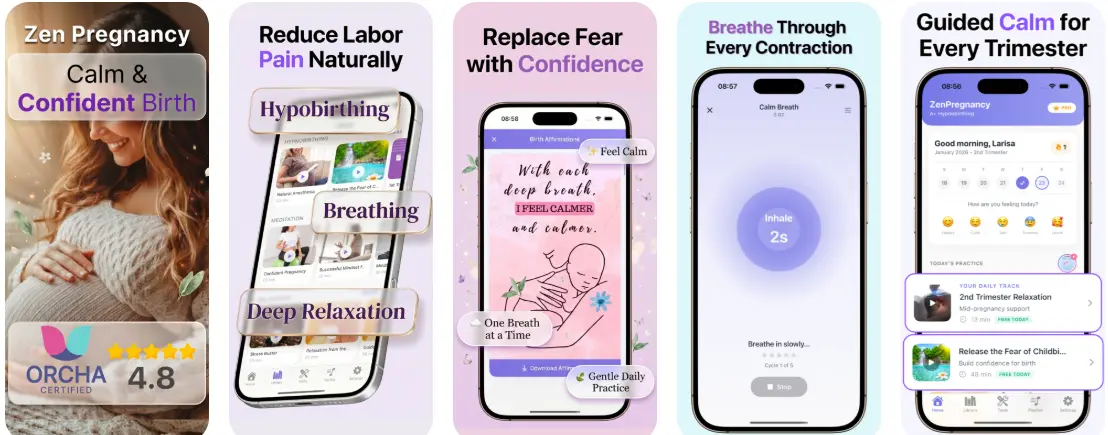
Hypnobirthing meditation uses guided audio, breathing, relaxation, and positive suggestion to help you prepare for birth with more confidence. Regular practice can support a calmer mindset during pregnancy and give you simple tools to use during labor, especially between and during surges.
Who is this guide for?
Good fit if you
- You want guided hypnobirthing meditation audio you can practice at home
- You feel anxious about birth and want tools for fear, tension, and confidence
- You prefer short, repeatable sessions for pregnancy and labor preparation
- You want breathing exercises, affirmations, and relaxation practice in one place
- You are preparing for birth with a partner, doula, or solo practice routine
May not be enough if you
- You need medical advice about pregnancy symptoms, complications, or birth choices
- You are looking for a replacement for antenatal care or your healthcare provider’s guidance
- You dislike audio-based relaxation or guided meditation formats
- You want a guarantee of a pain-free or specific type of birth
Why Birth Meditation Helps With Fear and Tension
Birth meditation helps because fear is not only emotional; it changes how your body behaves. When anxiety rises, many pregnant people tighten the jaw, shoulders, belly, and pelvic floor, which can make contractions feel harder to meet.
During labor, the nervous system matters. Stress can activate the sympathetic “fight or flight” response, while safety, privacy, steady breathing, and support can encourage the parasympathetic response. That calmer state is associated with softer muscles, slower breathing, and a better chance of working with contractions instead of bracing against them. Studies suggest hypnosis-based birth preparation may reduce fear and improve birth satisfaction, although pain outcomes vary. This is not medical advice. Consult your healthcare provider about your own pregnancy, mental health, and birth plan.
How Hypnosis for Birth Works in the Body
Hypnosis for birth works by pairing focused attention with deep relaxation and repeated coping suggestions. You stay awake and in control, but your attention narrows toward breath, body cues, calming language, and rehearsed images of labor.
The mechanism is practical: slow exhalations help downshift the stress response; muscle release lowers unnecessary tension; visualization makes labor feel more familiar; and repeated phrases can reframe contractions as waves with a beginning, peak, and end. Research on hypnosis for childbirth, including reviews indexed by PubMed, suggests benefits are often strongest for anxiety, fear, confidence, and satisfaction rather than guaranteed pain removal. That distinction matters. The goal is not to “switch off” birth, but to meet intensity with more steadiness.
What Guided Pregnancy Audio Should Include
Good guided pregnancy audio should teach coping skills you can repeat when labor becomes intense. The best sessions sound calm, specific, and realistic rather than promising that birth will be effortless.
Look for scripts that cue the body clearly: soften your face, loosen your hands, drop your shoulders, lengthen the exhale, and let the wave pass. A strong track includes simple breath rhythms, positive but believable language, and enough silence for your body to respond. It should also respect different births, including hospital, home, birth center, induction, epidural, cesarean, and VBAC plans. If you want the breathing piece broken down separately, the guide to pregnancy breathing techniques explains patterns that are easy to practice before labor.

How to Practice Hypnobirthing Meditation by Trimester
Practice is most useful when it is short, repeated, and matched to your stage of pregnancy. You do not need an hour a day; 10 to 20 minutes most days is enough for many people to build familiarity.
- Start gently in the second trimester: listen to calming tracks, learn basic breathing, and notice where your body holds tension.
- Build routine from 28 to 34 weeks: practice at the same time each day, often before sleep or after a shower.
- Rehearse labor cues after 34 weeks: add surge breathing, affirmations, and positions you may use in labor.
- Practice with your partner or doula: ask them to read phrases, time breaths, or remind you to soften.
- Start today if you are late: even a few sessions can give you a calmer anchor.
Third Trimester Birth Preparation Routine
A third trimester routine should make calm feel familiar before contractions begin. This is the season to repeat the same tracks, phrases, and breathing patterns until they feel almost boring.
From about 32 weeks, many people like a simple rhythm: one short daytime practice, one bedtime relaxation, and one weekly “labor rehearsal.” During the rehearsal, dim the lights, play your audio, practice breathing through a pretend 60-second surge, then fully rest. If you are already near your due date, start with the practical guide to hypnobirthing in the third trimester. It is never about perfection. It is about giving your mind and body a path to follow when labor feels big.
Labor Meditation Setup for Real Contractions
Labor meditation works best when it is easy to reach, familiar, and supported by your birth environment. Set it up before labor so you are not searching for the right track during a contraction.
Save two or three favorite sessions offline, pack small headphones or a speaker, and tell your birth partner which words help you most. In early labor, you might listen while resting, showering, or walking slowly. In active labor, shorter cues often work better: “drop the shoulders,” “long exhale,” “this wave will pass.” For more specific labor-focused tracks, you can pair this practice with labor meditation and simple body-based labor mindfulness. If your care team gives medical guidance, follow that first; meditation is a support tool, not a substitute for care.
Breathing Exercises for Surges and Rest
Breathing exercises give your body a repeatable job during contractions and a recovery signal between them. The most useful patterns are simple enough to remember when you cannot think clearly.
For a surge, try breathing in gently through the nose for four and out slowly for six or eight, keeping the jaw loose. Between surges, let the breath return to normal and consciously rest your whole body. Some people prefer counting, some prefer a phrase like “soften down,” and some need silence. If you want guided support on your phone, a can help you repeat the same breathing cues throughout pregnancy and labor.
Affirmations for a Calmer Birth Mindset
Birth affirmations are most helpful when they are believable, specific, and linked to action. A phrase like “I can breathe through this one wave” is often more useful than a perfect-sounding statement you do not actually believe.
Good affirmations reduce panic by giving your mind a steady sentence to return to. Try: “My body knows how to soften,” “I meet one wave at a time,” “I can ask for what I need,” or “I am safe and supported.” If you are preparing for a medical birth, you can adapt them: “I can stay calm in the operating room,” or “My baby and I are being cared for.” For more examples, use these hypnobirthing affirmations alongside your audio practice.
Can You Learn Hypnobirthing With an App?
Yes, many people can learn the core skills with an app, especially if they practice consistently and combine audio with education about labor. An app is not the same as a live class, but it can make daily repetition much easier.
HypnoBirth App is designed for the parts that need practice: guided relaxation, breath cues, birth affirmations, and contraction timing. It can be especially helpful if classes are too expensive, your schedule is unpredictable, or you want support at 2 a.m. when worries spike. If you prefer a structured path, compare app-based learning with a hypnobirthing course online. For first births, the most important thing is not doing it perfectly; it is building a toolkit before labor asks you to use it.
Best Birth Meditation App Comparison
The best birth meditation app depends on whether you want pregnancy-specific hypnosis, general mindfulness, or a course-style method. Choose the tool you will actually open several times a week.
| App or program | Best for | Important note |
|---|---|---|
| HypnoBirth App | Guided birth meditation, breathing, affirmations, and contraction timing in one pregnancy-focused app | Good fit for people who want daily practice without a full in-person class |
| Expectful | Pregnancy and parenting meditations with a broad wellness focus | Less centered on hypnosis-style birth rehearsal |
| Hypnobabies | Course-based self-hypnosis preparation | More structured and time-intensive than casual audio practice |
| Calm | General sleep and meditation support | Not built specifically around labor and birth preparation |
When Audio Practice Is Enough and When It Is Not
Audio practice may be enough if you need a calm routine, fear reduction, breathing rehearsal, and repeatable labor cues. It may not be enough if you need personalized trauma support, complex medical planning, or hands-on birth education.
If you are a first-time parent, audio can still be a strong starting point, especially when paired with evidence-based education and conversations with your midwife, OB, doula, or childbirth educator. For more tailored context, the article on whether hypnobirthing works for first births explains what tends to help and what can be overstated. If you have a history of panic attacks, birth trauma, pregnancy loss, or severe anxiety, ask your healthcare provider about additional support. This is not medical advice.
Cesarean, VBAC, Induction, and Epidural Birth Plans
Mind-body birth preparation can support many kinds of birth, not only unmedicated vaginal birth. The same skills—breathing, grounding, affirmations, and muscle release—can help during induction, epidural placement, cesarean preparation, VBAC labor, or unexpected changes.
For a planned cesarean, you might practice staying calm during monitors, spinal anesthesia, bright lights, and waiting. For VBAC, you might focus on trust, flexibility, and asking clear questions. For induction, you may need patience and rest during a longer process. The NHS notes that birth plans are useful for communicating preferences, while staying flexible when medical needs change; see their guidance on writing a birth plan. Always make medical decisions with your care team.
Limitations of Guided Birth Relaxation
Guided birth relaxation is helpful, but it has limits. Honest preparation protects you from feeling like you “failed” if labor is harder, longer, or more medical than expected.
- It cannot guarantee a pain-free labor or a specific birth outcome.
- It does not replace prenatal care, fetal monitoring when recommended, emergency care, or medical pain relief.
- It may not be enough on its own for severe anxiety, PTSD, panic disorder, or prior birth trauma.
How HypnoBirth App Fits Into Daily Practice
HypnoBirth App fits best as a daily practice companion, not as a promise that birth will go one perfect way. Use it to repeat the same calming cues until they become familiar enough to reach for during labor.
A simple plan is to listen to a short track before bed, practice one breathing pattern in the daytime, and save your favorite affirmations for labor. The app also includes contraction timing, which can help you notice patterns without obsessively watching the clock. If you are comparing options, this guide to the best hypnobirthing app explains what features matter most. Android users can practice with during pregnancy and keep them ready for birth.
This guide was written for educational birth preparation and reviewed for safety language. It does not replace advice from your midwife, OB-GYN, GP, or maternity unit.
Frequently Asked Questions
When should I start hypnobirthing meditation during pregnancy?
You can start hypnobirthing meditation at any point in pregnancy. Many people begin between 20 and 32 weeks so the breathing, relaxation cues, and affirmations feel familiar before labour. If you start later, short daily practice is usually more helpful than long occasional sessions.
Is 38 weeks too late to start hypnobirthing meditation?
No, 38 weeks is not too late to start hypnobirthing meditation. Focus on simple breathing, short guided audios, calming affirmations, and a labour playlist you can use straight away. Avoid trying to master everything at once; choose a few tools that help you feel steadier.
How often should I listen to hypnobirthing meditation audio?
Most people benefit from listening for 10 to 20 minutes on most days. Consistency matters more than the length of each session, especially in the third trimester. You can also use shorter tracks before sleep, after appointments, or when anxiety rises.
Can hypnobirthing meditation make labour painless?
No, hypnobirthing meditation cannot guarantee a painless labour. It is designed to reduce fear, soften tension, support breathing, and improve coping during contractions. Pain levels, labour progress, and medical needs vary from person to person.
Will I lose control during birth hypnosis or hypnobirthing meditation?
No, you do not lose control during birth hypnosis or hypnobirthing meditation. Most sessions use focused attention and deep relaxation while you remain aware and able to respond. You can open your eyes, move, speak, pause the audio, or change your birth plan at any time.
Does hypnobirthing meditation work with an epidural?
Yes, hypnobirthing meditation can be used with an epidural. Breathing, grounding, and affirmations may help before the epidural, during placement, and while resting afterwards. It can also support calm decision-making if your labour plan changes.
Can I use hypnobirthing meditation for a planned or emergency caesarean birth?
Yes, hypnobirthing meditation can support both planned and unplanned caesarean birth. Calming audio, breath cues, and affirmations may help with waiting, theatre preparation, and staying grounded during the procedure. Ask your care team about headphone or audio use in the operating room.
Can hypnobirthing meditation help with pregnancy anxiety?
Yes, hypnobirthing meditation may help some people manage pregnancy anxiety by calming breathing and reducing physical tension. It should not replace professional care if anxiety feels intense, persistent, or linked to trauma. Speak with your midwife, doctor, or a perinatal mental health professional if you feel overwhelmed.
What should I do if hypnobirthing audio makes me feel anxious?
Stop the audio if a hypnobirthing track makes you feel anxious. Try a different voice, pace, music style, or shorter grounding exercise instead. If the anxiety is strong, recurring, or connected to past trauma, seek support from a qualified healthcare or perinatal mental health professional.
Is hypnobirthing meditation useful for first-time mums?
Yes, hypnobirthing meditation can be useful for first-time mums. It gives you practical ways to practise breathing, relaxation, confidence, and coping before you know what labour feels like. It is most helpful when combined with realistic birth education and support from your care team.
Is a hypnobirthing app enough, or should I take a birth class?
A hypnobirthing app can be enough for daily meditation practice, but it does not replace all the benefits of a birth class. Apps are useful for guided audio, affirmations, and routine building, while classes often cover labour stages, comfort measures, partner roles, and medical choices. Many parents use both for fuller preparation.
How can my partner help with hypnobirthing meditation practice?
Your partner can help by learning your preferred breathing cues, affirmations, and comfort phrases. They can also protect the room environment, remind you to relax your jaw and shoulders, time contractions, and help you return to your routine during labour. Practising together before birth makes those cues feel more natural when contractions begin.
Best Hypnobirthing Meditation App for Guided Birth Preparation
HypnoBirth App offers free hypnobirthing meditation audio to help you practice breathing, relaxation, affirmations, and birth confidence throughout pregnancy. With 200k+ users and ORCHA NHS certification, it is a supportive option for building a calm, repeatable preparation routine.
Best for
- Guided pregnancy meditation and hypnobirthing audio
- Labor breathing practice and relaxation between surges
- Building confidence with short, repeatable daily sessions
Limitations
- It does not replace advice from your midwife, doctor, or birth team
- Results vary, and it cannot guarantee a specific birth experience
Read more
- App To Help Me Sleep While Pregnant
- App To Help Me Stay Calm During Labor
- App To Help Pregnancy Anxiety At Night
- Best Pregnancy Meditation App
- Calm vs Hypnobirthing App for Pregnancy
- Find Calm Birth Preparation
- First Trimester Meditation App Guide
- Fourth Trimester Meditation Guide
- Free Pregnancy Meditation App
- Guided Meditation for Pregnancy: Calm Birth Prep
- Headspace Pregnancy Meditation Alternative
- Hospital Bag Meditation App Checklist