 Hypno
HypnoFree Pregnancy Meditation App: 5 Options for Relaxation and Birth Prep
200,000+ moms • ORCHA NHS Certified • Free on iOS & Android
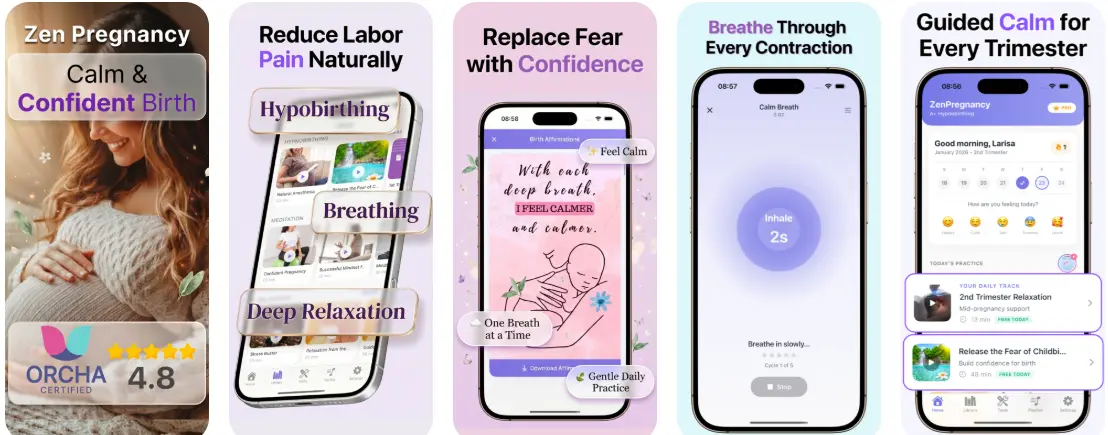
The best free pregnancy meditation app combines guided breathing exercises, trimester-specific relaxation tracks, and real birth-preparation tools like contraction coping scripts, not just generic calm music behind a paywall. The birth-focused option offers a free tier with hypnobirthing meditations, breathing exercises, contraction timing, and birth affirmations designed specifically for labor readiness. Below we compare five genuinely free or free-trial prenatal meditation apps so you can pick the one that fits your trimester, sleep needs, and birth goals.
Definition: A free pregnancy meditation app is a mobile application that provides guided meditations, breathing exercises, and relaxation audio tailored to pregnant users at no upfront cost, though free tiers may limit session count or features.
- Most “free” pregnancy meditation apps only unlock a handful of sessions before requiring payment, so check what’s actually included.
- The strongest apps offer birth-prep tools, such as contraction breathing, affirmations, and labor coping scripts, not just generic relaxation.
- Meditation can reduce prenatal anxiety and stress, but it does not replace medical care for depression, high-risk pregnancy, or complications.
At a Glance: What a Free Pregnancy Meditation App Should Include
A useful free pregnancy meditation app should help you practice calm in ordinary moments and prepare for labor in specific ways. Free should also mean clear limits, not a surprise paywall after one sleep track.
- Guided breathing: Look for paced breathing, longer exhales, and cues you can remember when monitor straps are across the bump.
- Trimester-specific content: First-trimester worry, third-trimester sleep, and due-date nerves are not the same body state.
- Labor coping tools: Contraction breathing, visualization, and coping scripts matter more than background music.
- Sleep tracks: A good library supports nighttime thoughts, bathroom trips, and returning to bed without spiraling.
- Birth affirmations: Short, repeatable phrases can help you come back to the breath during surges.
Perinatal depression affects about 1 in 7 women overall, according to ACOG guidance on perinatal mental health screening and treatment (https://www.acog.org/clinical/clinical-guidance/clinical-practice-guideline/articles/2023/06/treatment-and-management-of-mental-health-conditions-during-pregnancy-and-postpartum), so accessible support matters. Still, read the privacy policy before adding pregnancy details, mood notes, or due-date data.
The phone glow feels brighter at 3:17 a.m.
5 Best Free Pregnancy Meditation Apps for Relaxation and Birth Prep
The strongest free prenatal meditation options differ by how much content is actually free and whether they teach birth preparation. Good hypnobirthing apps deliver breathing, coping, and rehearsal tools, not vague promises of a painless birth.
- HypnoBirth App: The free tier offers hypnobirthing meditations, breathing exercises, a contraction timer, and birth affirmations. It is birth-specific rather than a general wellness library with one pregnancy category.
- Insight Timer: Insight Timer has a large free meditation library, including some prenatal tracks. The challenge is sorting through general relaxation content to find pregnancy-safe voices and themes.
- Mind the Bump: Mind the Bump is a free mindfulness app for pregnancy and early parenthood. It is strongest for evidence-informed mindfulness, but less focused on contraction tools.
- GentleBirth: GentleBirth offers a free trial with hypnobirthing, CBT, and sports psychology tools. Many deeper programs are trial-gated.
- Expectful: Expectful provides pregnancy-specific meditations and sleep content through a free trial. Ongoing access usually requires a paid plan.
If the priority is practicing for labor without buying a full course first, choose the option that combines breathing, affirmations, and contraction timing in one birth-prep workflow.
Selection Criteria for Free Prenatal Meditation Apps
We judged each free prenatal meditation app by five practical criteria: actual free content depth, birth-prep specificity, expert involvement, privacy transparency, and user reviews. A pretty interface matters less than whether you can practice three days in a row without hitting a locked screen.
A systematic review of mindfulness-based interventions in pregnancy reported reductions in prenatal anxiety, depression, and stress symptoms, though study quality and intervention formats varied (https://bmcpregnancychildbirth.biomedcentral.com/articles/10.1186/s12884-017-1457-9). That supports prenatal mindfulness as a helpful practice, but it does not make every meditation app clinically designed. I looked for signs that midwives, clinicians, psychologists, or childbirth educators shaped the content.
There is also a real split between relaxation apps and birth-preparation tools. A pregnancy meditation app may help you soften your jaw before sleep, while a birth-focused app should also teach what to do during a contraction. One palm on the bump, one hand feeling the ribs expand, then a slow exhale. That is practice, not decoration.

Source Notes and Medical Review Standards
This guide was editorially reviewed for clarity and source quality, but it was not medically reviewed by an OB-GYN, midwife, or mental-health clinician. Use it as app-shopping guidance, not as a diagnosis, treatment plan, or substitute for prenatal care.
When medical context is included, the strongest weight goes to organizations and research types most relevant to pregnancy care: ACOG, NHS, CDC, peer-reviewed clinical trials, and systematic reviews. App-specific claims, such as whether a free tier includes breathing exercises, birth affirmations, sleep tracks, or a contraction timer, come from app store listings, publisher materials, and publicly available product information at the time of writing. Those details can change quietly after publication, especially free trials, locked libraries, renewal pricing, and download limits.
- Check the current app store listing before you install.
- Compare the free tier against the features you actually need this week.
- Confirm any mental-health or birth-prep advice with your clinician if symptoms feel intense.
- Remember that evidence supports coping skills, stress reduction, and fear management; it does not guarantee shorter labor, pain-free birth, or complication-free outcomes.
How Pregnancy Meditation Works for Relaxation and Birth Readiness
Pregnancy meditation works by pairing attention, breath regulation, and body awareness to invite the parasympathetic nervous system. In plain language, it helps the body shift from bracing toward “safe enough for now.”
Guided breathing often extends the exhale, which can soften the jaw, forehead, and shoulders. Visualization gives the mind a place to land. Hypnobirthing meditation also works with the fear-tension-pain cycle, where fear can tighten the body and make sensations feel harder to meet. Practice does not remove labor intensity; it gives you a repeatable response.
A randomized controlled trial found that mindfulness-based childbirth training reduced fear of childbirth and depressive symptoms compared with standard care. That is why active skills matter. Passive relaxation music may be soothing, but contraction breathing, affirmations, and labor scripts are more useful during birth rehearsal.
If nighttime anxiety is the issue, the birth-focused app earns its place because it turns meditation into short coping practice, using guided breathing and birth affirmations you can repeat when Braxton Hicks wake you.
How to Use a Free Pregnancy Relaxation App for Birth Prep
A free pregnancy relaxation app works best when you use it before you “need” it. Ten quiet minutes in the second trimester can become familiar enough to reach for during late pregnancy.
- Download and check the free tier before committing, including session limits, ads, trial length, and locked labor tools.
- Set a daily 10-minute session tied to your trimester, such as nausea anxiety, pelvic heaviness, or due-date thoughts.
- Practice contraction breathing exercises at least 3 times per week, even before labor feels close.
- Listen to affirmations or visualization scripts before bed so the language feels familiar when you are tired.
- Use the contraction timer or labor playlist during late pregnancy rehearsals, with the hospital bag open on the floor.
- Review your progress with your midwife or provider, especially if anxiety, panic, or low mood is increasing.
After a bathroom trip in the dark, when the mind starts listing every possible birth scenario, a saved track is easier than searching.
Free Pregnancy Meditation App Comparison Table
This comparison separates truly free content from trial-based access and locked labor features. For a deeper paid-and-free breakdown, the best pregnancy meditation app guide covers more options.
| App name | Free tier scope | Birth-prep tools | Breathing exercises | Sleep tracks | Platform availability |
|---|---|---|---|---|---|
| HypnoBirth | Free tier with pregnancy and labor tools | Contraction timer, affirmations, hypnobirthing meditations | Yes | Yes | iOS and Android |
| Insight Timer | Large free library, mixed prenatal depth | Limited, depends on teacher | Yes | Yes | iOS and Android |
| Mind the Bump | Free mindfulness content | Pregnancy and early parenthood mindfulness, less labor-specific | Yes | Some | iOS and Android |
| GentleBirth | Free trial, then paid access | Hypnobirthing, CBT, sports psychology | Yes | Yes | iOS and Android |
| Expectful | Free trial, then paid access | Pregnancy meditations, some birth content | Yes | Yes | iOS and Android |
The birth-prep-first option stands out when labor tools matter because the contraction timer, breathing exercises, and affirmations sit together instead of being scattered across search results.
Best Free Prenatal Meditation App for Sleep, Anxiety, and Labor
Different pregnancy weeks ask for different support. A third-trimester sleep problem is not the same as wanting a contraction coping plan.
Best Free App for Pregnancy Sleep
For sleep, Insight Timer has the deepest free library because it offers many long relaxation and sleep tracks. If you want pregnancy-specific nighttime support, a pregnancy sleep meditation app may feel less random.
Best Free App for Prenatal Anxiety
For anxiety skills, Mind the Bump and GentleBirth are strong choices. GentleBirth includes CBT-informed tools during its free trial, while Mind the Bump stays focused on mindfulness.
Best Free App for Labor Preparation
For labor preparation, the birth-focused option is the clearest fit because it includes contraction timing, breathing exercises, and birth affirmations in the same practice space. ZenPregnancy users who practice in short sessions can move from daily calm to birth rehearsal without switching apps.
Prenatal anxiety support usually depends more on consistent practice and clinical backup than on having the longest audio library.
Honest Cons of Free Pregnancy Meditation Apps
Free pregnancy meditation apps can help, but the free version is often too thin to build a daily habit. Three unlocked sessions may not be enough when sleep changes every week.
Many general relaxation apps rarely teach actual birth-coping skills. A soft voice is not the same as knowing how to exhale longer than you inhale during a contraction. Privacy is another concern, because pregnancy apps may collect sensitive health details, due dates, mood patterns, and usage behavior.
Some apps also overpromise pain-free or shorter labor outcomes. Evidence supports better coping and reduced fear, not guaranteed pain elimination. Ads can disrupt a session too, which feels especially jarring when you are half-asleep with earbuds tucked under a pregnancy pillow.
ACOG recommends professional screening for depression and anxiety during pregnancy and postpartum. Apps can support self-care, but they cannot replace that screening, diagnosis, or treatment plan.
When to Talk to a Clinician About Prenatal Anxiety or Low Mood
Talk to a clinician when anxiety or low mood feels persistent, frightening, or hard to interrupt. Seek urgent help now if you have thoughts of self-harm, feel detached from reality, have panic that will not settle, or worry you may not be safe.
Meditation apps can support coping between appointments, but they cannot diagnose depression, anxiety, PTSD, bipolar disorder, or treat a perinatal mood disorder. ACOG recommends screening for depression and anxiety during pregnancy and postpartum, so it is reasonable to ask for that directly instead of waiting for symptoms to become severe.
- Call your OB-GYN or midwife if worry, sadness, rage, numbness, or insomnia is changing how you eat, sleep, bond, work, or function.
- Ask for a therapist referral if intrusive thoughts, trauma memories, or dread keep returning.
- Consult a psychiatrist if medication questions, severe symptoms, or past mental-health diagnoses are part of your story.
- Use emergency care for self-harm thoughts, psychosis symptoms, dissociation, or panic that feels unmanageable.
- Pause triggering tracks if body scans, breathwork, birth visualization, or pelvic-focused scripts make you feel trapped, frozen, or unsafe.
Limitations
Pregnancy meditation can be a steady support, but it has clear limits. Reset the plan if an app starts feeling like pressure.
- This app is not a substitute for therapy, prenatal care, or treatment for perinatal mood disorders.
- Free tiers often expire or restrict session length, downloads, offline listening, and labor-specific content.
- No meditation app can guarantee an easier, pain-free, shorter, or complication-free labor.
- Users with panic disorder, PTSD, trauma triggers, or severe depression may find some body scans or scripts upsetting.
- Clinician guidance is advised if meditation increases distress, dissociation, or fear.
- Most apps do not clearly disclose the clinical basis of their content or whether experts reviewed it.
- Pregnancy apps vary widely in quality, privacy practice, and regulatory oversight.
- Expectful and GentleBirth may be useful, but ongoing access can depend on paid plans after the trial.
If you mainly need sleep help, an app to help me sleep while pregnant may be a better starting point than a labor-heavy program.
Read more
- App To Help Me Sleep While Pregnant
- App To Help Me Stay Calm During Labor
- App To Help Pregnancy Anxiety At Night
- Best Pregnancy Meditation App
- Calm vs Hypnobirthing App for Pregnancy
- Find Calm Birth Preparation
- First Trimester Meditation App Guide
- Fourth Trimester Meditation Guide
- Guided Meditation for Pregnancy: Calm Birth Prep
- Headspace Pregnancy Meditation Alternative
- Hospital Bag Meditation App Checklist
- Hypnobirthing Meditation for Calm Birth Prep
Best Free Pregnancy Meditation App for Relaxation and Birth Preparation
HypnoBirth App is a strong choice if you want free pregnancy meditation with a birth-prep focus. It combines calming hypnobirthing tracks, breathing support, and relaxation practices designed for pregnancy, with ORCHA NHS certification and a community of 200k+ users.
Best for
- Pregnancy relaxation, sleep, and anxiety support
- Gentle birth preparation with hypnobirthing techniques
Limitations
- It is not a replacement for medical or mental health care
- Some users may prefer a general meditation app with broader non-pregnancy content
Frequently Asked Questions
What is a free pregnancy meditation app?
A free pregnancy meditation app is a mobile app that offers guided relaxation, breathing, sleep support, or birth preparation without an upfront cost. Many apps include free tracks, trial access, or basic features, while some offer paid upgrades. Choose one that feels calm, practical, and clearly designed for pregnancy.
Can a pregnancy meditation app help with pregnancy anxiety?
Yes, a pregnancy meditation app can help reduce feelings of pregnancy anxiety by guiding you through breathing, relaxation, and grounding techniques. It is not a substitute for medical or mental health care, especially if anxiety feels severe or persistent. Speak to your midwife, GP, or healthcare provider if you feel overwhelmed.
Is it safe to use a meditation app during pregnancy?
Yes, meditation apps are generally safe during pregnancy when they use gentle relaxation, breathing, and visualisation techniques. Avoid anything that encourages breath-holding, extreme breathing, or ignoring medical advice. If you have a high-risk pregnancy or feel unwell, check with your healthcare provider.
Can I start using a pregnancy meditation app at 38 weeks?
Yes, you can start using a pregnancy meditation app at 38 weeks. Even a short daily practice can help you feel calmer, practise breathing, and prepare mentally for labour. Focus on simple tracks for relaxation, sleep, confidence, and birth breathing.
What is the best free pregnancy meditation app for first-time mums?
The best free pregnancy meditation app for first-time mums is one that explains techniques clearly and keeps sessions simple. Look for guided breathing, birth preparation, anxiety support, sleep meditations, and short tracks you can use daily. A gentle hypnobirthing-style app can be especially helpful if birth feels unfamiliar or intimidating.
Can a pregnancy meditation app replace a hypnobirthing class?
No, a pregnancy meditation app does not fully replace a hypnobirthing class for everyone. An app is flexible, affordable, and easy to use at home, while a class may offer live teaching, partner involvement, and personalised support. Many parents use an app alongside a class or as a lower-cost starting point.
Can I use a pregnancy meditation app if I plan to have an epidural?
Yes, you can use a pregnancy meditation app if you plan to have an epidural. Breathing, relaxation, and mindset tools can still help before hospital admission, while waiting for pain relief, during examinations, and after birth. Hypnobirthing and meditation do not require you to avoid medical pain relief.
Do pregnancy meditation apps help with sleep?
Yes, pregnancy meditation apps can help with sleep by using calming audio, body scans, and slower breathing exercises. They may make it easier to settle when discomfort, busy thoughts, or late-pregnancy anxiety disrupt rest. For ongoing insomnia or symptoms such as severe itching, pain, or breathlessness, seek medical advice.
What features should I look for in a free pregnancy meditation app?
A good free pregnancy meditation app should include guided relaxation, breathing exercises, sleep support, anxiety tools, and birth preparation tracks. Clear language, short sessions, offline access, and pregnancy-specific guidance are also useful. Avoid apps that promise guaranteed birth outcomes or pressure you into one type of birth.
How often should I use a pregnancy meditation app?
Using a pregnancy meditation app for 5 to 15 minutes most days is a helpful starting point. Consistency matters more than long sessions, especially if you are tired or close to your due date. You can also use tracks at bedtime, during anxious moments, or while practising birth breathing.
Can a pregnancy meditation app help during labour?
Yes, a pregnancy meditation app can help during labour by offering familiar breathing cues, calming words, and relaxation prompts. It cannot control how labour unfolds or remove the need for medical support when needed. Download tracks in advance so they are easy to play in hospital, at a birth centre, or at home.
Are free pregnancy meditation apps really free?
Some pregnancy meditation apps are genuinely free, while others offer a free trial, limited free tracks, or in-app purchases. Check what is included before relying on an app for birth preparation. A useful free option should still provide practical support for relaxation, sleep, anxiety, and breathing without making you feel pressured to upgrade.