 Hypno
HypnoLabor Mindfulness: Staying Present During Contractions
How labor mindfulness techniques keep you grounded during contractions. Practical methods for staying present, managing pain, and working with your body.
200,000+ moms • ORCHA NHS Certified • Free on iOS & Android
Labor mindfulness is the practice of staying present during contractions by using breath, body awareness, and simple attention anchors instead of fighting each sensation. It can help you feel more grounded, work with your body, and return to calm between surges during birth.
Who is this guide for?
Good fit if you
- You want practical ways to stay present during contractions
- You are preparing for labor with breathing, relaxation, or hypnobirthing techniques
- You feel anxious about pain, checks, monitors, or the hospital environment
- You want a simple birth partner-friendly approach for coping with surges
- You prefer calm, non-medical tools that can be used alongside your birth plan
May not be enough if you
- You need urgent medical guidance or advice about symptoms in labor
- You are looking for a guaranteed pain-free birth method
- You prefer not to use breathing, visualization, or relaxation techniques
- You want a replacement for your midwife, doctor, or clinical birth team
Why Labor Mindfulness Matters During Contractions
Labor mindfulness matters because contractions are not only physical sensations; they are also filtered through fear, anticipation, memory, and your sense of safety. When your mind jumps to “How much worse will this get?” your body often tightens, and tight muscles can make contractions feel harder to work with.
A mindful approach brings attention back to the contraction you are actually having: the rise, the peak, the easing, and the rest afterward. Studies suggest mindfulness-based childbirth preparation may reduce fear of birth and anxiety, although results vary by program and person. Research published in BMC Pregnancy and Childbirth has explored mindfulness training for pregnancy, stress, and childbirth coping. Mindfulness is not a promise of an easy or unmedicated birth; it is a practical skill for staying steady in hospital, home, or birth center settings.
How Labor Mindfulness Works in the Brain and Body
Labor mindfulness works by changing your relationship with intensity: instead of bracing against every sensation, you notice, name, breathe, and release what you can. This can reduce the threat response that makes the nervous system act as if every contraction is an emergency.
During labor, the sympathetic nervous system can rise with fear, pain, bright lights, unfamiliar people, or feeling rushed. Mindfulness practices encourage slower breathing, interoception, and parasympathetic recovery between surges. In plain language, you are teaching your brain to say, “This is intense, and I am safe enough right now.” Oxytocin supports contractions, while endorphins are the body’s natural pain-modulating chemicals. A calm environment, supportive touch, and familiar audio cues may help you settle between waves. For pregnancy-specific awareness practice before birth, prenatal mindfulness techniques can make this response feel more automatic.
How to Practice Mindfulness in Labor
The easiest way to practice mindfulness in labor is to pair one simple anchor with every contraction. Do not try to perform perfectly; choose a repeatable cue that brings you back to the present moment.
- Choose one anchor: Use your breath, a low sound, a visual point, your partner’s hand, or a phrase like “soften and open.”
- Notice the beginning: Say quietly, “This is starting,” then relax your jaw, brow, shoulders, and hands.
- Ride the peak: Keep the exhale longer than the inhale, or use a steady hum to avoid panic breathing.
- Release after the wave: Let your body go heavy when the contraction fades, even if the break is short.
- Repeat without judging: If one contraction feels messy, begin again with the next one.
If breath is your main anchor, practice with pregnancy breathing techniques for labor in the third trimester.

Contraction Awareness Anchors for Staying Present
Contraction awareness anchors are small, specific cues that keep your attention from racing ahead. The most useful anchors are simple enough to remember when you are tired, shaky, nauseous, or deep in active labor.
Try “jaw, hands, floor”: unclench your jaw, loosen your fingers, and feel your feet or knees supported. Another option is “name the wave”: beginning, building, peak, softening, gone. This labeling helps your mind recognize that contractions move in a pattern; they do not stay at peak intensity forever. Some people prefer sound, such as a low “ahhh” or “oooh,” because a low tone encourages a relaxed throat and softer belly. If meditation feels natural to you, labor meditation practices can give you audio anchors to rehearse before birth. The goal is not to escape labor. The goal is to meet one wave at a time.
Mindful Breathing for Labor Pain Coping
Mindful breathing helps with labor pain coping by giving your nervous system a rhythm when sensations feel big. It does not erase pain for everyone, but it can reduce panic breathing, jaw tension, shoulder bracing, and the feeling that you are losing control.
In early labor, try breathing in for four and out for six, letting the exhale be slow but not forced. In active labor, counting may become annoying; switch to “in, out, soften” or a low hum. During transition, you may only manage one word: “down,” “open,” or “safe.” That still counts. If you want guided support, a can help you rehearse calm breathing before contractions begin. This is not medical advice. If you feel faint, cannot catch your breath, or something feels wrong, tell your care team immediately.
Mindful Movement and Position Changes in Birth
Mindful movement in birth means changing positions with awareness rather than from panic. Your body may ask for leaning, swaying, kneeling, side-lying, standing, or resting, and each position can change how pressure feels.
Before moving, ask yourself: “Am I trying to escape this contraction, or is my body asking for support?” Both are understandable, but the answer helps you choose. Swaying can soothe the nervous system, hands-and-knees may ease back pressure for some people, and side-lying can offer rest during long labors or with an epidural. If you are being monitored, have an IV, or are preparing for a cesarean birth, mindful movement may look smaller: rolling the shoulders, softening the mouth, or relaxing the pelvic floor. For more birth-specific tools, hypnobirthing techniques for labor can pair movement with breathing, visualization, and calm cue words.
Hospital Mindfulness for Monitors and Cervical Checks
Hospital mindfulness helps you stay grounded when the room becomes clinical, noisy, or busy. Monitors, cervical checks, blood pressure cuffs, shift changes, and bright lights can interrupt your focus, especially if you hoped for a quiet birth space.
A helpful phrase is: “I can be present and ask questions.” Mindfulness is not passive. You can breathe, soften your shoulders, and still ask, “What are you checking for?” or “Can we have a minute to decide?” During cervical checks, try placing one hand on your heart or belly, slow your exhale, and let your knees fall heavy. If a monitor limits movement, ask what positions are still available. The NHS overview of labor stages is a helpful general reference, but your own provider should guide medical decisions during labor.
The 5 Ps of Labor and Mindful Birth Preparation
The 5 Ps of labor are commonly described as passenger, passageway, powers, position, and psyche. Mindful birth preparation mainly supports the fifth P, psyche, while also influencing how you respond to contractions, position changes, and support.
The passenger is the baby; the passageway is the pelvis and soft tissues; the powers are contractions and pushing efforts; position includes both your baby’s position and your body positions; psyche is your emotional state, fear level, and sense of safety. Mindfulness cannot control all five factors, and it cannot guarantee a vaginal birth, short labor, or specific outcome. It can help you notice tension, communicate needs, and recover between waves. Many people combine mindfulness with practical preparation such as natural birth preparation tools, while others use it alongside epidurals, inductions, planned cesareans, or VBAC plans.
Contraction Timing and Mindful Labor Decisions
Contraction timing can support mindful labor decisions because it turns anxious guessing into observable information. Tracking frequency, duration, and pattern helps you notice whether labor is changing, stalling, or intensifying.
Many families hear about the 4-1-1 or 5-1-1 guideline: contractions about four or five minutes apart, lasting about one minute, for about one hour. These are general tools, not medical rules. Some labors move quickly, some start with irregular patterns, and some pregnancies need earlier contact with a provider. Use timing as one piece of information alongside your care team’s instructions, your distance from the birth place, your waters, bleeding, baby’s movement, and your instincts. If tracking makes you spiral, hand it to your partner. A contraction timer with meditation support can help blend practical timing with calming audio cues.
Comparison: Mindfulness, Hypnobirthing, and Birth Apps
Mindfulness, hypnobirthing, and birth apps overlap, but they are not identical. Mindfulness emphasizes present-moment awareness; hypnobirthing adds relaxation conditioning, affirmations, visualization, and fear-release practice; apps make practice easier to repeat at home.
| Option | Best for | Typical approach | Honest note |
|---|---|---|---|
| HypnoBirth App | Daily hypnobirthing, breathing, affirmations, and labor support | Guided sessions, birth preparation audio, and practical tools | Helpful for repetition, but not a substitute for medical care or a full in-person class if you want hands-on coaching |
| Expectful | Pregnancy and postpartum meditation | Mindfulness audio, sleep, and emotional support | Less focused on contraction timing and hypnobirthing-specific labor practice |
| Hypnobabies | Structured hypnosis-based childbirth education | Longer course format with scripts and practice tracks | More intensive, but may feel like a bigger time commitment |
If affirmations are your strongest anchor, a birth affirmations app can be especially useful in late pregnancy.
Where a Hypnobirthing App Fits in Labor Practice
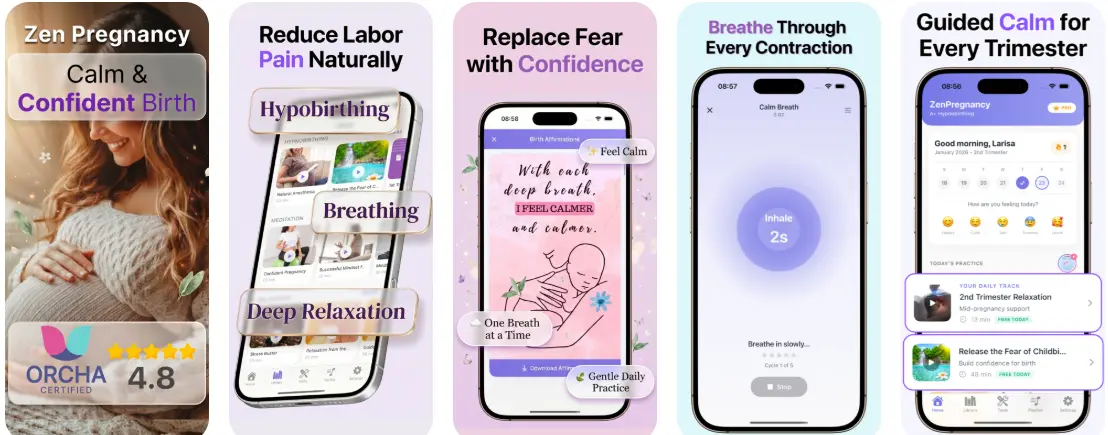
A hypnobirthing app fits best as a daily rehearsal tool before labor and a familiar audio cue during early labor, rest periods, or moments of fear. HypnoBirth App is a hypnobirthing app that provides guided meditation, breathing exercises, contraction timing, and birth affirmations for pregnant women.
Think of it like muscle memory for your nervous system. If you have practiced the same relaxation track at 32, 36, and 39 weeks, your body may recognize the voice, pace, and breathing cues when contractions begin. The app can support hospital births, home births, birth center births, inductions, epidurals, and cesarean preparation because the core skill is regulation, not a single type of birth. For structured audio practice, you can use a alongside your provider’s advice and your chosen birth education.
Limitations and Safety of Mindfulness in Labor
Mindfulness is a supportive coping skill, not a medical treatment or a guarantee of a specific birth outcome. It works best when paired with informed decision-making, respectful care, and appropriate medical support.
- It will not guarantee a pain-free birth. Some people feel less pain; others feel the same pain with less panic.
- It cannot replace urgent care. Heavy bleeding, reduced fetal movement, fever, severe headache, or concerns about waters breaking need professional guidance.
- It may feel difficult with trauma history. Eyes-closed meditation or body scanning can be triggering; open-eye grounding may be safer.
This is not medical advice. Consult your healthcare provider for personal recommendations.
Start a Calm Labor Mindset Tonight
The best time to begin a calm labor mindset is before labor asks you to use it. Ten minutes a day in the third trimester can teach your body the pattern: breathe, soften, notice, release, repeat.
Tonight, choose one short practice. Sit or lie on your side, place a hand on your belly, and breathe out slowly through a relaxed mouth. Notice one sensation without judging it: warmth, pressure, movement, tightness, or emotion. Then say one phrase you can use in labor, such as “one wave at a time.” If you miss a day, simply begin again. Birth preparation should not become another thing to feel guilty about. It should help you feel more accompanied, more capable, and more ready to meet your baby in whatever way your birth unfolds.
This guide was written for educational birth preparation and reviewed for safety language. It does not replace advice from your midwife, OB-GYN, GP, or maternity unit.
Frequently Asked Questions
What is labor mindfulness?
Labor mindfulness is the practice of paying attention to contractions, breathing, body sensations, and thoughts in the present moment without judgement. During birth, it helps you notice one contraction at a time instead of getting caught in fear about what comes next. It can be used on its own or alongside hypnobirthing, partner support, and medical pain relief.
Does mindfulness reduce labor pain?
Mindfulness does not guarantee less labour pain, but it can reduce how overwhelming pain feels for some people. By calming panic, softening muscle tension, and focusing attention, it may help you cope more steadily during contractions. It is safe to combine with options such as gas and air, an epidural, or other pain relief recommended by your care team.
Can I start labor mindfulness at 38 weeks pregnant?
Yes, you can start labour mindfulness at 38 weeks pregnant. Even a few minutes a day of breathing, body scanning, or contraction-style practice can make the techniques feel more familiar in labour. Short, repeated practice is usually more helpful than trying to learn everything in one long session.
Can mindfulness help with pregnancy anxiety before labour?
Yes, mindfulness can help some people manage pregnancy anxiety before labour. It gives you a practical way to notice anxious thoughts, return to your breath, and calm your body without trying to force the thoughts away. If anxiety feels intense, persistent, or affects sleep or daily life, speak with your midwife, doctor, or mental health professional.
Can I use mindfulness with an epidural during labour?
Yes, you can use mindfulness with an epidural during labour. Mindful breathing and grounding can help with anxiety, waiting, position changes, cervical checks, and decisions as labour progresses. An epidural may change pain sensations, but staying present can still support comfort and confidence.
Is labour mindfulness useful for first-time mums?
Yes, labour mindfulness is useful for many first-time mums. It provides simple tools for coping with unfamiliar sensations, uncertainty, and the intensity of contractions. It also helps partners or birth companions offer clear support, such as reminding you to breathe, relax your jaw, or return to one calming phrase.
What should I do if I panic during contractions?
Panic during contractions is common and does not mean you are failing. Choose one simple anchor, such as lengthening your exhale, softening your jaw, holding someone’s hand, or repeating, “This wave will pass.” If panic feels unmanageable or you feel unsafe, tell your midwife, doctor, or birth team straight away.
Is hypnobirthing the same as labor mindfulness?
No, hypnobirthing and labour mindfulness are related but not identical. Mindfulness focuses on present-moment awareness without judgement, while hypnobirthing often includes visualisations, affirmations, relaxation scripts, and birth-specific conditioning. Many birth preparation plans combine both approaches.
Can mindfulness help during an induction of labour?
Yes, mindfulness can help during an induction of labour. It can support coping during waiting periods, cervical ripening, IV placement, monitoring, examinations, and stronger contractions. Your midwife or doctor should guide all medical decisions about induction timing, methods, and safety.
What is the 4-1-1 rule in labour?
The 4-1-1 rule means contractions are about four minutes apart, lasting one minute each, for one hour. It is a general timing guide that some people use when deciding when to call or go to the birth place. Always follow the specific advice from your midwife, doctor, or maternity unit, especially if waters break, bleeding occurs, baby’s movements change, or you feel concerned.
Can mindfulness help during a cesarean birth?
Yes, mindfulness can help during a planned or unplanned caesarean birth. Breathing, grounding, calm audio, affirmations, and noticing one sensation at a time can reduce fear and support steadiness before, during, and after surgery. It should be used alongside, not instead of, medical care from your surgical and maternity team.
Is a labor mindfulness app enough or should I take a class?
A labour mindfulness app can be enough for basic practice, but a class may give more personalised support. Apps are helpful for daily breathing exercises, guided relaxation, and reminders, while classes often include partner practice, questions, birth positions, and coping strategies for real labour scenarios. If possible, use the format you will actually practise consistently.
Best Labor Mindfulness App for Staying Calm During Contractions
HypnoBirth App helps you practice labor mindfulness with guided hypnobirthing, calming audio, breathing support, and relaxation techniques designed for pregnancy and birth preparation. It is free to use, ORCHA NHS certified, and trusted by 200k+ users preparing for a calmer birth experience.
Best for
- Practicing mindful breathing before labor
- Using calm audio between contractions
- Building confidence with hypnobirthing-style relaxation
- Preparing a birth partner to support your focus
Limitations
- It is not a substitute for medical advice or clinical care
- Mindfulness may not remove pain, but it can support coping and calm
Read more
- App To Help Me Sleep While Pregnant
- App To Help Me Stay Calm During Labor
- App To Help Pregnancy Anxiety At Night
- Best Pregnancy Meditation App
- Calm vs Hypnobirthing App for Pregnancy
- Find Calm Birth Preparation
- First Trimester Meditation App Guide
- Fourth Trimester Meditation Guide
- Free Pregnancy Meditation App
- Guided Meditation for Pregnancy: Calm Birth Prep
- Headspace Pregnancy Meditation Alternative
- Hospital Bag Meditation App Checklist