 Hypno
HypnoHypnobirthing Online with an App vs Traditional Classes
Hypnobirthing app vs in-person classes: cost, flexibility, effectiveness, and what works better for different situations. An honest comparison with real numbers
200,000+ moms • ORCHA NHS Certified • Free on iOS & Android
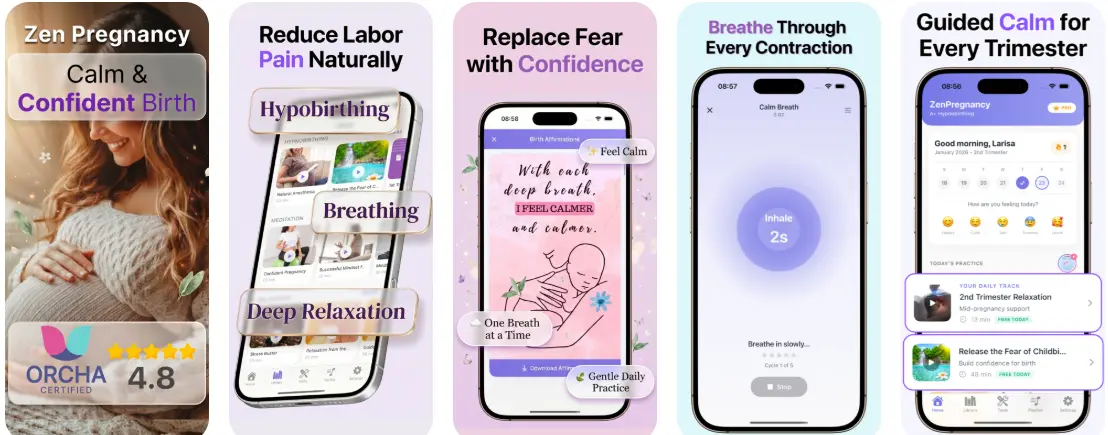
Hypnobirthing online app vs classes comes down to flexibility, cost, and the type of support you want. An app is usually best for self-paced daily practice and listening on your own schedule, while traditional classes can suit parents who want live teaching, group discussion, and personalised feedback.
Who is this guide for?
Good fit if you
- You want flexible hypnobirthing practice at home, on commute, or before sleep
- You prefer a lower-cost or free way to start birth preparation
- You learn well through guided audio, repetition, and short daily sessions
- You want support for pregnancy anxiety, relaxation, breathing, and confidence-building
- You have an unpredictable schedule or cannot attend fixed class times
May not be enough if you
- You want live, in-person coaching with direct feedback from a teacher
- You prefer group learning and asking questions in real time
- You need tailored clinical advice about your pregnancy or birth plan
- You find it difficult to stay consistent without scheduled sessions
- You want hands-on partner practice led by an instructor
Why Online Birth Preparation Helps Pregnancy Anxiety
Online birth preparation can help because pregnancy anxiety often grows in quiet moments, not only during appointments. When you can practice breathing or guided relaxation at home, the skills become available during the exact moments you feel most unsettled.
Many pregnant people worry about pain, losing control, medical interventions, or whether they will cope if labor changes direction. Those fears are understandable. Hypnobirthing does not erase uncertainty, but it gives your nervous system a rehearsed way to settle. Slow breathing, positive cues, and repeated relaxation can reduce muscle tension and make contractions feel less threatening. For more day-to-day support, many parents pair hypnobirthing with simple calm pregnancy practices in the second and third trimesters. This is not medical advice. If anxiety feels intense, persistent, or linked with panic, speak with your midwife, OB-GYN, therapist, or healthcare provider.
How Hypnobirthing Works Online and In Person
Hypnobirthing works by training the body to respond to labor with less fear and less bracing. The mechanism is simple: repeated relaxation practice teaches you to notice tension, slow the breath, soften the body, and return attention to a chosen cue.
Most programs combine childbirth education, guided hypnosis or meditation, breathing patterns, visualization, and birth affirmations. These tools target the fear-tension-pain cycle, where worry increases adrenaline, muscles tighten, and sensations can feel more alarming. Online and in-person formats teach similar skills; the difference is how much live feedback and structure you receive. If you want a deeper skill breakdown, this guide to hypnobirthing techniques explains common breathing, visualization, and relaxation methods. This is not medical advice, and hypnobirthing should sit alongside your clinical birth plan, not replace it.
Hypnobirthing App or Live Class: Quick Comparison
A hypnobirthing app is usually best for flexible, repeatable daily practice, while a live class is usually best for structure, instructor feedback, and partner involvement. The right choice is not the one that sounds most impressive; it is the one you will actually practice when you are tired, busy, or close to your due date.
| Option | Best for | Common tradeoff |
|---|---|---|
| Self-paced app | Daily audio practice, bedtime sessions, busy schedules, lower cost | Less personal feedback |
| Live online class | Questions, accountability, partner practice, clear weekly structure | Set schedule and higher price |
| In-person class | Hands-on teaching, local birth community, instructor observation | Travel, childcare, limited replay access |
If you learn by repetition, an app may fit beautifully. If you need someone to watch your technique and answer questions in real time, a class may feel safer.

Costs for Digital Hypnobirthing and Classes
Digital hypnobirthing is usually less expensive than a traditional course because you are paying for recordings, tools, or a subscription instead of several hours of teacher time. Live hypnobirthing classes often cost more because they include instruction, discussion, and personal support.
In many areas, in-person or live online courses sit in the couple-hundred-dollar range, though pricing varies by country, teacher training, course length, and whether partner materials are included. A self-paced app may be free, low-cost, or subscription-based, making it easier to start earlier in pregnancy. If you want the structure of lessons but still prefer to learn from home, compare a full hypnobirthing course online with app-based practice. Budget matters, but so does follow-through. A cheaper option that you use five nights a week can be more helpful than a premium class you never revisit.
Support Differences in Self-Paced and Teacher-Led Birth Prep
Teacher-led birth preparation gives you live support, while self-paced practice gives you privacy and timing control. This difference matters most if you have a lot of questions, a previous difficult birth, a high-anxiety pregnancy, or a partner who needs guidance.
In a class, an educator can notice if you are holding your breath, tightening your shoulders, or misunderstanding a labor stage. They can also help you adapt tools for induction, epidural use, cesarean birth, home birth, or a hospital setting. With an app, the support is usually built into the recordings and prompts, so you must be more self-directed. That can feel freeing for some parents and lonely for others. First-time parents often benefit from extra reassurance, so this article on hypnobirthing for first-time moms may help you decide how much support you want.
Best Fit by Schedule, Learning Style, and Birth Plan
The best hypnobirthing format depends on how you learn under stress, not only on where you plan to give birth. Hospital, birth center, and home birth parents can all use hypnobirthing, but they may need different levels of education and support.
- Choose an app if you need short sessions, bedtime practice, flexible timing, or a low-cost way to repeat audio daily.
- Choose a live online class if you want teacher access but cannot travel or sit comfortably in a classroom.
- Choose in-person classes if hands-on coaching, local community, and scheduled accountability help you stay consistent.
- Combine both if you want a teacher to explain the big picture and an app to keep practice going between sessions.
If your pregnancy has medical complications or you are planning specific interventions, ask your healthcare provider how relaxation and breathing tools can fit safely into your care.
How to Practice Hypnobirthing Online Before Birth
Practice works best when it is simple, repeated, and tied to moments that already exist in your day. You do not need a perfect candlelit routine; you need a reliable rhythm your body begins to recognize.
- Start small: do 5 to 10 minutes of guided relaxation three or four times a week.
- Add breathing: practice slow exhale breathing during mild discomfort, such as Braxton Hicks or pelvic pressure.
- Repeat one track: replay the same meditation until the voice, music, and cues feel familiar.
- Practice positions: try side-lying, leaning forward, sitting on a birth ball, or resting in bed.
- Bring in your partner: ask them to read affirmations, count breaths, or protect the room from interruptions.
If you are just beginning, this step-by-step guide on how to start hypnobirthing pairs well with online practice.
Third Trimester Routine for Online Hypnobirthing Practice
In the third trimester, aim for frequent short practice rather than occasional long sessions. By 34 to 36 weeks, many parents find that 10 to 20 minutes most days helps the techniques feel automatic.
A realistic weekly rhythm might include three guided relaxation sessions, two breathing-only practices, one birth affirmation session, and one partner rehearsal. You can practice while lying on your left side, resting before sleep, sitting on a birth ball, or taking a quiet break after work. The goal is to connect a cue, such as a long exhale or a phrase, with a softer jaw, lower shoulders, and steadier thoughts. For breathing patterns you can repeat during pregnancy and labor, see these pregnancy breathing techniques. If your provider has given activity restrictions, follow their guidance before adding any physical birth positions.
Using Relaxation Techniques During Labor and Delivery
During labor, hypnobirthing techniques are most useful when they are simple enough to remember mid-contraction. Choose one breathing pattern, one phrase, and one physical release cue before labor begins.
For early labor, many parents use slow breathing, dim lighting, warm water, and guided audio to stay settled. During active labor, shorter cues often work better: “drop the shoulders,” “soft jaw,” “long exhale,” or “one wave at a time.” If birth moves toward induction, epidural, assisted birth, or cesarean, the same skills can still support steadier breathing and decision-making. The American College of Obstetricians and Gynecologists explains signs of labor and when to contact your care team in its guidance on how to tell when labor begins. This is not medical advice; always follow your maternity unit’s instructions.
Evidence on Hypnosis, Relaxation, and Childbirth Pain
Research suggests hypnosis-based techniques may help some people feel calmer in labor, but the evidence does not prove guaranteed pain relief or a specific birth outcome. The strongest benefit many parents report is improved coping, reduced fear, and a clearer sense of control.
A Cochrane review on hypnosis for pain management during labour found mixed evidence and called for better-quality studies. That matters because birth is affected by many variables: fetal position, labor length, support, medical history, environment, fatigue, and personal pain perception. Hypnobirthing should be presented honestly as a preparation tool, not as a promise. It can sit alongside epidurals, water birth, inductions, cesarean planning, VBAC preparation, and unmedicated birth preferences. If you have clinical questions, ask your midwife or doctor.
Birth Affirmations and Mental Rehearsal Online
Birth affirmations work best when they feel believable, specific, and connected to a practiced breathing cue. The point is not to force positivity; it is to give your mind a steady phrase when labor feels intense or uncertain.
Useful affirmations are often short: “My breath brings me back,” “I can meet one wave at a time,” or “My team and I can make the next right decision.” Mental rehearsal adds another layer. You imagine arriving at the hospital or birth center, hearing a change in the plan, or moving through a contraction while staying connected to your breath. This can reduce the shock of unfamiliar moments. If words help you feel grounded, a dedicated birth affirmations app can make repetition easier during the final weeks of pregnancy.
Contraction Timing With Online Birth Tools
A contraction timer helps you notice labor patterns without trying to remember every start time while uncomfortable. It does not diagnose labor progress, but it can give you clearer information when you call your midwife, doula, OB-GYN, or maternity unit.
Many parents track contraction frequency, duration, and regularity during early labor. The most helpful tools are simple: start, stop, and a visible pattern over time. If timing contractions makes you anxious, hand the phone to a partner and return to breathing or guided audio. If your waters break, bleeding starts, baby’s movement changes, or your care team has given special instructions, call them rather than waiting for a timer pattern. Parents who want meditation and timing together may like a contraction timer meditation approach, especially during early labor at home.
How HypnoBirth App Fits Into Online Practice
HypnoBirth App is a hypnobirthing app that provides guided meditation, breathing exercises, contraction timing, and birth affirmations for pregnant women. It fits best as a daily practice companion, especially if you want short sessions you can repeat at bedtime, during pregnancy stress, or in early labor.
Use it as your main preparation if you are self-motivated, or pair it with a live course if you want instructor support plus between-class repetition. On iPhone, you can start with the hypnobirthing practice app; on Android, you can use the pregnancy wellness app. Keep expectations grounded: recordings can build familiarity and calm, but they cannot replace medical assessment, emergency care, or individualized advice from your healthcare provider.
Comparison: Hypnobirth App, Hypnobabies, and Expectful
Different pregnancy apps and programs serve different needs, so compare the kind of support they provide before choosing. Some focus heavily on hypnosis education, some on meditation, and some on practical labor tools.
| Option | Main focus | Best fit |
|---|---|---|
| HypnoBirth App | Guided hypnobirthing, breathing, affirmations, contraction timing | Parents wanting simple self-paced birth preparation |
| Hypnobabies | Structured hypnosis-based childbirth education | Parents wanting a more formal course-style method |
| Expectful | Pregnancy and motherhood meditation | Parents wanting broader mindfulness and sleep support |
| The Positive Birth Company | Digital hypnobirthing education | Parents wanting video lessons and birth education modules |
If you are comparing tools, look beyond price. Ask whether you need labor-specific features, daily audio, partner content, birth education, or a teacher-led structure.
Limitations of Online Hypnobirthing Programs
Online hypnobirthing is helpful for many parents, but it has real limits. Trustworthy preparation should be honest about what an app or digital course cannot do.
- It cannot guarantee a pain-free, intervention-free, fast, or vaginal birth.
- It cannot assess bleeding, reduced fetal movement, waters breaking, blood pressure symptoms, fever, severe pain, or other urgent concerns.
- It may not give enough support if you have severe birth trauma, panic attacks, tokophobia, or complex mental health needs.
This is not medical advice. Use hypnobirthing as emotional and practical preparation, and consult your healthcare provider about symptoms, risks, and birth planning.
When to Combine a Class With a Pregnancy App
Combining a class with an app can be the strongest option if you want both human guidance and repeatable daily practice. A teacher can explain the birth process, while an app helps your body rehearse the same calming cues over and over.
This pairing is especially useful if your partner wants a role, you are planning a VBAC, you feel nervous about interventions, or you prefer learning the “why” before practicing the “how.” Take the class for education, questions, and confidence. Use the app for bedtime meditations, breathing drills, affirmations, and early labor support. If you are comparing hypnobirthing online app vs classes, the answer may not be either-or. Many families do best with one structured learning source and one convenient practice tool they can return to every day.
This guide was written for educational birth preparation and reviewed for safety language. It does not replace advice from your midwife, OB-GYN, GP, or maternity unit.
Frequently Asked Questions
Is online hypnobirthing effective for preparing for birth?
Yes, online hypnobirthing can be effective for learning breathing, relaxation, visualisation, and coping techniques. It works best when you practise regularly over several weeks, rather than only watching lessons once. Evidence on pain reduction is mixed, so use it as birth preparation rather than a guarantee of a pain-free labour.
Is a hypnobirthing app better than an in-person class?
No, a hypnobirthing app is not automatically better than an in-person class; the best choice depends on how you learn. An app suits flexible, self-paced daily practice, while a class is better for live feedback, accountability, and asking questions. Many parents use both: a class for education and an app for repetition at home.
Are hypnobirthing classes better than an app for first-time mums?
Yes, hypnobirthing classes are often better for first-time mums who want reassurance, structure, and the chance to ask questions. A teacher-led class can also help explain labour stages, birth choices, and how a birth partner can support you. An app can still be a good option if your schedule is tight or you prefer private practice.
When should I start hypnobirthing in pregnancy?
Most parents start hypnobirthing around 28 to 34 weeks of pregnancy. Starting earlier gives you more time to practise the techniques until they feel familiar and automatic. If you are already near your due date, a shorter course can still help you learn useful breathing and calming tools.
Is it too late to start hypnobirthing at 38 weeks pregnant?
No, 38 weeks is not too late to start hypnobirthing. Focus on simple, repeatable techniques such as slow breathing, longer exhales, relaxation tracks, birth affirmations, and partner cues. You may not cover everything in depth, but even a few days of practice can make the tools feel more accessible in labour.
Can online hypnobirthing help with pregnancy anxiety?
Yes, online hypnobirthing can help some people manage pregnancy anxiety by giving them calming routines and a greater sense of preparation. Breathing exercises, guided relaxation, and clear birth information can reduce fear of the unknown. If anxiety feels overwhelming, persistent, or affects daily life, speak with your midwife, doctor, or mental health professional.
Does hypnobirthing work if I plan to have an epidural?
Yes, hypnobirthing can work alongside an epidural. The techniques may help you stay calm before the epidural is placed, cope during contractions, rest afterwards, and manage decisions during labour. Hypnobirthing does not replace medical pain relief; it is a set of coping and relaxation skills you can use with or without medication.
Can I use hypnobirthing if I am being induced?
Yes, hypnobirthing can be used during an induction. Breathing, relaxation, affirmations, and visualisation may help you cope with waiting, monitoring, examinations, and contractions. Always follow your care team’s guidance and ask how your preferred comfort measures fit with your induction plan.
Can hypnobirthing help with a planned or emergency caesarean birth?
Yes, hypnobirthing can support both planned and unplanned caesarean birth. Breathing techniques, calming scripts, music, visualisation, and birth partner cues can help you feel steadier before and during surgery. It should be used alongside, not instead of, surgical and medical guidance.
How much do hypnobirthing apps and classes usually cost?
Hypnobirthing apps usually cost less than live hypnobirthing classes. Apps may be free, subscription-based, or a one-off low-cost purchase, while private or group classes often cost more because they include teacher time and support. The best value is the option you will actually use consistently.
How often should I practise hypnobirthing techniques?
Short practice most days is usually better than one long session occasionally. Aim for 10 to 20 minutes several times a week, then increase practice in the final month if it feels helpful. Repetition helps your body associate the techniques with calm, which makes them easier to use during labour.
Do I still need childbirth education if I use a hypnobirthing app?
Yes, you still need childbirth education if your hypnobirthing app does not cover labour, birth choices, interventions, consent, recovery, and newborn care in enough detail. Hypnobirthing is mainly focused on mindset, breathing, relaxation, and coping skills. Many parents get the best preparation by combining evidence-based childbirth education with regular hypnobirthing practice.
Best Hypnobirthing App for Flexible Online Birth Preparation
HypnoBirth App is a strong fit if you want hypnobirthing online without committing to fixed class times. It offers free hypnobirthing practice used by 200k+ parents and is ORCHA NHS certified, making it a practical choice for daily relaxation, breathing, and birth confidence routines.
Best for
- Self-paced hypnobirthing practice during pregnancy
- Parents comparing online birth preparation with traditional classes
- Daily third trimester relaxation and breathing routines
- Adding guided audio support alongside an existing birth plan
Limitations
- It does not replace personalised advice from your midwife, doctor, or antenatal educator
- It does not provide live teacher feedback or in-person group support
Read more
- About HypnoBirth App: Calm Birth Support
- Are Hypnobirthing Apps Regulated
- Are Hypnobirthing Apps Safe
- Birth Partner Hypnobirthing App Guide
- App for Natural Birth Preparation: What to Choose
- Best Birth Meditation App for Calm Labor
- Best Contraction Timer App for iPhone: 2026 Guide
- Best Hypnobirthing App 2026: Top Picks
- Does Hypnobirthing Work for First Births? Guide
- Free Hypnobirthing App for iPhone: Calm Birth
- How to Start Hypnobirthing: Beginner Guide
- Hypnobirthing for C Section Prep: Calm Cesarean