 Hypno
HypnoLabor Breathing App: Techniques That Work During Contractions
A labor breathing app with guided techniques for every stage of contractions. Practice before birth, use during delivery. Free on iOS and Android.
200,000+ moms • ORCHA NHS Certified • Free on iOS & Android
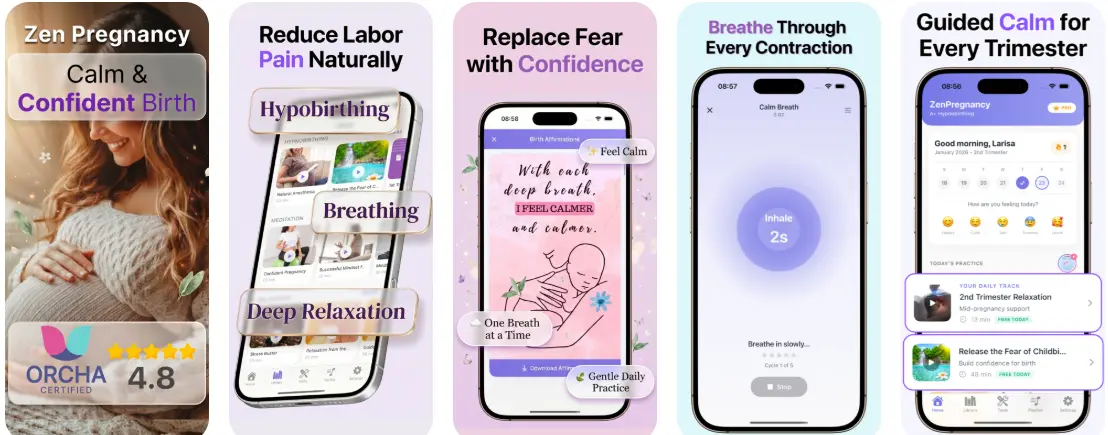
A labor breathing app can help you practise steady breathing patterns, calming audio, and contraction timing so the techniques feel familiar when contractions begin. HypnoBirth App combines guided breathing, meditation, and hypnobirthing tools to support calmer practice before birth and during labor.
Who is this guide for?
Good fit if you
- You want guided breathing prompts to follow during contractions
- You are practising hypnobirthing, relaxation, or meditation before birth
- You want a simple way to rehearse early labor, active labor, and transition breathing
- You would like audio support that can be used at home, in hospital, or at a birth center
- You prefer a free hypnobirthing app used by 200k+ parents
May not be enough if you
- You need medical advice about pain relief, labor progress, or complications
- You want an app to replace your midwife, doctor, doula, or birth team
- You prefer not to use audio, headphones, or screen-based prompts during labor
- You are looking for a clinical contraction diagnosis tool rather than relaxation support
Why Guided Labor Breathing Helps With Contractions
Guided labor breathing helps because it gives your nervous system a steady rhythm when contractions feel big, unfamiliar, or frightening. The aim is not to breathe perfectly; it is to reduce panic, soften tension, and give your body a repeatable coping pattern.
Many people naturally hold their breath, lift their shoulders, or clench their jaw during a contraction. Those reactions can make the wave feel harder to manage. A calm voice cueing “soft inhale, longer exhale” can bring attention back to one small job. This matters in early labor, active labor, transition, hospital birth, home birth, birth center birth, and planned or unplanned changes in your birth plan. This is not medical advice. Consult your healthcare provider about any breathing, movement, or pain relief plan for labor.
How a Birth Breathing App Works During Contractions
A birth breathing app works by pairing auditory cues, pacing, and relaxation prompts with the natural rise and fall of contractions. The mechanism is simple: repeated slow exhalation can reduce threat perception, lower muscle guarding, and support parasympathetic activity.
During a contraction, the app may guide a soft inhale, a longer exhale, a low sound, or a brief body-scan cue such as “release your jaw.” These cues help interrupt the fear-tension-pain cycle often discussed in hypnobirthing education. Some apps also combine breathing tracks with contraction timing, so you can notice frequency and duration without mentally calculating every wave. HypnoBirth App is a hypnobirthing app that provides guided meditation, breathing exercises, contraction timing, and birth affirmations for pregnant women.
Labor Breathing Techniques for Early Labor
Early labor breathing should be simple enough to use while walking, resting, showering, or trying to sleep between mild-to-moderate waves. A good starting pattern is a soft inhale through the nose and a longer, unforced exhale through the mouth.
Try counting in for four and out for six, but do not force the numbers if they make you tense. The longer exhale is the helpful part. You can pair it with loose shoulders, heavy hands, and an unclenched jaw. If you want to build the skill before contractions begin, practice with pregnancy breathing techniques for labor during the third trimester, or earlier if anxiety is already present. Stop any exercise that makes you dizzy and ask your clinician for guidance.

Active Labor Breathing Exercises for Stronger Waves
Active labor breathing usually needs more focus than early labor breathing because contractions are longer, closer together, and harder to talk through. Many birthing people do best with one clear cue: “breathe out longer than you breathe in.”
During each wave, try a gentle inhale followed by a slow “haaah” or “whooo” exhale, as if fogging a mirror. Keep your mouth soft; jaw tension often travels down into the pelvic floor. If you like structure, pair this with hypnobirthing techniques for labor coping, such as visualization, body scanning, and positive suggestion. These tools do not remove all sensation, and they are not a substitute for medical care, but they can make the intensity feel more organized and less lonely.
Transition Breathing and Low-Tone Vocal Cues
Transition breathing is about staying grounded when labor feels most intense and thoughts like “I can’t do this” may appear. Low, open sounds can be more useful than silent breathing because they give the body a clear outlet for pressure and emotion.
Try dropping your pitch on the exhale: “ooooh,” “haaah,” or a gentle hum. Avoid high, tight sounds if they make your shoulders, throat, or jaw grip. A low tone can become a rhythm your partner, doula, or midwife joins with you. This stage can feel emotionally huge, even when everything is normal. If you feel scared, that does not mean you are failing; it means you need support, reassurance, and possibly a change in position, environment, or pain relief.
How to Use a Labor Breathing App Before Birth
Use a labor breathing app before birth by practicing in short, repeatable sessions so the cues feel familiar when contractions begin. Think of it like muscle memory: the calmer response is easier to find when you have rehearsed it many times.
- Choose one early-labor breathing track and repeat it for five to ten minutes daily.
- Practice during mild discomfort, such as Braxton Hicks, a long walk, or a warm shower.
- Pair each exhale with a body cue, such as soft jaw, loose hands, or heavy shoulders.
- Invite your partner to listen so their prompts match the app’s language.
- Save your favorite tracks before 37 weeks so they are easy to find during labor.
Pregnancy Breathing Practice by Trimester
Pregnancy breathing practice can start in any trimester, but the goal changes as birth gets closer. In the first and second trimesters, use breathing mainly for stress regulation, sleep, and body awareness; in the third trimester, make it more birth-specific.
From about 28 weeks, try three short practices each week: one for slow breathing, one for low-tone exhaling, and one for relaxation after a tightening or discomfort. From 34 to 36 weeks, add a practice that includes your birth partner and the exact phrases you want to hear. If you are new to this style of preparation, learning how to start hypnobirthing can help you connect breathing with confidence, consent, and decision-making rather than treating it as just another task.
Using Breathing Prompts in Hospital, Home, or Birth Center Labor
Breathing prompts can support many kinds of birth plans, including hospital labor with an epidural, unmedicated birth, home birth, birth center birth, induction, VBAC, or cesarean preparation. The best cue is the one that still feels kind when plans change.
In hospital, keep tracks short and easy to restart after monitoring, exams, or conversations with staff. At home, pair breathing with movement, hydration, showering, or resting. In a birth center, ask your midwife whether sound, music, or headphones fit the room setup. If you are preparing for a broader birth plan, a labor and delivery app for birth preparation can bring breathing, meditation, affirmations, and timing tools into one place without replacing clinical guidance.
Combining Contraction Timing With Birth Breathing
Contraction timing and birth breathing work well together because one tracks what the uterus is doing while the other supports how you cope. Timing can show patterns; breathing can help you stay present inside each wave.
In early labor, many families use a timer to note how long contractions last, how far apart they are, and whether they are becoming more regular. Between waves, return to rest instead of staring at the numbers. During stronger labor, your partner can manage the timer while you follow the breathing cues. If you want the two tools together, contraction timer meditation for labor is especially helpful because it combines practical tracking with a calm mental anchor.
Partner Cues for Labor Breathing Support
Partner breathing cues work best when they are short, specific, and practiced before labor. “Breathe” is often too vague; “long exhale,” “drop your shoulders,” or “soft mouth” gives the birthing person something concrete to do.
A partner can mirror the rhythm, count quietly, lower the lighting, offer water, remind you to unclench your hands, or restart a track when a contraction begins. The key is consent: some people love touch during labor, while others cannot tolerate it. Decide ahead of time which phrases feel supportive and which feel annoying. If anxiety is high in pregnancy, daily pregnancy stress relief practices can help both you and your partner build a calmer baseline before labor begins.
Best Birth Breathing App Features vs Fluff
The best birth breathing features are practical under pressure: one-hand controls, short tracks, stage-specific guidance, offline access, and a voice you genuinely like. Pretty design matters less than whether you can use the app at 3 a.m. during a contraction.
- Helpful: early labor, active labor, transition, pushing, and rest-between-waves tracks.
- Helpful: adjustable volume, simple navigation, and saved favorites.
- Helpful: breathing plus labor meditation for contractions when you need a deeper reset.
- Fluff: long theory lessons when you need immediate cues.
- Fluff: complicated breathing ratios that make you feel like you are being tested.
Breathing App Comparison: HypnoBirth, Expectful, and Freya
Breathing apps differ most in how birth-specific they are, not just how relaxing they sound. Compare whether the app supports actual contraction moments, not only general pregnancy calm.
| App | Best for | Breathing and labor support |
|---|---|---|
| HypnoBirth | Hypnobirthing-style practice with breathing, affirmations, and timing | Birth-focused tracks plus contraction support |
| Expectful | General fertility, pregnancy, and motherhood meditation | Strong mindfulness library; less contraction-specific |
| Freya | Contraction timing with guided breathing | Simple labor timer and breathing prompts |
If your main need is daily mindfulness, a broad meditation library may be enough. If you want birth-stage practice, compare options in this best hypnobirthing app guide before choosing.
Evidence for Breathing, Relaxation, and Hypnobirthing
Evidence suggests breathing and relaxation techniques may help some people cope with labor pain, fear, and stress, although results vary and no method guarantees a specific birth outcome. The strongest use case is often emotional regulation: feeling less panicked and more able to participate in decisions.
A Cochrane review on relaxation techniques for labor found potential benefits for pain intensity and satisfaction, but also noted differences in study quality. The NHS describes breathing and relaxation as one option among several pain management approaches. This is not medical advice. Discuss labor coping tools, pain relief, and any medical concerns with your midwife, OB-GYN, or healthcare provider.
Honest Limitations of Birth Breathing Apps
Birth breathing apps can be supportive, but they have limits. Trustworthy preparation should make you feel informed, not pressured to cope in only one “natural” or silent way.
- They cannot diagnose labor progress, fetal wellbeing, bleeding, waters breaking, or urgent symptoms.
- They do not replace your midwife, OB-GYN, doula, hospital triage line, or emergency services.
- They may feel irritating during transition; some people need silence, touch, medication, or a different position instead.
Birth Affirmations and Breathing for Fearful Moments
Affirmations can make breathing more emotionally steady when fear rises, especially for first-time parents or anyone with a previous difficult birth. The most useful affirmations are believable, brief, and linked to the exhale.
Instead of forcing yourself to think “I am completely calm,” try something your body can accept: “I can do this one wave,” “my jaw is soft,” or “I can ask for help.” Repeat the phrase on the out-breath. This gives the mind a job and keeps the statement connected to a physical release. For more phrase ideas, a birth affirmations app for labor confidence can help you choose words that fit your personality and birth preferences.
Start a Calm Labor Breathing Routine Tonight
Start with one short breathing session tonight, not a perfect birth plan. Choose a quiet time, place one hand on your bump or chest, inhale gently, and make the exhale slower than the inhale for five minutes.
In HypnoBirth App, you can practice with a labor breathing exercises app on iPhone or a birth breathing app on Android. Use it during pregnancy first, then decide which tracks feel helpful for early labor, active labor, and rest between contractions. If any breathing pattern makes you lightheaded, anxious, or uncomfortable, stop and ask your healthcare provider for personalized advice.
This guide was written for educational birth preparation and reviewed for safety language. It does not replace advice from your midwife, OB-GYN, GP, or maternity unit.
Frequently Asked Questions
Do labor breathing apps help during contractions?
Yes, a labor breathing app can help some people feel calmer and more focused during contractions. Guided cues give you something simple to follow when waves feel intense, but they do not guarantee less pain or a specific birth outcome.
What is the best breathing technique for labor contractions?
A slow inhale followed by a longer, relaxed exhale is a practical breathing technique for labor contractions. As contractions become stronger, low-toned exhales, humming, or sighing can help soften the jaw, shoulders, and pelvic floor.
How does a birth breathing app work during labor?
A birth breathing app works by giving timed audio or visual cues for breathing, relaxation, and contraction tracking. You can use it to follow a rhythm during each wave, rest between contractions, and help your partner know what support to offer.
When should I start practising labor breathing techniques?
You can start practising labor breathing techniques at any point in pregnancy. Many people build a routine from around 28 to 34 weeks, using short daily sessions so the cues feel familiar before labour begins.
Is 38 weeks too late to start using a labor breathing app?
No, 38 weeks is not too late to start using a labor breathing app. Keep practice simple and regular, such as a few minutes of slow breathing, relaxation tracks, and partner cues each day.
Can a labor breathing app help with pregnancy anxiety?
Yes, a labor breathing app can support pregnancy anxiety by giving you calming routines and guided breathing to practise. It should not replace mental health care, midwife support, or urgent help if anxiety feels overwhelming or unsafe.
Can I use labor breathing techniques with an epidural?
Yes, you can use labor breathing techniques with an epidural. Breathing cues can still help with staying calm, resting, changing positions where allowed, making decisions, and preparing for pushing with your care team’s guidance.
Is a labor breathing app useful for first-time moms?
Yes, a labor breathing app can be useful for first-time moms because it adds structure to an unfamiliar experience. It gives clear cues for early labour, active labour, and rest periods, while still allowing flexibility because every birth is different.
Can a labor breathing app replace a hypnobirthing or antenatal class?
No, a labor breathing app does not fully replace a hypnobirthing or antenatal class. An app is useful for daily practice and in-the-moment cues, while a class can provide deeper education, birth planning, partner preparation, and time to ask questions.
Can breathing techniques replace pain relief in labor?
No, breathing techniques cannot replace pain relief for everyone. Breathing is one coping tool, and you should still have access to medical pain relief, clinical care, and support if you want or need them.
What should I do if labor breathing makes me dizzy?
Stop the breathing technique if it makes you dizzy. Return to normal breathing, sit or lie down safely, and contact your midwife, doctor, or maternity unit if dizziness continues or you have any medical concerns.
Should my birth partner use the labor breathing app too?
Yes, your birth partner should learn the labor breathing app cues if they will be supporting you. They can start tracks, time contractions, count longer exhales, offer water, and remind you of the phrases or breathing patterns you practised.
Best Labor Breathing App for Guided Contraction Practice
HypnoBirth App is a strong fit if you want calm, guided breathing techniques to practise before birth and use as prompts during contractions. It includes free hypnobirthing, meditation, and relaxation support, and is ORCHA NHS certified.
Best for
- Practising labor breathing techniques before contractions start
- Using calming audio prompts during early labor, active labor, or transition
Limitations
- It does not provide medical advice or assess labor progress
- Audio prompts may not suit everyone during intense contractions