 Hypno
HypnoBreathing Exercises For Labor: Step-By-Step Practice For Calm Coping
200,000+ moms • ORCHA NHS Certified • Free on iOS & Android
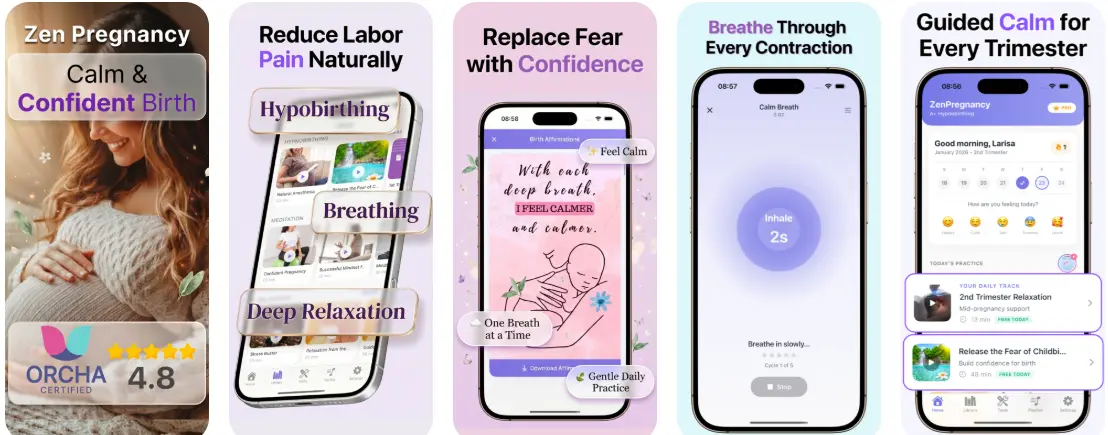
Breathing exercises for labor activate your body's relaxation response, may reduce pain perception, and help you stay focused through contractions. The core technique is slow, deep breathing practiced during pregnancy so it becomes familiar before labor begins. Guided audio can help you rehearse these patterns, but breathing practice is supportive coping, not medical care.
> Definition: Breathing exercises for labor are repeatable, rhythm-based breathing patterns, typically slow inhales through the nose and longer exhales through the mouth, used during contractions to lower stress hormones, support oxygen flow, and encourage calmer coping throughout childbirth.
- Simple slow breathing activates your parasympathetic nervous system, reducing pain and panic during contractions.
- Practicing labor breathing exercises daily with a breathing practice app builds the automatic response you need on birth day.
- Breathing techniques adapt across every labor phase, early, active, transition, and pushing, and work alongside medical pain relief.
What Breathing Exercises For Labor Actually Are
Breathing exercises for labor are planned breathing patterns you practice before birth, then use during contractions to stay steadier. They are different from “just take a deep breath” because the rhythm is repeatable, timed, and familiar.
In practice, that may mean inhaling through your nose for four counts, then exhaling through your mouth for seven or eight. It may mean adding a low sound on the exhale when the contraction peaks. The point is not to perform. The point is to give your body one simple job when labor feels big.
Sticky hospital socks. Monitor belts. One breath.
These tools are low-risk for most people, but they don't guarantee a pain-free birth. You can use them with an epidural, IV medication, nitrous oxide, induction, or cesarean preparation. Clinicians typically recommend comfort measures as support, not as a substitute for medical assessment or pain relief when needed.
Five Evidence-Based Facts About Labor Breathing Exercises
- Controlled breathing can reduce pain perception. Slow breathing supports the relaxation response, which can lower panic and make contractions feel more manageable. The contraction may still hurt, but the fear around it can soften.
- Practice matters before labor. Regular birth breathing practice during pregnancy helps the pattern become automatic. When the contraction timer app pings in early labor, you don't want to be learning from scratch.
- Different rhythms fit different phases. Slow breathing often works well in early labor, while active labor may need counted breaths or sound on the exhale. Both are generally safe for most pregnancies.
- Research supports relaxation methods, with limits. A 2016 Cochrane review of 19 trials involving more than 2,400 women found relaxation techniques, including breathing, were associated with reduced labor pain intensity and higher satisfaction with pain relief compared with usual care source.
- Breathing is supportive care, not medical care. Use it alongside your care team's guidance, especially if labor changes quickly or complications appear.
How Birth Breathing Practice Works Inside Your Body

Birth breathing practice works by helping your nervous system downshift from threat mode into a calmer state. Slow, prolonged exhales may increase vagal activity and support parasympathetic regulation, a mechanism described in reviews of slow-breathing physiology source. In plain language, that means your body gets a stronger “settle down” signal.
Longer exhales can also help reduce the stress response tied to cortisol and adrenaline. When those hormones surge, shoulders climb, jaws lock, and pelvic floor muscles may tighten. Steady oxygen flow supports uterine muscle work and may reduce tension-related cramping around contractions.
The most common medically supported way to use breathing for labor coping is to pair slow exhales with relaxation, position changes, and support from a trained birth partner.
There is also a psychological loop. Fear increases tension. Tension can make pain feel sharper. Calmer breathing interrupts that fear-tension-pain cycle. Practice before labor creates a conditioned relaxation response, so one cue word or touch can bring the pattern back. I’ve watched a partner whisper “long exhale” while offering a straw cup, and the whole room got quieter.

What You Need Before Starting Labor Breathing Exercises
You need a quiet space, a comfortable position, and a few minutes of daily repetition. Sit upright, lie on your side, or prop sofa cushions behind aching hips with a blanket pulled over swollen ankles. Comfort counts.
No special equipment is required. A phone, a saved audio track, and a birth partner who will practice cue-based prompts are enough. Tools like HypnoBirth App can guide the rhythm, but the skill is still yours to build.
If possible, start around 28 to 30 weeks. That gives your body time to connect the breathing pattern with calm before labor starts. Your birth partner should learn the same cues. “In slow, out longer” is more useful during a contraction than six worried questions in a row.
How To Use Breathing Exercises For Labor: 5 Guided Steps
Use labor breathing exercises as a daily rehearsal first, then as a contraction-by-contraction coping tool in labor. Keep the pattern simple enough that you can return to it when you are tired, nauseated, or distracted.
Step 1: Set Up Daily Practice With Guided Audio
- Set a daily practice time with a guided breathing track, ideally 10 to 15 minutes when you can stay undisturbed.
Step 2: Learn The Core Slow-Breathing Pattern
- Practice one core rhythm, such as inhaling for four counts and exhaling for seven or eight counts.
Step 3: Adapt Your Breathing For Each Labor Phase
- Adjust the rhythm by labor phase, using slower breathing in early labor and more focused breathing when contractions intensify.
Step 4: Rehearse With Contraction Timer Simulations
- Run a short contraction timer rehearsal so the sound of timing a surge does not feel new on birth day.
Step 5: Sync Breathing Cues With Your Birth Partner
- Ask your birth partner to cue one phrase and one touch, then refine what actually helps.
For a phone-based setup, the guide on how to breathe through contractions with phone walks through timing, audio, and prompts together.
Breathing Techniques For Every Labor Phase
Labor breathing usually works best when the same basic skill adapts to each phase, rather than changing into a brand-new method every hour. A good hypnobirthing app delivers timed breathing, guided relaxation, and contraction support, not a promise that birth will follow a script.
Slow Breathing For Early Labor Contractions
In early labor, use slow rhythmic breathing to conserve energy. Breathe in through your nose, then make the exhale longer than the inhale. Rest between contractions if you can.
Counted Breathing During Active Labor
In active labor, count the breath through the peak. A longer exhale gives your mind something steady to follow when the contraction climbs.
Focused Breathing Through Transition
During transition, short focused breaths or low vocal tones may help. Not pretty. Useful.
Down-Breathing For The Pushing Stage
For pushing, down-breathing means directing the exhale downward while bearing down with guidance. Some people use this with open-glottis pushing. Others need coached pushing. The deeper explanation sits in hypnobirthing breathing techniques, including how surge breathing fits.
Common Mistakes With Labor Breathing Exercises
The biggest mistake is waiting until labor starts to learn the pattern. Labor is not the easiest classroom. Once contractions are close, your brain wants familiar cues, not a new technique from a hospital handout.
Another mistake is breathing too fast and shallow. That can increase panic, tingling, dizziness, and chest tightness. Slow the exhale first. If counting feels annoying, drop the count and follow a phrase instead.
Breathing also gets oversold. It may improve coping, but it will not erase all pain for every person. Needing an epidural or other medical pain relief does not mean the breathing failed. It means you used another tool.
Keep it simple. Elaborate patterns often disappear during active labor, especially when gown snaps are half-open at the shoulder and someone is adjusting the monitor. Hypnobirthing breathing is not only for home births or unmedicated births. It can be used in hospitals, inductions, epidural labors, and surgical birth preparation.
How To Verify Your Birth Breathing Practice Is Working
Your birth breathing practice is working if your body settles faster than it did before. Look for a noticeable drop in heart rate, jaw tension, shoulder tightness, or chest pressure within two to three minutes.
You should also be able to finish a guided session without repeatedly losing the rhythm. Wandering thoughts are normal. Coming back to the breath is the skill.
A birth partner should be able to cue you with one word, one touch, or one repeated phrase. Questions scribbled before an appointment can become simple labor language later: “Shoulders soft.” “Long exhale.” “One contraction at a time.”
Aim for at least three to four weeks of daily practice before your due date. For many people, app-based practice is easier than reading instructions because the voice keeps pacing when the mind gets busy. If you want a dedicated comparison, the best app for labor breathing guide covers what to look for.
When To Call Your Provider During Labor
Call your provider, hospital triage, or midwife team whenever labor symptoms feel worrying or different from the plan they gave you. Breathing can help you stay steadier, but it should never slow down urgent medical assessment.
- Call right away for vaginal bleeding, reduced fetal movement, a severe headache, sudden swelling with visual changes, intense dizziness, or pain that feels unusual for you.
- Ask for guidance if contractions are getting close together, your waters break, you have a fever, fluid looks green or foul-smelling, or nausea, shaking, or weakness feels concerning.
- Follow your triage instructions from your hospital, birth center, or midwife, including when to come in, where to park, and whether to call before arrival.
- Keep coping gently while you wait for clinical advice, using slow exhales, side-lying rest, dim lights, a sip of water, or your partner’s cue phrase.
- Escalate promptly if symptoms worsen, you cannot reach your team, or your instincts say something is not right.
One long exhale can help you make the call. It cannot replace the call.
Limitations
Breathing exercises are helpful, but they have real limits. Treat them as one part of your birth preferences, not as a test you must pass.
- Evidence is promising but mixed. Not every study shows large reductions in pain, intervention rates, or labor length.
- Breathing techniques usually work better after weeks of regular practice. Downloading an app the week labor starts limits the benefit.
- Severe anxiety, panic, trauma triggers, or high-risk complications may require medication, extra monitoring, or specialist support.
- Online instructions often oversell exact methods. Flexibility matters more than copying a pattern perfectly.
- Breathing exercises are supportive tools, not medical care. Follow your provider's guidance if symptoms, bleeding, fetal movement, or pain patterns worry you.
- Individual responses vary. A technique that works in early labor may feel useless during transition.
- Medical pain relief can still be the right choice. Breathing and an epidural can sit in the same birth plan.
- Some people find audio calming; others want silence once labor intensifies.
A randomized trial of 108 women found that structured breathing and relaxation reduced pain scores and shortened active labor compared with controls, but one study should not be treated as a guarantee source.
Best Breathing Exercises for Labor App for Calm Contraction Practice
HypnoBirth App helps you practise breathing exercises for labor alongside calming hypnobirthing tracks, relaxation cues, and birth preparation tools. It is free to use, ORCHA NHS certified, and trusted by 200k+ users preparing for a calmer birth experience.
Best for
- Practising steady breathing before labor begins
- Using guided relaxation during contractions
- Building confidence with short, repeatable sessions
Limitations
- It does not replace advice from your midwife, doctor, or birth team
- Breathing techniques may feel different during active labor, so flexibility is important
Frequently Asked Questions
What are the best breathing exercises for labour?
The best breathing exercises for labour are slow breathing, counted breathing, surge breathing and gentle down-breathing for the pushing stage. These techniques help you focus your attention, soften tension and create a steady rhythm during contractions. Practise them in pregnancy so they feel familiar when labour begins.
How do breathing exercises help during labour contractions?
Breathing exercises help during labour contractions by reducing panic and giving your mind a clear focus. Slow, steady breathing can support relaxation, help you avoid holding your breath and make each contraction feel more manageable. They do not remove all pain, but they can improve coping.
How do I practise breathing exercises for labour step by step?
Practise labour breathing by sitting comfortably, relaxing your shoulders and taking slow breaths in through your nose and out through your mouth. Count the inhale and exhale, then gradually make the exhale longer than the inhale. Repeat for a few minutes daily and add visualisation or a calming word if that helps.
Can I start labour breathing exercises at 38 weeks pregnant?
Yes, you can start labour breathing exercises at 38 weeks pregnant. Even a short daily practice can help your body recognise the breathing pattern and make it easier to use during contractions. Choose simple techniques first and avoid any breath-holding or anything that makes you dizzy.
When should I start practising breathing exercises for labour?
You can start practising breathing exercises for labour at any point in pregnancy. Many people begin in the second or third trimester, but later practice is still worthwhile. Consistency matters more than perfection, so a few minutes most days is a helpful goal.
Are breathing exercises safe during pregnancy?
Yes, gentle breathing exercises are generally safe during pregnancy. Keep the breath comfortable, avoid prolonged breath-holding and stop if you feel dizzy, faint, short of breath or unwell. Speak to your midwife or doctor if you have a medical condition or concerns about any technique.
Can breathing exercises help with pregnancy anxiety before birth?
Yes, breathing exercises can help with pregnancy anxiety by calming the nervous system and giving you something practical to do when worries rise. Slow exhalations, grounding breaths and guided relaxation are often useful before appointments, at night or when thinking about birth. If anxiety feels overwhelming or persistent, ask your midwife, GP or mental health professional for support.
Do breathing exercises still help if I have an epidural?
Yes, breathing exercises can still help if you have an epidural. They can support calm during early labour, while the epidural is being placed and if you feel pressure later in labour. Breathing also helps you stay present and communicate with your birth team.
Are labour breathing exercises useful for first-time mums?
Yes, labour breathing exercises are useful for first-time mums because they offer a simple coping tool when labour feels unfamiliar. Practising in advance can build confidence and reduce the feeling of not knowing what to do during contractions. They work best alongside good support, comfort measures and flexible birth planning.
What is the difference between hypnobirthing breathing and normal labour breathing?
Hypnobirthing breathing is labour breathing combined with relaxation, positive focus and often visualisation or self-hypnosis. Normal labour breathing may simply mean using slow or counted breaths through contractions. Both approaches aim to reduce tension and support coping rather than guarantee a pain-free birth.
Is a hypnobirthing app enough for learning labour breathing, or do I need a class?
A hypnobirthing app can be enough to learn and practise basic labour breathing if it gives clear guidance and regular practice sessions. A class may be better if you want personalised support, partner coaching or time to ask questions. Many parents use both: an app for daily practice and a class for deeper preparation.
What should I do if breathing exercises do not help during labour?
If breathing exercises do not help during labour, try changing position, using movement, water, massage, vocalising or asking for extra support. Breathing is one coping tool, not a test you have to pass. Tell your midwife or doctor how you are feeling so they can discuss comfort measures and pain relief options.