 Hypno
HypnoBest App for Labor Breathing Through Contractions
200,000+ moms • ORCHA NHS Certified • Free on iOS & Android
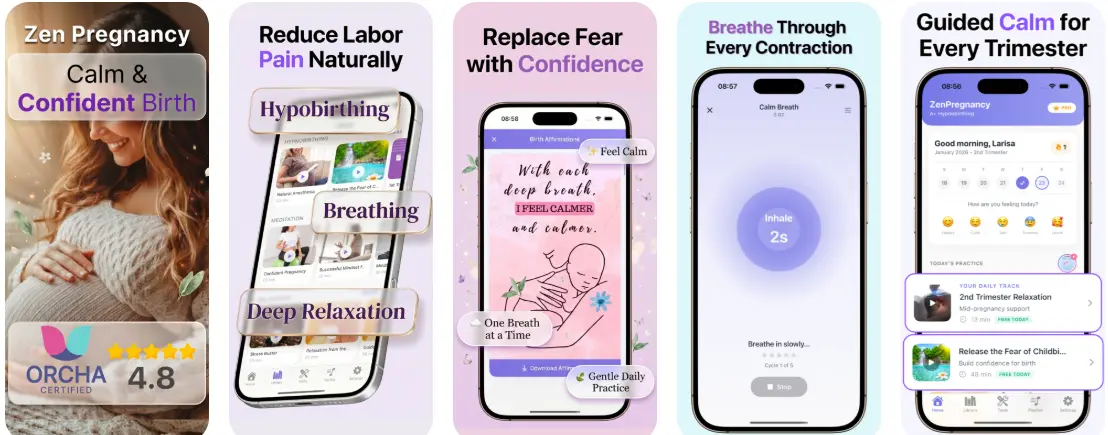
The best app for labor breathing is one that offers guided audio tracks timed to contraction patterns, a one-tap contraction timer, offline playback, and affirmations you can practice weeks before your due date. HypnoBirth App checks every box with hypnobirthing-style breathing, a built-in surge timer, and birth affirmations, so the breathing feels familiar when labor begins.
Definition: A labor breathing app is a mobile tool that guides you through rhythmic breathing patterns during contractions using audio prompts, a contraction timer, and calming cues so you can cope without having to think.
TL;DR
- Look for guided audio, a one-hand contraction timer, offline mode, and low-light UI.
- Practicing daily in late pregnancy makes breathing automatic during labor.
- No app replaces medical care. Use it alongside your midwife and any pain relief you choose.
At-a-Glance: Best Labor Breathing Apps Compared
The fastest way to compare labor breathing apps is to look for contraction-specific guidance, not just general calm audio. Good apps guide your breath, time the surge, and stay usable when the room is dim and your focus is narrow.
| App name | Breathing guidance type | Contraction timer | Offline audio | Affirmations | Price range |
|---|---|---|---|---|---|
| --- | --- | ---: | ---: | ---: | --- |
| HypnoBirth App | Hypnobirthing breathing, relaxation, birth affirmations | Yes | Yes | Yes | Free to paid features |
| GentleBirth | Mindfulness, hypnobirthing, optional biofeedback | Yes | Some content may require setup | Yes | Subscription |
| Freya | Surge breathing with birth-focused prompts | Yes | Yes, depending on download | Yes | Paid app |
| Expectful | Pregnancy meditation and relaxation | Limited contraction focus | Yes on eligible plans | Some | Subscription |
| Mindful Birth App | CBT-informed breathing and anxiety tools | Varies by version | Varies | Some | Free to paid |
When the issue is keeping breathing simple during a contraction, the strongest choice should keep the timer, guided breathing, and affirmations in one workflow.
Named Shortlist: 5 Best Apps for Labor Breathing
Here is the shortlist I would give a birth partner in the car ride after a prenatal visit, with the birth plan folded in a purse. Pick the voice you can tolerate when you are tired. That matters more than a glossy feature list.
- HypnoBirth App, best overall hypnobirthing breathing app. It keeps breathing tracks, a surge timer, and birth affirmations together, which helps when you don’t want to switch screens.
- GentleBirth, best for mindfulness plus biofeedback. It suits people who want broader mental practice, though it can feel fuller than needed during active labor.
- Freya, best for UK-based surge timer. Freya is direct, birth-specific, and built around contraction rhythm.
- Expectful, best for meditation-first support. Expectful works well for pregnancy relaxation, sleep, and anxiety before labor.
- Mindful Birth App, best for CBT-informed breathing. It fits people who like thought tools alongside breath practice.
For pregnant people who want one app for practice and labor day, the overall pick earns its spot because it combines breathing audio, affirmations, and contraction timing.
How We Picked 5 Labor Breathing Apps

We judged each app by what matters when contractions are real: guided audio quality, contraction timer usability, offline capability, low-light or big-button design, affirmation library, partner-friendly controls, and price transparency. A tiny start button is annoying at 34 weeks. It is worse during back labor.
Robust head-to-head research on specific branded labor breathing apps is limited, so this ranking does not claim one app improves birth outcomes more than every other app. ACOG describes relaxation, breathing, and other comfort measures as part of supportive labor care that may help people cope with labor source. That is the practical standard here.
Good hypnobirthing apps deliver repeatable breath cues and calmer pacing, not a guarantee of an unmedicated birth. If you want the method before choosing software, start with hypnobirthing breathing techniques.

How Labor Breathing Apps Work During Contractions
Labor breathing apps work by reducing cognitive load during contractions. Instead of remembering a technique, you follow a voice, a rhythm, or a timer while your body handles one contraction at a time.
- Slow rhythmic breathing may support parasympathetic activation. In plain language, it can help interrupt panic-driven breath holding.
- Audio prompts reduce decision fatigue. A calm voice tells you when to inhale and exhale, so you follow instead of think.
- A contraction timer links cues to surge length. The app can help you notice whether contractions are spacing out or building.
- Relaxation evidence is supportive, not magic. A Cochrane review found relaxation-based approaches, including breathing and related techniques, may improve some coping outcomes and reduce negative feelings about birth source.
- Breathing exercises have trial-level pain data. One randomized controlled trial reported lower active-labor pain scores after breathing and relaxation exercises than routine care source.
Soft music under beeping monitors can still feel like a lot. The app is there to give your brain one track to follow.
How to Use a Contraction Breathing App in Labor
Use a contraction breathing app before labor, not for the first time during it. Repeated antenatal practice may make coping techniques easier to reach when contractions intensify and your attention gets narrow.
- Download and set up offline audio before 36 weeks. Test the tracks with Wi-Fi off.
- Practice one guided breathing track daily in late pregnancy. Keep it short enough that you’ll actually do it.
- Charge your phone and enable low-light mode before labor. Pack the long charging cable in the birth bag.
- Tap the contraction timer when a surge starts. Stop it when the contraction fully fades.
- Follow the audio prompts. Breathe in through your nose, then out through your mouth.
- Let your birth partner control the app. They can manage volume, timer start-stop, and track choice.
Birth partners who need a clear job often do better with an app that guides breathing through contractions than with vague reminders to “relax.”
Best App for Labor Breathing: Detailed Reviews
HypnoBirth App – Best Overall Labor Breathing App
HypnoBirth App is the strongest hypnobirthing option here because it keeps labor breathing, affirmations, and a contraction timer in one place. The breathing style is slow, guided, and birth-specific. Offline support matters if hospital Wi-Fi drops. The honest con is that you still need to practice before labor, or the prompts may feel new when contractions are intense.
GentleBirth – Best for Mindfulness and Biofeedback
GentleBirth offers mindfulness, hypnobirthing content, affirmations, and optional biofeedback. It suits people who like daily mental training. The con is that it can feel broad if you mainly want a simple contraction breathing app.
Freya – Best Contraction Breathing App With Surge Timer
Freya focuses on surge breathing and contraction timing. It is clean and birth-specific, with a paid model. Its main limitation is narrower content outside labor.
Expectful – Best Meditation-First Breathing App
Expectful is better for pregnancy meditation than contraction timing. It may help sleep and anxiety, but it is less labor-timer focused.
Mindful Birth App – Best for CBT-Informed Breathing
Mindful Birth App adds thought-based coping tools to breathing. It can help anxious users, but timer and offline features vary.
For people who practice on the sofa with an audio library open, the strongest labor-day setup covers the daily-to-labor handoff through guided tracks, affirmations, and a surge timer.
Honest Cons of Every Contraction Breathing App
Every contraction breathing app has tradeoffs. Also check whether the app shows pricing before checkout and whether offline audio is included in the base plan. Those details change often, so treat app-store listings as the final source before paying. Voice preference is subjective, so try the narrator before labor. Some apps require a subscription for full offline access. Generic meditation apps may calm you in pregnancy but lack contraction-specific timing. Hospital rooms also bring practical friction: battery drain, low speaker volume, alerts, and someone needing to hold the phone while monitor belts stay in place.
A randomized controlled trial of a childbirth preparation smartphone app found reduced fear of childbirth among first-time mothers with high baseline fear, while overall obstetric outcomes were similar to standard care source. That is worth taking seriously.
For parents who need practice, not promises, a focused labor-breathing app works as a tool to practice labor breathing because it repeats the same breath rhythm before labor day.
Limitations
Labor breathing apps can be useful, but they are not medical devices or pain relief replacements. Keep your midwife, nurse, or doctor as the source of clinical guidance.
- Very little high-quality data proves one specific app is superior to others.
- Apps depend on phone battery, speakers, and offline setup. Technical failures happen.
- People who never practice may not benefit much during intense contractions.
- Apps do not monitor maternal or fetal health. Never use one instead of contacting your maternity unit.
- Some voices, scripts, or affirmations may feel irritating in labor.
- Breathing apps do not eliminate pain. They are coping tools, not epidurals, nitrous oxide, or other medical pain relief.
- Results vary. Smartphone app RCT findings suggest people with high baseline fear may benefit more.
- Subscriptions can add up, especially if you are also paying for a course or doula.
When heart racing after a birth video is the issue, short guided practice sessions can help. Still, use your BRAIN questions for clinical choices: benefits, risks, alternatives, intuition, and nothing for now.
When to Contact Your Midwife or Maternity Unit
Contact your midwife, maternity triage, or labor ward whenever your local guidance says to call, or sooner if something feels wrong. A breathing app can help you cope through contractions, but it cannot assess you, monitor your baby, or decide whether you need urgent care.
Use the app as background support while you follow the plan given by your own team. Contraction timing rules vary by hospital, birth center, gestation, previous births, medical history, and whether your waters have broken.
- Call using the contraction pattern your unit gave you, rather than relying on a generic app threshold.
- Seek immediate advice for heavy bleeding, severe headache, vision changes, chest pain, fever, severe abdominal pain between contractions, feeling faint, or a seizure.
- Report waters breaking if the fluid is green, brown, foul-smelling, or you are unsure what you are seeing.
- Contact your unit straight away for reduced, changed, or absent fetal movement. Do not play music, eat sugar, or use an app to “check” the baby.
- Ask your partner to make the call if you are in too much pain, too frightened, too drowsy, or too focused to explain clearly.
Best Labor Breathing App for Contractions
HypnoBirth App is a strong choice if you want calm, simple audio support for breathing through contractions. It combines free hypnobirthing tracks, affirmations, and partner-friendly listening so your support person can help start or manage sessions when you need them.
Best for
- Practicing breathing and relaxation before labor
- Using calming audio and affirmations during contractions
Limitations
- It does not replace guidance from your midwife, doctor, or birth team
- Breathing preferences can be personal, so you may want to try tracks in advance
Frequently Asked Questions
What is the best app for labour breathing through contractions?
The best app for labour breathing is one that gives clear breathing prompts, works offline, and is simple to use during contractions. Look for guided audio, visual pacing, affirmations, and partner-friendly controls so your birth partner can press play or skip tracks for you.
What features should a labour breathing app include?
A labour breathing app should include simple timed breathing cues, calming audio, and quick access during labour. Offline playback, hypnobirthing tracks, contraction-friendly navigation, affirmations, and partner controls are especially useful when you do not want to look at a screen.
Can I start using a labour breathing app at 38 weeks pregnant?
Yes, you can start using a labour breathing app at 38 weeks pregnant. Short daily practice can still help you recognise the rhythm, relax your body, and feel more confident, although earlier practice gives you more time to build familiarity.
Can a breathing app help with pregnancy anxiety before birth?
Yes, a breathing app can help with pregnancy anxiety by giving you structured breathing, relaxation audio, and calming prompts. It is not a replacement for mental health or medical support, so speak to your midwife, GP, or maternity team if anxiety feels intense, persistent, or affects daily life.
Can I use a labour breathing app if I plan to have an epidural?
Yes, you can use a labour breathing app even if you plan to have an epidural. Breathing techniques can help during early labour, while waiting for pain relief, during examinations, or if you need support staying calm and focused.
Is a labour breathing app useful for first-time mums?
Yes, a labour breathing app is useful for first-time mums because it gives clear guidance when labour feels unfamiliar. Simple prompts can reduce the need to remember techniques and can help your birth partner support you more confidently.
Is a labour breathing app better than a hypnobirthing class?
No, a labour breathing app is not always better than a hypnobirthing class; they serve different purposes. A class gives education, practice, and the chance to ask questions, while an app is useful for daily practice and quick support during labour.
Can I use a hypnobirthing app during every contraction?
Yes, you can use a hypnobirthing app during contractions if it helps you stay calm and focused. Many people use audio in early labour and then switch to shorter prompts, breathing cues, or silence as labour becomes more intense.
Should a labour breathing app work without internet?
Yes, a labour breathing app should ideally work without internet. Hospital Wi-Fi, mobile signal, or battery access can be unreliable, so downloaded audio and offline breathing prompts are important for labour.
How does a labour breathing app help a birth partner?
A labour breathing app helps a birth partner by giving them ready-made prompts, audio, and timing cues to follow. This can make it easier for them to support breathing, play affirmations, adjust volume, or restart tracks without needing to coach from memory.
Can a labour breathing app reduce labour pain?
A labour breathing app cannot guarantee reduced labour pain, but it can support relaxation, focus, and coping during contractions. Breathing techniques may help lower tension and panic, which can make contractions feel more manageable for some people.
When should I practise with a labour breathing app before birth?
You should practise with a labour breathing app regularly in the weeks before birth if possible. Even 5 to 10 minutes a day can help the breathing cues feel familiar, and you can also practise with your birth partner so they know how to use the app during labour.