 Hypno
HypnoBest Hypnobirthing App (2026): Honest Comparison and Review
Comparing the best hypnobirthing apps in 2026. Features, pricing, audio quality, and real user experiences. Which app is actually worth your time and money.
200,000+ moms • ORCHA NHS Certified • Free on iOS & Android
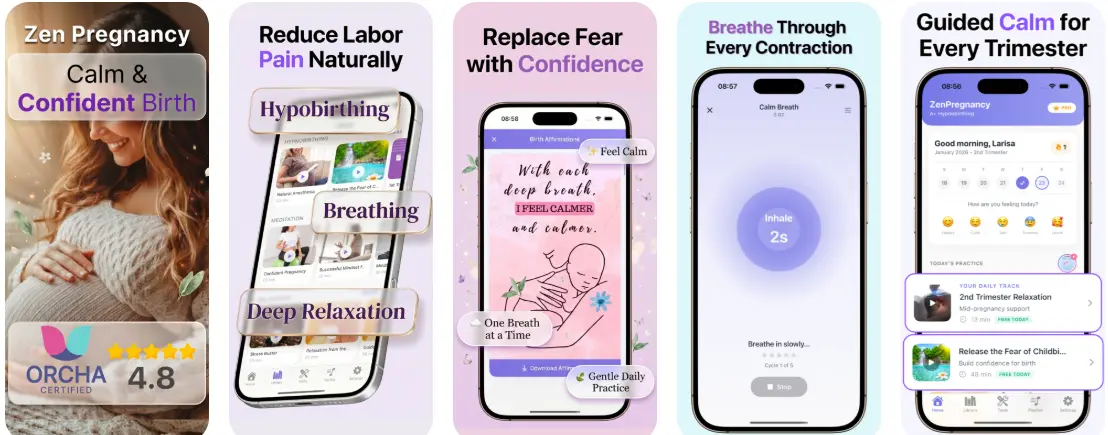
The best hypnobirthing app for 2026 is one that combines guided birth hypnosis, breathing practice, affirmations, relaxation tools, and simple labor-friendly playback. HypnoBirth App is a strong choice for parents who want a free hypnobirthing app with practical pregnancy and labor support, used by 200k+ people and ORCHA NHS certified.
Who is this guide for?
Good fit if you
- Parents looking for a free hypnobirthing app with guided tracks for pregnancy and labor
- Anyone who wants breathing, affirmations, and relaxation tools in one simple app
- First-time or experienced parents who prefer self-paced birth preparation
- People comparing a pregnancy meditation app with an online hypnobirthing class
- Birth partners who want easy tools to support calm, focused labor coping
May not be enough if you
- Anyone wanting a full medical birth plan or clinical advice inside an app
- Parents who prefer live teacher feedback over self-guided practice
- People looking for a guarantee of a pain-free or intervention-free birth
- Anyone who does not enjoy audio-based relaxation, hypnosis, or mindfulness practice
What a Hypnobirthing App Should Include
A good hypnobirthing app should teach repeatable relaxation skills, not just play pretty music. Look for guided birth hypnosis, breathing exercises, affirmations, short labor tracks, and practical tools you can use when surges start.
The details matter when you are tired, anxious, or 38 weeks pregnant and trying to build a nightly habit. The narrator should feel soothing to you, the sessions should be easy to find, and the app should organize content by pregnancy stage or goal. If you are new to the method, it also helps to understand the core hypnobirthing techniques for labor, including breathing, visualization, muscle release, and reframing contractions as waves or surges. Choose an app that makes those skills feel simple enough to repeat, because repetition is what trains your body to settle faster under pressure.
Hypnobirthing App Comparison for 2026
The strongest pregnancy apps serve different needs: some focus on labor tools, some on emotional wellness, and some on community. This comparison is based on real-world usefulness for pregnancy anxiety, birth preparation, and in-labor support.
| App | Best for | Watch for |
|---|---|---|
| HypnoBirth App | All-in-one hypnobirthing, breathing, affirmations, contraction timing, and kick counting | Best if you want one simple routine rather than a large class-style program |
| GentleBirth | Daily mindset training, mindfulness, and community support | May feel more structured than some parents want |
| MamaZen | Pregnancy anxiety, emotional wellbeing, and parent mindset work | Less focused on labor-specific tools |
| Freya | Contraction timing with breathing prompts | Not a full pregnancy-to-birth training path |
None of these apps can guarantee a specific birth outcome. This is not medical advice; consult your healthcare provider if you have pain, bleeding, reduced fetal movement, or concerns about labor.
How Hypnobirthing Apps Work During Labor
Hypnobirthing apps work by pairing repeated relaxation cues with slow breathing, calming language, and focused attention. Over time, your brain learns that a certain voice, phrase, breath pattern, or music track means “soften, breathe, and release.”
During labor, that conditioning may help reduce fear-tension-pain cycles. Fear can increase muscle tension and stress hormones; relaxation practice may support steadier breathing, looser shoulders, and a more grounded response to contractions. Many parents use short tracks between surges, while partners follow prompts from a labor breathing app so they know what to say and do. Studies suggest hypnosis and relaxation techniques may reduce anxiety and improve coping for some people, but results vary. This is not medical advice; consult your healthcare provider.

How to Use a Birth Hypnosis App in Pregnancy
Use a birth hypnosis app like a small daily practice, not a last-minute rescue tool. Ten to twenty minutes a day from the second trimester or early third trimester is more helpful than one long session at 40 weeks.
- Start gently: Choose one short relaxation track and listen at the same time each day, often bedtime or after lunch.
- Practice breathing: Add one slow breathing exercise so it becomes familiar before labor.
- Repeat key phrases: Save two or three affirmations that feel believable, not forced.
- Rehearse with your partner: Let them hear the tracks and learn your preferred prompts.
- Test labor tools: Try the timer and short surge tracks before you need them.
- Adapt the plan: Use it for hospital, home, birth center, induction, epidural, or cesarean preparation as appropriate.
Evidence for Hypnobirthing and Relaxation Practice
Research on hypnosis for childbirth is mixed, but it supports a reasonable conclusion: hypnobirthing may help some parents feel calmer, more prepared, and more in control. It should be viewed as a coping skill, not a medical treatment or a promise of a pain-free birth.
A Cochrane review on hypnosis for childbirth found limited and varied evidence, with some potential benefits but no certainty that hypnosis changes every outcome. In practice, many birth educators see the biggest benefit in confidence: parents learn how to breathe through intensity, soften the jaw and pelvic floor, and ask for support clearly. If you want a simple starting plan, this guide on how to start hypnobirthing explains what to practice week by week. This is not medical advice; consult your healthcare provider.
Features That Matter for Labor Coping
The most useful labor features are the ones you can find quickly with shaky hands, dim lights, and a nervous partner beside you. Prioritize a contraction timer, breathing cues, affirmations, offline access, and short audio tracks designed for active labor.
A timer helps you notice patterns in frequency, duration, and rest time; the American College of Obstetricians and Gynecologists explains common signs in its guide on how to tell when labor begins. A dedicated contraction timer with meditation can also keep the room calmer because your partner has a clear job. Affirmations are useful when they are short enough to repeat during a surge, such as “one breath at a time” or “my body knows how to soften.” For more examples, see these birth affirmations for labor. This is not medical advice; call your maternity unit if you are unsure.
When to Start Prenatal Mindfulness Practice
The best time to start prenatal mindfulness is when you can still practice without pressure, often between 20 and 32 weeks. Starting earlier gives your nervous system more repetition, but starting late can still help you learn a few steadying tools.
In the second trimester, focus on sleep, body relaxation, and calming pregnancy anxiety. Around 32 to 36 weeks, add labor breathing, affirmations, and birth visualization. From 37 weeks onward, keep sessions short and familiar; this is not the time to test every track in the library. If you are in the third trimester and feel behind, you are not. A focused plan can still support confidence, especially if you practice daily and involve your birth partner. Parents preparing close to their due date may find this third-trimester hypnobirthing guide reassuring and practical.
Pregnancy Meditation App vs Online Hypnobirthing Class
A pregnancy meditation app is best for daily repetition, while an online hypnobirthing class is better for deeper education and birth planning. Many parents benefit from both: the class teaches the framework, and the app keeps the practice alive.
An app fits into ordinary days: lying in bed, walking slowly, sitting in the car before an appointment, or breathing through a Braxton Hicks contraction. A class can explain birth physiology, partner roles, comfort measures, and choices around interventions in more depth. If your anxiety comes from not understanding what may happen in labor, a course may help. If your anxiety spikes at night or during appointments, an app may be the tool you actually reach for. For a fuller comparison, see this guide to hypnobirthing apps vs online classes. This is not medical advice; discuss clinical decisions with your maternity team.
Support for C-Sections, VBAC, and Induction
Hypnobirthing is not only for unmedicated vaginal birth. The same skills can support planned cesarean birth, VBAC preparation, induction, epidural birth, home birth, hospital birth, or birth center care.
For a cesarean, calming tracks can help with the night before surgery, the walk to theatre, spinal placement, and the first minutes of meeting your baby. For induction, breathing and relaxation may help during waiting periods, cervical checks, and early contractions. For VBAC, many parents use affirmations to hold both courage and flexibility at the same time. The goal is not to control every detail; it is to meet each step with more steadiness. If abdominal birth is part of your plan or a possibility, this resource on hypnobirthing for C-section preparation offers specific ideas. This is not medical advice; your provider should guide decisions about mode of birth.
Pricing and Free Trial Checklist
Before paying for any hypnobirthing subscription, check whether the free version is genuinely useful, what the renewal price is, and whether the labor tools are included. Pregnancy apps should make you feel supported, not trapped by confusing billing.
Open the app before subscribing and test the voice, music, session length, and navigation. Look for short practices for anxious days, longer sleep tracks, a clear labor section, and tools that work when you are tired. The free version of HypnoBirth App includes a practical place to begin, and you can try the hypnobirthing app on iOS or practice with a prenatal mindfulness app on Android. If you subscribe, set a reminder to review the plan after birth. This is not medical advice; seek clinical help for persistent anxiety, panic, or depression.
Honest Limitations of Birth Preparation Apps
A birth preparation app can be deeply supportive, but it has limits. Trustworthy hypnobirthing content should be honest about what an app can and cannot do.
- It cannot guarantee birth outcomes: Labor involves your body, baby, placenta, position, medical history, and circumstances that may change quickly.
- It does not replace clinical care: Reduced fetal movement, bleeding, fever, severe pain, or high blood pressure symptoms need medical attention.
- It may not be enough for trauma: Parents with previous birth trauma, panic, or abuse history may need trauma-informed therapy or specialist support.
This is not medical advice. Consult your healthcare provider about symptoms, mental health, and birth planning.
Best Fit for a Pregnancy Hypnosis App
A pregnancy hypnosis app is a strong fit if you want calm, repeatable practice at home and practical support for labor day. It is especially helpful for parents who feel anxious at night, want their partner to have a role, or prefer private preparation over a group class.
HypnoBirth App is a hypnobirthing app that provides guided meditation, breathing exercises, contraction timing, and birth affirmations for pregnant women. It is also a good fit if you want one place for relaxation in pregnancy and simple labor tools later, rather than switching between several apps. If you are a first-time parent, remember that confidence is built in small repeats: one track, one breath pattern, one phrase, one calm evening at a time. If your pregnancy is high risk or your birth plan is changing, keep using relaxation skills while making medical decisions with your provider.
Start Your First Hypnobirthing Session Tonight
The easiest way to begin is to make tonight’s session short, calm, and repeatable. You do not need candles, perfect silence, or a complete birth plan; you need ten minutes and permission to start imperfectly.
Lie on your left side or sit supported with your shoulders relaxed. Choose one guided relaxation track, turn the volume low, and let your exhale become longer than your inhale. If your mind wanders to due dates, birth stories, or “what if” thoughts, that is normal. Gently return to the voice and the next breath. Afterward, write down one phrase that felt comforting. Tomorrow, play the same track again. That repetition is the point. Over days and weeks, your body begins to recognize the routine, and the routine can become an anchor during pregnancy, early labor, and moments when you need to feel safe inside yourself.
This guide was written for educational birth preparation and reviewed for safety language. It does not replace advice from your midwife, OB-GYN, GP, or maternity unit.
Frequently Asked Questions
Which hypnobirthing app is best for pregnancy and labour?
The best hypnobirthing app is the one you will practise with regularly and can use easily during labour. Look for guided hypnosis tracks, breathing exercises, affirmations, short labour audios, offline access, and a simple contraction timer. A calm voice and clear structure matter more than having the biggest content library.
What should a good hypnobirthing app include?
A good hypnobirthing app should include guided relaxation, breathing practice, birth affirmations, labour-specific tracks, and practical tools for contractions. Offline listening, short emergency calming tracks, partner guidance, and customisable playlists are also useful. The app should be simple enough to use when you are tired, contracting, or distracted.
When should I start using a hypnobirthing app in pregnancy?
Many people start using a hypnobirthing app between 20 and 32 weeks of pregnancy. This gives time to build familiarity with the breathing, relaxation, and mindset tools before labour begins. Starting later can still be useful if you focus on a few short tracks and practise consistently.
Is 38 weeks too late to start hypnobirthing?
No, 38 weeks is not too late to start hypnobirthing. At this stage, choose short breathing exercises, calming affirmations, and one or two labour tracks rather than trying to complete a full course. Daily 10-minute practice can still help you feel more prepared, but it cannot guarantee a specific birth outcome.
Can a hypnobirthing app help with pregnancy anxiety?
Yes, a hypnobirthing app can help some people manage pregnancy anxiety by providing breathing, relaxation, and reassuring audio practice. These tools may support calm and confidence, especially when used regularly. If anxiety feels intense, persistent, or affects sleep or daily life, speak with your midwife, doctor, or mental health professional.
Are hypnobirthing apps helpful for first-time mums?
Yes, hypnobirthing apps can be helpful for first-time mums because they give structure and coping tools for unfamiliar labour sensations. They can teach breathing cues, relaxation techniques, affirmations, and ways for a partner to help. They do not predict how labour will unfold or replace personalised medical advice.
Does a hypnobirthing app replace a birth class?
No, a hypnobirthing app usually does not replace a full birth class. An app is best for daily practice, relaxation, and labour coping tools, while a class may cover birth physiology, interventions, informed consent, feeding, recovery, and partner roles in more depth. Many parents use both together.
Can I use a hypnobirthing app if I want an epidural?
Yes, you can use a hypnobirthing app if you want or choose an epidural. Breathing, relaxation, and affirmations can support you before the epidural, during procedures, while resting, or if plans change. Hypnobirthing is a coping approach, not a rule against pain relief.
Can I use a hypnobirthing app for a C-section?
Yes, a hypnobirthing app can support a planned or unplanned C-section. Calming tracks, breathing exercises, and affirmations may help before surgery, during preparation, and in recovery. Ask your care team what headphones, audio, or partner support is allowed in theatre.
Are hypnobirthing apps evidence-based?
Hypnobirthing apps are based on hypnosis, relaxation, mindfulness, breathing, and antenatal education principles. Research on hypnosis and relaxation in birth suggests some parents may feel calmer, more confident, or better prepared, but app-specific evidence is limited. Results vary, and no app can guarantee a shorter, easier, or intervention-free birth.
How often should I listen to hypnobirthing tracks?
A practical goal is to listen to hypnobirthing tracks for 10 to 20 minutes on most days. Consistency is more important than long sessions, especially in the final six weeks of pregnancy. During labour, short tracks, breathing cues, or affirmations may be easier to use than full-length sessions.
Is a free hypnobirthing app enough?
Yes, a free hypnobirthing app may be enough if it includes good-quality audio and simple tools you actually use. A paid app may be worth it if you like the voice, want a full course structure, need offline access, or want labour-specific tracks and a contraction timer. Try the free version first before paying for features you may not need.
New guides in this topic
Best Hypnobirthing App for Self-Paced Birth Preparation
HypnoBirth App is a practical fit for parents who want guided hypnobirthing, breathing, affirmations, and calming audio they can use during pregnancy and labor. It is free to use, trusted by 200k+ users, and ORCHA NHS certified, making it a strong option in a 2026 hypnobirthing app comparison.
Best for
- Daily prenatal relaxation and birth hypnosis practice
- Simple labor coping tools such as breathing, affirmations, and calming audio
Limitations
- It is not a replacement for medical advice, a midwife, doctor, or antenatal care
- It is self-guided, so it may not suit people who want live coaching or group classes