 Hypno
HypnoHypnobirthing Third Trimester: Too Late?
200,000+ moms • ORCHA NHS Certified • Free on iOS & Android
Hypnobirthing Third Trimester: What Starting Late Means
Starting hypnobirthing in late pregnancy means learning practical calm-down skills, not trying to master a whole philosophy overnight. The focus is usually on breath rhythm, muscle release, fear reduction, birth language, and partner cues that can be practiced quickly and repeated often.
If you are 28, 34, or even 39 weeks pregnant, you still have time to build useful associations between a voice, a phrase, a breathing pattern, and a calmer body response. You may not get months of repetition, but you can still create a simple routine that supports sleep, appointments, early labor, and decision-making. This is not medical advice. Consult your healthcare provider about symptoms, birth choices, pain relief, or changes in your pregnancy.
Why Late-Pregnancy Birth Preparation Can Still Help
Late-pregnancy birth preparation can still help because the third trimester is when many people feel the most motivated to practice. The due date feels real, body sensations are stronger, and small daily routines can quickly become familiar.
Hypnobirthing does not promise a pain-free birth or a specific type of delivery. It gives you tools for coping, staying oriented, and reducing the fear-tension cycle that can make labor feel more overwhelming. Studies on relaxation, mindfulness, and hypnosis for childbirth suggest possible benefits for anxiety, coping, and satisfaction, though results vary by study design and individual circumstances. If you want a broader starting guide, pair this page with how to start hypnobirthing step by step so your final weeks feel structured rather than rushed.
How Third-Trimester Hypnobirthing Works
Third-trimester hypnobirthing works by pairing repeated cues with a calmer nervous system response. A guided voice, slow exhale, body scan, or phrase becomes a signal that tells your brain, “I know what to do here.”
The mechanism is simple: attention training, conditioned relaxation, and paced breathing. When you repeat the same audio or breathing pattern, your body starts recognizing the sequence. Long exhales can support parasympathetic activity, while guided imagery narrows attention so you are not scanning every sensation for danger. This matters in late pregnancy because the mind often jumps ahead: Is this labor, is baby okay, will I cope? Hypnobirthing gives that mental energy a practiced route back to the present moment.

How to Start Hypnobirthing at 28 to 40 Weeks
Start with a small routine you can repeat on tired days. The goal is not perfection; it is building a cue your body recognizes before labor begins.
- Choose one daily time: Practice for 10 to 15 minutes, ideally at bedtime or after a shower.
- Repeat one audio track: Use the same voice or meditation for several days so the cue becomes familiar.
- Practice one breathing pattern: Try a slow inhale and longer exhale, then compare it with other pregnancy breathing techniques.
- Write three believable phrases: Choose words you can trust, using hypnobirthing affirmations that feel grounded rather than forced.
- Rehearse with sensation: During Braxton Hicks, soften your jaw, drop your shoulders, and breathe through the wave.
- Involve support: Ask your partner, doula, or birth companion to practice one phrase and one touch cue.
Daily Hypnobirthing Practice for the Final Weeks
A good final-weeks routine is short, predictable, and forgiving. Think of it as brushing your teeth for your nervous system: small enough to do daily, useful because you repeat it.
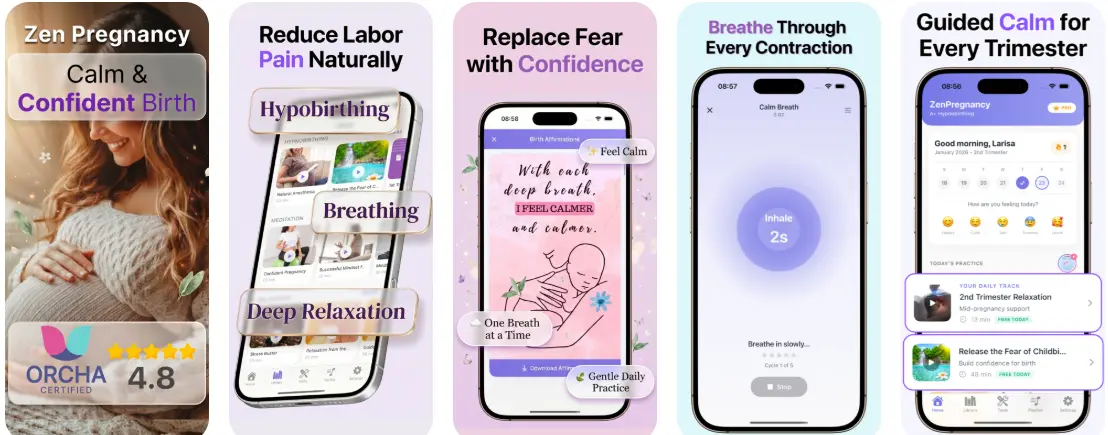
From weeks 28 to 32, focus on sleep meditations and basic breath awareness. From weeks 33 to 36, add birth affirmations and partner cues. From week 37 onward, rehearse early labor: dim lights, headphones, slow breathing, and a plan for when to call your provider. If you prefer guided audio on your phone, the hypnobirthing practice app can help keep the routine easy when your energy is low. HypnoBirth App works best when you repeat a few tracks often, rather than sampling a new one every night.
Labor Breathing Exercises for Late Pregnancy
Labor breathing exercises are most helpful when you practice them before contractions feel intense. In the third trimester, you can train your body to meet pressure with softening instead of bracing.
Begin with a simple pattern: inhale gently through the nose for four counts, exhale for six to eight counts, and keep the jaw loose. During a stronger practice wave, add a phrase such as “soften” or “one breath at a time.” Some people like counting; others prefer sound, humming, or low vocal tones. None of these choices is morally better. They are tools. If you want audio prompts for the rhythm, a labor breathing app can guide practice before you need the pattern in real time.
Birth Affirmations for Third-Trimester Fear
Birth affirmations work best when they are believable, specific, and connected to an action. In late pregnancy, the strongest phrases often sound steady rather than overly positive.
Instead of “My birth will be perfect,” try “I can meet one contraction at a time,” “My team can help me make decisions,” or “I can breathe, ask, pause, and choose.” These phrases support many birth plans, including hospital birth, home birth, birth center care, induction, epidural, unmedicated labor, VBAC planning, and cesarean birth. The point is not to deny fear. It is to give fear a calmer script. If written reminders help, you can build a small card set using pregnancy affirmations for sleep, appointments, and labor.
Contraction Timing with Calm Labor Skills
Contraction timing is easier when you practice the tool before labor begins. Set up your timer in the third trimester so you are not downloading apps or learning buttons while tired, excited, or unsure.
Many people use early contractions as a cue to begin the same hypnobirthing pattern they practiced at night: start timer, soften shoulders, exhale slowly, rest. Timing helps you notice frequency and duration, while the breathing routine helps you stay present between waves. Follow your provider’s instructions about when to call or go in, especially with bleeding, reduced fetal movement, waters breaking, severe pain, or any concern. For a calmer workflow, pair contraction timer meditation with your birth plan and provider guidance.
Best Hypnobirthing Apps for Late Pregnancy
The best app for a late start is the one you will actually open every day. Look for short sessions, clear organization, labor breathing, affirmations, and practical tools you can use when contractions begin.
| App | Best for | Late-start strengths | Possible drawback |
|---|---|---|---|
| HypnoBirth App | Guided hypnobirthing plus labor tools | Meditations, breathing, affirmations, contraction timing, and kick counting in one place | Best if you like app-led practice more than live classes |
| GentleBirth | Mindfulness and hypnobirthing blend | Large audio library and mental training style | Can feel like a lot to choose from late in pregnancy |
| Expectful | Pregnancy meditation and sleep | Gentle meditations for stress and rest | Less focused on full hypnobirthing course structure |
For more side-by-side detail, see this guide to the best hypnobirthing app for different birth-prep styles.
Hospital, Birth Center, Home, and Cesarean Prep
Hypnobirthing can support many kinds of birth because the skills are about coping, communication, and nervous system regulation. You do not have to be planning an unmedicated birth to benefit.
In a hospital, you might use audio while waiting for triage, during induction, or before an epidural. In a birth center or home setting, breath cues and dim lighting may blend naturally with the environment. For a planned or unexpected cesarean, relaxation scripts can help before theatre, during spinal placement, or in recovery when emotions rise. Always follow your clinical team’s instructions. If surgical birth is part of your plan or a possibility you want to feel less afraid of, read hypnobirthing for c-section prep alongside your medical guidance.
Limits of Starting Birth Hypnosis Late
Starting birth hypnosis late can still be worthwhile, but it has limits. Honest expectations make the practice more useful and less pressured.
- Less repetition: You may not build the same automatic response as someone who practiced for months.
- No guaranteed outcome: Hypnobirthing cannot promise a vaginal birth, unmedicated birth, short labor, or pain-free experience.
- Medical needs come first: Bleeding, reduced fetal movement, high blood pressure symptoms, fever, waters breaking, or severe pain need clinical advice, not meditation.
- Trauma may need extra support: Prior birth trauma, panic, or medical anxiety may require a therapist, trauma-informed doula, or specialist midwife.
- Audio is not a full care team: Apps and tracks support preparation, but they do not replace your provider, birth class, or emergency care.
This is not medical advice. Consult your healthcare provider about your pregnancy and birth plan.
Common Mistakes in Late-Start Hypnobirthing
The biggest mistake is trying to do too much too fast. Late-start hypnobirthing works better when you repeat a few simple skills than when you cram ten techniques into the final week.
- Changing tracks every night: Familiar cues matter, so repeat the same audio often.
- Practicing only when anxious: Practice when calm too, so the cue is not linked only with panic.
- Choosing fake-positive affirmations: Use phrases your nervous system can believe.
- Leaving your partner out: A birth companion can remind you to breathe when you forget.
- Ignoring practical tools: Pack chargers, headphones, birth preferences, snacks, and provider numbers before labor starts.
Small, repeated practice gives you more confidence than a huge plan you never use.
Verdict: Calm Birth Practice Is Worth Starting
Yes, calm birth practice is worth starting in the third trimester. Even a short routine can improve your sense of readiness, give your support person clear cues, and help you meet the unknowns of labor with more steadiness.
Think of the final weeks as practice reps, not a countdown to being judged. You are allowed to begin where you are. You are allowed to use pain relief, change plans, ask questions, and still use hypnobirthing skills. If you want one place for guided audio, breathing, affirmations, and labor tools, the Android hypnobirthing app is a simple place to start. HypnoBirth App is not a replacement for medical care, but it can be a steady companion in the last stretch.
Frequently Asked Questions
Is 36 weeks too late to start hypnobirthing?
No, 36 weeks is not too late to start hypnobirthing. Focus on the essentials: one breathing technique, one daily audio track, and one simple cue your birth partner can use. Short, consistent practice is more useful than trying to learn everything at once.
Can I start hypnobirthing at 38 weeks pregnant?
Yes, you can start hypnobirthing at 38 weeks pregnant. Use a simple routine of 10 minutes a day with calm breathing, relaxation audio, and a few birth affirmations. The aim is not perfection; it is to give your body and mind familiar tools for labour.
How long should I practise hypnobirthing each day in the third trimester?
Ten to 15 minutes a day is enough for many people starting hypnobirthing in the third trimester. Daily repetition helps the techniques feel more automatic during labour. If you have more time, you can add a longer relaxation session before bed.
Can hypnobirthing help with pregnancy anxiety in the third trimester?
Yes, hypnobirthing can help some people manage pregnancy anxiety by using breathing, relaxation, and calming language. It is not a replacement for medical or mental health support, especially if anxiety feels severe or affects daily life. Speak to your midwife, doctor, or mental health professional if you feel overwhelmed.
Does hypnobirthing help if I plan to have an epidural?
Yes, hypnobirthing can still help if you plan to have an epidural. The techniques can support early labour, waiting for pain relief, staying calm during procedures, and making decisions with your care team. Hypnobirthing is not only for unmedicated birth.
Does hypnobirthing work for a planned or emergency c-section?
Yes, hypnobirthing can support a planned or emergency c-section by helping with calm breathing, fear reduction, and preparation for theatre and recovery. It does not replace medical advice or the guidance of your maternity or surgical team. Ask your provider what options are available for a gentle or family-centred caesarean if that interests you.
Is hypnobirthing useful for first-time mums starting in the third trimester?
Yes, hypnobirthing can be useful for first-time mums even when started in the third trimester. It gives you practical tools for understanding contractions, calming your nervous system, and working with your birth partner. Pair it with evidence-based birth education if you want more detail about labour stages and choices.
Is a hypnobirthing app enough or should I take a class?
A hypnobirthing app is enough for some people, especially if they want flexible daily practice late in pregnancy. A class may be better if you want personal guidance, a chance to ask questions, or support for a specific birth plan. Many people combine an app for daily practice with a class, doula, or educator for extra confidence.
What should I do if I panic during labour after practising hypnobirthing?
Panic during labour does not mean you have failed at hypnobirthing. Return to one slow exhale, one calming phrase, and one trusted voice or touch cue from your support person. Tell your midwife, doctor, or care team how you feel so they can help you feel safe and supported.
When should I call my midwife or doctor in late pregnancy?
Call your midwife, doctor, or maternity unit straight away for reduced fetal movement, bleeding, severe pain, fever, waters breaking, high blood pressure symptoms, or anything that worries you. Hypnobirthing is not medical care and should not delay urgent advice. Always follow the instructions given by your own maternity team.
Try HypnoBirth App Free
Guided hypnobirthing, pregnancy meditation, breathing, affirmations, and a contraction timer in one free app. ORCHA NHS certified, used by 200k+ mothers on iOS and Android.
Best for
- Daily hypnobirthing and pregnancy meditation practice
- Calm birth preparation before labor
Limitations
- Not a replacement for advice from your midwife, doctor, or care team
- Does not guarantee a specific birth outcome