 Hypno
HypnoHow to Start Hypnobirthing (Beginner Guide)
200,000+ moms • ORCHA NHS Certified • Free on iOS & Android
Hypnobirthing Practice for Beginners: What It Means
Hypnobirthing means training your body and mind to meet birth with less fear and more practiced coping skills. It is not about being perfectly calm, refusing medical support, or having a certain personality type.
In practice, beginners learn three things: relaxation cues, breathing patterns, and birth language that feels safe rather than frightening. You might listen to a 10-minute audio track, practice a long exhale, and repeat one phrase such as “my body knows the next step.” Over time, those small repetitions become familiar enough to use during hospital birth, home birth, birth center care, induction, cesarean preparation, or early labor at home. If you want the skill list first, start with beginner hypnobirthing techniques and choose only one or two to practice this week.
Best Time to Begin Prenatal Relaxation Training
The best time to begin prenatal relaxation training is whenever you can repeat it consistently, not at a perfect gestational week. Many people start between 20 and 32 weeks, but third-trimester practice can still be useful.
In the second trimester, you may have more energy to learn the basics: body scans, breathing, visualization, and affirmations. In the third trimester, practice often becomes more practical: falling asleep, calming appointment nerves, preparing for induction conversations, or rehearsing early labor at home. If you are already 34, 36, or 38 weeks, do not panic. Choose shorter sessions and repeat them more often. First-time parents may also like this guide to hypnobirthing for first-time moms, especially if birth feels exciting and intimidating at the same time.
How Hypnobirthing Works in the Nervous System
Hypnobirthing works by pairing focused attention with repeated relaxation cues so the nervous system can shift away from threat mode more easily. The goal is not to switch pain off; it is to reduce the fear-tension-pain cycle that can make contractions feel harder to cope with.
During practice, slow exhale-led breathing, guided imagery, and familiar phrases send safety signals to the brain. Muscle relaxation lowers unnecessary gripping in the jaw, shoulders, belly, and pelvic floor. Repetition matters because the same voice, rhythm, and cue words become associated with calm. In labor, those cues can help you return attention to the present contraction instead of spiraling into “what if” thoughts. This is a coping skill, not a guarantee of a specific birth outcome, and it should sit alongside medical care, informed consent, and your provider’s guidance.

How to Start Hypnobirthing This Week
If you have one week, keep the plan simple enough to repeat even when you are tired. A short daily rhythm is better than a long routine you only do once.
- Choose a 10-minute time slot, ideally after brushing your teeth, before sleep, or after lunch.
- Listen to one guided relaxation track while seated, side-lying, or supported with pillows.
- Practice one breathing pattern for three minutes: inhale gently through the nose, then make the exhale longer than the inhale.
- Repeat three birth affirmations out loud so your own voice becomes part of the cue.
- Invite your partner, doula, or support person to read one cue phrase twice a week.
- Review what helped after seven days, then keep the easiest two habits going.
For breathing choices, this pregnancy breathing techniques guide can help you match each pattern to relaxation, early labor, or pushing.
Pregnancy Meditation Routine by Trimester
A pregnancy meditation routine should change as your body, sleep, and emotions change. The best routine is the one that meets your current trimester rather than trying to copy someone else’s birth prep schedule.
In the first trimester, keep sessions gentle: five minutes of body scanning or sleep-focused meditation can be enough when nausea and fatigue are high. In the second trimester, add structured hypnobirthing audio three to five times per week and begin noticing which words make you feel safe. In the third trimester, practice in real-life positions: side-lying, leaning over a birth ball, sitting on the toilet, or standing with your hands on a counter. If you are close to your due date, use third-trimester hypnobirthing practice to focus on labor cues, confidence, and calm decision-making.
Labor Breathing and Birth Affirmations Practice
Labor breathing and birth affirmations are most helpful when they feel familiar before contractions begin. Practice them together so the words cue the breath and the breath steadies the body.
Try this pairing: inhale softly for a count of four, exhale for six or eight, and repeat one short phrase such as “one wave at a time.” Avoid complicated scripts if they make you feel pressured. Some people love spiritual language; others prefer practical phrases such as “soft jaw, loose shoulders” or “I can ask questions.” Affirmations can also support cesarean birth, induction, VBAC, epidural use, or unmedicated labor because they are about steadiness, not one “right” birth. If spoken cues help you, explore a birth affirmations app so your phrases are ready before labor day.
Birth Partner Support for Hypnobirthing Practice
A birth partner supports hypnobirthing by protecting the calm cues you practiced, not by trying to control the birth. Their job is to notice what helps you breathe, soften, ask questions, and reset between contractions.
Practice partner support in small rehearsals. Ask them to read your favorite affirmation in a steady voice, time three slow breaths, offer counter-pressure, or remind you to unclench your jaw. They can also help with practical advocacy: asking for a pause, requesting privacy, dimming lights when possible, or repeating your preferences to the care team. If you are deciding between a full class and app-based practice, this comparison of hypnobirthing apps versus online classes can help you choose the amount of structure your household needs.
Best Hypnobirthing Apps for Beginners Compared
The best hypnobirthing app for a beginner gives structure without making birth prep feel like homework. Look for guided audio, breathing practice, affirmations, and practical labor tools in one place.
| App | Best for | Beginner strengths | Watch-outs |
|---|---|---|---|
| HypnoBirth App | Daily hypnobirthing and pregnancy calm | Guided meditation, breathing exercises, affirmations, contraction timing, and kick counting | App practice still needs repetition and medical guidance |
| GentleBirth | Mindfulness-based birth preparation | Broad mix of hypnobirthing, sport psychology, and mindfulness content | Some beginners may need time to choose a path |
| Expectful | Pregnancy and parenting meditation | Large meditation library for pregnancy, sleep, and postpartum | Labor-specific drills may need searching |
If you want a longer app comparison before choosing, see the current best hypnobirthing app guide.
Evidence and Safety for Pregnancy Hypnosis
Research suggests hypnosis and relaxation may help some people cope with labor, but evidence is mixed and outcomes vary. Hypnobirthing should be treated as supportive birth preparation, not a replacement for clinical care.
A Cochrane review on hypnosis for labor pain found possible benefits for some outcomes, while also noting limitations in study quality and certainty. The NHS guidance on pain relief in labor lists many options, from breathing and water to medication and epidural anesthesia. That matters emotionally: you can prepare for calm and still choose medical pain relief. This is not medical advice. Consult your healthcare provider about symptoms, risk factors, mental health history, and the safest plan for your pregnancy.
Limitations of Hypnobirthing and Medical Support
Hypnobirthing is a useful coping approach, but it has limits. Trustworthy birth preparation should name those limits clearly so you do not feel blamed if labor is intense, complex, or different from your plan.
- It does not guarantee a pain-free birth. Some people feel calmer; others still want or need medication.
- It cannot replace medical assessment. Bleeding, reduced fetal movement, severe headache, fever, or unusual pain need prompt clinical advice.
- It may not be enough for trauma triggers. A trauma-informed therapist, midwife, doctor, or doula may be important.
For tools that sit beside medical care, compare features in a labor and delivery app before your due date.
Beginner Mistakes in Birth Meditation Practice
The most common beginner mistake is waiting until you feel calm to practice. Hypnobirthing is most useful when you practice on ordinary, messy days, because birth rarely happens in perfect conditions.
Another mistake is choosing tracks that sound impressive but do not make your body soften. Your nervous system does not care what is popular; it responds to repetition, safety, and familiarity. Beginners also tend to switch techniques too often. Pick one breathing pattern, one relaxation track, and three affirmations for two weeks before changing everything. Finally, avoid using hypnobirthing as a test of whether you are “good” at birth. Wandering thoughts are normal. Starting again, one exhale at a time, is the practice.
Calm Birth Prep Routine With an App
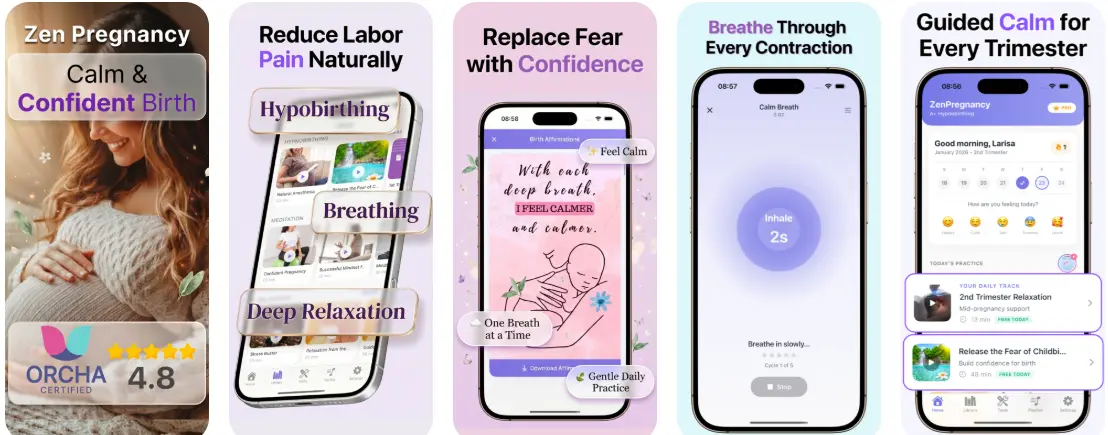
A calm birth prep routine works best when it is easy to open, repeat, and return to during real pregnancy life. HypnoBirth App keeps the core pieces together: guided sessions, breathing practice, affirmations, kick counting, and contraction timing.
If you like practicing from your phone, start with the iOS or the Android . Use it for 10 minutes a day for two weeks before judging whether it is helping. The aim is not to become fearless. The aim is to build a familiar place to return to when pregnancy anxiety rises, contractions begin, or birth takes a path you did not expect.
Frequently Asked Questions
When should I start hypnobirthing in pregnancy?
You can start hypnobirthing at any point in pregnancy, but many people begin between 20 and 32 weeks. This gives you time to practise breathing, relaxation, affirmations, and partner prompts before labour. Short, regular practice is more useful than waiting for the “perfect” week.
Can I start hypnobirthing at 38 weeks pregnant?
Yes, you can start hypnobirthing at 38 weeks pregnant. Focus on simple daily practice: one breathing technique, one short guided audio, and a few calming phrases. Avoid trying to learn everything at once and use the techniques that feel easiest to repeat.
Does hypnobirthing make labour painless?
No, hypnobirthing does not guarantee a painless birth. It is designed to help you reduce fear, release tension, and cope with contractions more calmly. You can still use medical pain relief if you want or need it.
Can I use hypnobirthing with an epidural?
Yes, you can use hypnobirthing with an epidural. Breathing, visualisation, relaxation audios, and affirmations can support calm decision-making before the epidural and rest afterwards. Hypnobirthing is compatible with many birth preferences and does not require an unmedicated labour.
Is hypnobirthing good for pregnancy anxiety?
Hypnobirthing can be helpful for pregnancy anxiety, but it is not a substitute for mental health or medical care. The breathing and guided relaxation may support a calmer nervous system and give you practical tools when anxious thoughts rise. Speak to your midwife, GP, or healthcare provider if anxiety feels intense, persistent, or hard to manage.
Is hypnobirthing useful for first-time mums?
Yes, hypnobirthing can be especially useful for first-time mums. It gives you a simple way to learn about fear, tension, breathing, birth preferences, and coping tools before labour begins. It can also help your birth partner understand how to support you.
Do I need a hypnobirthing class or is an app enough?
You do not always need a hypnobirthing class, because many beginners learn well with an app, book, or short online course. A class may be better if you want live guidance, partner practice, and time to ask questions. An app may be enough if you prefer flexible, low-pressure daily practice at home.
How often should I practise hypnobirthing?
Practising hypnobirthing for about 10 minutes most days is a good beginner target. Regular repetition helps your body associate the breathing, voice, or affirmation with relaxation. Longer sessions can be added if they feel supportive, but consistency matters more than perfection.
Is hypnobirthing safe during pregnancy?
Hypnobirthing breathing and relaxation are generally low risk for many pregnancies. Personal circumstances still matter, especially if you have medical complications, trauma triggers, dizziness, or mental health concerns. This is not medical advice, so ask your midwife, doctor, or healthcare provider what is appropriate for you.
Can hypnobirthing be used for induction or a caesarean birth?
Yes, hypnobirthing can be adapted for induction or caesarean birth. Breathing, affirmations, visualisation, and calming audio can support rest, focus, and decision-making during a more medicalised birth. It does not replace monitoring or clinical care, so discuss your plan with your maternity team.
Try HypnoBirth App Free
Guided hypnobirthing, pregnancy meditation, breathing, affirmations, and a contraction timer in one free app. ORCHA NHS certified, used by 200k+ mothers on iOS and Android.
Best for
- Daily hypnobirthing and pregnancy meditation practice
- Calm birth preparation before labor
Limitations
- Not a replacement for advice from your midwife, doctor, or care team
- Does not guarantee a specific birth outcome