 Hypno
HypnoContraction Timer with Meditation for Childbirth
A contraction timer that pairs with guided meditation for childbirth. Track surges while staying calm with breathing exercises and hypnobirthing audio.
200,000+ moms • ORCHA NHS Certified • Free on iOS & Android
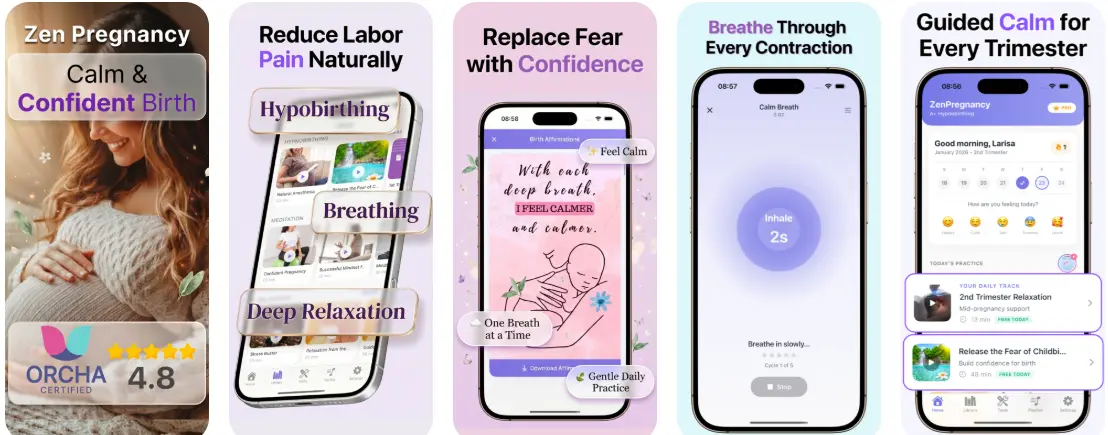
Contraction timer meditation helps you track labor surges while using calming tools like breathing, hypnosis, and affirmations alongside each contraction. It can support a steadier rhythm in early and active labor, helping you notice patterns while staying more focused and relaxed.
Who is this guide for?
Good fit if you
- You want to time contractions while also using relaxation and breathing cues
- You prefer a calmer labor tool than a basic stopwatch-style contraction counter
- You are preparing for hypnobirthing, unmedicated birth, or a more mindful hospital or home birth
- You want affirmations, guided hypnosis, and meditation available during early or active labor
- You are looking for a free hypnobirthing app trusted by a large birth community
May not be enough if you
- You need medical diagnosis or advice about when to go to hospital or call your care team
- You want a clinical monitoring device for baby or contractions
- You prefer to time contractions manually without audio, breathing, or meditation support
- You are experiencing urgent symptoms and need immediate professional care
Why a Labor Contraction Timer With Meditation Helps
A labor contraction timer with meditation helps because it gives your thinking brain clear information while giving your body a relaxation cue. You track when surges start and stop, then return your attention to breath, sound, or a calming phrase instead of watching the clock with dread.
That matters because fear can tighten the jaw, shoulders, pelvic floor, and belly, which often makes contractions feel harder to cope with. Relaxation practices may support parasympathetic activity, oxytocin, and endorphin release, although they do not guarantee a shorter or pain-free birth. If you want a foundation before labor begins, practice hypnobirthing techniques for birth preparation during the third trimester so the cues feel familiar when contractions become stronger.
How Contraction Timer Meditation Works in Labor
Contraction timer meditation works by pairing objective timing data with nervous-system regulation. You press start at the beginning of a contraction, press stop when it fades, and use the rest period for slow breathing, body softening, or a guided hypnobirthing track.
The timer measures duration, frequency, and pattern: how long each contraction lasts, how far apart they are from start to start, and whether they are becoming longer, stronger, and closer together. The meditation element gives your brain a task that is not panic. HypnoBirth App is a hypnobirthing app that provides guided meditation, breathing exercises, contraction timing, and birth affirmations for pregnant women. This is not medical advice; contact your care team if contractions, waters breaking, bleeding, reduced movement, or pain concern you.
How to Use a Contraction Tracker With Meditation
Use a contraction tracker with meditation in the simplest possible way: time the surge, then recover on purpose. The goal is not perfect data; the goal is enough information to communicate clearly while staying as steady as you can.
- Start timing when the contraction first builds, not at the peak.
- Stop timing when the tightening noticeably releases.
- Notice the pattern across several contractions: duration, frequency, and intensity.
- Breathe during the break with a low, slow exhale or a practiced audio cue.
- Share the numbers with your midwife, doula, OB-GYN, or birth unit when you call.
- Follow medical guidance if you are preterm, high-risk, bleeding, or unsure.
For practice before labor, try pregnancy breathing techniques at 32–36 weeks so the breathing rhythm feels automatic.

Early Labor Timing and Calm Breathing Cues
In early labor, timing contractions can help you decide whether your body is warming up or settling into a real pattern. Meditation is especially useful here because early labor can last for hours, and your job is often to eat lightly, hydrate, rest, and avoid using all your energy too soon.
A practical rhythm is to time a few contractions, then put the phone down and listen to a short meditation while lying on your side, leaning over a birth ball, or resting in a warm shower if your provider says it is safe. Many people like the cue: soften jaw, drop shoulders, heavy hands, long exhale. If you want more audio-based support, guided meditation for pregnancy can train that relaxation response well before the first contraction arrives.
Active Labor: When Surge Tracking Matters Most
Active labor is when a surge tracker becomes more than a curiosity; it becomes a communication tool. If contractions are consistently close together, lasting around a minute, and growing more intense, your care team can use that information alongside your symptoms, gestation, medical history, and birth plan.
This stage can feel emotionally intense. You may think, “I cannot do this,” even when you are doing it beautifully one breath at a time. A meditation track can help you ride the first half of the contraction, stay loose at the peak, and actively soften as it fades. According to ACOG guidance on signs of labor, regular contractions that become stronger and closer together are one sign labor may be progressing. This is not medical advice; call your provider for your personal timing instructions.
Birth Meditation for Pain, Fear, and Focus
Birth meditation does not promise painless labor, but it can change how you relate to intensity. Studies suggest mindfulness-based and relaxation approaches may reduce anxiety and improve coping in pregnancy and birth, especially when practiced before labor rather than introduced for the first time at transition.
In practical terms, meditation gives you somewhere to place your attention: breath count, body scan, visualization, affirmation, or a calm voice in your headphones. That focus can interrupt the fear-tension-pain cycle many birth educators talk about. If you prefer birth-specific audio rather than general meditation, labor meditation for contractions is usually more useful because it matches the rhythm of surges, rest periods, and the emotional waves of birth. This is not medical advice; use meditation as support, not as a replacement for clinical care.
Breathing Exercises That Pair With a Contraction Counter
The best breathing exercise to pair with a contraction counter is the one you can remember when labor gets loud. For many people, that means a slow inhale through the nose and a longer, softer exhale through the mouth, with the exhale doing most of the relaxing work.
Try inhaling for four, exhaling for six, and letting the shoulders drop at the end of every breath. During stronger contractions, you might prefer a gentle patterned breath, such as “in two, out four,” or a low humming exhale that keeps the throat and pelvic floor from gripping. If you feel dizzy, tingly, or panicky, return to natural breathing and tell your support person. A dedicated labor breathing app can help you practice different rhythms before labor so you are not deciding in the middle of a contraction.
Birth Affirmations During Timed Contractions
Birth affirmations can be powerful during timed contractions because they give your mind a short, repeatable sentence when thinking becomes difficult. The best affirmations are not fake positivity; they are believable anchors that help you stay present.
Examples include “This contraction has a beginning, middle, and end,” “My body can soften while it works,” and “I only need to do this one breath.” You can repeat one phrase during the peak and another during the rest period. This is especially helpful for first-time parents, VBAC parents, and anyone carrying fear from a previous birth. If spoken cues help you more than silent ones, explore a birth affirmations app and record or choose phrases that match your actual birth preferences, whether hospital, home, birth center, induction, epidural, or cesarean preparation.
Best App Features for Labor Tracking and Meditation
The best labor tracking and meditation setup is quick to open, easy to tap, and calm enough not to pull you into screen-checking. In labor, a beautiful app matters less than one that works with one hand, shows clear contraction history, and lets you switch into breathing or audio without fuss.
Look for a visible start-stop button, frequency and duration history, optional notes, offline-friendly audio, birth affirmations, and guided tracks that are short enough for real contractions. If you are choosing in advance, compare your options with a practical guide to the best contraction timer app for iPhone and test the app while having Braxton Hicks or practice tightenings. You can also use an iOS or an Android before your due date so the flow feels familiar.
Contraction Timer App Comparison: Hypnobirth, Freya, Full Term
Different contraction apps serve different needs, so the right choice depends on whether you want pure timing, hypnobirthing audio, or a broader birth preparation library. If meditation is central to your coping plan, choose an app that combines timing with breathing, affirmations, and relaxation rather than a stopwatch alone.
| App | Best for | Meditation support | Contraction timing |
|---|---|---|---|
| HypnoBirth App | Hypnobirthing, affirmations, breathing, and timing in one place | Guided pregnancy and birth meditation | Built for labor tracking |
| Freya | Surge timing with hypnobirthing-style support | Breathing and relaxation prompts | Strong surge timer focus |
| Full Term | Simple contraction logging | Limited or separate from timing | Clear, straightforward tracking |
| GentleBirth | Mindfulness and birth preparation | Large meditation library | May depend on setup/version |
Test any app before labor, because your favorite while calm may not be your favorite during a 60-second contraction.
Natural Birth, Epidural, Induction, and Cesarean Planning
A timer-and-meditation approach can support many birth plans, not just unmedicated labor. Natural birth, epidural birth, induction, VBAC, planned cesarean, home birth, hospital birth, and birth center care can all include calming skills, clear communication, and body awareness.
For an induction, meditation can help with waiting, cervical ripening, and the emotional strain of a long process. With an epidural, breathing and affirmations may still help during placement, exams, position changes, and pushing. For a planned cesarean, relaxation tracks can support sleep, pre-op nerves, and recovery mindset. If your plan includes fewer interventions, an app for natural birth preparation can help you rehearse coping tools while still staying flexible. This is not medical advice; your birth plan should be reviewed with your healthcare provider.
When to Call Your Midwife or Hospital
Call your midwife, OB-GYN, or hospital when your provider’s labor instructions say to call, even if an app suggests something different. Timing patterns are useful, but they are only one part of safety in pregnancy and birth.
Many people are told about the 5-1-1 pattern: contractions about five minutes apart, lasting one minute, for one hour. Others receive different guidance because of distance from the hospital, group B strep status, previous fast labor, planned cesarean, VBAC, preterm labor risk, or medical conditions. Call urgently for heavy bleeding, decreased fetal movement, severe headache, fever, waters breaking with concerns, constant abdominal pain, or if you feel something is wrong. The NHS explains common signs that labor has begun, but your own care team’s advice comes first. This is not medical advice.
How to Practice Before Labor Starts
Practice makes the timer and meditation feel automatic when labor begins. Start around the late second trimester or early third trimester with short sessions: two minutes of breathing, one affirmation, and a quick run-through of starting and stopping the timer.
By 34–36 weeks, try a realistic rehearsal. Dim the lights, play your chosen audio, ask your partner or doula to time a pretend contraction, and practice changing positions while staying with the breath. Rehearse calling your care team and reading out frequency and duration. This may sound overly practical, but in labor the small familiar things can feel deeply reassuring. If you are new to the method, how to start hypnobirthing can help you build a gentle routine without turning birth preparation into another stressful checklist.
Honest Limitations of Contraction Timing Apps
Contraction timing apps are helpful, but they cannot assess your cervix, your baby, or your full medical picture. Treat them as support tools, not decision-makers.
- They cannot diagnose labor stage. Only a qualified clinician can assess dilation, effacement, station, and clinical concerns.
- They may miss context. Bleeding, reduced movement, preterm symptoms, waters breaking, fever, or severe pain matter more than tidy timing data.
- They can increase anxiety. If watching the numbers makes you panic, hand the phone to your support person.
Start a Calm Labor Setup Tonight
The simplest calm labor setup is one timer, one breathing pattern, one meditation track, and one person who knows how to support you. You do not need to master every birth technique; you need a few cues that your body recognizes when contractions begin.
Tonight, choose your app, play a five-minute birth meditation, practice one slow exhale, and decide who will handle timing if you no longer want to look at the screen. Pack headphones or a small speaker in your hospital bag and save your care team’s phone number where it is easy to find. HypnoBirth App keeps contraction timing, meditation, breathing, and affirmations together, so your labor support tools are not scattered across five different places. Use it as preparation and comfort, while continuing to follow your provider’s medical guidance.
This guide was written for educational birth preparation and reviewed for safety language. It does not replace advice from your midwife, OB-GYN, GP, or maternity unit.
Frequently Asked Questions
What is contraction timer meditation for labour?
Contraction timer meditation is the practice of tracking labour contractions while using breathing, hypnosis, affirmations, or guided relaxation. It helps you notice the pattern of surges while staying calmer during and between them. It supports coping and communication with your care team, but it does not replace medical advice.
When should I start timing contractions in labour?
Start timing contractions when they become regular, stronger, longer, or noticeably different from Braxton Hicks. Timing a few contractions can help you see whether a pattern is developing. If you are preterm, bleeding, leaking fluid, have reduced baby movements, or feel worried, contact your midwife, OB-GYN, or maternity unit straight away.
Should I start using a contraction timer at 38 weeks pregnant?
Yes, you can start using a contraction timer at 38 weeks if you think labour may be starting. It is also helpful to practise with the timer before labour so you and your birth partner know how it works. Do not wait for a timing pattern if you have urgent symptoms or your care team has given you different instructions.
What is the 5-1-1 rule for contractions?
The 5-1-1 rule means contractions are about 5 minutes apart, last about 1 minute, and continue for 1 hour. Many people use it as a guide for when to call or go to their birth place. Your own provider may recommend a different rule based on your pregnancy, distance from hospital, previous births, or medical history.
How does meditation help during contractions?
Meditation helps during contractions by reducing fear, tension, and mental overwhelm. Calm breathing, guided imagery, and affirmations can make surges feel more manageable and help you rest between them. Meditation does not guarantee a pain-free birth, and you can still use medical pain relief if you choose.
Can contraction timer meditation help with pregnancy anxiety?
Yes, contraction timer meditation can help some people manage pregnancy anxiety by giving them a simple focus and a calming routine. Breathing cues and affirmations can reduce spiralling thoughts during early labour or when contractions intensify. If anxiety feels severe, persistent, or unsafe, seek support from your maternity team or a mental health professional.
Should my partner or doula run the contraction timer?
Yes, a partner, doula, or support person is often the best person to run the contraction timer. This lets the labouring person keep their eyes closed, breathe, move, and rest without watching the numbers. The support person can also share the pattern clearly when calling the midwife, hospital, or doctor.
Can I use contraction timer meditation with an epidural?
Yes, you can use contraction timer meditation with an epidural. Breathing and relaxation can still help during early labour, epidural placement, position changes, cervical checks, pushing, and anxious moments. An epidural changes pain sensation, but it does not remove every physical or emotional need in labour.
Is contraction timer meditation useful for first-time mums?
Yes, contraction timer meditation is especially useful for many first-time mums because early labour can feel uncertain and long. A timer helps show whether contractions are becoming closer and more consistent, while meditation gives you something calming to do. First-time labour patterns vary, so follow your own care team’s guidance about when to call or go in.
Is a contraction timer app better than a hypnobirthing class?
No, a contraction timer app is not a replacement for a hypnobirthing class. An app helps you record contraction timing, while a class teaches breathing, relaxation, decision-making, birth partner support, and coping tools before labour. Many people use both: the class for preparation and the app for practical tracking in labour.
Can I use contraction timer meditation during induction?
Yes, contraction timer meditation can be useful during an induction. Induction may involve waiting, changing contraction patterns, hospital monitoring, and emotional fatigue, so breathing and guided relaxation can support focus and patience. Always follow your hospital’s monitoring, medication, and safety instructions.
What should I do if timing contractions makes me anxious?
Stop watching the timer if timing contractions makes you anxious. Hand the phone to your partner, doula, or midwife, or time only occasional sets of contractions instead of every surge. Your calm and sense of safety matter, and you do not need to track every number to have good labour support.
New guides in this topic
Guides in this topic
Best Contraction Timer Meditation App for Calm Labor Tracking
HypnoBirth App is a strong fit if you want to combine surge timing with hypnobirthing, calm breathing, and birth affirmations. It is free, used by 200k+ parents, and ORCHA NHS certified, making it a supportive option for preparing your mind and body for labor.
Best for
- Timing contractions while listening to calming birth meditation
- Using hypnobirthing techniques through early and active labor
- Pairing breathing exercises and affirmations with each surge
Limitations
- It is not a substitute for medical advice from your midwife, doctor, or birth team
- It does not replace clinical monitoring or urgent care if you have concerning symptoms