 Hypno
HypnoSurge Breathing For Labor: A Hypnobirthing Step-By-Step Guide
200,000+ moms • ORCHA NHS Certified • Free on iOS & Android
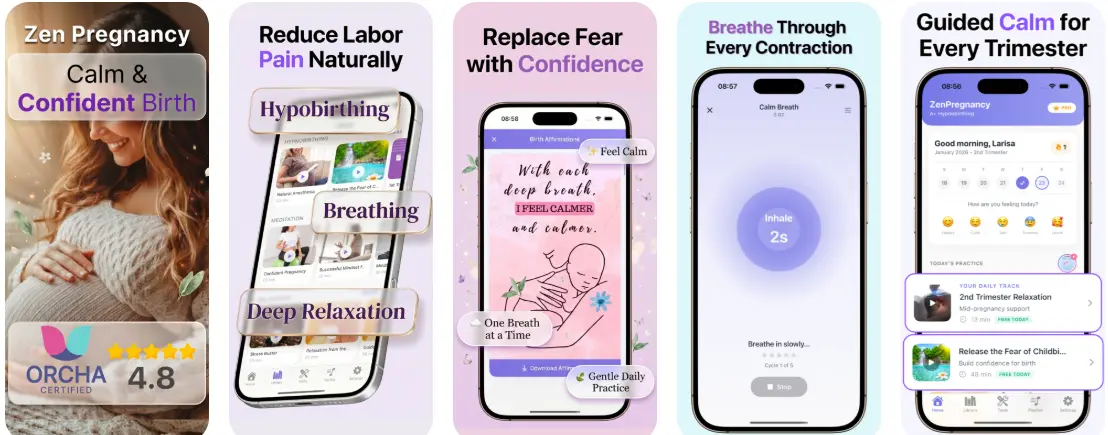
Surge breathing is a slow, deep abdominal breathing technique used in hypnobirthing to help you stay calm and reduce tension during labor contractions, often called surges. You inhale slowly through your nose and exhale at the same pace, matching each breath cycle to the length of a contraction so your body can work more efficiently.
Definition: Surge breathing is a hypnobirthing breathing technique in which you take long, slow abdominal breaths, in through the nose and out through the nose or mouth—timed to the duration of a contraction to promote relaxation and reduce fear-tension during labor.
TL;DR
- Surge breathing replaces shallow panting with slow, deep belly breaths timed to each contraction.
- Daily practice in the third trimester builds the muscle memory needed for labor.
- It works best alongside visualization, affirmations, and partner coaching, but never replaces medical guidance.
What Surge Breathing Means In Hypnobirthing
Surge breathing means taking long, slow abdominal breaths during a contraction, usually in through the nose and out through the nose or mouth. Hypnobirthing often uses the word “surge” instead of “contraction” because the word can feel less braced and more wave-like.
That wording matters for some people. If your body hears “contraction” and immediately tightens, your shoulders, jaw, and pelvic floor may follow. “Surge” gives you a different job: rise, breathe, soften, release.
This is not Lamaze-style panting. It is not quick chest breathing. The breath starts low, with the belly expanding gently on the inhale and settling on the exhale.
The goal is not to erase sensation. The goal is to interrupt the fear-tension cycle so the body has fewer layers of panic sitting on top of labor intensity.
5 Must-Know Facts About Breathing During Surges
- Surge breathing is long, slow, and abdominal. Each inhale-exhale cycle is timed to the contraction rather than rushed through the chest.
- The purpose is tension reduction, not a pain-free guarantee. For many people, breathing during surges makes labor feel more manageable, but it does not control every variable.
- Daily repetition matters. A 3-minute practice after brushing teeth is more useful than a 45-minute session you only do once.
- Visualization and affirmations can deepen the cue. Some people picture a balloon rising. Others use an anchor phrase like, “I soften and open.”
- Safe practice never uses breath-holding or hyperventilation. If you feel tingly, dizzy, or panicky, stop the pattern and return to normal breathing.
Tiny practices count.
For broader context, surge breathing sits inside the larger family of hypnobirthing breathing techniques, alongside calm breathing, down breathing, and relaxation cues.
How Surge Breathing Works During Labor Contractions

Surge breathing works by pairing slow breathing with relaxation cues, which can shift the body toward the parasympathetic nervous system. In plain terms, it tells the body, “we are working hard, but we are not in danger.”
Slow breathing may help lower stress hormones such as cortisol and adrenaline. It also keeps oxygen moving steadily to the uterine muscles and baby. Clinicians typically recommend continuous, comfortable breathing in labor rather than breath-holding, especially during intense sensations.
Hypnobirthing describes this as breaking the fear-tension-pain cycle. Fear tightens the body. Tension can make pain feel sharper. A release breath gives you one clear action when the surge begins.
A 2021 systematic review found that relaxation, breathing, and mindfulness-based methods were linked with reduced labor pain intensity and higher satisfaction, although study quality varied (https://www.ncbi.nlm.nih.gov/pmc/). A randomized trial of 80 first-time mothers found structured breathing-relaxation reduced pain scores and shortened active labor compared with routine care; cite the exact trial URL inline before publication.

What You Need Before Practicing Surge Breathing
Before practicing surge breathing, set up a quiet space, choose a supported position, and make sure you know basic belly breathing. You can sit upright, lean over pillows, or lie on your left side with one earbud in.
A simple setup is enough: dim light, water nearby, and a guided track if counting makes your brain noisy. If you use a visualization script, keep it short. One image is better than five.
Brief your partner or birth companion before labor. Their job is not to correct you like a coach at a gym. Their job is to breathe with you, repeat your anchor phrase, and remind you to soften your shoulders.
Many people start around 32 weeks. That gives the body time to learn the cue before contractions become real.
Step 1: Settle Into a Relaxed Position and Release Tension
Start surge breathing by releasing the tension you are already carrying before the contraction builds. Drop your shoulders away from your ears. Unclench your jaw. Let your tongue come down from the roof of your mouth.
Soften your hands.
Close your eyes if that helps, or lower your gaze to one steady point. Then scan from your forehead to your pelvis. Notice the places that are gripping before you ask your breath to do anything.
This first step matters because breathing into a braced body is hard work. If your neck, fingers, and face are tight, the breath often stays high in the chest. A relaxed starting point makes the next inhale easier to follow.
Step 2: Inhale Slowly Through the Nose for a Full Belly Breath
For the inhale, breathe slowly through your nose and direct the breath low into your belly rather than lifting your chest. Aim for a count of 4 to 7 seconds, but adjust it to your body.
Do not strain for a number. A steady 4-count breath is better than a dramatic 7-count breath that makes you tense.
As you inhale, picture the uterus expanding like a balloon rising on a wave. Some people like to place one hand above the bump and one hand below it during practice. You should feel the lower hand move first.
If the image does not work for you, drop it. Use a phrase instead: “Inhale, soften.” The breath should feel full, not forced.
Step 3: Exhale at the Same Pace and Ride the Surge Down
For the exhale, breathe out through your nose or softly through your mouth, matching the inhale or making the exhale slightly longer. Think of the wave cresting, then falling.
A common rhythm is inhale for 4, exhale for 4 to 6. During a contraction, you repeat that cycle until the surge passes. Many contractions last roughly 60 to 90 seconds, so you may take several slow breaths across one wave.
The exhale is where many people finally let go. Shoulders drop. Fingers uncurl. The forehead smooths out.
For late pregnancy practice, guided breathing tools can help you learn the timing before labor. A simple tool to practice labor breathing is useful if you lose count when tired.
Step 4: Rest and Reset Between Surges
Between surges, stop the labor breathing pattern and return to normal relaxed breathing. The rest interval is not wasted time. It is recovery.
Sip water if your mouth feels dry. Change position if your hips are asking for it. Let your partner place a hand on your shoulder or repeat one short birth affirmation.
A good reset sounds ordinary: “That one is done.” Then breathe normally.
Use the pause to prepare for the next surge without rehearsing fear. During birth classes, I often see people work too hard between contractions. Save your focus for the wave itself. Rest is part of the technique, not a break from it.
How To Use Guided Surge Breathing Cues
To use guided surge breathing cues, practice short sessions before labor and use timed prompts during contractions. A breathing app or audio track should deliver repeatable inhale cues, exhale cues, affirmations, and timing support, not a promise that birth will follow a script.
- Open the guided breathing exercises module.
- Select the surge breathing audio with timed inhale and exhale cues.
- Practice 3 to 4 breaths, twice a day, during the third trimester.
- Use the contraction timer during labor when surges become regular.
- Ask your partner to follow the on-screen prompts and coach your rhythm.
Tools like HypnoBirth App can also adapt the practice if your birth includes monitoring, induction, or an epidural. You may not be walking the room, but you can still soften your jaw and follow a release breath.
If you want phone-based timing without a full class, this app that guides breathing through contractions approach can make partner support more concrete.
Common Mistakes With Hypnobirthing Surge Breathing
The most common mistake with hypnobirthing surge breathing is treating it like a guarantee instead of a practiced coping skill. It can support labor, but it cannot promise a pain-free birth.
Another mistake is turning it into slow panting. Surge breathing is deep and abdominal. The belly moves. The shoulders stay low. The chest should not be doing all the work.
Choosing an epidural after practicing is not failure. It means you used the tools available to you. Birth is not a purity test, especially at 3 a.m. when you are tired and the room feels too bright.
Breath-holding is another common problem. Keep the breath moving unless your clinician gives specific instructions. Skipping daily practice also matters. According to a 2015 study of 200 women, those trained in breathing and relaxation reported lower anxiety and pain than untrained controls.
Guided tools are most useful when they help you rehearse before labor, not when they become one more thing to learn at intake.
Verifying Your Surge Breathing Technique Is Effective
You can tell surge breathing is working technically when your belly rises on the inhale, softens on the exhale, and your shoulders stay low. Your jaw should stay loose throughout the breath cycle.
Ask your partner to watch for visible relaxation cues. They may notice your hands unclenching before you do. During practice, one common turning point is when someone says, “I know what to do with my breath now,” after a week of short sessions.
Your heart rate should feel steady. You should not feel dizzy, tingly, or air-hungry. If you do, pause and breathe normally.
Reset the plan.
If you want to practice with phone prompts, the guide on how to breathe through contractions with phone explains how to keep the screen useful without making it distracting.
When To Call Your Midwife, OB-GYN, or Birth Team
Call your midwife, OB-GYN, or birth team whenever symptoms feel urgent, unusual, or outside the plan they gave you. Surge breathing can support calm, but it never outranks clinical warning signs or labor triage instructions.
- Call right away for bleeding, reduced or changed baby movement, fever, severe headache, vision changes, chest pain, sudden swelling, or fluid leaking if your team told you to report it.
- Contact your birth team when contractions follow the timing pattern they gave you, become hard to talk through, grow steadily stronger, or feel concerning before 37 weeks.
- Stop the breathing pattern if you feel dizzy, tingly, faint, panicky, or air-hungry. Return to normal breathing, sit or lie safely, and tell your support person.
- Follow your clinician’s labor triage instructions over any app, class script, or general rule about when to stay home.
- Ask for help early if your intuition says something is off. You are not bothering anyone by checking in.
The goal is not to be heroic at home. It is to use breathing as support while your clinical team helps decide what needs attention.
Limitations
Surge breathing is a supportive labor technique, but it is not medical treatment and it cannot control every birth outcome. Use it as one tool inside your birth plan, not as a replacement for clinical care.
- Evidence is indirect. Most studies group surge breathing under relaxation, hypnosis, or general breathing methods.
- It may not significantly reduce pain during very long, induced, or complicated labors.
- It cannot replace assessment for bleeding, reduced fetal movement, high blood pressure symptoms, or other concerns.
- Some people find counting, wave images, or birth affirmations irritating or anxiety-provoking.
- Without consistent prenatal practice, it can be hard to remember during intense contractions.
- It may need adapting with continuous monitoring, epidural placement, or limited movement.
- A 2013 Cochrane review on hypnosis for childbirth found mixed evidence and called for higher-quality trials.
For many first-time parents, short daily surge breathing practice is often easier than long rehearsals because it fits into existing routines.
Read more
- App That Guides Breathing Through Contractions
- App That Times Contractions And Guides Breathing
- Apple Watch Contraction Timer App Guide
- Best Contraction Timer With Breathing
- Can Contraction Timer Tell Labor
- Contraction Timer App Guide
- Contraction Timer Safety
- How To Breathe Through Contractions With Phone
- How To Time Contractions On Android
- How To Time Contractions On iPhone
- Pregnancy App With Kick Counter & Timer
- What App Identifies Labor Surges
Best Surge Breathing App for Practicing Calm Contraction Rhythms
HypnoBirth App helps you practice surge breathing with guided hypnobirthing tracks, relaxation cues, and simple tools you can return to throughout pregnancy. It is free to start, used by 200k+ parents, and ORCHA NHS certified.
Best for
- Practicing steady breathing before labor begins
- Pairing surge breathing with relaxation and hypnobirthing audio
Limitations
- Does not replace advice from your midwife, doctor, or birth team
- Breathing techniques may need adapting to your personal comfort and birth setting
Frequently Asked Questions
What is surge breathing in hypnobirthing?
Surge breathing is a calm, rhythmic breathing technique used during labour contractions. In hypnobirthing, contractions are often called surges to encourage a less fearful mindset. The technique combines slow breathing, relaxed muscles, and focused attention to help you work with each contraction.
How do you do surge breathing during labour contractions?
You do surge breathing by breathing in slowly as a contraction builds and breathing out gently as it eases. Keep your shoulders, jaw, and hands relaxed, and bring your attention back to the breath each time your mind wanders. Many people count the inhale and exhale or use a calming phrase to maintain rhythm.
When should I use surge breathing in labour?
Use surge breathing during contractions whenever you want a steady rhythm and a relaxation cue. It is most commonly used in early and active labour while the uterus is tightening and relaxing. Follow your midwife or doctor’s guidance if your breathing needs to change for medical reasons.
Can I start learning surge breathing at 38 weeks pregnant?
Yes, you can start learning surge breathing at 38 weeks pregnant. Even a short daily practice can help you recognise the rhythm, release tension, and feel more prepared before labour begins. If you have any pregnancy complications or concerns, check with your midwife or healthcare professional.
Does surge breathing help with pregnancy anxiety before birth?
Yes, surge breathing can help some people manage pregnancy anxiety by giving the mind a simple focus. Slow breathing and relaxation cues may reduce tension and support a calmer response to birth preparation. It should not replace professional support if anxiety feels intense, persistent, or overwhelming.
Can first-time mums use surge breathing for labour?
Yes, first-time mums can use surge breathing during labour. The technique is simple to learn and does not require previous birth experience. Practising before labour can make it easier to remember when contractions feel strong.
Can I use surge breathing if I have an epidural?
Yes, you can use surge breathing if you have an epidural. Breathing techniques can still support calm, focus, and relaxation, even if pain sensation is reduced. Your midwife or doctor will guide positioning, monitoring, and any changes needed for your labour.
Is surge breathing safe during pregnancy and labour?
Surge breathing is generally safe when practised as slow, comfortable breathing without forcing the breath. Avoid holding your breath, over-breathing, or making yourself dizzy. Seek guidance from your midwife, doctor, or antenatal teacher if you feel unwell or have a high-risk pregnancy.
What is the difference between surge breathing and breathing baby down?
Surge breathing is usually used during contractions before the pushing or birthing stage. Breathing baby down is a hypnobirthing technique often used later, when the body begins to move the baby down. Your birth team can advise which breathing pattern is appropriate for each stage of labour.
How often should I practise surge breathing before labour?
Practise surge breathing daily if possible, even for a few minutes at a time. Short, regular practice helps the technique feel familiar and automatic during labour. You can practise alongside relaxation tracks, birth affirmations, or gentle antenatal preparation.
Is a hypnobirthing app enough to learn surge breathing, or do I need a class?
A hypnobirthing app can be enough to learn the basics of surge breathing if you practise consistently. A class may offer more personalised feedback, birth partner involvement, and time to ask questions. Many people use both an app and a class, depending on budget, schedule, and confidence level.
Will surge breathing make labour pain-free?
No, surge breathing does not guarantee a pain-free labour. It is a coping tool designed to support relaxation, focus, and a calmer response to contractions. Pain relief choices, medical care, and individual birth experiences vary, so discuss your options with your midwife or doctor.