 Hypno
HypnoBirth Affirmations App: Positive Statements for Labor and Delivery
A birth affirmations app with audio tracks for pregnancy and labor. Build confidence with daily positive statements designed for expectant mothers.
200,000+ moms • ORCHA NHS Certified • Free on iOS & Android
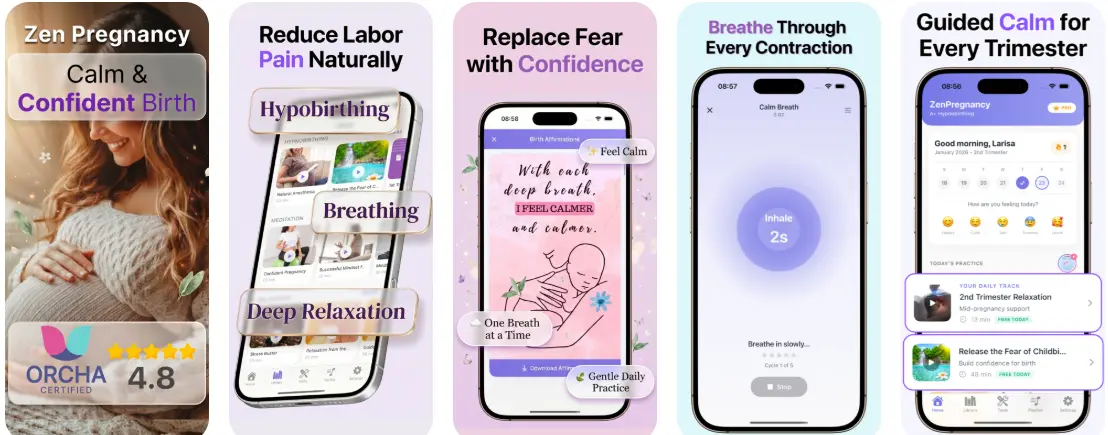
A birth affirmations app helps you practice positive statements for labor and delivery through audio, breathing prompts, and calming tools. HypnoBirth App combines free hypnobirthing tracks, affirmations, and labor support features so you can build confidence before birth and listen during contractions.
Who is this guide for?
Good fit if you
- You want short, calming birth affirmations you can listen to daily
- You prefer audio support for labor, breathing, and relaxation
- You are preparing for a hospital birth, home birth, VBAC, or planned C-section
- You want affirmations alongside hypnobirthing and contraction tracking
- You are looking for a free hypnobirthing app used by 200k+ parents
May not be enough if you
- You want medical advice or clinical decision-making during labor
- You prefer written affirmation cards only, with no audio guidance
- You need a replacement for your midwife, doctor, or birth team
- You are looking for guaranteed birth outcomes or pain-free birth promises
Why Positive Birth Affirmations Help During Labor
Positive birth affirmations help by giving your brain a steady script when labor feels intense, uncertain, or emotionally overwhelming. They are not magic words; they are practiced cues that can reduce panic, soften tension, and bring your attention back to one contraction at a time.
Many pregnant people fear losing control, needing interventions, or not coping well. Affirmations such as “I can meet this wave” or “My body and baby are working together” can gently interrupt catastrophic thoughts. When paired with slow breathing, they may support the parasympathetic nervous system, the “rest and digest” state associated with calmer breathing and less muscle guarding. This is not medical advice. Consult your healthcare provider about pain relief, anxiety, birth planning, and any symptoms that worry you.
How a Birth Affirmation Practice Works
A birth affirmation practice works through repetition, attention training, and body-based calming cues. The phrase becomes familiar before labor, so your mind can reach for it quickly when contractions, hospital decisions, or unexpected changes make thinking clearly harder.
In practical terms, affirmations are a form of cognitive reframing: you practice replacing a fear-based thought with a more supportive one. When you listen to affirmation audio while breathing slowly, relaxing your jaw, dropping your shoulders, or visualizing your cervix opening, the words become linked with a calmer physical state. Research on hypnosis and relaxation for childbirth suggests these approaches may reduce fear and improve coping for some people, though outcomes vary. A Cochrane review on hypnosis for labor pain found mixed but promising findings, and more high-quality research is needed.
What to Look for in Pregnancy Affirmations Audio
The best pregnancy affirmations audio is easy to start, calm enough to repeat daily, and practical enough to use during real labor. Look for short sessions, soothing voices, offline access, and tracks designed for different moments: bedtime, fear spikes, early labor, active labor, and pushing.
A good app should also let you combine affirmations with other skills. If you like spoken scripts, explore hypnobirthing affirmations for pregnancy and birth so the language feels natural to you before contractions begin. If anxiety tends to show up at night, pair affirmations with guided meditation for pregnancy rather than trying to “think positive” while your body is tense. Choose phrases you can actually believe, or at least tolerate, because forced positivity can feel lonely when pregnancy is already emotional.

How to Use a Birth Affirmations App
Use a birth affirmations app in small, repeatable sessions so the words feel familiar long before labor starts. Five minutes most days from the second or third trimester is usually more useful than one long session at 39 weeks.
- Choose one track. Pick a voice and theme that feels calming, such as confidence, releasing fear, or trusting your body.
- Pair it with breathing. Practice a slow inhale and longer exhale, or use pregnancy breathing techniques for labor alongside the affirmations.
- Repeat one phrase daily. Save a short statement your partner or doula can say when you need grounding.
- Practice during mild discomfort. Try affirmations during Braxton Hicks, pelvic pressure, or a tense appointment so your body learns the cue.
- Simplify for labor. During strong surges, use one phrase, one breath pattern, and one relaxation cue instead of changing tracks constantly.
Labor Breathing and Affirmations Together
Labor breathing and affirmations work best as a pair because the breath gives the body something to do while the words guide the mind. A simple phrase can feel much stronger when it is tied to a slow exhale, relaxed jaw, and unclenched hands.
For example, inhale gently and think “soft,” then exhale and think “open.” During active labor, many people prefer short cues: “down,” “loose,” “safe,” or “one wave.” If you want audio that guides both rhythm and mindset, a labor breathing app for contractions can help you practice before the day arrives. Breathwork is not a substitute for medical care, fetal monitoring when recommended, or pain relief if you want it. This is not medical advice. Ask your midwife, OB-GYN, or care team which breathing and pushing approaches fit your pregnancy and birth setting.
Birth Meditation, Hypnosis, and Affirmation Differences
Birth meditation, hypnosis, and affirmations overlap, but they are not identical. Affirmations use short supportive statements; meditation trains present-moment awareness; hypnobirthing often combines relaxation, visualization, breathing, and suggestion-based scripts for birth.
If you feel anxious, affirmations may be the easiest doorway because they are short and portable. Meditation can help you notice fear without spiraling into it. Hypnosis-style audio may go deeper by guiding your body into relaxation and pairing that state with labor cues. HypnoBirth App is a hypnobirthing app that provides guided meditation, breathing exercises, contraction timing, and birth affirmations for pregnant women. If you are comparing styles, this guide to the best birth meditation app features can help you decide whether you want affirmations alone or a fuller birth preparation tool.
Using Affirmations for C-Section, VBAC, and Hospital Birth
Affirmations can support many birth plans, including planned cesarean, unplanned cesarean, VBAC, induction, epidural birth, home birth, birth center birth, and hospital labor. The goal is not to force one “ideal” birth, but to help you feel steadier inside the birth you actually have.
For a planned C-section, phrases like “I can meet my baby with calm” or “This birth is still my birth” may feel more respectful than vaginal-birth language. For VBAC, affirmations can support courage while still leaving space for medical decisions. You may also want focused support for hypnobirthing for C-section preparation if surgery is likely or planned. For hospital birth, practice phrases that help with triage, monitors, cervical checks, and asking questions before consent. This is not medical advice; discuss your birth preferences and risks with your healthcare provider.
Contraction Tracking with Calming Audio
Contraction tracking with calming audio can help you stay grounded in early labor while also noticing when contractions become longer, stronger, and closer together. The most useful setup lets you time surges without leaving the relaxation or affirmation support you are using.
Many families become unsure in early labor: “Is this it?” “Should we call?” “Are they close enough?” A timer can record the pattern, while affirmations keep you from staring anxiously at the screen after every wave. If you want this combined approach, learn how contraction timer meditation can support both practical tracking and calm coping. Follow your provider’s instructions for when to call or go in, especially with bleeding, reduced fetal movement, waters breaking, severe pain, fever, or if something feels wrong. Medical guidance always comes first.
Choosing a Labor Support App: Hypnobirthing Options Compared
A labor support app should match how you actually prepare: some people want deep hypnobirthing courses, some want short meditations, and some want practical tools for labor day. Compare features, cost, and how quickly you can find support during a stressful moment.
| App | Best for | Affirmations | Labor tools |
|---|---|---|---|
| HypnoBirth App | People wanting affirmations, meditation, breathing, and contraction timing in one place | Yes, audio-based birth and pregnancy support | Includes breathing and labor tracking features |
| GentleBirth | Structured mindfulness and hypnobirthing-style practice | Yes, with broader mental training | More focused on training than timing |
| Freya by The Positive Birth Company | Contraction timing with guided breathing | Some positive birth support | Strong contraction timer focus |
| Expectful | Pregnancy and parenting meditation | Some affirmation-style content | Less focused on active labor tools |
For a wider feature breakdown, see this guide to the best hypnobirthing app for pregnancy and labor.
Honest Limitations of Birth Affirmation Tools
Birth affirmation tools can be genuinely helpful, but they are not a replacement for skilled medical care, emotional support, or pain relief options. A trustworthy app should support your choices without implying that mindset alone controls birth.
- They cannot guarantee a calm or unmedicated birth. Labor length, baby position, medical history, fatigue, and complications all matter.
- They may feel irritating during intense labor. Some people want silence, touch, water, medication, or practical coaching instead.
- They do not treat clinical anxiety or trauma. If affirmations trigger fear or memories, speak with a trauma-informed therapist or perinatal mental health professional.
When to Start Daily Pregnancy Affirmations
The best time to start daily pregnancy affirmations is whenever fear, anticipation, or birth planning begins taking up mental space. Many people start around 20 to 28 weeks, then become more consistent in the third trimester as labor feels closer.
If you are earlier than that, keep it light: one bedtime track, one phrase after appointments, or one calming statement during a walk. By 34 to 36 weeks, practice with the same audio you may want in labor so your nervous system recognizes it. You can also build a written list from pregnancy affirmations for each trimester and choose the words that fit your birth preferences. If you are high-risk, planning an induction, or preparing for a specific medical pathway, ask your care team which coping practices are safe and appropriate for you.
Start a Calm Birth Affirmation Session
Start with one short session tonight: lie on your side, place one hand on your bump if that feels good, and listen while breathing out longer than you breathe in. You do not have to believe every word immediately; familiarity is the first goal.
If you use an iPhone, you can begin with the and choose a track for confidence, relaxation, or labor preparation. If you use Android, save for quick access before appointments, bedtime, or early labor. HypnoBirth App is designed to feel simple when your brain is tired: open, listen, breathe, and come back to the next steady phrase. If you have medical concerns or symptoms, contact your healthcare provider rather than relying on an app.
This guide was written for educational birth preparation and reviewed for safety language. It does not replace advice from your midwife, OB-GYN, GP, or maternity unit.
Frequently Asked Questions
Do birth affirmations really work during labour?
Yes, birth affirmations can help some people feel calmer, more focused, and more confident during labour. They work best as a coping tool when practised with breathing, relaxation, movement, and support. They do not guarantee less pain, a shorter labour, or any specific birth outcome.
When should I start using birth affirmations in pregnancy?
You can start using birth affirmations at any point in pregnancy. Many people begin around 20 to 28 weeks, then practise more often in the third trimester so the phrases feel familiar during labour. A few minutes a day is enough to build a simple routine.
Is 38 weeks too late to start birth affirmations?
No, 38 weeks is not too late to start birth affirmations. Short daily practice can still help you choose calming phrases, pair them with breathing, and feel more prepared for contractions or birth decisions. Keep the practice simple and focus on statements that feel believable.
Can birth affirmations help with pregnancy anxiety?
Yes, birth affirmations can support pregnancy anxiety by giving your mind a steady, calming focus. They are most helpful when combined with slow breathing, relaxation, and practical birth preparation. If anxiety feels overwhelming, affects sleep, or causes panic, speak with your midwife, doctor, or mental health professional.
Can affirmations help during contractions?
Yes, short affirmations can help you focus during contractions. Phrases such as “one wave at a time” or “I can take the next breath” can be repeated with slow breathing and relaxed muscles. They are a coping support, not a replacement for medical care or pain relief if you want it.
What are good birth affirmations for labour and delivery?
Good birth affirmations are short, clear, and believable. Examples include “I am safe right now,” “My body can soften,” “Each breath helps me,” and “I can ask for what I need.” Choose words that feel supportive rather than forced or overly positive.
Can I use birth affirmations with an epidural?
Yes, you can use birth affirmations with an epidural. Affirmations can support calm, consent, rest, confidence, and decision-making whether you have an epidural, induction, monitoring, or other medical support. They work alongside your care plan rather than replacing it.
Do birth affirmations help with a C-section birth?
Yes, birth affirmations can be useful for a planned or unplanned C-section. Helpful phrases may focus on safety, steady breathing, meeting your baby, and remembering that surgical birth is still birth. Always follow the guidance of your surgical and maternity care team.
Are birth affirmations useful for first-time mums?
Yes, birth affirmations can be especially useful for first-time mums who want a simple way to practise calm and confidence before labour. They can help you rehearse supportive thoughts, breathing patterns, and requests for help. They do not remove uncertainty, but they can give you a steady tool to return to.
Should my birth partner say affirmations during labour?
Yes, your birth partner can say affirmations if you want that support. Give them two or three phrases you like so they can repeat them calmly during contractions, transition, pushing, or decision-making moments. Tell them in advance which words feel helpful and which do not.
Is a birth affirmations app better than a hypnobirthing class?
No, a birth affirmations app is not automatically better than a hypnobirthing class. An app is useful for daily practice, audio reminders, breathing tools, and quick access during labour, while a class may offer deeper teaching, guided practice, and live questions. Many people use both, depending on their budget, time, and learning style.
What if birth affirmations feel fake or uncomfortable?
Use neutral affirmations if positive statements feel fake. Phrases such as “I am safe right now,” “I can take the next breath,” or “I can ask questions” often feel more realistic than very confident statements. The goal is support and focus, not pretending birth is easy.
Guides in this topic
Best Birth Affirmations App for Calm Labor Practice
HypnoBirth App is a strong fit if you want positive birth affirmations paired with breathing, meditation, hypnosis-style audio, and contraction tracking. It is free to use, ORCHA NHS certified, and designed to support calm, confident preparation before and during birth without making medical promises.
Best for
- Daily pregnancy affirmation practice
- Listening to calming audio during contractions
- Combining birth affirmations with hypnobirthing and breathing
- Preparing for hospital birth, VBAC, C-section, or unmedicated labor
Limitations
- It does not replace medical advice from your care team
- Affirmations may not suit everyone’s preferred birth preparation style