 Hypno
HypnoHypnobirthing Affirmations for Labor and Birth: Realistic Examples and How to Use Them
200,000+ moms • ORCHA NHS Certified • Free on iOS & Android
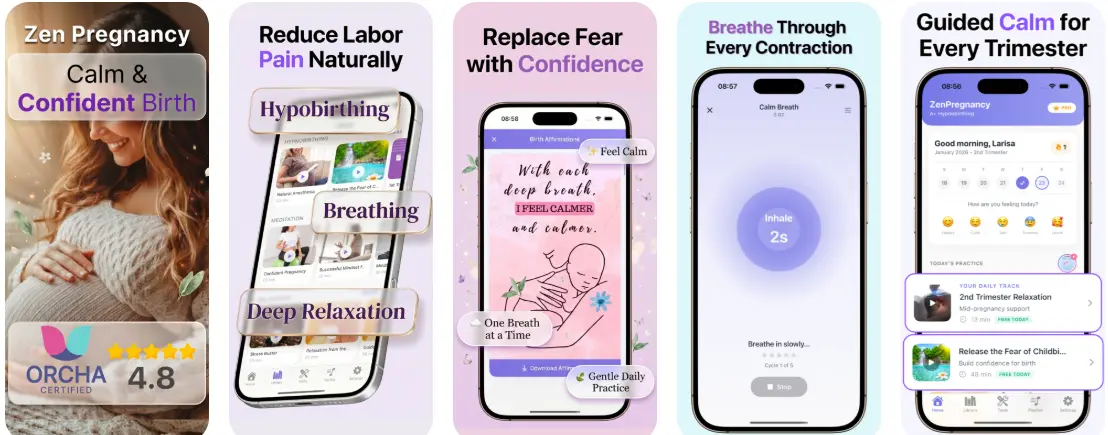
Hypnobirthing affirmations for labor are short, present-tense positive birth statements you repeat during pregnancy and birth to reduce fear, lower tension, and support coping through contractions. They work best when practiced before your due date, personalized to feel true, and paired with breathing techniques, guided audio, or a hypnobirthing app. Affirmations are evidence-informed mindset tools, not guarantees of a pain-free birth.
> Definition: Hypnobirthing affirmations are short, positive, present-tense statements repeated during pregnancy and labor to reduce fear and tension so the body can birth more efficiently.
TL;DR
- Hypnobirthing affirmations are evidence-informed mindset tools, not guarantees of painless or intervention-free birth.
- Consistent daily practice during pregnancy is what makes affirmations feel automatic and calming on birth day.
- Pair affirmations with breathing, position changes, partner scripts, and app-based audio for maximum effect.
- Adapt your statements in real time if your birth plan changes, affirmations work for inductions, epidurals, and cesareans too.
- A Cochrane review of 8,221 women linked relaxation and mind-body techniques to reduced labor pain and less pain medication use.
What Hypnobirthing Affirmations for Labor Actually Are
Hypnobirthing affirmations are short, positive, present-tense statements repeated during pregnancy and labor to reduce fear and tension so the body can birth more efficiently.
In plain language, they are sentences you rehearse until your brain recognizes them under pressure. Most begin with “I am,” “My body,” or “Each surge,” because first-person, present-tense language feels immediate. “I am softening my jaw” lands differently from “I hope I stay calm.”
They are not promises. They don't guarantee an unmedicated birth, a short labor, or a specific outcome. Think of them as relaxation cues that sit beside labor breathing, guided tracks, movement, and medical support.
I often ask parents to test one line during a 12-minute relaxation track with one earbud in, lying on the left side. If the phrase helps the tongue unclench from the roof of the mouth, it is probably useful.
5 Evidence-Based Facts About Positive Birth Statements
- Affirmations are evidence-informed, not magic. Positive birth statements sit within a wider group of mind-body techniques, including breathing, relaxation, hypnosis, and cognitive reframing.
- Daily repetition matters. A phrase practiced in pregnancy feels more familiar during contractions than a phrase first read at 39 weeks with the hospital bag open on the floor.
- The strongest statements feel personal. Present tense, specific wording, and a matching body cue work better than a long list copied from someone else’s birth plan.
- Delivery can be flexible. You can say labor affirmations silently, hear them in app audio, place them on cards, or ask your partner to read them from a highlighted preference sheet.
- Safe birth still needs care. Clinicians typically recommend using comfort tools alongside prenatal care, monitoring, and timely medical support when needed.
The most useful labor affirmation practice combines repeated phrases with breathing, relaxation cues, and a birth team that knows how to support the plan.
How Hypnobirthing Affirmations Work During Labor
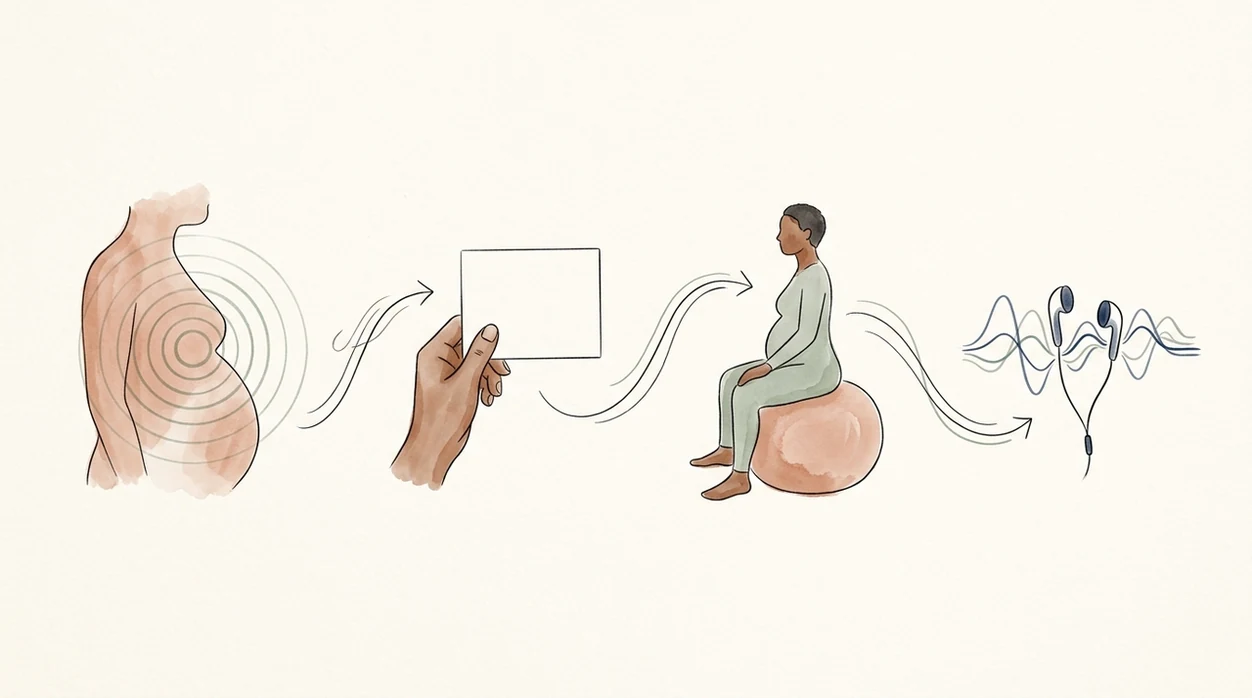
Hypnobirthing affirmations work by interrupting the fear-tension-pain cycle. When fear rises, the body often tightens; when the body tightens, contractions can feel harder to manage.
A practiced affirmation gives your brain a replacement track. That is cognitive reframing, which means changing the thought pattern from “I can’t do this” to “I can meet this one surge.” The body cue matters too. Soften your shoulders. Let the exhale lengthen. Repeat.
Daily repetition also creates neurological habituation. In normal words, the phrase stops feeling new. It becomes a familiar cue your nervous system has heard many times before.
According to a Cochrane review of 19 randomized trials with 8,221 women, relaxation, breathing, and related mind-body techniques were associated with lower labor pain intensity and less pain medication use (Cochrane: https://www.cochranelibrary.com/cdsr/doi/10.1002/14651858.CD009514.pub2/full). A 2017 systematic review also found that childbirth education using relaxation, breathing, and cognitive techniques reduced childbirth fear and improved birth-related self-efficacy (BMC Pregnancy and Childbirth: https://bmcpregnancychildbirth.biomedcentral.com/articles/10.1186/s12884-017-1448-2).

Requirements Before You Start Practicing Labor Affirmations
Start in the second or early third trimester if you can. That gives you enough daily repetition for the words to feel familiar before labor begins.
Choose 5 to 10 affirmations that sound like you. If “My body is opening beautifully” makes you roll your eyes, change it. Try “I can breathe through this wave” or “My body and my baby are working together.”
You also need a delivery method. Cards, a phone note, a partner script, or a playlist can all work. A guided hypnobirthing audio tool can support affirmation audio and contraction timing, especially if you want breathing cues in the same place.
Brief your partner or doula before labor. Ask them to read slowly, pause between lines, and stop if the words become irritating. That last part matters. During transition, even a loving voice can feel like too much.
How to Use Hypnobirthing Affirmations in Labor: Step-by-Step
Use hypnobirthing affirmations by choosing a small set, pairing them with breath practice, preparing birth-day tools, and adapting the words as labor changes.
Step 1: Select Present-Tense Affirmations That Resonate
- Choose 5 to 10 present-tense statements that feel believable, such as “I soften with each exhale” or “I can meet this contraction.”
Step 2: Practice Daily With Breathing Exercises
- Practice after an existing habit, such as brushing your teeth, and pair each line with a slow release breath or guided track.
Step 3: Set Up Delivery Tools for Birth Day
- Prepare your tools with lock-screen cards, a partner cue sheet, and a downloaded affirmation playlist before contractions begin.
Step 4: Repeat Affirmations in Early Labor
- Begin in early labor by repeating one phrase through each contraction while keeping your jaw loose and your exhale longer than your inhale.
Step 5: Adapt Statements When Your Birth Plan Changes
- Swap the wording when needed, using cesarean, induction, or epidural-supportive statements that still protect your sense of agency.
Step 6: Let Your Partner Speak Affirmations in Transition
- Let your partner or doula take over when self-focus becomes hard, using short lines you already approved.
Good hypnobirthing tools deliver repeatable cues and calm practice, not control over every medical turn of birth.
20 Realistic Hypnobirthing Affirmation Examples for Every Stage
Realistic affirmations work better than overly idealized language because intense labor can make “everything is easy” feel false. Keep the wording steady, honest, and usable.
Early Labor Affirmations
- I have time to settle into this rhythm.
- Each wave gives me information.
- I breathe in calm and release tension.
- My body knows how to begin.
- I rest between surges.
Active Labor and Transition Affirmations
- I only need to meet this one contraction.
- My breath is my anchor.
- I soften my face, jaw, and shoulders.
- Strong sensations can be safe sensations.
- I am closer with every surge.
Affirmations for Cesarean or Induction Births
- I can birth with care and support.
- My choices still matter here.
- I breathe steadily as my baby arrives.
- I can ask questions and receive help.
- This is still my baby’s birth.
Partner-Spoken Affirmation Scripts
- You are doing this one breath at a time.
- Drop your shoulders. I’m right here.
- Your body and baby are working together.
- Let the bed hold you now.
- Follow my voice, slow breath in, longer breath out.
If you want audio instead of printed cards, an app that plays birth affirmations can make these easier to use when your eyes are closed.
Common Myths About Labor Affirmations
Labor affirmations have real value, but the benefit range is practical, not miraculous. A randomized trial of 680 first-time mothers found that a psychoeducational program using cognitive reframing and relaxation lowered epidural use from 38% to 30%, which is helpful but not absolute (trial record: https://pubmed.ncbi.nlm.nih.gov/25807316/).
| Myth | More accurate view |
|---|---|
| Affirmations guarantee painless, intervention-free birth. | They may reduce fear and tension, but they cannot guarantee a birth outcome. |
| Labor affirmations replace all medical pain relief. | They can complement pain relief, breathing, movement, and clinical care. |
| An epidural or cesarean means affirmations failed. | A changed plan can still include calm cues, consent, and emotional steadiness. |
| Positive birth statements only work at home births. | They can be used in hospitals, birth centers, operating rooms, and induction rooms. |
Per the CDC’s 2021 U.S. birth data, about 61% of U.S. hospital vaginal births involved an epidural or combined spinal-epidural (CDC/NCHS: https://www.cdc.gov/nchs/data/nvsr/nvsr72/nvsr72-01.pdf). That statistic should remove shame, not motivation.
Common Mistakes When Practicing Positive Birth Statements
The biggest mistake is reading affirmations once near the due date and expecting them to appear during labor. Familiarity comes from daily repetition, not a pretty printable.
Another common issue is choosing phrases that sound nice but feel untrue. If a statement makes you tense, edit it. “I am safe and supported right now” may work better than “Birth is easy.”
Some parents forget the practical setup. Phone battery, hospital noise, Bluetooth speakers, and tolerance for audio all matter. Transition is not the moment to search downloads on hospital Wi-Fi.
Prepare your partner too. Ask them to practice reading slowly, with space between sentences. A pregnancy affirmations app can help during practice, but your support person still needs to know your preferred words.
Small preparation prevents a lot of fumbling.
3 Checkpoints to Verify Your Labor Affirmation Practice
Your practice is on track when the affirmations begin to cue your body, not just your thoughts.
Check for these signs:
- You can recall 3 to 5 affirmations without looking. They do not need to be exact; the feeling should be familiar.
- Your breathing slows when you repeat them. The phrase should help you lengthen the exhale and drop your shoulders.
- Your partner can say your preferred lines back to you. If they can read them calmly, they can support you when speech feels hard.
After a week of short sessions, I love hearing someone say, “I know what to do with my breath now.” That is the point.
Guided hypnobirthing sessions can also act as a checkpoint if you want practice reminders and completed-session tracking.
When to Contact Your Midwife, OB, or Emergency Care
Contact your midwife, OB, labor ward, or emergency care any time symptoms feel concerning or your birth team has told you to call. Affirmations are coping tools, not clinical triage, and they should never be used to “breathe through” a possible complication.
Use your local birth team’s labor-call instructions first, because advice can vary by gestation, risk factors, and place of birth. If something changes quickly, medical guidance overrides the affirmation plan.
- Call immediately if you notice reduced or absent fetal movement, heavy bleeding, your waters break with concerning color or smell, or you feel that something is not right.
- Seek urgent maternity advice for fever, chills, severe abdominal pain, chest pain, shortness of breath, fainting, seizures, or a severe headache, especially with vision changes or swelling.
- Follow the plan your midwife or OB gave you for contractions, rupture of membranes, induction timing, VBAC guidance, or high-risk pregnancy monitoring.
- Pause the script if your team recommends assessment, medication, monitoring, transfer, or surgery. Your affirmation can become, “I can receive help now.”
Calm is still useful, but safety leads.
Limitations
Affirmations are useful, but they have limits. Clear expectations protect you from feeling like you did something wrong if birth becomes medical, intense, or surprising.
- High-quality research rarely isolates affirmations alone; most studies examine broader mind-body programs.
- Affirmations cannot prevent, diagnose, or treat complications such as fetal distress, hemorrhage, preeclampsia, or infection.
- Overly positive language can feel invalidating during severe pain, emergency decisions, or a birth that changes quickly.
- Benefits depend on consistent practice and personal meaning; one late-pregnancy read-through usually won't help much.
- App and audio methods can fail because of low battery, hospital policies, room noise, poor signal, or personal irritation.
- Affirmations should never be used to decline recommended monitoring, medication, surgery, or lifesaving care.
- Some people prefer neutral coping statements over positive ones, especially if anxiety makes cheerful language feel fake.
Reset the plan. You can still use your breath.
Best Hypnobirthing Affirmations App for Labor Confidence
HypnoBirth App helps you practice realistic hypnobirthing affirmations for labor alongside calming audio, breathing, and relaxation tools. It is free to use, ORCHA NHS certified, and designed to support steady, confident coping before and during birth.
Best for
- Practicing affirmations regularly before labor
- Pairing birth affirmations with guided hypnobirthing audio
- Building a calm, familiar mindset for labor and birth
Limitations
- Affirmations are a coping tool, not a guarantee of a specific birth experience
- The app is not a replacement for advice from your midwife, doctor, or care team
Frequently Asked Questions
What are hypnobirthing affirmations for labour and birth?
Hypnobirthing affirmations are short, positive statements used to support calm, confidence, and focus during labour and birth. They work best when they feel realistic to you, such as “Each surge brings my baby closer” or “I can meet this one breath at a time.” They are not medical guarantees, but they can be a helpful coping tool alongside your birth preferences and clinical care.
Do hypnobirthing affirmations really help during labour?
Yes, hypnobirthing affirmations can help some people feel calmer and more focused during labour. Repeating familiar phrases may reduce fear, support steady breathing, and give your mind something constructive to return to during contractions. They do not remove the need for medical support when it is needed.
What are good hypnobirthing affirmations for labour?
Good hypnobirthing affirmations for labour are simple, believable, and easy to remember. Examples include “I breathe through each surge,” “My body and baby are working together,” “I can do this one moment at a time,” and “I am safe, supported, and listened to.” Choose phrases that feel calming rather than forced.
Can I start using hypnobirthing affirmations at 38 weeks pregnant?
Yes, you can start using hypnobirthing affirmations at 38 weeks pregnant. Even a short daily practice can help the phrases feel familiar before labour begins. Try repeating them during breathing practice, while resting, or when listening to a relaxation track.
Are hypnobirthing affirmations useful for first-time mums?
Yes, hypnobirthing affirmations can be especially useful for first-time mums who want a simple way to manage uncertainty. They can help you practise calm responses before labour and build confidence in your ability to cope. Pair them with practical birth education so you understand your options as labour unfolds.
Can hypnobirthing affirmations help with pregnancy anxiety?
Yes, hypnobirthing affirmations can help manage mild pregnancy anxiety by giving you a calming focus. Phrases such as “I am safe in this moment” or “I can take this one breath at a time” may support relaxation when anxious thoughts appear. If anxiety feels overwhelming, persistent, or affects daily life, speak to your midwife, GP, or mental health professional.
Can I use hypnobirthing affirmations if I plan to have an epidural?
Yes, you can use hypnobirthing affirmations if you plan to have an epidural. Affirmations can support calm decision-making, breathing, and confidence before, during, or after pain relief. Hypnobirthing is compatible with many birth choices, including epidural use, induction, assisted birth, and caesarean birth.
What should hypnobirthing affirmations sound like if I do not like overly positive phrases?
Realistic hypnobirthing affirmations should sound steady, grounded, and believable. Instead of “Birth is pain-free,” you might use “I can handle this one contraction,” “I have support,” or “I can ask for what I need.” The most effective phrases are the ones your mind does not reject.
How do I use hypnobirthing affirmations during contractions?
Use hypnobirthing affirmations during contractions by pairing one short phrase with slow breathing. For example, inhale with “I am safe” and exhale with “I soften and release.” Keeping the phrase short makes it easier to remember when labour becomes intense.
How often should I practise hypnobirthing affirmations before birth?
Practising hypnobirthing affirmations daily is a good aim, even for five minutes at a time. Repetition helps your brain associate the words with relaxation and confidence. You can practise while walking, resting, breathing, or listening to a hypnobirthing audio.
Is a hypnobirthing app better than a hypnobirthing class for affirmations?
A hypnobirthing app is better for flexible daily practice, while a class is better for structured teaching and personal guidance. An app can provide affirmations, relaxation tracks, and reminders whenever you need them. A class may be more suitable if you want live support, partner involvement, and time to ask questions.
Can my birth partner say hypnobirthing affirmations to me in labour?
Yes, your birth partner can say hypnobirthing affirmations to you in labour if you find that supportive. Agree the phrases in advance so they know what feels calming and what to avoid. Simple prompts such as “Breathe with me,” “You are doing this,” and “One surge at a time” are often easier to hear than long statements.