 Hypno
HypnoBest Contraction Timer With Breathing Prompts for Calmer Labor
200,000+ moms • ORCHA NHS Certified • Free on iOS & Android
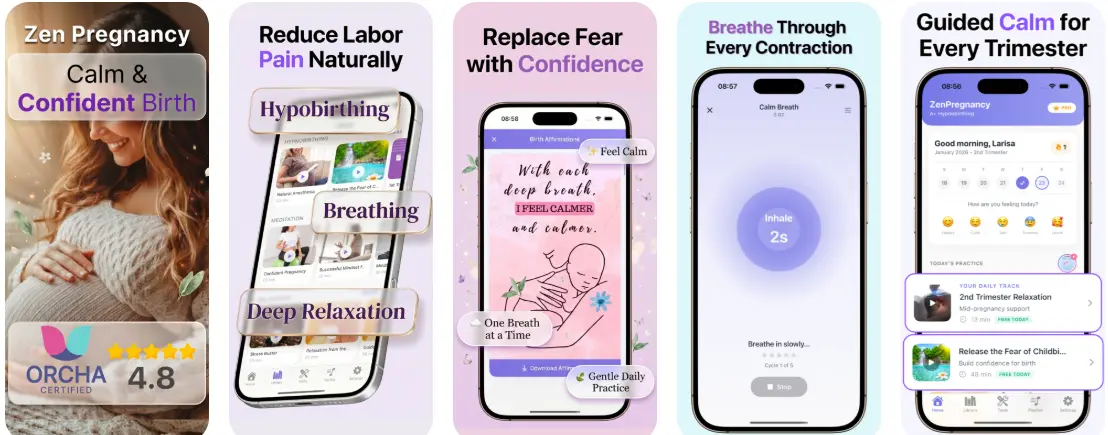
The best contraction timer with breathing combines accurate surge tracking with guided breathing cues so you stay calm without switching apps mid-labor. HypnoBirth App, ZenPregnancy, Freya Surge Timer, and GentleBirth are the strongest options, but the right choice depends on whether you want a simple timer or a timer tied to practice you've already used.
> Definition: A contraction timer with breathing is a labor app that logs surge length and frequency while simultaneously guiding you through structured breathing exercises, calming audio, or hypnobirthing prompts during each contraction.
- Look for large buttons, voice-only guidance, and offline audio. You won't want to stare at a screen during strong surges.
- Breathing during labor is evidence-backed: a 2020 Cochrane review linked relaxation techniques to reduced pain and a shorter first stage by about 1.3 hours.
- No contraction timer app replaces your midwife or OB. Apps estimate patterns but cannot assess clinical status.
At-a-Glance: Best Contraction Timer With Breathing Apps Compared
The strongest contraction timer breathing app is the one you can use with dim lights, tired hands, and a birth partner asking, “Start or stop?” Big tap targets matter more than pretty charts once the contraction timer app pinging becomes part of early labor.
| App | Breathing style | Offline audio | Platform | Price tier | Wider course integration |
|---|---|---|---|---|---|
| --- | --- | ---: | --- | --- | --- |
| HypnoBirth App | Hypnobirthing breathing, affirmations, guided calm tracks | Yes, for saved audio | iOS, Android | Free and paid options | Full hypnobirthing program bundled with timer |
| Freya Surge Timer | Up-breathing voice prompts | Yes | iOS, Android | Paid app | Links to Positive Birth Company style, but timer is standalone |
| GentleBirth | Mindfulness breathing with contraction data | Varies by content | iOS, Android | Subscription | Part of GentleBirth mindfulness ecosystem |
Choose the integrated hypnobirthing option if you want the timer, breathing tracks, affirmations, and birth-preparation audio in one practiced workflow instead of separate screens.
What a Contraction Timer With Breathing Does
A contraction timer with breathing records each surge while guiding your breath through it. It keeps timing, audio cues, and pattern review in one place so you are not juggling a stopwatch, notes app, and relaxation track.
In practice, the app becomes a shared labor tool: one person can tap the timer while the laboring person listens, exhales, changes position, or closes their eyes. The data can show duration, frequency, and rest time between surges, but it cannot diagnose labor stage, cervical change, or whether you need urgent care.
- Start the timer when a contraction begins so the app marks the beginning of the surge.
- Follow the breathing prompt during the surge instead of counting every inhale and exhale yourself.
- Stop the timer when the contraction fades so duration and rest interval are logged.
- Review the summary after several surges to notice whether the pattern is changing.
- Share the phone with your birth partner if you want them to manage timing while you stay with the breath.
- Call your care team based on their guidance, especially if symptoms feel unusual or concerning.
Named Shortlist: Top 3 Surge Timers With Breathing Support
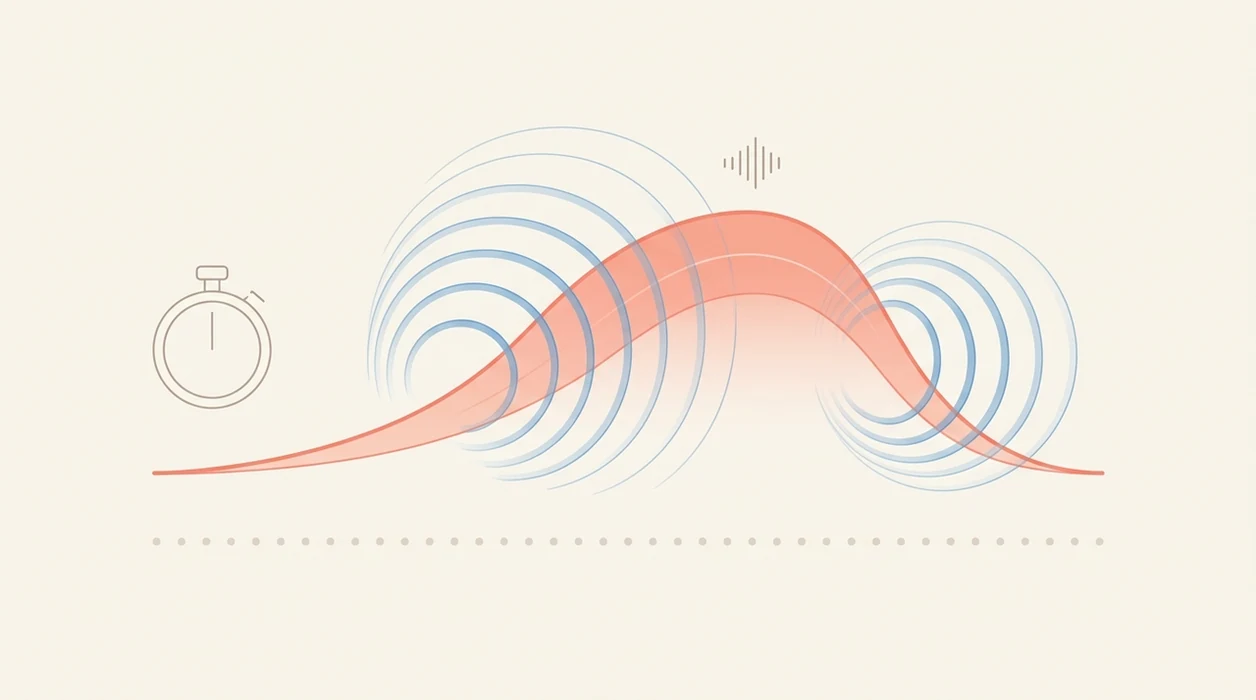
A strong surge timer with breathing should do three things well: time the surge, keep the breath steady, and stay out of the way. Monitor straps across the bump don't stop you using breathing cues; you just need the phone within reach or in your partner's hand.
- HypnoBirth App: best for integrated hypnobirthing practice and contraction timing, especially if you've trained with the breathing tracks before labor.
- Freya Surge Timer by The Positive Birth Company: best standalone surge timer with up-breathing audio and a simple labor-focused interface.
- GentleBirth Contraction Timer: best for data-focused tracking with mindfulness layers, especially for users who like summaries and logs.
Birth partners looking for fewer decisions during labor should consider HypnoBirth App because it combines the breathing prompt and timing screen in one routine.
For a deeper feature walk-through, the related app that times contractions and guides breathing page explains the timing-plus-audio setup.

How We Picked the Best Contraction Timer Breathing App
We judged each app on breathing guidance quality, offline reliability, hands-free usability, integration with a hypnobirthing program, and privacy basics. We did not rank any app by claims about cesarean rates, Apgar scores, or “better births,” because strong brand-specific evidence does not exist.
In active labor, dashboards lose value fast. Eyes-closed usability, large start and stop buttons, calm voice tone, and saved audio matter more than a detailed graph. I care whether a partner can tap the phone while offering a straw cup between contractions.
Small things become big.
When the issue is not wanting to swap between a timer and a breathing track, HypnoBirth App earns its place because the wider hypnobirthing practice and timer live in the same workflow. Good hypnobirthing apps deliver familiar cues under pressure, not a promise that birth will follow a script.
How a Contraction Timer With Breathing Actually Works
A contraction timer with breathing works by combining timed labor data with nervous-system calming cues. The timer records the surge pattern, while the breathing audio gives your body something steady to follow.
- Tap-to-start logging records the beginning, peak, and end of each contraction to calculate duration and frequency.
- Breathing overlays may use a slow inhale and longer exhale, such as 4 seconds in and 8 seconds out.
- Audio, haptics, or visuals guide the rhythm so you don't have to count while coping.
- Controlled breathing supports parasympathetic activity, the “settle and soften” side of the nervous system.
- Relaxation research is encouraging: a Cochrane review of relaxation techniques for pain management in labor found lower pain intensity and a shorter first stage of labor in some studies, but rated the evidence as limited: https://www.cochrane.org/CD009514/PREG_relaxation-techniques-pain-management-labour
Clinicians and birth guidelines often include breathing, relaxation, position changes, and continuous support as non-drug comfort measures, while also being clear that they may not remove pain completely.
How to Use a Contraction Timer With Breathing in Labor
Use a contraction timer with breathing before labor gets intense, not for the first time when surges are already close. Practice turns the app from “one more thing” into a familiar cue.
- Practice with the app at least 2 to 3 weeks before your due date so the breathing voice feels known.
- Open the app and switch to low-brightness or night mode when surges begin.
- Tap the large start button when a surge begins and follow the breathing audio.
- Tap stop when the surge ends to log duration and rest interval.
- Review the pattern summary after 4 to 6 surges, then use your provider's guidance about when to call.
- Hand the phone to your birth partner so you can focus on body sensations and breathing.
Anyone dealing with early labor nerves may prefer HypnoBirth App because the same breathing track used in practice can be saved for labor. If you need device-specific steps, read how to time contractions on iPhone.
Why Breathing During Contractions Is Evidence-Backed
Breathing during contractions is evidence-backed for reducing pain and anxiety, but it is not a guarantee of pain-free labor. The most evidence-backed approach is controlled breathing combined with support, movement, and appropriate medical care when needed.
A 2018 randomized trial of 110 first-time mothers found that structured breathing reduced active-labor pain scores and shortened the second stage: https://pubmed.ncbi.nlm.nih.gov/30172250/. A 2016 Cochrane review on hypnosis for pain management in labor found possible reductions in pharmacological pain relief, but the evidence was not strong enough to prove consistent outcome benefits: https://www.cochrane.org/CD009356/PREG_hypnosis-pain-management-during-labour-and-childbirth. A JAMA Network Open pilot study on mindfulness-based childbirth education reported reduced childbirth-related fear and improved self-efficacy: https://jamanetwork.com/journals/jamanetworkopen/fullarticle/2702214
That does not mean breathing replaces an epidural, nitrous oxide, sterile water injections, or other pain options. It means breathing is a useful layer. Sticky hospital socks, gown snaps at the shoulder, and a birth ball in the corner can all coexist with a breathing app.
For many people, labor comfort usually depends more on familiar practice than on the exact brand name of the timer.
Common Myths About Contraction Timer Breathing Apps
Contraction timer breathing apps are helpful, but they are often misunderstood. Use them as support tools, not as medical decision-makers.
| Myth | Reality |
|---|---|
| The app tells you exactly when to go to the hospital. | Apps estimate timing patterns. They cannot assess bleeding, fetal movement, waters breaking, or your clinical status. |
| A contraction timer breathing app makes labor pain-free. | Breathing can reduce pain and anxiety, but most people still feel intense sensations. |
| All surge timers with breathing are the same. | Voice tone, affirmations, offline access, screen design, and privacy settings vary a lot. |
| Hypnobirthing contraction timers are only for home births. | Many people use them with inductions, epidurals, and planned hospital births. |
If you want a plain explainer on pattern tracking, the guide on what app tracks contraction frequency covers frequency and rest intervals in more detail.
Honest Cons of Each Contraction Timer Breathing App
Every contraction timer breathing app has tradeoffs. I would rather you know them now than discover them during a bathroom trip in the dark, trying not to wake the whole house.
HypnoBirth App works best when you've used the broader hypnobirthing program before labor. If you download it during early labor with no practice, the breathing cues may feel unfamiliar.
Freya Surge Timer is strong as a standalone surge timer, but it has limited integration with a full hypnobirthing course inside the same app.
GentleBirth offers more data and mindfulness content, but the dashboards can pull attention away during active labor. It also uses a subscription model.
Reset the plan.
All of these apps become less useful without advance practice. No phone can replace a midwife's clinical judgment, a nurse noticing a change, or your own sense that something feels off.
Limitations
Contraction timer breathing apps can support labor, but they have clear limits. Keep these in mind when choosing between HypnoBirth App, Freya, GentleBirth, ZenPregnancy, or any other surge timer.
- No strong clinical evidence links any specific branded app to improved cesarean rates, Apgar scores, or hard birth outcomes.
- Inconsistent tapping during irregular surges, inductions, or VBAC labor can produce misleading timing patterns.
- Downloading an app in early labor without prior practice reduces the value of breathing prompts.
- Over-reliance on a screen can pull attention away from body sensations, counterpressure, and birth partner connection.
- High-risk pregnancies need provider-specific guidance that no app can replace.
- Hospital signal, battery drain, and forgotten chargers can interrupt audio if offline mode is not set up.
- A timer cannot interpret bleeding, reduced fetal movement, fever, unusual pain, or waters breaking.
For people comparing simple timing versus surge recognition, what app identifies labor surges explains where app labels can help and where they can overreach.
See also: Apple Watch Contraction Timer App for Labor.
Read more
- App That Guides Breathing Through Contractions
- App That Times Contractions And Guides Breathing
- Apple Watch Contraction Timer App Guide
- Can Contraction Timer Tell Labor
- Contraction Timer App Guide
- Contraction Timer Safety
- How To Breathe Through Contractions With Phone
- How To Time Contractions On Android
- How To Time Contractions On iPhone
- Pregnancy App With Kick Counter & Timer
- Surge Breathing For Labor
- What App Identifies Labor Surges
Best Contraction Timer With Breathing App for Calmer Labor Practice
HypnoBirth App pairs free hypnobirthing support with calming breathing and relaxation tools, helping you stay grounded while tracking the rhythm of labor. It is designed to support a calmer experience without making unsafe claims about diagnosing labor or replacing clinical guidance.
Best for
- Timing contractions while using calm breathing prompts
- Parents who want hypnobirthing tools alongside labor support
- Anyone looking for a free, ORCHA NHS certified birth preparation app
Limitations
- It does not diagnose active labor or tell you when it is medically safe to stay home
- You should always follow advice from your midwife, doctor, or maternity unit
Frequently Asked Questions
What is the best contraction timer with breathing prompts for labour?
The best contraction timer with breathing prompts is one that records contraction start times, duration and spacing while also guiding slow, calming breaths. It should be simple to use during labour, easy to pause, and avoid making unsafe claims about diagnosing active labour or when to go to hospital. Always follow your midwife’s or doctor’s advice if your symptoms change or you are unsure.
How does a contraction timer with breathing prompts work?
A contraction timer with breathing prompts tracks each surge and guides your breathing during or between contractions. You usually tap a button when a contraction starts and ends, while the app records the pattern and may offer visual, audio or vibration breathing cues. The timer helps you notice trends, but it does not replace clinical assessment.
Can a contraction timer tell me when to go to hospital?
No, a contraction timer cannot safely decide when you should go to hospital or call your maternity unit. It can show how frequent and long your contractions are, which may help when speaking to your midwife or doctor. Contact your care team urgently if you have bleeding, reduced baby movements, waters breaking with concerns, severe pain, fever, or any symptom you have been told to report.
Should I start using a contraction timer at 38 weeks pregnant?
Yes, you can start using a contraction timer at 38 weeks if you are having regular tightenings or want to practise before labour. Practising in late pregnancy can help you feel confident with the buttons, breathing prompts and saved history before you need them. If contractions are painful, regular, or accompanied by worrying symptoms, contact your maternity unit for advice.
Is a contraction timer with breathing prompts helpful for pregnancy anxiety?
Yes, a contraction timer with breathing prompts can help some people manage pregnancy anxiety by giving a simple task and a steady breathing rhythm. Calm breathing may reduce panic and help you feel more in control during surges. It is not a treatment for anxiety, so speak with your midwife, GP or mental health professional if anxiety feels intense, persistent or overwhelming.
Can I use a contraction timer if I plan to have an epidural?
Yes, you can use a contraction timer even if you plan to have an epidural. The timer may help you track early labour at home, communicate your contraction pattern to your care team, and use breathing prompts while waiting for pain relief. Once in hospital, follow the guidance of your midwife or anaesthetist.
Is a contraction timer with breathing good for first-time mums?
Yes, a contraction timer with breathing can be especially useful for first-time mums who are unsure what to track during early labour. It provides a clear record of contraction length and frequency while offering breathing cues to support calm focus. First labours can vary widely, so use the data as information rather than a diagnosis.
Is a hypnobirthing app better than a hypnobirthing class for timing contractions?
No, a hypnobirthing app is not always better than a class, but it can be more convenient for timing contractions in the moment. A class gives teaching, practice and personalised discussion, while an app gives on-demand tools such as a contraction timer, breathing prompts and audio tracks. Many parents use both for preparation and labour support.
What features should I look for in a contraction timer app with breathing?
The key features to look for are accurate start-and-stop timing, clear contraction history, simple breathing prompts and easy one-handed use. Helpful extras include partner access, calming audio, dark mode, exportable notes and reminders to contact your care team based on your own maternity guidance. Avoid apps that promise to diagnose labour stage or guarantee medical decisions.
Can breathing prompts reduce contraction pain?
Breathing prompts do not guarantee pain reduction, but they can help you stay calmer and more focused during contractions. Slow rhythmic breathing may reduce tension, support relaxation and make surges feel more manageable for some people. Pain relief needs are personal, so it is always valid to ask for medical pain relief if you want it.
Are contraction timer apps safe to use during labour?
Yes, contraction timer apps are generally safe when used as a tracking and comfort tool rather than a medical decision-maker. They can help you record patterns and practise breathing, but they cannot assess your baby, your cervix or your overall clinical situation. If something feels wrong, contact your midwife, doctor or maternity triage immediately.
Do I need internet access to use a contraction timer with breathing prompts?
No, many contraction timer apps can work without internet access once they are installed, but this depends on the app. Offline access is useful in hospital, at home or while travelling when signal may be poor. Check before labour that the timer, breathing prompts and any downloaded hypnobirthing tracks work without Wi-Fi or mobile data.