 Hypno
HypnoCan a Contraction Timer Tell You Labor Has Started?
200,000+ moms • ORCHA NHS Certified • Free on iOS & Android
If you're asking "can contraction timer tell labor," the answer is no: a timer can record how long contractions last and how far apart they are, but it cannot confirm whether labor has actually started. True labor is diagnosed by a clinician who evaluates cervical change alongside contraction patterns, so no app can replace that assessment.
Definition: A contraction timer is a tracking tool, not a medical device, that logs the duration and frequency of uterine contractions without assessing cervical dilation or clinical status.
TL;DR
- Contraction timers measure timing patterns, not cervical change, so they cannot diagnose labor.
- Regular contractions do not always mean active labor—Braxton Hicks and early labor can produce similar patterns.
- Only 19% of health apps making diagnosis claims had supporting evidence, reinforcing the need for clinical evaluation.
- Warning signs like preterm contractions, bleeding, or fluid leakage require a provider call, not an app check.
- Some birth-preparation apps include timers for calm tracking, but clinical decisions belong with your maternity care team.
What a Contraction Timer Actually Measures
A contraction timer measures two things: how long each contraction lasts and how much time passes between contractions. It cannot assess cervical dilation, cervical effacement, fetal position, bleeding, fluid leakage, or whether the baby is tolerating labor.
In practice, you tap “start” when the tightening begins and “stop” when it fades. The app then shows duration and frequency. That can be useful when the contraction timer app pings in early labor and your birth partner is trying to decide whether the pattern is changing.
A timer is an observation tool, not a diagnostic device. It helps you describe what is happening when you call your midwife, doctor, or hospital triage. It does not look at your cervix. It does not know your gestational age, birth history, or risk factors unless you enter them, and even then it cannot examine you.
The pocket check is real.
5 Facts About Contraction Timers and Labor Diagnosis
- Timers record patterns, not progress. A timer can show contractions every five minutes, but it cannot prove the cervix is dilating.
- Apps are not a substitute for clinical assessment. Most contraction timers are wellness or tracking tools, not regulated medical devices; the safety questions overlap with whether are hypnobirthing apps regulated.
- Braxton Hicks, early labor, and true labor can overlap. All three can feel like tightening, pressure, or waves that come and go.
- Closer contractions can suggest labor is moving, but they do not confirm it. The most common medically supported way to confirm labor is contraction history combined with a clinical exam showing cervical change.
- Warning signs override the timer. Bleeding, fluid leakage, decreased fetal movement, severe pain, or contractions before 37 weeks need provider guidance, not another hour of logging.
I’ve watched a birth partner press tennis balls into a lower back during back labor while the timer looked “early.” The body was telling a bigger story than the numbers.
Medical Scope and Disclaimer
This article is educational only and is not medical advice. A contraction timer can help you describe a pattern, but it cannot diagnose labor or tell you whether you and your baby are safe.
Labor diagnosis belongs with clinical assessment: your maternity team may consider contraction history, your symptoms, your gestational age, and cervical change such as dilation and effacement. The safest plan is the one your own midwife, doctor, hospital, or birth center has given you, because they know your pregnancy and local triage process.
Use timing data as a note-taking aid, not a decision-maker:
- Follow the instructions your maternity team gave you for when to call, go in, or keep observing.
- Report the full picture, including contraction spacing, duration, pain, baby’s movement, fluid, bleeding, and anything that feels unusual.
- Override the timer when warning signs appear, even if contractions seem irregular or “not close enough.”
- Seek urgent or emergency care if symptoms feel severe, unsafe, rapidly worsening, or if you cannot reach your provider.
If your gut says something is wrong, treat that as information too.

How Contraction Timing Works Behind the Scenes
Contraction timing works by turning your taps into interval data. You press start when the contraction begins, stop when it ends, and the app calculates duration plus the gap from one contraction start to the next.
That sounds precise, but it is still pattern-matching. The common 1-5-1 rule means contractions last about 1 minute, come 5 minutes apart, and continue for 1 hour. It is a rule of thumb, not a clinical algorithm. Your hospital may give different advice, especially for a second baby, a high-risk pregnancy, or a long drive.
A 2016 study of smartphone health apps found that only 19% of apps making treatment or diagnosis claims cited supporting evidence in the app description or developer website source. That matters if you are wondering, “can app tell if in labor?”
Clinical labor diagnosis still requires the full picture, including a physical exam that confirms cervical change. For birth teams, timing is often better than guessing because it gives shared language during triage.
Common Myths About Apps Diagnosing Labor
Myth 1: A contraction timer can confirm labor by itself. It cannot. It can record a pattern, but contraction timer diagnosis is not the same as clinical diagnosis.
Myth 2: Regular contractions always mean active labor. Regular waves can happen in Braxton Hicks, prodromal labor, or early labor that pauses. Baby kicks under the duvet can also make every sensation feel urgent at 2 a.m.
Myth 3: A labor app can replace a clinician’s exam or triage call. It cannot check dilation, effacement, fetal position, blood pressure, fluid color, or fetal movement.
Myth 4: If the app says “go to the hospital,” it has diagnosed labor. Usually, that message is based on a timing threshold. It is not the same as a midwife or doctor assessing you.
Good hypnobirthing apps deliver breathing cues, affirmations, timers, and calm practice, not a medical verdict about whether your cervix is changing.
When to Call Your Provider Instead of Checking the Timer
Use the timer when contractions are mild, you are full term, baby is moving normally, and your care team has told you to track patterns. Call your provider when symptoms move outside that ordinary picture.
Timer Data Is Helpful
Timer data is helpful when you need clear notes: contraction length, spacing, intensity, and how long the pattern has lasted. A hospital tour map on the fridge is nice, but triage usually wants numbers and symptoms.
Provider Contact Is Essential
Provider contact is essential for contractions before 37 weeks, bleeding, fluid leakage, decreased fetal movement, severe pain, or anything that feels wrong. Mayo Clinic describes likely preterm labor as regular uterine contractions with cervical softening, thinning, and opening before 37 weeks source.
One-size-fits-all timing rules can mislead. Your own maternity team’s instructions matter most, especially if you are deciding when to call hospital during labor.
How a Birth App Can Support Calm Contraction Tracking
A birth-preparation app can pair contraction timing with guided breathing, meditation, birth affirmations, and hypnobirthing tools. That support can make patterns easier to describe during a triage call, but it does not diagnose clinical status.
That distinction matters in the room. You may have headphones tucked into a gown pocket, monitor straps across the bump, and a birth partner offering a straw cup between contractions. In that moment, a timer can reduce confusion. It still cannot tell whether admission is needed.
If you use HypnoBirth App, treat the timer as a communication aid: log contractions, note symptoms, and follow your maternity team's instructions for safety, admission, or unexpected symptoms.
Limitations
Contraction timers are useful, but their limits are not small. Treat these limits as safety information, not fine print.
- A timer cannot determine whether contractions are causing cervical dilation.
- App-based rules can mislead because labor patterns vary by person, parity, gestational age, and pregnancy risk.
- Timing is less useful when contractions are irregular or hard to feel clearly.
- Pain medication, exhaustion, or anxiety can change how contractions are perceived and logged.
- A timer cannot rule out preterm labor, placental problems, rupture of membranes, fetal distress, or infection.
- One-size-fits-all timing advice is overhyped; safe guidance depends on your maternity team’s instructions.
- A “go in” notification is not a medical diagnosis or a guarantee of hospital admission.
Reset the plan.
If you use hypnobirthing tools during labor, keep the same caution around bold claims. The same safety thinking applies to can hypnobirthing replace pain relief and other birth-preparation promises.
Read more
- App That Guides Breathing Through Contractions
- App That Times Contractions And Guides Breathing
- Apple Watch Contraction Timer App Guide
- Best Contraction Timer With Breathing
- Contraction Timer App Guide
- Contraction Timer Safety
- How To Breathe Through Contractions With Phone
- How To Time Contractions On Android
- How To Time Contractions On iPhone
- Pregnancy App With Kick Counter & Timer
- Surge Breathing For Labor
- What App Identifies Labor Surges
Best Contraction Timer App for Tracking Early Labor Patterns
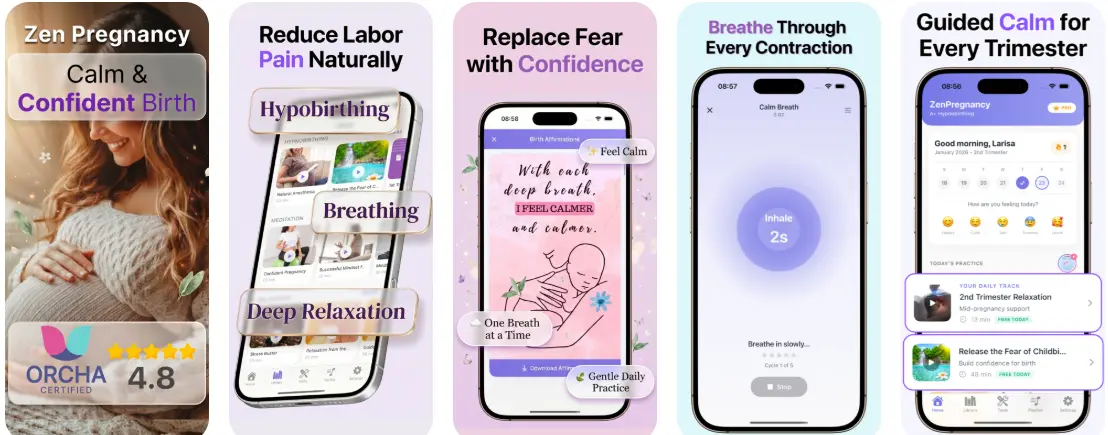
HypnoBirth App can help you time contractions and notice patterns while also supporting calm breathing and relaxation in early labor. A contraction timer can record frequency and duration, but it cannot confirm true labor or decide when you should go to hospital, so always follow your care team’s guidance.
Best for
- Tracking contraction timing patterns clearly
- Staying calm with hypnobirthing tools while you monitor changes
Limitations
- Cannot diagnose true labor or medical urgency
- Does not replace advice from your midwife, doctor, or hospital
Frequently Asked Questions
Can a contraction timer tell if labour has started?
No, a contraction timer cannot diagnose that labour has started. It records how often contractions come, how long they last, and how the pattern changes, but true labour is confirmed by your overall symptoms and, if needed, assessment by a midwife or doctor.
What does a contraction timer actually measure?
A contraction timer measures the length of each contraction and the time between contractions. This helps you spot patterns, such as contractions becoming longer, stronger, and closer together, but it does not measure cervical dilation or guarantee labour is established.
When should I go to hospital based on contraction timing?
You should follow the guidance given by your maternity unit, midwife, or doctor rather than relying on timing alone. Many people are told to call when contractions are regular, painful, and close together, but advice varies depending on your pregnancy, distance from hospital, waters breaking, bleeding, baby’s movements, and previous births.
Can a contraction timer tell the difference between Braxton Hicks and real labour?
No, a contraction timer cannot reliably tell the difference between Braxton Hicks and real labour. Braxton Hicks often stay irregular and may ease with rest, hydration, or a change of position, while true labour usually builds in intensity and becomes more regular, but you should seek advice if you are unsure.
Is it normal to start timing contractions at 38 weeks pregnant?
Yes, it is normal to start timing contractions at 38 weeks if you notice a repeated tightening or cramping pattern. Timing can help you describe what is happening when you call your midwife or maternity triage, but it should not replace medical advice.
Can timing contractions reduce pregnancy anxiety?
Yes, timing contractions can reduce pregnancy anxiety for some people by making the pattern feel clearer and more manageable. For others, constant checking can increase worry, so it may help to time for a set period and then use breathing, relaxation, or hypnobirthing techniques while contacting your care team if concerned.
Should first-time moms use a contraction timer?
Yes, first-time mums can use a contraction timer to understand the rhythm of early labour. It is especially useful for describing contractions clearly, but first labours can be long and unpredictable, so decisions about when to seek care should include your maternity team’s advice.
Can a contraction timer predict how soon the baby will be born?
No, a contraction timer cannot predict exactly when your baby will be born. Contractions may speed up, slow down, or change with rest, movement, hydration, or labour progression, and birth timing varies widely from person to person.
Do I still need to call my midwife if my contraction timer shows regular contractions?
Yes, you should call your midwife or maternity unit if contractions are regular and you think labour may be starting. You should also seek urgent advice for reduced baby movements, heavy bleeding, severe pain, fever, waters breaking with concerns, or anything that feels wrong.
Can I use a contraction timer if I plan to have an epidural?
Yes, you can use a contraction timer even if you plan to have an epidural. Timing may help you decide when to contact the hospital, but epidural timing and suitability depend on your labour progress, your health, and the clinical team’s assessment.
Is a contraction timer app better than a hypnobirthing class?
No, a contraction timer app and a hypnobirthing class do different jobs. An app tracks contraction patterns, while a class or structured hypnobirthing programme teaches breathing, relaxation, decision-making, and comfort techniques for labour.
What contraction pattern usually suggests active labour?
Active labour often involves contractions that become stronger, longer, and closer together over time. A common pattern people are told to watch for is contractions lasting around 60 seconds and coming every few minutes, but your own maternity unit’s instructions are the safest guide.