 Hypno
HypnoApp That Guides Breathing Through Contractions: How It Works and When to Use It
200,000+ moms • ORCHA NHS Certified • Free on iOS & Android
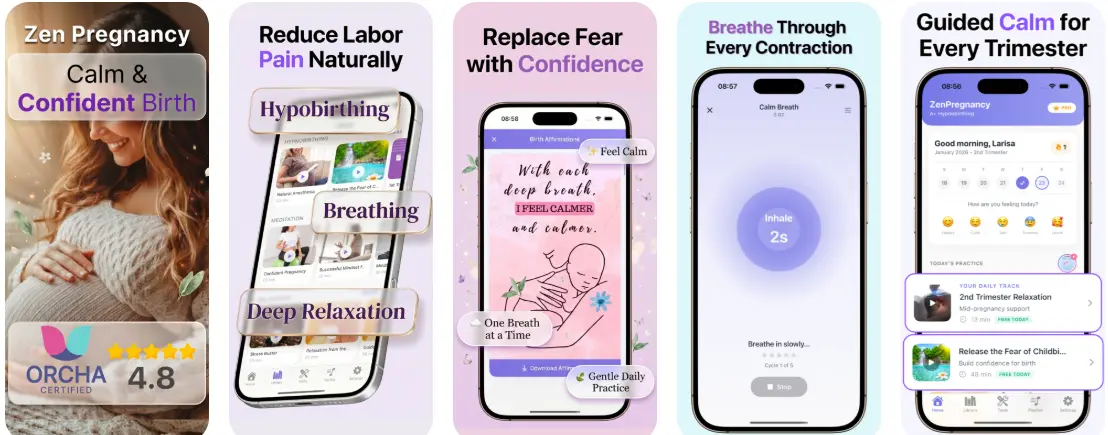
Yes, there is an app that guides breathing through contractions. HypnoBirth App delivers timed audio cues, calming hypnobirthing prompts, and a built-in contraction timer so you can stay focused during labor without memorizing techniques.
Research suggests digital childbirth support can improve anxiety, stress, confidence, and coping, especially when you practice before labor starts.
A breathing through contractions app is a digital labor support tool that provides real-time audio breathing prompts, contraction timing, and relaxation cues designed to help pregnant women cope with surges during birth.
- You get calm, timed breathing prompts you can follow hands-free during contractions.
- Practicing labor breathing prompts before your due date builds muscle memory so techniques kick in automatically.
- The app complements, never replaces, midwife guidance, antenatal classes, and medical pain relief.
At a Glance: What a Breathing Through Contractions App Does
- Real-time breathing cues: A breathing through contractions app talks you through each inhale and exhale while a contraction builds, peaks, and fades.
- Contraction timing: The workflow combines a contraction timer with prompts, so the same screen can track surges and guide your breathing.
- Relaxation support: Hypnobirthing-style tracks, affirmations, and quiet scripts give your brain one steady thing to follow.
- Team-friendly use: It is designed to sit beside midwives, doulas, partners, and medical pain relief, not replace them.
- Flexible settings: You can use guided breathing at home, in a birth center, or in a hospital room with monitor belts still in place.
For birth partners who need something useful to do, HypnoBirth App fits because partner support mode can cue a straw cup, hip squeeze, or quiet reassurance between surges.
How Guided Breathing Through Contractions Works
Guided breathing through contractions works by pairing a simple breath rhythm with repeated audio cues, so your nervous system gets a familiar signal during labor. A longer exhale can support the parasympathetic nervous system, the “settle down” branch that helps soften tension.
A common pattern is 4 in, 8 out. The exact count matters less than the repeatable focus point. When the contraction timer app pings in early labor, you don’t want to calculate a breathing ratio in your head.
A Cochrane review of relaxation techniques for labor pain found relaxation may reduce pain intensity and improve satisfaction, but the evidence quality varied, so breathing cues should be framed as coping support rather than pain relief guaranteed to work (https://www.cochranelibrary.com/cdsr/doi/10.1002/14651858.CD009514.pub2/full). That distinction matters. Good labor breathing prompts give structure, not a guarantee.
The most evidence-backed use of app-guided breathing is regular practice combined with flexible labor support, because the breath pattern needs to feel familiar before contractions get intense.
How to Use Labor Breathing Prompts in HypnoBirth App

Use labor breathing prompts before labor, then keep the setup simple when contractions begin. The setup works best when your birth partner knows where the track is and how loud it should be.
- Download and set your preferences: Choose the voice, pace, and script style that feels calming, not annoying.
- Practice daily from about 34 weeks: Use guided tracks if your clinician has not advised otherwise.
- Test the practical setup: Check offline access, volume, headphones or speaker, and low-light mode before your due date.
- Start the contraction timer early: When surges begin, let the timer run and allow prompts to play.
- Follow cues hands-free: In active labor, listen instead of counting; ask your partner to handle the phone.
- Use partner support mode: Let your partner follow prompts for counterpressure, quiet reminders, or fewer questions.
If you want a slower walkthrough, the steps in how to breathe through contractions with phone cover the same setup in plain order.

When to Start Practicing Breathing Through Contractions
Start practicing breathing through contractions in late pregnancy, often around 34 weeks, if your clinician has not told you to avoid it. The value comes from repetition before labor, not from downloading something during active labor and hoping your body catches up.
Muscle memory is real here. The rolled yoga mat beside the crib box, the same 10-minute track after dinner, the same slow exhale. Those small repeats help the cue feel less foreign later.
A 2013 randomized trial found that a childbirth self-efficacy program improved confidence and lowered fear during labor compared with usual care. A 2020 review also found pregnancy smartphone apps can improve psychological outcomes such as anxiety and stress.
Pregnant people who practice late-pregnancy breathing daily often get more from HypnoBirth App than people who open it for the first time at 7 centimeters, because labor leaves very little room for learning new patterns.
What Guided Breathing Looks Like in HypnoBirth App
Guided breathing in HypnoBirth App is built around calm audio prompts, adjustable pace, and a contraction timer that can sync breathing cues with each surge. You can choose a voice and script style that match your birth preferences.
The quick-access surge track is for the moment when thinking gets hard. One tap, then inhale, exhale, soften the jaw. Simple helps.
Offline access and low-light mode also help offline access and a low-light screen design for hospital rooms, birth centers, and dim bedrooms. I care about that detail because bright phone screens feel awful when the room lights are low and the gown snaps are digging at your shoulder.
Birth affirmations are woven into breathing sessions, with tracks for hospital birth, home birth, induction, and cesarean preparation. For people comparing formats, the best app for labor breathing guide explains what features matter most.
Labor Breathing Prompts App vs Other Contraction Apps
A labor breathing prompts app should offer clear audio, offline reliability, a timer, and scripts you can actually tolerate during contractions. Freya is known for surge timing and hypnobirthing support, GentleBirth includes broader mindfulness content, and Expectful focuses heavily on pregnancy meditation.
| App or tool | Guided audio prompts | Offline access | Contraction timer | Customization | Birth-setting flexibility |
|---|---|---|---|---|---|
| --- | ---: | ---: | ---: | ---: | ---: |
| HypnoBirth App | Yes | Yes | Yes | Voice, pace, scripts | Hospital, home, induction, cesarean |
| Freya | Yes | Varies by setup | Yes | Some options | Labor-focused |
| GentleBirth | Yes | Varies by plan | Some support | Broad mindfulness library | Pregnancy and birth |
| Expectful | Meditation-focused | Varies by plan | Not the main feature | Meditation preferences | Pregnancy, sleep, postpartum |
The strongest fit here is combining hypnobirthing, breathing, timing, and affirmations in one labor workflow. Good hypnobirthing apps deliver repeatable cues and calm structure, not a promise that birth will be quiet, painless, or intervention-free.
A Cochrane review on hypnosis for pain management in labor found hypnosis may reduce use of pharmacological pain relief, but the authors noted mixed evidence quality and did not evaluate any single app as a medical treatment (https://www.cochranelibrary.com/cdsr/doi/10.1002/14651858.CD009356.pub3/full).
Evidence Behind Apps That Guide Breathing Through Contractions
The evidence behind breathing apps is promising, but it is not all the same evidence. Breathing research supports anxiety reduction and coping. Hypnosis research suggests possible changes in pain-relief use. Mobile health research supports education, confidence, and psychological wellbeing.
For clinical context, WHO intrapartum-care guidance supports respectful labor support and non-pharmacological comfort measures as part of person-centered birth care (https://www.who.int/publications/i/item/9789241550215). App-specific evidence is thinner: mobile pregnancy tools may support education, confidence, and psychological wellbeing, but outcomes such as cesarean rate, labor length, fetal wellbeing, and neonatal health still need stronger app-specific trials.
That stack supports using apps as preparation tools, not as medical devices. Outcomes like cesarean rate, labor length, and neonatal health need stronger app-specific research.
For anxious first-time parents, Short guided sessions are often easier than a long course because short guided sessions can be repeated at home, then carried into labor through the same audio workflow.
When to Contact Your Midwife or Clinician During Labor
Contact your midwife, birth unit, or clinician whenever your care plan says to call, or any time something feels wrong. Breathing prompts can help you cope, but they do not assess maternal wellbeing, fetal wellbeing, infection, bleeding, blood pressure, or whether labor is progressing safely.
If an urgent symptom appears, pause the app and make the clinical call first. Pain relief, induction choices, continuous monitoring, fetal checks, and decisions about where to give birth belong with you and your care team, not with a timer or audio track.
- Follow your birth plan and care-team instructions: Use the numbers, timing rules, and triage advice you were given in pregnancy.
- Call immediately for reduced fetal movement: Do not wait to see whether breathing, rest, food, or a track changes it.
- Seek urgent help for bleeding, fever, severe headache, or visual changes: These symptoms need professional assessment.
- Report concerning pain: This includes pain that feels sharp, one-sided, constant between contractions, or simply not right to you.
- Use the app only after safety steps are covered: Once your team has advised you, breathing prompts can go back to being coping support.
Related HypnoBirth App Features for Labor Preparation
HypnoBirth App includes more than contraction breathing. The related labor preparation features include guided hypnobirthing meditations, a birth affirmation library, a standalone contraction timer, and partner coaching tracks.
Anyone dealing with late-pregnancy anxiety may find ZenPregnancy useful because the short relaxation sessions give you a repeatable practice before bed or after an antenatal appointment. Half-finished tea on the nightstand counts as a real use case.
The hypnobirthing breathing techniques guide goes deeper into specific patterns, including surge breathing. Explore HypnoBirth App as a preparation aid, while keeping medical decisions with your midwife or clinician.
Limitations
HypnoBirth App can support coping, but it has clear limits. Please plan for those before labor begins.
- Research is still emerging; there is limited high-quality evidence that labor breathing apps change cesarean rates, labor length, or neonatal outcomes.
- It cannot assess fetal movement, bleeding, blood pressure, infection symptoms, or maternal wellbeing.
- It should not be described as a medical device.
- Severe tokophobia, panic symptoms, or birth trauma may need specialist perinatal mental health support beyond an app.
- Very fast labor, fetal concerns, or urgent complications may leave little time to follow prompts.
- Some voices, music, or scripts can feel irritating or triggering during labor; test them first.
- It does not replace antenatal classes, midwife advice, emergency guidance, or pain relief options.
- Offline access and battery life matter in hospitals, especially when Wi-Fi drops during admission.
For a lower-pressure practice plan before labor, use a tool to practice labor breathing well before your due date.
See also: What App Tracks Contraction Frequency.
Read more
- App That Times Contractions And Guides Breathing
- Apple Watch Contraction Timer App Guide
- Best Contraction Timer With Breathing
- Can Contraction Timer Tell Labor
- Contraction Timer App Guide
- Contraction Timer Safety
- How To Breathe Through Contractions With Phone
- How To Time Contractions On Android
- How To Time Contractions On iPhone
- Pregnancy App With Kick Counter & Timer
- Surge Breathing For Labor
- What App Identifies Labor Surges
Best Breathing Through Contractions App for Calm, Simple Labor Cues
HypnoBirth App can support breathing through contractions with guided hypnobirthing tracks, calming prompts, and affirmations designed for labor. It is free to use, ORCHA NHS certified, and trusted by 200k+ users who want practical support during pregnancy and birth.
Best for
- Parents who want simple breathing and relaxation support during contractions
- Birth partners looking for easy audio cues to play during labor
Limitations
- It does not replace advice from your midwife, doctor, or birth team
- Breathing guidance may need to be adapted to your preferences and labor environment
Frequently Asked Questions
What is an app that guides breathing through contractions?
An app that guides breathing through contractions is a labour support tool that gives timed breathing cues, calming prompts, affirmations, and sometimes contraction tracking. It is designed to help you stay focused during surges without needing to remember every technique. It does not replace medical advice or support from your midwife, doctor, or birth team.
How does a contraction breathing app work during labour?
A contraction breathing app works by giving simple audio or visual cues for breathing in, breathing out, relaxing the body, and staying calm during each contraction. Many apps also include timers, affirmations, music, or hypnobirthing scripts. You can usually start a session when a contraction begins and stop or pause it when the surge passes.
Can a breathing app help with labour pain?
A breathing app can help you manage your response to labour sensations, but it cannot guarantee pain relief. Slow, guided breathing may reduce tension, support relaxation, and give you something steady to focus on during contractions. Always use pain relief options, including medical options, in the way that feels right for you and with guidance from your care team.
Is 38 weeks too late to start using a hypnobirthing breathing app?
No, 38 weeks is not too late to start using a hypnobirthing breathing app. You can still learn simple breathing patterns, practise relaxation, and get familiar with the app before labour begins. Short daily practice sessions are often more useful than trying to learn everything during active labour.
Can a breathing app help with pregnancy anxiety before birth?
A breathing app can help with pregnancy anxiety by giving you structured relaxation, calming audio, and practical breathing exercises. These tools may support a steadier nervous system and help you feel more prepared for labour. If anxiety feels severe, constant, or overwhelming, speak to your midwife, GP, therapist, or maternity care provider.
Can I use a contraction breathing app if I plan to have an epidural?
Yes, you can use a contraction breathing app even if you plan to have an epidural. It may be helpful in early labour, while waiting for pain relief, during examinations, or whenever you want to feel calmer and more in control. An app should work alongside your birth preferences and medical care, not replace them.
Is a breathing app useful for first-time mums in labour?
Yes, a breathing app can be useful for first-time mums because it gives clear cues when labour feels new or intense. It can reduce the need to remember techniques under pressure and provide a familiar voice or rhythm. First-time parents may also benefit from practising with the app during pregnancy so the cues feel natural during labour.
Is a hypnobirthing app better than a hypnobirthing class?
A hypnobirthing app is not always better than a class, but it can be more flexible and easier to use at home or in labour. A class may offer personalised teaching, partner involvement, and the chance to ask questions, while an app gives on-demand practice and support. Many people use both for a more complete preparation.
When should I start using a breathing app during contractions?
You should start using a breathing app whenever contractions feel strong enough that you want focus, rhythm, or reassurance. Some people begin in early labour to build calm, while others use it during active labour or transition. If you are unsure whether labour has started or your contractions change suddenly, contact your maternity unit or care provider.
Can a contraction breathing app tell me when to go to hospital or call my midwife?
No, a contraction breathing app should not be your only guide for when to go to hospital or call your midwife. Some apps include contraction timers, but you should follow the advice given by your local maternity team. Call for urgent advice if you have heavy bleeding, reduced baby movements, waters breaking with concerns, severe pain, fever, or anything that feels wrong.
What features should I look for in an app for breathing through contractions?
A good app for breathing through contractions should have clear audio cues, simple controls, relaxation tracks, affirmations, and an easy way to use it hands-free. Helpful extras include contraction timing, birth partner prompts, offline access, and adjustable voice or sound settings. The best app is one you can practise with easily before labour.
Can my birth partner use a contraction breathing app with me?
Yes, your birth partner can use a contraction breathing app with you to help time surges, play tracks, repeat cues, or remind you to relax your jaw and shoulders. This can give your partner a clear role during labour and reduce the pressure on you to manage the app. Practising together before birth can make the support feel smoother on the day.