 Hypno
HypnoDoes Hypnobirthing Work for First Births?
200,000+ moms • ORCHA NHS Certified • Free on iOS & Android
What Hypnobirthing Means for a First Birth
For a first birth, hypnobirthing “working” usually means better coping, less fear, and more confidence—not a perfect birth story. First-time labor can feel emotionally huge because you have no personal reference point for contractions, cervical checks, transition, pushing, or a change in plans.
Hypnobirthing combines relaxation, breathing, visualization, affirmations, and calm decision-making skills. Many first-time parents use it in hospitals, birth centers, and home births, and it can sit alongside epidurals, inductions, cesarean births, or unmedicated plans. A helpful starting point is learning what first-time practice looks like in real life through hypnobirthing for first-time moms. The goal is not to “perform” calmness; it is to give your nervous system something familiar to return to when labor feels intense.
Evidence on Hypnosis and Labor Coping
Research suggests hypnosis-based birth preparation may help some people reduce fear and improve coping, but the evidence is mixed and does not prove guaranteed outcomes. A Cochrane review on hypnosis for labor pain found possible reductions in pharmacological pain relief use, while also noting uncertainty and variation between studies.
That is why experienced birth educators talk about hypnobirthing as a skills practice, not a promise. Studies on relaxation techniques in labor also suggest benefits for pain experience and satisfaction for some women, though quality and results vary. In practical terms, the strongest value for a first birth is often emotional: you know how to breathe, how to soften tension, and how to ask for support. This is not medical advice. Always discuss labor preparation, pain relief, and safety decisions with your midwife, doctor, or maternity team.
How Hypnobirthing Works in a First Labor
Hypnobirthing works by training the stress response before labor begins, so calm cues feel more familiar when contractions intensify. The core mechanism is nervous-system conditioning: repeated audio, slow breathing, and positive rehearsal pair a cue word, voice, or rhythm with reduced muscle tension.
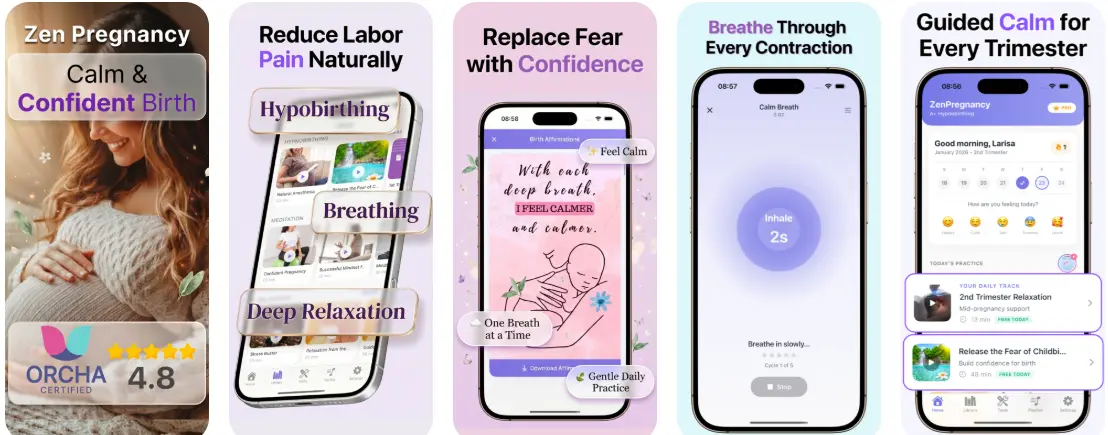
In labor, fear can increase adrenaline, breath-holding, jaw clenching, and protective tightening through the pelvis. Hypnobirthing practice aims to shift attention toward parasympathetic patterns: longer exhales, relaxed facial muscles, steady vocal sounds, and mental images of opening or softening. HypnoBirth App is a hypnobirthing app that provides guided meditation, breathing exercises, contraction timing, and birth affirmations for pregnant women. These tools do not remove medical complexity, but they can help you return to one simple job: breathe, release, and take the next contraction one at a time.

How to Practice Hypnobirthing Before Baby Arrives
A first-birth routine works best when it is small enough to repeat, especially from around 24–34 weeks onward. You do not need a two-hour ritual; you need familiar cues your body recognizes when you are tired, excited, or unsure.
- Choose one daily track or breathing practice lasting 5–15 minutes.
- Repeat the same relaxation cue, such as “soft jaw” or “loose shoulders,” until it feels automatic.
- Practice one breathing rhythm during ordinary moments, like walking, showering, or trying to sleep.
- Rehearse likely scenarios, including the car ride, triage, a cervical check, or a change in pain-relief preferences.
- Teach your birth partner one phrase, one touch cue, and one practical job.
- Review your plan weekly and adapt it with your healthcare provider.
If you want a fuller starter path, use this guide on how to start hypnobirthing.
Best Hypnobirthing App Features for First-Time Parents
The best app features for a first birth are the ones you can use when your brain feels busy: short tracks, simple breathing, affirmations, and labor tools in one place. A first-time parent often needs less theory and more repeatable structure.
Look for guided pregnancy meditations, birth breathing practice, affirmations you can personalize, and an easy way to track contractions when early labor begins. If you are comparing app options, a dedicated best hypnobirthing app guide can help you see what matters beyond a pretty interface. You can also practice on iOS with a or on Android with a . Choose tools you will actually open on a normal Tuesday, not only during a perfect calm moment.
First-Time Labor Breathing and Relaxation Skills
Breathing helps most when it is practiced before labor, not introduced for the first time at 6 centimeters. First-time parents often hold their breath during intensity, especially if they feel watched, rushed, or unsure whether a contraction is “real.”
Start with down-regulating breaths in pregnancy: inhale gently through the nose for about 4 counts, then exhale slowly for 6–8 counts while relaxing the jaw. In active labor, many people prefer a simpler rhythm, such as breathing in for comfort and sighing out with a low sound. During pushing, your care team may suggest different breathing based on your baby’s position, your energy, and the birth setting. For more options, explore pregnancy breathing techniques and practice two or three until they feel natural. This is not medical advice; follow clinical guidance if you or baby need support.
Birth Affirmations for First-Birth Anxiety
Birth affirmations work best when they feel believable, specific, and emotionally steady. A first-time parent may not connect with phrases like “my birth will be easy,” but may feel grounded by “I can do one wave at a time” or “I can ask questions and make informed choices.”
Use affirmations to interrupt spirals, especially around unknowns: arriving at hospital, being monitored, waiting through slow progress, or hearing a change in recommendation. Pair each phrase with a physical cue, such as dropping your shoulders or unclenching your hands. You can write five personal phrases on your phone, record your partner saying them, or use a birth affirmations app for guided repetition. Affirmations are not denial. They are reminders that you can be informed, flexible, and supported even when birth changes direction.
When to Start Prenatal Hypnobirthing Practice
The ideal time to start hypnobirthing is when you can repeat it consistently, often in the late second trimester or early third trimester. Starting around 24–30 weeks gives you time to build familiarity without feeling like you have to cram.
If you are already 35, 36, or 37 weeks, it is not too late. Focus on the highest-value skills: one relaxation track, one breathing pattern, one partner cue, and one plan for early labor. Third-trimester practice is often more practical because birth feels real; you can rehearse the drive, hospital bag, triage questions, and what you want your partner to say when intensity rises. For a late-pregnancy plan, see hypnobirthing in the third trimester. Always adapt practice around pelvic pain, high-risk pregnancy needs, or medical advice from your care team.
Using a Contraction Timer With Calm Birth Skills
A contraction timer is most useful when it supports calm observation rather than obsessive checking. In early labor, first-time parents may time every tightening and become more anxious if the pattern changes, which is very common.
Use timing to notice the basic pattern: how far apart contractions are, how long they last, whether they are growing stronger, and whether you can still talk or rest between them. Pair each logged contraction with a coping cue: exhale, soften jaw, relax hands, sip water, change position. If you prefer a dedicated tracking tool, compare options in this guide to the best contraction timer app for iPhone. Follow your maternity unit’s guidance on when to call or go in, especially if your waters break, bleeding occurs, baby’s movement changes, or you have risk factors.
Hypnobirthing Apps Compared for First Birth Preparation
For a first birth, compare apps by structure, labor usability, and whether they support real-time coping—not just relaxing background audio. The right choice depends on whether you want a birth-specific program, broad pregnancy wellness, or a traditional hypnosis course style.
| App | Best fit | First-birth strengths | Limits to note |
|---|---|---|---|
| HypnoBirth App | Daily hypnobirthing and labor support | Guided meditations, breathing, affirmations, contraction timing | Still requires regular practice and medical guidance |
| Expectful | Pregnancy mindfulness and emotional support | Large meditation library and wellness focus | Less focused on in-labor hypnobirthing tools |
| GentleBirth | Hypnobirthing-style birth preparation | Mindset, positive birth prep, and tracks | May feel broader than some first-time parents need |
| Hypnobabies | Structured hypnosis course approach | Detailed program and strong practice framework | More time commitment than a light app routine |
If you want more side-by-side detail, see hypnobirthing app reviews.
Limitations of Hypnobirthing for a First Baby
Hypnobirthing is useful, but it is not a guarantee and it should never replace clinical care. A trustworthy first-birth plan leaves room for preferences, safety, pain relief, and change.
- It cannot guarantee a pain-free birth. Many people still feel strong intensity, pressure, or fear at points in labor.
- It cannot control labor length. First births are often longer and may include pauses, slow progress, or exhaustion.
- It may feel harder during medical complexity. Induction, continuous monitoring, emergency decisions, or assisted birth can challenge your focus.
Hospital, Home, VBAC, and Cesarean Birth Plans
Hypnobirthing can support many birth plans because it teaches coping, communication, and nervous-system regulation rather than one “right” way to give birth. You can use the same skills in a hospital room, birth center, home setting, operating theatre, or recovery space.
For an induction, the skills may help during waiting periods, monitoring, and decision-making. For an epidural birth, they may help before placement and during rest. For a cesarean, they may support calmer breathing, affirmations, and partner connection before and after surgery. If a surgical birth is part of your plan or possibility, this guide to hypnobirthing for C-section prep is a helpful next step. Always follow medical guidance in urgent situations; calm tools should support safety, not delay needed care.
My Honest Recommendation for First-Birth Hypnobirthing
For a first baby, I recommend treating hypnobirthing as practical rehearsal for uncertainty. The parents who benefit most are usually not the ones who feel calm all the time; they are the ones who have repeated a few simple skills until they are easy to remember.
Choose one main program, practice most days, involve your birth partner, and keep your plan flexible. HypnoBirth App can be a gentle fit if you want guided meditations, labor breathing, affirmations, and contraction timing in one place without building a complicated routine. If you prefer live discussion or need extra accountability, compare a digital program with classes using this guide to hypnobirthing online app vs classes. However you prepare, your worth is not measured by how quiet, unmedicated, or “perfect” your birth looks.
Frequently Asked Questions
Does hypnobirthing work for first-time mums?
Yes, hypnobirthing can help many first-time mums feel calmer, more prepared, and more confident in labour. It teaches breathing, relaxation, visualisation, and coping cues that can reduce fear and tension. It does not guarantee a pain-free birth or a particular birth outcome.
What is hypnobirthing for a first birth?
Hypnobirthing is a birth preparation method that uses relaxation, breathing, positive suggestion, and focused attention. For a first birth, it gives you practical tools to manage uncertainty, stay calm between contractions, and communicate your preferences. It can be used alongside standard antenatal education and medical care.
Can I start hypnobirthing at 38 weeks pregnant?
Yes, you can start hypnobirthing at 38 weeks and still benefit from simple practice. Focus on short daily sessions, slow exhaling, a calming cue word, and one or two tracks you can repeat often. Starting earlier gives more repetition, but late practice is still useful.
When is the best time to start hypnobirthing in pregnancy?
The best time to start hypnobirthing is often between 24 and 34 weeks of pregnancy. This gives you time to practise regularly before labour begins. If you start later, consistency and simplicity matter more than completing a perfect course.
Does hypnobirthing help with pregnancy anxiety?
Yes, hypnobirthing can help some people manage pregnancy anxiety by providing structure, calming routines, and coping tools. Breathing exercises, relaxation scripts, and positive rehearsal can make birth feel less unknown. If anxiety feels overwhelming, persistent, or affects daily life, speak with your midwife, doctor, or a perinatal mental health professional.
Can I use hypnobirthing with an epidural?
Yes, hypnobirthing can be used with an epidural. Breathing, relaxation, visualisation, and decision-making tools can support you before the epidural, during placement, and while resting afterwards. Always follow your healthcare team’s guidance for safe positioning and monitoring.
Is hypnobirthing only for natural birth?
No, hypnobirthing is not only for an unmedicated or “natural” birth. The techniques can be used during induction, epidural birth, planned caesarean birth, VBAC, home birth, birth centre birth, or hospital birth. The goal is calm coping and informed decision-making, not one fixed type of birth.
Will hypnobirthing make labour pain-free?
No, hypnobirthing cannot promise a pain-free labour. It may help change your response to contractions by reducing fear, panic, and muscle tension. Pain relief options, medical support, and personal coping needs vary from person to person.
Is a hypnobirthing app as good as a hypnobirthing class?
A hypnobirthing app can be a good option if you want flexible, repeatable practice at home. A class may offer more personal guidance, partner involvement, and the chance to ask questions. Many first-time parents use both: a class for education and an app for daily rehearsal.
What hypnobirthing skills are most useful in a first labour?
The most useful hypnobirthing skills in a first labour are slow exhaling, releasing jaw and shoulder tension, using a cue word, and resting between contractions. Position changes, partner prompts, and calm decision-making phrases can also help. Practising these skills before labour makes them easier to use when contractions become intense.
Try HypnoBirth App Free
Guided hypnobirthing, pregnancy meditation, breathing, affirmations, and a contraction timer in one free app. ORCHA NHS certified, used by 200k+ mothers on iOS and Android.
Best for
- Daily hypnobirthing and pregnancy meditation practice
- Calm birth preparation before labor
Limitations
- Not a replacement for advice from your midwife, doctor, or care team
- Does not guarantee a specific birth outcome