 Hypno
HypnoHypnobirthing Success Stories From Real Moms
200,000+ moms • ORCHA NHS Certified • Free on iOS & Android
What Counts as a Real Hypnobirthing Birth Story?
A real hypnobirthing birth story explains the tools a person used, the birth setting, and how those tools affected their experience. The most useful stories include specifics: first baby or not, spontaneous labor or induction, hospital or birth center, partner support, pain relief choices, and the exact breath, phrase, or relaxation cue that helped.
A calm birth story does not have to mean an unmedicated birth. Some people use hypnobirthing with an epidural, induction, assisted birth, planned cesarean, or home birth. What matters is whether the person felt more informed, less afraid, and better able to stay connected to their body and care team. This is not medical advice. Consult your healthcare provider about your own pregnancy, risk factors, and birth plan.
Why Positive Birth Stories Can Reduce Labor Fear
Positive birth stories can reduce fear because they give the brain practical images to rehearse instead of only worst-case scenes. When you read or hear someone describe a loose jaw, slow exhale, low sound, or steady partner cue, your mind begins to file birth as something you can prepare for, not just endure.
Research on hypnosis and relaxation in labor is mixed but promising for anxiety, coping, and satisfaction; a Cochrane review on hypnosis for childbirth found potential benefits while noting that study quality varies. Stories should be treated as emotional preparation, not proof of a guaranteed outcome. If a story brings up trauma, panic, or dread, pause and speak with a midwife, OB-GYN, therapist, or qualified birth professional.
How Hypnobirthing Practice Works in Real Birth Stories
Hypnobirthing works by pairing repeated cues with a calmer nervous-system response before labor begins. In real birth stories, the same pattern appears often: the person practiced a track, breath count, visualization, or affirmation during pregnancy, then recognized it during contractions when thinking felt harder.
The mechanism is simple but powerful. Slow breathing can support parasympathetic activity, while familiar audio and language create a conditioned relaxation response. Releasing the jaw, shoulders, and hands can also reduce protective tension. None of this makes birth painless for everyone, and it should not replace clinical care. If you want the skill set behind those stories, start with practical hypnobirthing techniques for labor and birth and practice them when you are calm, tired, and mildly stressed.

How to Use Birth Stories as a Calm Labor Plan
Use birth stories as a practice map, not a script. Your goal is to borrow repeatable actions, then adapt them to your body, care plan, and place of birth.
- Choose three stories that resemble your likely setting, such as hospital, home, birth center, induction, VBAC, or planned cesarean.
- Highlight the tools used during early labor, active labor, transition, pushing, or surgical prep.
- Write a short cue list: breath count, music, affirmation, movement, touch, and partner words.
- Practice one tool daily for 7 days so it feels familiar instead of theoretical.
- Rehearse under mild pressure, such as during a Braxton Hicks contraction, a walk, or a hard evening.
- Review your plan with your provider or birth team, especially if you have medical risks.
If you are new, this guide to starting hypnobirthing in pregnancy can help you begin without feeling overwhelmed.
What Moms Actually Do During Labor With Hypnobirthing Tools
In real labor, hypnobirthing usually looks ordinary from the outside: closed eyes, slow breathing, low sounds, quiet reminders, and small position changes. The work is happening internally as the person stays with one contraction at a time instead of racing ahead.
- During early labor, many people dim lights, eat lightly if advised, walk, shower, or listen to familiar audio.
- During stronger contractions, they lengthen the exhale, soften the jaw, and use a repeat phrase.
- During hospital admission or monitoring, they return to breathing cues while answering questions.
- During pushing or cesarean prep, they use grounding words, eye focus, and touch cues.
For skill practice, pair a labor breathing app for contraction coping with simple hypnobirthing affirmations for birth confidence.
App Support for Story-Inspired Birth Preparation
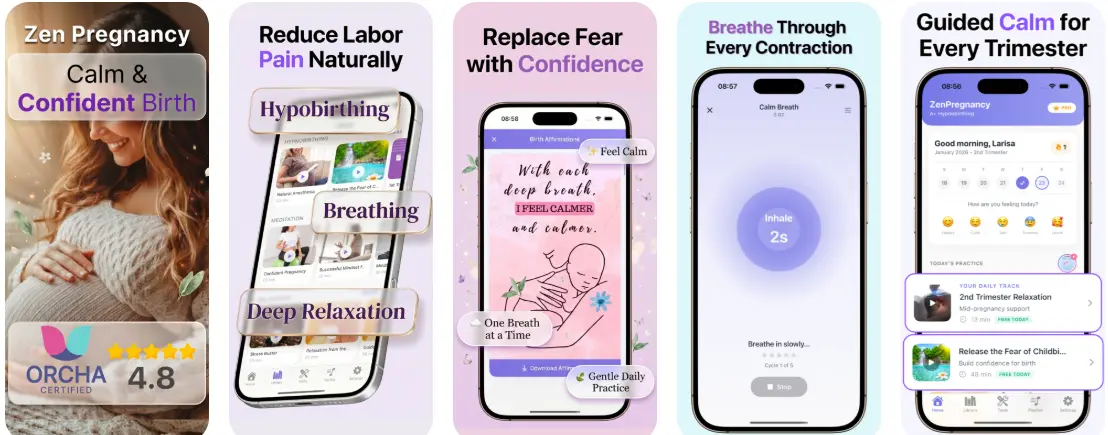
An app helps because birth preparation is mostly repetition, not one big learning session. HypnoBirth App is a hypnobirthing app that provides guided meditation, breathing exercises, contraction timing, and birth affirmations for pregnant women.
Many people start with a story that moves them, then build a daily routine around the exact tools they noticed: breath pacing, calm imagery, partner scripts, and affirmations. If you prefer practicing on your phone, the iOS hypnobirthing practice app and Android pregnancy wellness app make it easier to repeat short sessions in bed, on a walk, or during third-trimester rest. For a broader feature comparison, see this guide to the best hypnobirthing app for birth prep.
Hypnobirth App vs Expectful vs GentleBirth for Birth Prep
The best app depends on whether you want hypnobirthing-specific practice, general pregnancy meditation, or a structured mindfulness and hypnosis program. Here is a practical comparison for people using birth stories to shape daily preparation.
| App | Best fit | Helpful tools | Watch-outs |
|---|---|---|---|
| HypnoBirth App | Story-inspired hypnobirthing routines | Guided meditation, breathing, affirmations, contraction timer | Best if you want phone-based practice |
| Expectful | Pregnancy and postpartum meditation | Meditations, expert content, sleep support | Less focused on labor timing tools |
| GentleBirth | Hypnosis, mindfulness, and birth education | Hypno tracks, mindfulness, daily training | May feel more program-based |
No app can promise a specific birth outcome. Use digital tools alongside prenatal care, childbirth education, and medical guidance.
Natural Birth, Epidural, Induction, and C-Section Stories
Hypnobirthing stories are not only natural-birth stories. Some of the most reassuring accounts come from people who used the same calm tools during an epidural, induction, assisted birth, or cesarean and still felt present and respected.
For an induction, the practice might be breathing through cervical checks, using affirmations during the wait, and staying grounded as decisions change. With an epidural, it may mean resting deeply, releasing fear before placement, and using visualization for pushing. For cesarean birth, hypnobirthing can support steady breathing, surgical-room grounding, and emotional recovery, but it must sit within medical care. If surgery is possible or planned, this guide to hypnobirthing for C-section preparation explains how to adapt the tools safely with your care team.
Third Trimester Practice Timeline for Calm Birth
The third trimester is a good time to make hypnobirthing feel automatic. You do not need hours a day; 10 to 20 minutes of repeated practice, most days of the week, is often more realistic than a long session you rarely do.
A simple timeline works well. Around 28 to 32 weeks, learn the core breathing pattern and choose two or three audio tracks. From 32 to 36 weeks, add partner cues, affirmations, and position practice. From 36 weeks onward, rehearse early-labor routines: dim lights, shower, snack guidance from your provider, rest positions, and when to call. If you are already late in pregnancy, do not panic. This third-trimester hypnobirthing plan shows how to focus on the highest-value habits first.
Honest Assessment: What Birth Stories Cannot Tell You
Birth stories are meaningful, but they are incomplete. They can show what helped one person feel safer and calmer, but they cannot predict your labor, your baby’s position, your medical needs, or your emotional response on the day.
- Stories are selective; people may leave out fear, doubt, pain, conflict, or medical detail.
- A calm birth can still include tears, long labor, intervention, transfer, or surgery.
- Some people need trauma-informed support before using body-based relaxation or visualization.
- Medical conditions such as preeclampsia, placenta concerns, fetal growth issues, or previous surgery may change the plan.
- No breathing technique should delay urgent care or necessary monitoring.
This is not medical advice. Consult your healthcare provider before applying any birth-preparation method to your situation.
Common Mistakes When Chasing a Perfect Calm Birth
The biggest mistake is turning calm birth prep into another pressure test. Hypnobirthing is meant to reduce fear, not make you feel like you failed if you ask for pain relief, need induction, cry, swear, shake, or change your mind.
Another common mistake is only reading inspiring stories without practicing. Confidence grows when your body recognizes the breath, sound, and words before labor begins. People also sometimes choose stories that do not match their circumstances, then feel disappointed when birth looks different. Choose flexible goals instead: informed decisions, steady support, fewer panic spirals, and the ability to return to yourself after each contraction. A good birth plan leaves room for both preferences and medical judgment. Calm is a skill, not a performance.
Evidence and Safety for Hypnobirthing Birth Preparation
Evidence for hypnobirthing and childbirth hypnosis suggests possible benefits for anxiety, coping, and birth satisfaction, but results vary across studies. That means it is reasonable to use hypnobirthing as a supportive preparation tool, while staying realistic about pain, labor length, and medical uncertainty.
Safety comes from using hypnobirthing alongside care, not instead of it. Keep attending prenatal appointments, learn your unit’s guidance on when to call, and discuss reduced fetal movement, bleeding, severe headache, fever, waters breaking, or unusual pain promptly. The NHS also recommends making a birth plan that records preferences while allowing plans to change; their birth plan guidance is a helpful starting point. This is not medical advice. Always consult your healthcare provider.
Best Next Step for Turning Stories Into Confidence
The best next step is to choose one story, extract one skill, and practice it today. Do not wait until labor to find out whether a breath count, affirmation, visualization, or audio track helps your nervous system settle.
Try this tonight: listen to a short guided session, place one hand on your bump or chest, breathe out longer than you breathe in, and repeat one phrase such as, “I can meet this one wave.” Tomorrow, practice the same skill while walking or showering. HypnoBirth App can support that gentle repetition, but your care team, partner, doula, or childbirth educator can help personalize it. If this is your first baby, you may also like this guide to hypnobirthing for first-time moms.
Frequently Asked Questions
Do hypnobirthing success stories prove that hypnobirthing works?
No, hypnobirthing success stories do not prove that hypnobirthing works for everyone. They are personal experiences, not clinical evidence, but they can show how parents used breathing, relaxation, visualisation, partner support, and mindset tools during labour.
Can I use hypnobirthing if I plan to have an epidural?
Yes, you can use hypnobirthing with an epidural. Many parents use the techniques before the epidural, while waiting for pain relief, during rest periods, and for calm communication with their care team.
Is 38 weeks too late to start hypnobirthing?
No, 38 weeks is not too late to start hypnobirthing. Focus on simple, repeatable tools such as slow breathing, relaxation tracks, affirmations, and partner cue words rather than trying to complete a full course perfectly.
Can hypnobirthing help with pregnancy anxiety before birth?
Yes, hypnobirthing can help some people manage pregnancy anxiety by giving them calming routines to practise before labour. It is not a replacement for mental health care, so speak to a midwife, doctor, or qualified therapist if anxiety feels intense, persistent, or linked to trauma.
Is hypnobirthing useful for first-time moms?
Yes, hypnobirthing can be useful for first-time moms because it teaches practical ways to stay calm with unfamiliar labour sensations. Birth stories can also help first-time parents understand how plans may change while still using breathing, grounding, and decision-making tools.
Does hypnobirthing make labour pain-free?
No, hypnobirthing does not guarantee a pain-free birth. Some people feel calmer and more in control, but pain levels, labour progress, medical needs, and birth outcomes vary for every pregnancy.
Are negative birth stories bad to read during pregnancy?
No, negative birth stories are not always bad to read. Honest stories can help you prepare for different possibilities, but stop reading and seek professional support if they increase panic, fear, or trauma symptoms.
What happens if my birth plan changes during labour?
Hypnobirthing can still be useful if your birth plan changes. The core tools are breathing, relaxation, grounding, and communication, so they can support you during induction, assisted birth, caesarean birth, epidural use, or other unexpected changes.
Is hypnobirthing safe for a high-risk pregnancy?
Hypnobirthing is generally a relaxation and birth-preparation practice, but high-risk pregnancy needs personalised medical guidance. Always ask your midwife, obstetrician, or healthcare provider how to use any birth-preparation method safely alongside your care plan.
Is a hypnobirthing app as good as a hypnobirthing class?
A hypnobirthing app is not the same as a full class, but it can be a helpful way to practise regularly. Classes often offer teaching, questions, and personalised support, while apps are useful for guided audio, breathing practice, affirmations, and quick daily repetition.
Try HypnoBirth App Free
Guided hypnobirthing, pregnancy meditation, breathing, affirmations, and a contraction timer in one free app. ORCHA NHS certified, used by 200k+ mothers on iOS and Android.
Best for
- Daily hypnobirthing and pregnancy meditation practice
- Calm birth preparation before labor
Limitations
- Not a replacement for advice from your midwife, doctor, or care team
- Does not guarantee a specific birth outcome