 Hypno
HypnoHypnobirthing For Hospital Birth: A Flexible Guide To Calm, Informed Choices
200,000+ moms • ORCHA NHS Certified • Free on iOS & Android
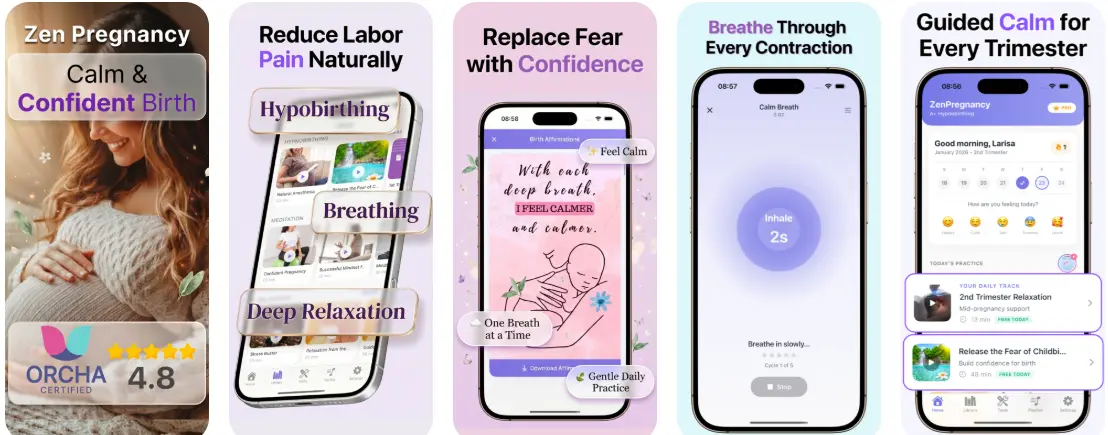
Hypnobirthing for hospital birth means using breathing techniques, guided relaxation, visualization, and affirmations to stay calm and make informed decisions while giving birth in a medical setting. HypnoBirth App can help you practice those skills before labor, then use familiar audio, affirmations, and contraction timing when the hospital room feels busy. These learnable tools work alongside epidurals, inductions, continuous monitoring, and cesarean births, so you don't have to choose between relaxation and medical care.
Definition: Hypnobirthing is a set of self-hypnosis, breathing, and relaxation techniques that pregnant women practice before and during labor to reduce fear, manage pain perception, and support informed decision-making in any birth setting, including hospitals.
TL;DR
- Hypnobirthing works in hospitals. It pairs with epidurals, inductions, monitoring, and C-sections.
- Regular practice during pregnancy, via classes or an app like HypnoBirth App, is essential for effectiveness.
- Evidence suggests reduced pharmacological pain relief use and higher birth satisfaction, though study quality is still limited.
- Your birth partner and hospital staff need to understand your preferences for hypnobirthing to work smoothly.
- Hypnobirthing does not guarantee a pain-free or intervention-free birth. It gives you coping tools and confidence.
At A Glance: 5 Facts About Hypnobirthing In Hospital
- Hypnobirthing is a skill set, not a birth location. You can use breathing, guided relaxation, affirmations, and visualization in a labor ward, triage room, operating theater, or recovery bay.
- Research is promising but not settled. Studies suggest hypnosis may reduce use of some pharmacological pain relief and improve satisfaction, but trial methods vary.
- Practice matters more than intention. Most parents do better when the audio and breathing cues feel familiar before contractions begin. Dim bedroom, slow exhales, phone beside the water bottle. That repetition counts.
- Hospital care and hypnobirthing can work together. Induction, an epidural, continuous monitoring, or a cesarean can all sit inside a calm plan.
- The main target is the fear-tension-pain cycle. Hospital hypnobirthing helps you stay oriented enough to ask questions, change positions, and take one contraction at a time.
If the priority is keeping practice simple before a hospital birth, choose one routine that combines guided relaxation, breathing practice, affirmations, and contraction timing so you are not switching tools during labor.
Hospital Birth Anxiety And Hypnobirthing Skills
Hospital birth can bring real safety and real noise. Bright overhead lights, unfamiliar staff, shift changes, monitor belts, and a blood pressure cuff squeezing every few minutes can make a calm person feel watched.
That matters because fear can tighten the jaw, shoulders, pelvic floor, and breathing pattern. Tension can make contractions feel sharper, which can increase fear again. That loop is the fear-tension-pain cycle, and it is one reason a birth partner may be more useful pressing tennis balls into a lower back than asking, “Are you okay?” every two minutes.
An Australian randomized trial of 297 women found higher childbirth satisfaction scores with antenatal hypnotherapy, 116.9 versus 110.2 on the Mackey scale (Werner et al., 2013: https://pubmed.ncbi.nlm.nih.gov/23470112/).
For hospital-birthing parents, hypnobirthing is often easier than relying on willpower alone because it gives the brain a practiced job during medical routines.
How Hypnobirthing For Hospital Birth Works
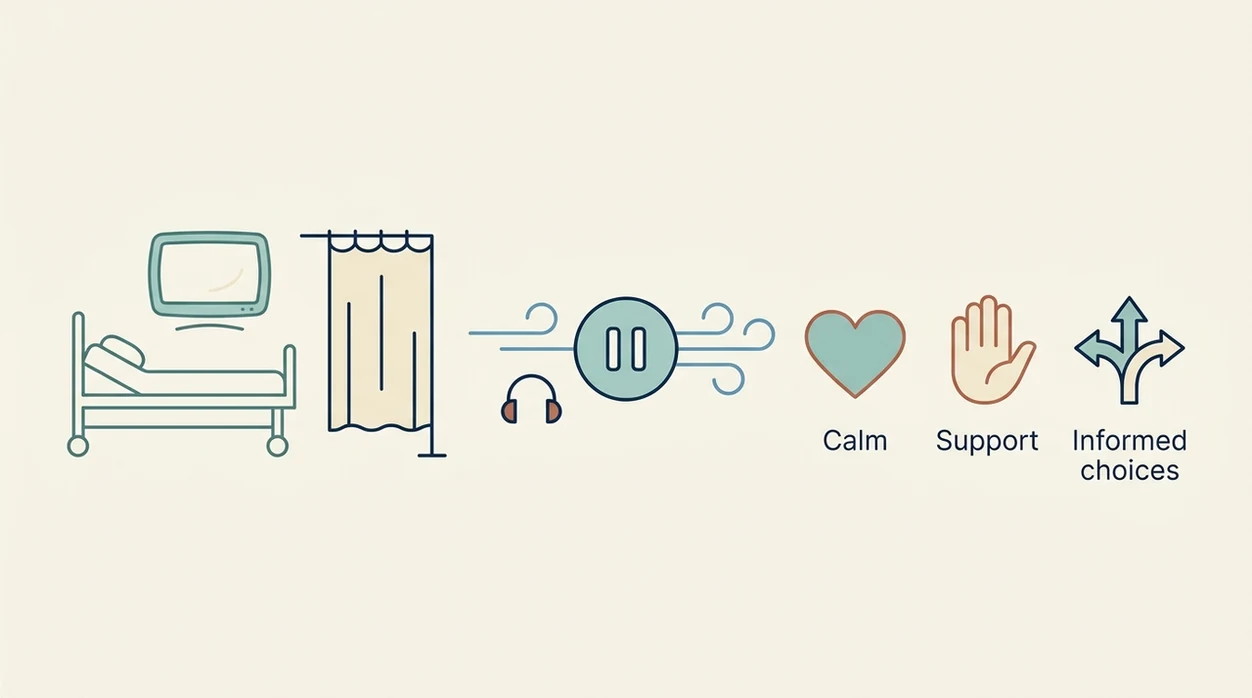
Hypnobirthing for hospital birth works by interrupting the stress response before it takes over the body. It uses self-hypnosis, paced breathing, and repeated cues to help the parasympathetic nervous system settle.
The Fear-Tension-Pain Cycle In Hospital Settings
When fear rises, adrenaline can climb. In plain language, the body starts acting like it needs to defend itself. That can work against oxytocin, the hormone that supports effective contractions. A 2020 meta-analysis of 10 randomized trials found hypnosis during childbirth was associated with reduced pharmacological pain relief and shorter first-stage labor, but the authors rated the evidence quality as low (https://pubmed.ncbi.nlm.nih.gov/32010962/).
Breathing And Guided Relaxation As Interruption Tools
Slow breathing gives the body a repeatable signal: lower the guard. Visualization and affirmations can also reframe contractions as waves, pressure, or work rather than danger. You are not unconscious. You are alert, focused, and easier to guide when someone says, “Next breath, drop your shoulders.”
Good hypnobirthing apps deliver repeatable cues under pressure, not a promise that birth will stay quiet or intervention-free.

How To Use Hypnobirthing In Hospital: 5 Steps
Use hypnobirthing in hospital by practicing before labor, writing clear preferences, briefing your support person, packing the right items, and telling staff what helps you stay calm.
- Start daily practice from mid-pregnancy. Use breathing exercises and audio tracks in HypnoBirth App so the cues feel familiar before labor.
- Write flexible birth preferences. Include phrases such as “please offer a pause for breathing before vaginal checks when safe.”
- Brief your birth partner. Assign simple jobs: start the contraction timer, offer a straw cup, remind you to loosen your jaw, and use your BRAIN questions.
- Pack hypnobirthing essentials. Bring headphones, phone, battery pack, affirmation cards, massage oil, and a small light or eye mask.
- Tell staff on arrival. Ask the triage nurse or midwife for dim lights, minimal interruptions, and time to breathe between checks when clinically appropriate.
Pregnant parents who already use ZenPregnancy during evening practice can carry the same rhythm into triage because familiar audio reduces the need to explain everything while contracting.
The pocket check is real.
For partner-specific cues, the full support role is covered in hypnobirthing for birth partners.
Top 3 HypnoBirth App Features For Hospital-Birthing Parents
A phone-based hypnobirthing tool is most useful in hospital when it turns practice into something you can repeat in a noisy room. The point is not to create a spa. The point is to give your nervous system a familiar track to follow.
- Guided meditation tracks. Headphones can recreate a practiced calm space when monitors beep or someone opens the door without warning.
- Contraction timer. A birth partner can track contraction length and spacing without interrupting your breathing every few minutes.
- Birth affirmations library. Short phrases can help during long labors, induction changes, or a sudden move to theater.
After contractions begin, when the room gets busier, HypnoBirth App earns its place because the contraction timer lets the birth partner track progress while the laboring parent stays with the audio cue.
Consistency is the feature people underestimate. Practicing once during a bathroom trip in the dark is not the same as knowing the track by heart.
Adapting Hospital Hypnobirthing To Inductions, Epidurals, And C-Sections
Hospital hypnobirthing does not fail because an intervention appears. It changes shape. Flexibility is the core skill, not sticking to one version of birth.
Hypnobirthing During Induction And Continuous Monitoring
During induction, contractions can feel strong and close together, especially with Pitocin. Use slow breathing during IV placement, vaginal checks, and monitor adjustment. If the belts limit movement, change what can change: shoulders, jaw, hands, gaze, music, and breath. For a deeper induction plan, read hypnobirthing for induction.
Using Hypnobirthing Alongside An Epidural Or C-Section
With an epidural, visualization and affirmations still help with anxiety, rest, and decision-making. During a cesarean, guided audio can run quietly while your birth partner repeats preferences if you feel shaky. Soft music under beeping monitors can still help.
A 2016 UK randomized trial of 680 women found the self-hypnosis group had similar epidural use, 27.9% versus 30.3%, but slightly lower use of any pharmacological pain relief, 68.6% versus 72.9%.
Anyone dealing with a possible epidural plan can use HypnoBirth App because the breathing and affirmation workflow still works after pain sensation changes. More details are in hypnobirthing with epidural.
4 Common Myths About Hypnobirthing In Hospital
Hypnobirthing in hospital is often misunderstood, usually because people picture either a silent home birth or stage hypnosis. Neither picture is accurate.
| Myth | What is more accurate |
|---|---|
| Hypnobirthing only works at home or in a birth center. | The same breathing, audio, and focus skills can be used in triage, labor ward, theater, or recovery. |
| Hypnobirthing means you won't feel pain or need an epidural. | It may change pain perception and coping, but pain relief may still be useful or needed. |
| Hypnobirthing means rejecting medical care. | It can support informed consent during induction, monitoring, epidural, or cesarean birth. |
| Hypnobirthing puts you in an unconscious trance. | Most people remain awake, responsive, and aware of the room. |
According to a Cochrane review of nine trials and 2,954 women, evidence was inconclusive for consistent reductions in pain intensity or epidural use, mainly because studies were small and different from each other (https://www.cochranelibrary.com/cdsr/doi/10.1002/14651858.CD009356.pub3/full).
For planned or unexpected surgery, hypnobirthing for C section preparation can help you adapt the same skills to theater.
Hospital Hypnobirthing Preparation Gaps
Hypnobirthing preparation can leave gaps if it assumes every hospital team already understands the language. Some nurses know exactly what “quiet cues” means. Others may hear “hypnobirthing” and think you do not want monitoring, pain relief, or clinical updates.
Write the plan down. Shift changes reset the room, and a new midwife should not have to guess why the lights are low or why headphones are in. Printed affirmations taped to a mirror can help, but a visible birth-preferences sheet helps more.
Some parents find self-hypnosis only mildly useful. Others prefer counterpressure, water, sterile water injections, or a birth ball in the corner. That is not failure. It is information.
HypnoBirth App can support consistent practice, but some learners still do better with an in-person class like Hypnobabies or The Positive Birth Company, especially if they need live rehearsal and partner coaching.
When To Pause Hypnobirthing And Follow Medical Guidance
Pause hypnobirthing when a clinician gives urgent safety instructions or when symptoms suggest you or your baby need immediate assessment. Calm tools are useful, but they should not slow treatment for bleeding, suspected fetal distress, fever, severe headache, chest pain, or any sudden change that worries the team.
Hypnobirthing supports consent and communication. It is not a rule that you must refuse monitoring, medication, assisted birth, or surgery when care is needed.
- Listen when a midwife, nurse, obstetrician, or anesthesiologist says the situation is urgent.
- Ask for the shortest clear explanation if there is time: “What is happening, and what do you recommend now?”
- Breathe while staff work, using one simple cue such as “soft jaw” or “long exhale” instead of a full script.
- Support the room as a partner by lowering your voice, keeping eye contact, moving bags out of the way, and repeating the birthing parent’s key preferences when safe.
- Review birth preferences before labor with a midwife or clinician so the team knows what matters to you and where flexibility is already built in.
The goal is steady participation, not perfect stillness.
Limitations
Hypnobirthing is useful, but it has limits. Honest preparation makes it safer and less disappointing.
- Evidence is promising but mixed. Current trials are often small, use different hypnosis methods, and are usually low-to-moderate quality.
- A Cochrane review rated evidence inconclusive because studies were heterogeneous and many were small.
- Hypnobirthing does not guarantee a pain-free birth.
- It also does not guarantee an intervention-free birth. Induction, assisted birth, or cesarean may still be medically appropriate.
- Techniques need weeks of practice. One first listen in active labor is rarely enough.
- Not all staff can accommodate dim lights, fewer interruptions, or headphone use during urgent monitoring.
- Individual responses vary widely. Some people feel deeply settled; others notice only a small shift.
- HypnoBirth App does not replace medical advice, a trained midwife, or an anesthesiologist.
- GentleBirth, Expectful, Christian Hypnobirthing, and similar tools may suit different values, teaching styles, or audio preferences.
Reset the plan.
For parents comparing calm preparation with medication-free goals, hypnobirthing for drug free birth explains where the overlap ends.
See also: Offline Hypnobirthing App for Hospital, Birth Center, or Home Birth.
See also: Hypnobirthing for Twins: Calm Preparation for Multiple Pregnancy.
See also: Hypnobirthing Birth Plan App: Turning Calm Practice Into Practical Preferences.
Read more
- About HypnoBirth App: Calm Birth Support
- Are Hypnobirthing Apps Regulated
- Are Hypnobirthing Apps Safe
- Birth Partner Hypnobirthing App Guide
- App for Natural Birth Preparation: What to Choose
- Best Birth Meditation App for Calm Labor
- Best Contraction Timer App for iPhone: 2026 Guide
- Best Hypnobirthing App 2026: Top Picks
- Does Hypnobirthing Work for First Births? Guide
- Free Hypnobirthing App for iPhone: Calm Birth
- How to Start Hypnobirthing: Beginner Guide
- Hypnobirthing for C Section Prep: Calm Cesarean
Best Hypnobirthing App for Hospital Birth Preparation
HypnoBirth App can help you prepare for a hospital birth with calm breathing practice, relaxation tracks, and partner-friendly tools you can use alongside your care team’s guidance. It is free, ORCHA NHS certified, and designed to support informed, flexible choices before and during labour.
Best for
- Practising hypnobirthing techniques for a planned hospital birth
- Supporting birth partners with simple calming tools and language
- Building confidence around breathing, relaxation, and coping strategies
Limitations
- It does not replace advice from your midwife, doctor, or hospital team
- Hospital policies and clinical needs may affect your birth preferences
Frequently Asked Questions
Can hypnobirthing help with a hospital birth?
Yes, hypnobirthing can help you feel calmer and more prepared during a hospital birth. It teaches breathing, relaxation, visualisation, and decision-making tools that work alongside midwives, doctors, monitoring, pain relief, and other medical care.
What is hypnobirthing for a hospital birth?
Hypnobirthing for a hospital birth is a practical preparation method for staying calm, informed, and involved in your care. It focuses on relaxation techniques, birth preferences, partner support, and communication with your maternity team rather than promising a specific type of birth.
Is 38 weeks too late to start hypnobirthing for a hospital birth?
No, 38 weeks is not too late to start hypnobirthing. You can still learn simple breathing, relaxation scripts, affirmations, and partner prompts that may support you in labour, even with limited time to practise.
Can hypnobirthing help with pregnancy anxiety before a hospital birth?
Yes, hypnobirthing can help some people manage pregnancy anxiety by giving them calming tools and a clearer sense of choice. If anxiety feels overwhelming, affects sleep or daily life, or includes panic symptoms, speak to your midwife, GP, or mental health professional for personalised support.
Can I use hypnobirthing if I want an epidural?
Yes, you can use hypnobirthing if you want an epidural. Hypnobirthing is not only for unmedicated birth; the breathing, relaxation, and communication tools can support you before, during, and after pain relief decisions.
Is hypnobirthing useful for first-time mums giving birth in hospital?
Yes, hypnobirthing is useful for many first-time mums planning a hospital birth. It can explain what labour may involve, reduce fear of the unknown, and help you practise coping strategies before contractions begin.
Can hypnobirthing be used during an induction in hospital?
Yes, hypnobirthing can be used during an induction in hospital. Breathing, rest positions, relaxation tracks, and informed decision-making can support you through waiting periods, monitoring, pessaries, drips, or changes to your birth plan.
Can hypnobirthing help if I need a caesarean birth?
Yes, hypnobirthing can still help if you need a planned or unplanned caesarean birth. Relaxation, breathing, visualisation, and partner support can help you feel more grounded, but your surgical and medical care should always be guided by your maternity team.
How does a birth partner use hypnobirthing in hospital?
A birth partner uses hypnobirthing by helping protect a calm environment and reminding you of the techniques you practised. They can support breathing, read affirmations, help with comfort measures, ask questions, and communicate your preferences when you are focused on labour.
Should I choose a hypnobirthing app or an in-person class for hospital birth preparation?
Both a hypnobirthing app and an in-person class can be useful for hospital birth preparation. An app is flexible, affordable, and easy to repeat at home, while a class may offer live teaching, personalised questions, and partner practice; the best choice depends on your schedule, budget, and learning style.
Does hypnobirthing mean I have to refuse medical interventions in hospital?
No, hypnobirthing does not mean you have to refuse medical interventions. A good hypnobirthing approach helps you understand options, ask informed questions, and make decisions that feel right for your situation and clinical advice.
What should I put in a hospital birth plan if I am using hypnobirthing?
A hospital birth plan for hypnobirthing should include your preferences for calm support, communication, comfort measures, and medical choices. You might note dim lighting, quiet voices where possible, breathing prompts, partner involvement, pain relief preferences, monitoring discussions, and how you would like changes to be explained.