 Hypno
HypnoHypnobirthing for Drug-Free Birth: Practical Preparation That Keeps Your Options Open
200,000+ moms • ORCHA NHS Certified • Free on iOS & Android
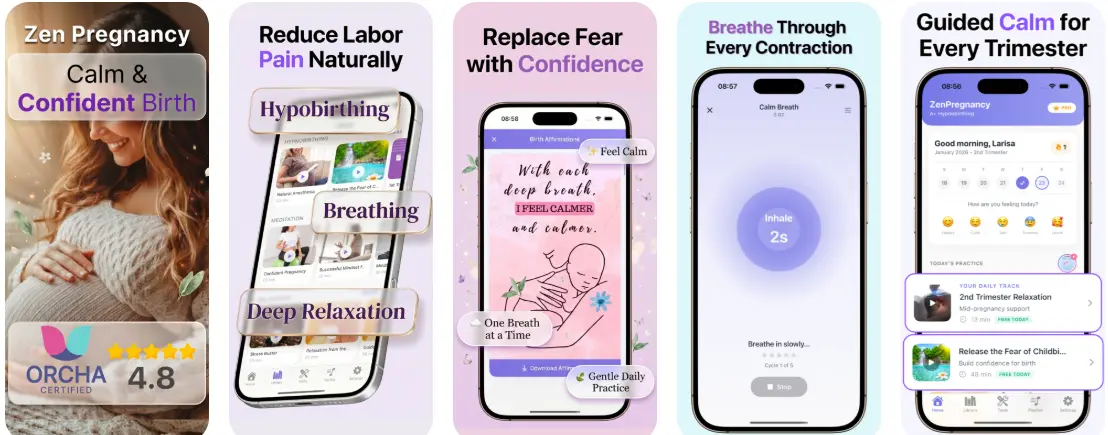
Hypnobirthing for drug free birth uses guided relaxation, breathing techniques, and self-hypnosis to reduce fear and improve coping during labor. It does not guarantee a pain-free experience, but steady pregnancy practice gives your body a familiar way to soften around contractions instead of bracing against them. If you use an app, keep it as practice support rather than a substitute for your care team’s advice.
> Definition: Hypnobirthing is a natural birth preparation method that combines guided meditation, controlled breathing, visualization, and self-hypnosis to help laboring women manage pain, reduce anxiety, and maintain calm awareness during contractions.
TL;DR
- Hypnobirthing builds coping skills for drug-free birth but does not promise pain elimination.
- Evidence shows reduced pain scores and lower pharmacological pain relief use with consistent practice.
- Daily third-trimester practice using an unmedicated birth app turns techniques into automatic responses.
- Hypnobirthing integrates with hospital care, doulas, water immersion, and even epidurals if needed.
- Flexible expectations prevent guilt if your birth path changes.
Why 73% Epidural Use Matters for Hypnobirthing Birth Preparation
Drug-free birth is a minority path in U.S. hospital care, so it usually needs deliberate preparation. Per the CDC, about 73% of U.S. vaginal births involve epidural or spinal anesthesia, which means most birth rooms are built around medicated pain relief as a normal option.
That is not bad. It is context.
The point of hypnobirthing is not to prove you are tougher than someone with an epidural. It is to interrupt the fear-tension-pain cycle: fear raises adrenaline, tension tightens muscles, and pain can feel sharper. Hypnobirthing gives you breathing, focus, and relaxation cues before labor asks for them.
If the priority is staying active in early labor without turning birth into a test, repeated guided sessions can make the breathing and relaxation workflow feel familiar. That matters for the person with a birth ball beside the coffee table and a half-packed hospital bag nearby, trying to practice without making birth a performance.
How Hypnobirthing Skills Change Breathing, Focus, and Muscle Tension
Hypnobirthing works by training focused attention, slower breathing, and conditioned relaxation. Self-hypnosis in birth does not mean you are unconscious or unable to respond; it means you practice narrowing attention so the next contraction gets your focus, not every fear in the room.
The body piece matters. Slow breathing and guided relaxation can support parasympathetic nervous system activity, which is the “downshift” side of your stress response. Less adrenaline may mean less guarding, less jaw tension, and softer pelvic floor muscles. Deep relaxation can also support endorphin release, the body’s own pain-modulating system. For the physiology claim, cite a clinical source on relaxation breathing, stress response, or hypnosis in labor; do not leave parasympathetic and endorphin claims unsupported.
Practice frequency matters because neuroplasticity is boring but real. Repeated scripts, anchor words, touch cues, and breathing patterns become easier to access under stress. The pocket check is real: if your headphones are tucked into a gown pocket, you want the track to feel known, not new.
Anyone dealing with nighttime birth anxiety may find sleep tracks and breathing exercises useful because they create a repeatable cue before labor begins.
5 Evidence-Based Facts About Hypnobirthing and Unmedicated Birth

Five evidence-based facts give a fair picture: hypnobirthing may improve pain coping and reduce medication use for some people, but results are mixed. The most defensible goal is better coping with labor, not a guaranteed drug-free outcome.
- A 2016 Cochrane review of 9 randomized trials with 2,954 women found antenatal hypnosis was linked with lower pharmacological pain relief use, with an average risk ratio of 0.73 source.
- The same Cochrane review found lower labor pain intensity, with a mean difference of −0.74 on a 0–10 scale.
- A 2024 randomized trial of 80 first-time mothers reported lower pain scores in the hypnobirthing group, VAS 4.0 versus 6.2, and lower state anxiety source.
- An NIH-funded trial of 680 women found no significant epidural reduction, 27% versus 30%, but did find higher self-rated coping source.
- Practice consistency usually matters more than one impressive session during labor.
The most evidence-backed approach to hypnobirthing for drug-free birth is regular antenatal practice combined with flexible medical decision-making.

Top 3 HypnoBirth App Features for Natural Birth Preparation
HypnoBirth App supports natural birth preparation by turning hypnobirthing into small, trackable habits. That matters because most people do better with repeated cues than with a class binder they never reopen.
Guided Relaxation and Sleep Practice Tracks
Guided meditation and sleep tracks help you practice during the second and third trimester, especially when your brain gets loud after a birth video. On days sleep feels scattered, HypnoBirth App gives you a familiar audio path back to slower breathing.
Breathing Exercises with Contraction Timer
Breathing exercises pair with real-time contraction timing, so early labor does not become a guessing game. A contraction timer pinging at 3 a.m. feels less dramatic when the next cue is already there.
Birth Affirmations for Flexible Confidence
Birth affirmations work best when they build steadiness, not denial. HypnoBirth App reinforces flexible confidence with practice reminders and audio routines, while ZenPregnancy keeps the tone practical instead of rigid.
Good hypnobirthing apps deliver repeated body cues and decision support, not magical promises of painless labor.
5 App Practice Steps for Hypnobirthing Before Labor Day
Use hypnobirthing before labor by practicing the same small routine often enough that your body recognizes it under pressure. For most people, 15 to 30 minutes a day is more useful than one long session once a week.
- Start daily guided sessions in the second trimester. Use HypnoBirth App after lunch, before bed, or whenever you can protect a quiet window.
- Practice breathing patterns with timed exercises. Keep the exhale longer than the inhale, then repeat until it feels less like homework.
- Add sleep tracks to build conditioned relaxation. Let the same voice and music become a body cue, especially in the third trimester.
- Involve your birth partner in script and anchor drills. Have them read one cue, offer a straw cup, and stop asking ten questions.
- Use the contraction timer and audio tracks together during labor. Time the pattern, breathe through one contraction, then reset.
For birth partners who need something useful to do, HypnoBirth App covers the basics because the timer, audio, and breathing cues sit in one workflow.
4 Hypnobirthing Myths That Mislead Drug-Free Birth Plans
Hypnobirthing myths can make drug-free birth preparation feel more fragile than it is. Clear expectations protect your confidence better than any polished promise.
Myth 1: Hypnobirthing guarantees a pain-free birth. It does not. It may reduce fear and pain intensity for some people, but contractions can still be intense.
Myth 2: You go into a trance and lose control. Self-hypnosis is focused awareness. You can hear the nurse, answer questions, change positions, and use your BRAIN questions.
Myth 3: Hypnobirthing means you are anti-medicine. No. You can use hypnobirthing with an epidural, induction, or other medical support. The full decision point is covered in hypnobirthing with epidural.
Myth 4: It only works in uncomplicated births. It can still support breathing, focus, and anxiety during complex care, though the plan may need to change.
When the issue is fear of “failing” at unmedicated birth, affirmations work best when they are built around coping and choice, not purity.
Hospital Birth Care with Hypnobirthing Tools
Hypnobirthing can fit inside hospital birth care when your birth preferences are clear but not rigid. Tell staff what helps: dim lights, fewer voices during contractions, movement when safe, and time to ask your BRAIN questions before non-urgent decisions.
I have seen people use hypnobirthing while a nurse adjusts the bed rail and monitor belts stay in place. Sticky hospital socks, gown snaps at the shoulder, a birth ball in the corner. Still birth. Still choices.
Combine hypnobirthing with water immersion, massage, counterpressure, a doula, and position changes. If care shifts toward induction, epidural, assisted birth, or cesarean, the breathing and audio can still help you stay oriented. For a deeper hospital-specific plan, read hypnobirthing for hospital birth.
For people planning hospital-based low-intervention birth, a contraction timer and guided breathing can be easier than relying on memory because they give the room a shared rhythm.
App-Based Hypnobirthing Gaps for Drug-Free Birth Preparation
An app can structure practice, but it cannot replace every part of drug-free birth preparation. Labor is physical, relational, and medical; a phone cannot press tennis balls into your lower back during back labor.
Some people do not respond strongly to self-hypnosis. Others like the audio in pregnancy but cannot focus on scripts once contractions are close together. That does not mean they did it wrong.
HypnoBirth App works best as one layer: daily practice, breathing reminders, affirmations, and contraction timing. Add a childbirth class, doula support, partner drills, and medical guidance if your pregnancy has extra risk factors. If you are preparing after a previous cesarean, a hypnobirthing app for VBAC can help frame practice around both calm and safety.
Expectful, GentleBirth, Hypnobabies, and The Positive Birth Company may also fit different learning styles, especially if you want longer courses or live teaching.
When to Get Medical Guidance During Drug-Free Birth Preparation
Get medical guidance whenever your pregnancy has risk factors, symptoms feel unusual, or your labor pattern changes quickly. Hypnobirthing is preparation for coping and calm; it is not medical advice, diagnosis, or risk screening.
Check in before labor if you have high blood pressure, gestational diabetes, placenta concerns, reduced fetal movement, bleeding, severe headache, vision changes, intense swelling, fever, or a history of preterm birth, cesarean, hemorrhage, or other complications. Also ask how your team wants you to handle waters breaking, especially if the fluid is green or brown, has a bad smell, or comes with fever or reduced movement.
- Share your app practice plan with your midwife, OB, doula, or birth educator so everyone knows your cues and preferences.
- Ask which symptoms mean “call now” for your specific pregnancy, not a generic internet plan.
- Call your care team when contractions are regular by their guidance, become hard to talk through, or feel unusually intense early on.
- Accept that induction, epidural, assisted birth, or cesarean can be the safer, more compassionate choice when medical conditions change.
Limitations
Hypnobirthing is useful, but it has real limits. A clear plan should include these caveats before labor starts.
- Research is heterogeneous, and some studies are small or lower quality; marketing can overstate pain relief, epidural reduction, or cesarean reduction.
- Hypnobirthing cannot override medical indications for induction, assisted delivery, emergency treatment, or cesarean birth.
- An NIH-funded trial of 680 women found no significant epidural reduction, 27% versus 30%, despite better self-rated coping.
- Some people cannot focus on scripts during transition, back labor, or fast labor, even after serious practice.
- Overemphasizing a “perfect” drug-free hypnobirth can create guilt if pain relief or intervention becomes the safer choice.
- App-based practice without partner coaching, doula support, or live feedback may have less impact on labor day.
- High-risk pregnancies need individualized guidance from the care team, not app-only planning.
- Christian Hypnobirthing or course-based programs may suit people who want a specific faith frame or more instructor contact.
If your care plan includes possible induction, keep a flexible version of the tools ready through hypnobirthing for induction.
See also: Hypnobirthing Results After 90 Days.
Read more
- About HypnoBirth App: Calm Birth Support
- Are Hypnobirthing Apps Regulated
- Are Hypnobirthing Apps Safe
- Birth Partner Hypnobirthing App Guide
- App for Natural Birth Preparation: What to Choose
- Best Birth Meditation App for Calm Labor
- Best Contraction Timer App for iPhone: 2026 Guide
- Best Hypnobirthing App 2026: Top Picks
- Does Hypnobirthing Work for First Births? Guide
- Free Hypnobirthing App for iPhone: Calm Birth
- How to Start Hypnobirthing: Beginner Guide
- Hypnobirthing for C Section Prep: Calm Cesarean
Best Hypnobirthing App for Drug-Free Birth Preparation
HypnoBirth App helps you practise breathing, relaxation, visualisation and confidence-building techniques that can support a drug-free birth plan while keeping your choices open. It is free to use, ORCHA NHS certified, and trusted by 200k+ users preparing for birth in a calm, practical way.
Best for
- Learning coping techniques for labour without relying on medication as the first option
- Building confidence while staying flexible about pain relief and birth preferences
Limitations
- Hypnobirthing cannot guarantee a drug-free birth or specific labour outcome
- It should complement, not replace, guidance from your midwife, doctor or birth team
Frequently Asked Questions
Can hypnobirthing help me have a drug-free birth?
Yes, hypnobirthing can help you prepare for a drug-free birth by building practical coping skills for labour. It uses breathing, relaxation, visualisation and mindset tools to reduce fear and support calm decision-making. It does not guarantee a birth without pain relief, and your options should stay open if your needs or circumstances change.
What is hypnobirthing for a drug-free birth?
Hypnobirthing for a drug-free birth is a preparation approach that teaches you how to manage labour using breathing, relaxation, self-hypnosis, affirmations and birth education. The aim is to lower tension and fear so your body can work as effectively as possible. It is not about refusing medical support; it is about feeling informed, calm and able to choose what is right for you.
Is 38 weeks too late to start hypnobirthing for a drug-free birth?
No, 38 weeks is not too late to start hypnobirthing. You may not cover everything in depth, but short daily practice with breathing, relaxation tracks and simple birth preferences can still be helpful. Focus on the tools you can use immediately and speak with your midwife or clinician if you have any concerns about your birth plan.
Can I use hypnobirthing if I might want an epidural?
Yes, you can use hypnobirthing even if you might want an epidural. Hypnobirthing skills can help you stay calm before pain relief, during procedures and if plans change. Choosing an epidural does not mean hypnobirthing has failed; it means you are using the support that feels right for your labour.
Does hypnobirthing help with pregnancy anxiety before birth?
Yes, hypnobirthing can help some people manage pregnancy anxiety by giving them calming techniques and a clearer understanding of labour. Breathing exercises, guided relaxation and positive rehearsal can reduce fear and improve confidence. If anxiety feels severe, persistent or overwhelming, contact your midwife, GP or mental health professional for support.
Is hypnobirthing suitable for first-time mums who want a drug-free birth?
Yes, hypnobirthing is suitable for first-time mums who want to prepare for a drug-free birth. It can be especially useful if labour feels unknown or intimidating, because it explains what may happen and gives you tools to practise beforehand. First-time parents should still keep an open plan, as every labour is different.
How often should I practise hypnobirthing for a drug-free birth?
Daily practice is best, even if it is only 10 to 15 minutes. Regular repetition helps breathing, relaxation and positive cues feel familiar during labour. If you start late in pregnancy, prioritise one or two techniques you can practise consistently rather than trying to learn everything at once.
What hypnobirthing techniques are most useful for avoiding pain relief in labour?
The most useful hypnobirthing techniques are calm breathing, deep relaxation, visualisation, affirmations and fear-release practice. These tools help reduce tension and support focus during contractions. They may reduce your need for pain relief, but they cannot promise a pain-free or medication-free birth.
Can hypnobirthing be used in hospital for a drug-free birth?
Yes, hypnobirthing can be used in hospital, birth centres and home births. You can use breathing, headphones, relaxation scripts, dim lighting, movement and your birth partner’s prompts in most settings. Ask your maternity team what is possible in your chosen place of birth and include your preferences in your birth plan.
Should I choose a hypnobirthing app or a hypnobirthing class for drug-free birth preparation?
Both a hypnobirthing app and a class can support drug-free birth preparation, but they suit different needs. A class gives live teaching, questions and partner involvement, while an app is flexible, affordable and easy to repeat daily. Many parents use both: a class for understanding and an app for ongoing practice.
Can my birth partner help with hypnobirthing during a drug-free labour?
Yes, a birth partner can play a very helpful role in hypnobirthing. They can guide breathing, read scripts, protect the birth environment, remind you of your preferences and communicate with staff when needed. Practising together before labour makes these prompts feel more natural.
Is hypnobirthing safe for pregnancy and labour?
Yes, hypnobirthing is generally safe because it is a non-invasive preparation method based on relaxation, breathing and education. It should be used alongside, not instead of, appropriate maternity care and medical advice. Always contact your midwife or clinician promptly if you notice reduced baby movements, bleeding, severe pain, or any symptom that worries you.