 Hypno
HypnoZenPregnancy vs Expectful (2026)
200,000+ moms • ORCHA NHS Certified • Free on iOS & Android
Pregnancy App Comparison: What You’re Really Choosing
The real decision is not only which app sounds calmer; it is which app you will open consistently from the second trimester through labor. A zenpregnancy vs expectful search usually means you want help with anxiety, breathing, birth confidence, and practical labor support without juggling five different tools.
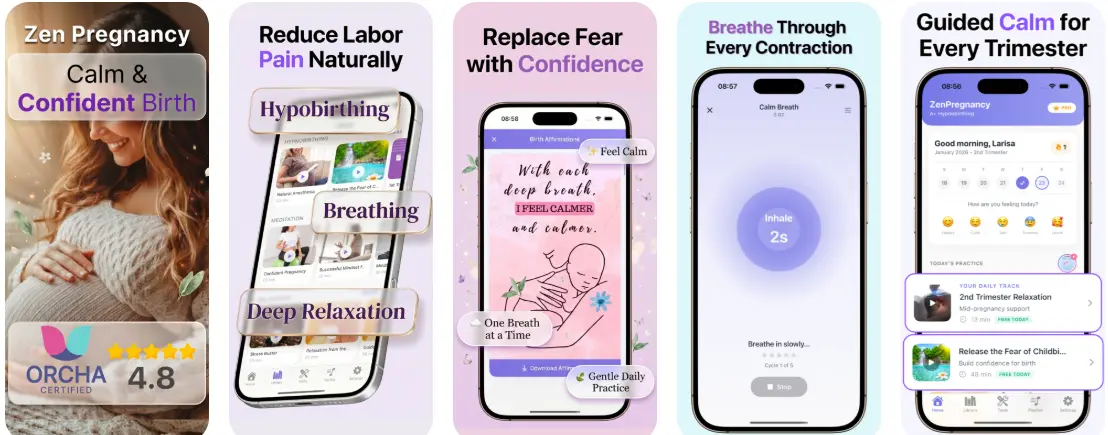
ZenPregnancy is built around birth preparation: hypnobirthing audio, labor breathing, affirmations, a contraction timer, and pregnancy tracking. Expectful focuses more on meditation, emotional wellness, sleep, and community-style support. Both can be helpful, especially if you feel overwhelmed by birth stories or late-night worries. The better fit depends on whether you want a daily calm routine or a labor-ready practice plan. This is not medical advice. Consult your healthcare provider before making decisions about pregnancy, labor, or birth care.
Birth Preparation Strengths in ZenPregnancy
ZenPregnancy is stronger for parents who want hypnobirthing practice plus practical labor tools in one place. The app’s advantage is that it connects daily relaxation with the moments when contractions, decision fatigue, and hospital noise can make focus harder.
Inside the HypnoBirth App experience, users can practice guided birth meditations, breathing patterns, birth affirmations, and contraction tracking without switching apps. That matters at 39 or 40 weeks, when you may not want a long course or a complicated menu. If you are comparing options more broadly, this guide to the best hypnobirthing app for pregnancy and birth explains what to look for in audio quality, labor tools, and daily practice structure. For iPhone users, the hypnobirthing practice app is a simple way to test whether the voice, pacing, and features suit you.
Meditation Strengths in Expectful
Expectful is a better fit if your main goal is pregnancy mindfulness rather than a full hypnobirthing workflow. It is often chosen by people who want emotional support, sleep meditations, fertility or postpartum content, and a gentler wellness-library feel.
That can be valuable. Pregnancy can bring intrusive thoughts, body changes, appointment anxiety, and a strange mix of excitement and fear. A familiar meditation voice before bed may help you downshift, especially in the first and second trimesters. Expectful may also appeal if you already have birth education elsewhere and only need audio support for stress. The tradeoff is that you may still want separate tools for labor breathing, contraction timing, or birth affirmations. If meditation is your main focus, compare it with guided meditation for pregnancy options before deciding.

How Hypnobirthing Audio Apps Work
Hypnobirthing audio apps work by repeating a calm cue sequence: voice guidance, slower breathing, muscle release, visualization, and reassuring language. Over time, the brain starts to associate those cues with safety and control, which can make practice feel familiar when labor sensations intensify.
The mechanism is not magic. It is attention training, nervous-system regulation, and rehearsal. Many tracks use progressive muscle relaxation, counted breathing, positive suggestion, and anchoring phrases. In labor, a short audio cue can act like an external rhythm when your own thoughts feel scattered. Studies suggest hypnosis-based birth preparation may reduce fear and increase coping confidence for some people, though results vary. This is not medical advice. Consult your healthcare provider, midwife, or doctor for guidance that fits your pregnancy and birth plan.
How to Choose a Pregnancy App in 15 Minutes
You can choose faster by testing the app the way you will actually use it: tired, distracted, and needing comfort. Do not only compare feature lists; compare how your body responds to the voice, pacing, and menu design.
- Name your goal. Decide whether you need hypnobirthing for labor, daily meditation, better sleep, or practical tracking.
- Play two short tracks. Try one relaxation session and one labor-focused session; notice whether the voice helps you soften or irritates you.
- Check labor tools. Look for breathing cues, affirmations, and contraction timing if you plan to use the app in early labor.
- Practice for seven days. A single listen rarely tells the truth; daily repetition matters.
- Ask your provider. Confirm that your coping plan fits your medical needs, especially with high-risk pregnancy, VBAC, induction, or planned cesarean birth.
Feature Comparison: ZenPregnancy, Expectful, and GentleBirth
For a zenpregnancy vs expectful shortlist, add GentleBirth as a third reference point because it also blends hypnobirthing and mindfulness. The table below shows the practical difference: ZenPregnancy is more tool-based, Expectful is more meditation-library based, and GentleBirth sits between the two.
| Feature | ZenPregnancy | Expectful | GentleBirth |
|---|---|---|---|
| Core focus | Hypnobirthing plus pregnancy tools | Pregnancy meditation and wellness | Hypnobirthing and mindfulness blend |
| Labor breathing | Yes, with birth-focused pacing | More meditation-led | Yes, depending on program |
| Contraction timing | Built in | Not the main focus | Varies by workflow |
| Affirmations | Birth-focused affirmations | Mindset and emotional support | Mindfulness-based support |
| Best for | All-in-one labor preparation | Daily calm and sleep support | Flexible birth mindset practice |
Labor Tools That Matter During Early Labor
The most useful labor app features are the ones you can use with one hand, in low light, while your attention is split. Early labor is not the moment for a cluttered interface or a twenty-minute search for the right track.
Look for a contraction timer, saved favorite tracks, offline or fast-loading audio, short breathing sessions, and affirmations that do not feel cheesy to you. A built-in timer is especially helpful when you are deciding whether contractions are becoming longer, stronger, and closer together. If timing is your priority, compare dedicated options in this guide to the best contraction timer app for iPhone. If breath pacing is where you freeze, a labor breathing app for contractions can be more useful than a general meditation library.
Evidence on Hypnobirthing, Meditation, and Birth Anxiety
Research suggests hypnosis-based birth preparation and mindfulness may help some pregnant people reduce fear, improve coping, and feel more satisfied with support, but they do not guarantee a specific birth outcome. The strongest use case is emotional preparation: practicing calm responses before labor becomes intense.
A Cochrane review on hypnosis for childbirth found mixed evidence, with possible benefits for some outcomes but no promise of pain-free birth. The NHS describes relaxation and breathing exercises as practical coping tools during labor. In real life, these techniques work best when paired with clinical care, birth education, partner support, and flexible expectations. This is not medical advice. Consult your healthcare provider for personal guidance.
Birth Affirmations and Mindset Support
Birth affirmations are most helpful when they feel believable, specific, and connected to your actual plan. A good affirmation does not deny discomfort; it gives your mind a steady phrase to return to when fear gets loud.
Examples might include “I can meet one wave at a time,” “My team and I make decisions together,” or “My breath gives me a place to rest.” This matters whether you are planning a hospital birth, birth center birth, home birth, induction, epidural, VBAC, or cesarean. The point is not to force positivity. It is to reduce the spiral of what-ifs and remind you that you have choices. If affirmations are central to your practice, compare features in a dedicated birth affirmations app and pair them with real medical conversations.
Limitations of Pregnancy Apps in Labor
Pregnancy apps can support practice, but they cannot replace skilled clinical care, hands-on support, or medical judgment. A calm app is helpful; a safe care team and clear plan matter more.
- No app can guarantee a pain-free birth. Hypnobirthing may improve coping, but labor intensity varies widely.
- Medical changes can override preferences. Induction, fetal monitoring, blood pressure concerns, breech position, or cesarean recommendations may change the plan quickly.
- Audio may not suit every moment. Some people want silence, touch, movement, water, or medication instead.
This is not medical advice. Consult your healthcare provider about symptoms, labor timing, reduced fetal movement, or urgent concerns.
Common Buying Mistakes With Birth Preparation Apps
The biggest mistake is choosing the app with the prettiest screenshots instead of the one you will practice with at 10 p.m. when your hips ache and your mind is racing. Birth preparation is built through repetition, not a one-time download.
A second mistake is waiting until 39 weeks to learn the tools. You can still benefit late in pregnancy, but starting earlier gives your body more chances to associate the audio with calm. A third mistake is ignoring your partner or support person; if they know the tracks, breathing cues, and timer, they can help without asking a dozen questions. If you are new to the method, start with how to start hypnobirthing in pregnancy and keep the plan realistic: five to fifteen minutes a day is enough to build familiarity.
Best Fit by Birth Plan and Personality
Choose ZenPregnancy if you want a hypnobirthing-first app with meditation, affirmations, breathing, and labor tracking in one place. Choose Expectful if you mainly want pregnancy meditation, sleep support, and emotional wellness content outside a structured birth-prep flow.
If this zenpregnancy vs expectful decision feels stressful, use your birth plan as the filter. First-time parents often benefit from structure and rehearsal, while experienced parents may only want short resets between appointments, work, and family life. People planning an unmedicated birth may want more labor breathing practice; people planning an epidural or cesarean may still want calm audio for procedures, waiting, and recovery. For Android users, the prenatal mindfulness app offers a direct way to test the ZenPregnancy style before committing to daily practice.
When to Start Hypnobirthing Practice
The best time to start hypnobirthing is usually between 20 and 32 weeks, but it is not too late in the third trimester. Earlier practice gives you more repetition; later practice can still give you a calmer plan for the final weeks.
In the second trimester, focus on relaxation, sleep, and learning the basic breath patterns. Around 28 to 34 weeks, add birth affirmations, partner practice, and a few labor-specific tracks. From 36 weeks onward, rehearse the exact flow you might use in early labor: timer, breathing audio, water, movement, and rest. First-time parents may appreciate this guide to hypnobirthing for first-time moms, while those comparing several tools can browse hypnobirthing app reviews before choosing one app to practice with consistently.
Frequently Asked Questions
Which app is better for hypnobirthing, ZenPregnancy or Expectful?
ZenPregnancy is usually better for structured hypnobirthing. It focuses more on birth preparation with labour audio, breathing practice, affirmations, and tools designed for contractions, while Expectful is stronger for general pregnancy meditation and emotional wellbeing.
Is Expectful good for labour and birth preparation?
Yes, Expectful can be useful in labour if you want calming meditation and relaxation audio. It is less focused on practical labour tools, so you may prefer a dedicated birth-prep or hypnobirthing app if you want contraction timing, labour breathing cues, or more birth-specific practice.
Do hypnobirthing apps reduce labour pain?
No app can guarantee reduced labour pain or a specific birth outcome. Hypnobirthing apps may help you practise breathing, relaxation, and fear-reduction techniques that support coping during labour, but pain relief and birth choices should be discussed with your midwife, doctor, or care team.
Can I start hypnobirthing at 38 weeks pregnant?
Yes, you can start hypnobirthing at 38 weeks. Short daily practice with breathing, relaxation tracks, affirmations, and a simple labour plan can still be helpful, especially if you focus on the tools you are most likely to use during contractions.
Which pregnancy app is best for pregnancy anxiety?
Expectful is often a strong choice for pregnancy anxiety because it has a broad meditation and mindfulness focus. ZenPregnancy may be better if your anxiety is mainly about labour and birth, because it combines calming audio with more specific birth preparation tools; speak with a healthcare professional if anxiety feels overwhelming or persistent.
Can I use a hypnobirthing app if I plan to have an epidural?
Yes, hypnobirthing and meditation can be used with an epidural. Breathing, relaxation, and audio tracks can support you during early labour, while waiting for pain relief, during procedures, and when resting or making decisions.
Is ZenPregnancy or Expectful better for first-time mums?
ZenPregnancy is often better for first-time mums who want step-by-step birth preparation. Expectful may suit first-time mums who mainly want emotional support, sleep meditations, and anxiety relief throughout pregnancy rather than a labour-focused toolkit.
Is a pregnancy app as good as a hypnobirthing class?
No, a pregnancy app is not the same as a live hypnobirthing class. An app is convenient, cheaper, and easy to repeat daily, while a class may offer personalised feedback, partner practice, and the chance to ask questions; many people use both.
Do I need a contraction timer in a pregnancy or hypnobirthing app?
No, a contraction timer is not essential, but it can be helpful in early labour. It records contraction length and spacing so you can notice patterns more easily, but you should contact your maternity unit or healthcare provider if you are unsure when to go in or if anything feels concerning.
Can partners use ZenPregnancy or Expectful during birth preparation?
Yes, partners can use pregnancy and hypnobirthing apps to learn your preferred breathing cues, tracks, affirmations, and labour routine. Practising together before labour can make support feel calmer and more natural when contractions begin.
Try HypnoBirth App Free
Guided hypnobirthing, pregnancy meditation, breathing, affirmations, and a contraction timer in one free app. ORCHA NHS certified, used by 200k+ mothers on iOS and Android.
Best for
- Daily hypnobirthing and pregnancy meditation practice
- Calm birth preparation before labor
Limitations
- Not a replacement for advice from your midwife, doctor, or care team
- Does not guarantee a specific birth outcome