 Hypno
HypnoZenPregnancy vs Hypnobabies: App vs Course Comparison
200,000+ moms • ORCHA NHS Certified • Free on iOS & Android
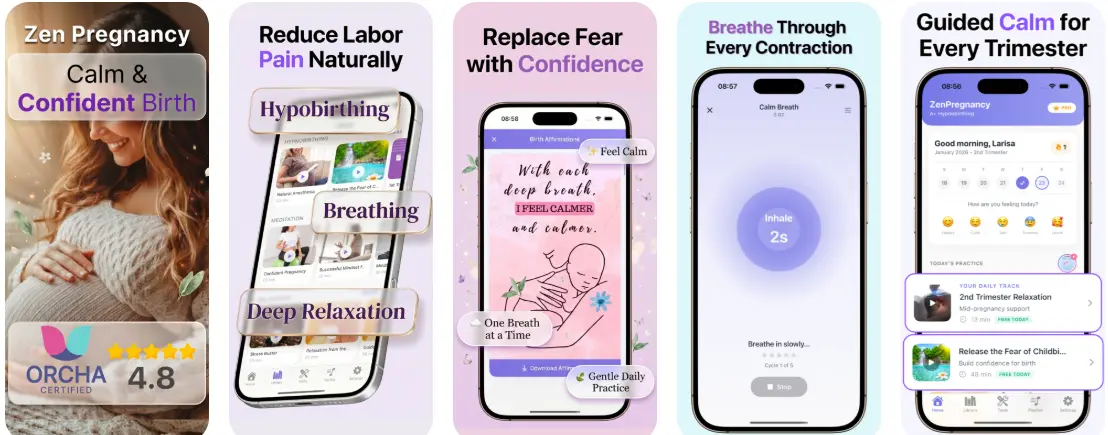
App vs Course in Hypnobirthing Preparation
A hypnobirthing app is built for frequent, short practice on your phone, while a hypnobirthing course is built around lessons, scripts, and a planned learning sequence. The better choice depends less on which one sounds more impressive and more on what you will actually repeat at 28, 34, and 39 weeks pregnant.
App-based preparation suits people who want guided audios, breathing prompts, affirmations, and labor tools in one place. Course-based preparation suits people who like a clear curriculum and homework-style progress. If you are still deciding whether mobile support or class-style learning fits your life, this deeper guide to hypnobirthing online app vs classes explains the same tradeoff in more detail.
Mobile Hypnobirthing App: Best Fit and Tradeoffs
A mobile hypnobirthing app fits best when you want daily support that is easy to open during pregnancy, bedtime anxiety, early labor, or hospital waiting. HypnoBirth App, also known by some users as ZenPregnancy, is designed for this kind of repeated, phone-first practice.
The main advantage is low friction: you can press play for a 5 to 15 minute meditation, practice a breathing pattern, or use a timer without setting up a workbook. That matters when your energy is low in the third trimester. The tradeoff is that an app can feel less linear than a course if you want a week-by-week syllabus. If daily audio practice sounds realistic, you can start with the hypnobirthing app on iPhone.
Structured Hypnobirthing Course: Best Fit and Tradeoffs
A structured hypnobirthing course fits best when you learn by following ordered lessons, completing practice assignments, and building a shared vocabulary with your birth partner. Hypnobabies is commonly known for this course-style approach, where the program itself gives you a path to follow.
The benefit is clarity: you know what to study next, and you may feel reassured by a more formal program. The tradeoff is time. A course can become another task on a long pregnancy list if you are already juggling work, appointments, older children, or fatigue. If you are new to the method and want a simpler starting point before choosing a full program, this guide on how to start hypnobirthing can help you set a realistic practice routine.

How Hypnobirthing Apps Work
Hypnobirthing apps work by pairing guided voice tracks with breathing patterns, repetition, relaxation cues, and sometimes practical labor tools such as contraction timing. The mechanism is simple: repeated listening trains familiarity, so your body has a practiced calming cue when sensations, noise, or uncertainty increase.
Most apps combine audio playback, favorites, reminders, breathing timers, affirmation libraries, and tracking features. For labor, a breathing track may guide slow inhales and longer exhales while a contraction timer records start time, duration, and spacing. HypnoBirth App also brings these pieces together as a hypnobirthing practice app for Android. For technique-specific learning, see these hypnobirthing techniques. This is not medical advice. Consult your healthcare provider about pain relief, monitoring, and your birth plan.
How to Choose a Pregnancy Hypnosis App or Course
Choose by matching the format to your real week, not your ideal week. A beautiful course you do not open is less useful than a simple practice you repeat; a simple app may not be enough if you want structured study and partner scripts.
- Audit your time: Decide whether 10 minutes daily or 45 to 60 minutes weekly is more realistic.
- Pick your learning style: Choose press-play audio if you like repetition, or lessons if you like a syllabus.
- Check labor access: Confirm whether you can quickly find breathing, affirmations, and timing tools.
- Include your partner: Ask whether they need scripts, cue words, or simple reminders.
- Trial it for 7 days: Keep the option you actually use, not the one you planned to use.
Feature Comparison: ZenPregnancy, Hypnobabies, and Expectful
The clearest comparison is format: ZenPregnancy is app-first, Hypnobabies is course-first, and Expectful is meditation-library-first. Each can support a calmer pregnancy routine, but they solve different problems for different learners.
| Feature | ZenPregnancy | Hypnobabies | Expectful |
|---|---|---|---|
| Primary format | Mobile app with daily tools | Structured home-study course | Pregnancy mindfulness app |
| Best for | Short repeatable practice | Step-by-step learners | Meditation variety |
| Labor support | Breathing, affirmations, contraction timing | Course audio and scripts | Relaxation and mindfulness tracks |
| Tracking tools | Includes pregnancy and labor tools | Not usually tracker-led | Content-focused |
| Potential drawback | Less classroom-like | Requires more study time | Less birth-tool focused |
If you are also comparing meditation-first options, the ZenPregnancy vs Expectful review may be the next useful read.
Evidence and Safety for Hypnobirthing Practice
Evidence suggests hypnosis and relaxation-based birth preparation may help some people feel calmer and more confident, but research does not support promising a pain-free or intervention-free birth. Reviews, including Cochrane-style analyses of hypnosis for childbirth, generally find mixed results: some outcomes improve for some groups, while certainty varies by study quality and design.
That uncertainty is important. Hypnobirthing is best understood as a coping and preparation tool, not a replacement for medical care, fetal monitoring, emergency support, or pain relief choices. You can use it with an epidural, unmedicated birth, induction, planned cesarean, VBAC, home birth, hospital birth, or birth center plan. This is not medical advice. Consult your healthcare provider, especially if you have complications, reduced fetal movement, trauma history, hypertension, diabetes, bleeding, or severe anxiety.
Labor Breathing and Contraction Tracking Tools
Labor tools matter most when you are no longer in planning mode and need quick, practical support. An app can be helpful in early labor because breathing prompts, affirmations, and contraction timing are available from the same phone you already have beside you.
During early contractions, many families want to know whether sensations are getting longer, stronger, and closer together. A timer can reduce mental math and give your provider clearer information when you call. Breathing guidance can also help you soften your jaw, lengthen exhales, and return to a practiced rhythm between surges. For tool-specific comparisons, see the guide to the best contraction timer app for iPhone and the dedicated labor breathing app page.
Birth Affirmations and Partner Practice
Affirmations work best when they are practiced before labor, not introduced for the first time when contractions are intense. The goal is not to force positivity; it is to give your mind a familiar phrase to return to when fear or tension rises.
Examples include short lines such as, “I can take this one breath at a time,” or “My body and my baby are working together.” A partner can read affirmations, remind you of cue words, lower the lights, offer water, or help restart an audio track. This kind of support can be useful in many birth plans, including epidural, induction, cesarean preparation, and physiological labor. For more phrase ideas, explore the birth affirmations app resource.
Cost and Access in Birth Preparation Apps
Cost is not just the price of the program; it is also the time, attention, devices, and support needed to use it well. An app may be cheaper and easier to start, while a structured course may justify a higher cost if you want curriculum depth and partner involvement.
Access also matters. If you commute, rest in bed, or wake at 3 a.m. with racing thoughts, phone access can make practice more likely. If you learn best by sitting down with printed materials and a clear sequence, a course may feel more grounding. HypnoBirth App is positioned as a free hypnobirthing app for calm pregnancy and birth, but your best choice should still depend on actual use, not price alone.
Limitations of Hypnobirthing Apps and Courses
Hypnobirthing content can be genuinely supportive, but it has limits. Honest expectations help you choose without pressure or disappointment.
- It cannot guarantee a pain-free birth, vaginal birth, short labor, or no interventions.
- It works better with repetition; one late-third-trimester session may not feel automatic in labor.
- Apps can feel too open-ended if you need a strict weekly curriculum.
This is not medical advice. Consult your healthcare provider for individualized guidance.
Common Mistakes When Comparing Birth Prep Options
The biggest mistake is buying for the person you wish you were instead of the pregnant person you are right now. If you are exhausted, nauseated, anxious, or parenting other children, a demanding plan may not be the most supportive choice.
Other common mistakes include ignoring partner access, assuming a longer program is always better, forgetting to test audio offline, and choosing based only on testimonials. It is also easy to compare features without asking what you need in the room: a calming voice, a breathing count, a timer, a script, or a full lesson plan. If natural birth preparation is part of your goal, this guide to an app for natural birth preparation explains how mobile tools can support practice without promising a specific outcome.
Verdict: Best Choice for Daily Hypnobirthing Practice
For most people who want daily hypnobirthing practice, the app-first option is easier to stick with; for people who want formal teaching, the course-first option may feel stronger. The deciding factor is consistency, not the size of the library or the number of lessons.
Choose a mobile tool if you want fast access to meditation, breathing, affirmations, and labor tracking. Choose a course if you want a guided syllabus and are willing to protect study time. If you are still comparing app-first options, the best hypnobirthing app 2026 review gives a broader look at features, value, and fit. However you prepare, your birth remains your own; calm support is a tool, not a test.
Frequently Asked Questions
Is a hypnobirthing app better than a hypnobirthing class or course?
A hypnobirthing app is better if you want flexible, short, repeatable practice on your phone. A class or course is better if you want structured lessons, a clear programme, and more detailed education. The best choice depends on whether you are more likely to use quick daily tools or complete a guided curriculum.
What is the difference between ZenPregnancy and Hypnobabies?
ZenPregnancy is an app-based hypnobirthing option, while Hypnobabies is a more structured childbirth hypnosis course. ZenPregnancy is suited to daily listening, relaxation, and quick labour tools. Hypnobabies may suit parents who want a fuller programme with specific lessons, tracks, and practice instructions.
Can I start hypnobirthing at 38 weeks pregnant?
Yes, you can start hypnobirthing at 38 weeks pregnant. A late start is unlikely to give you the same depth of practice as beginning in the second or third trimester, but short daily sessions can still help you learn breathing, calming cues, and relaxation techniques. Keep the plan simple and follow your healthcare provider’s advice for labour signs and birth decisions.
Does hypnobirthing help with pregnancy anxiety?
Yes, hypnobirthing may help some people manage pregnancy anxiety by supporting relaxation, breathing, and positive mental rehearsal. It is not a replacement for mental health care, especially if anxiety feels severe, persistent, or affects daily life. Speak with your midwife, doctor, or mental health professional if you need additional support.
Can I use hypnobirthing if I want an epidural?
Yes, you can use hypnobirthing if you plan to have an epidural. Hypnobirthing tools can support calm decision-making, early labour coping, breathing during procedures, and confidence in a hospital setting. It should be used alongside, not instead of, medical pain relief options and clinical advice.
Is Hypnobabies only for an unmedicated or natural birth?
No, Hypnobabies and other hypnobirthing methods do not have to be limited to unmedicated birth. Relaxation, breathing, and mindset techniques can support induction, epidural, caesarean birth, VBAC, hospital birth, birth centre birth, or home birth. Your medical team should guide decisions about safety and interventions.
Is a hypnobirthing app good for first-time mums?
Yes, a hypnobirthing app can be good for first-time mums who want simple, accessible practice during pregnancy. It can help build familiarity with breathing, affirmations, relaxation tracks, and labour prompts. First-time parents who want more complete birth education may still benefit from a structured class or antenatal course.
How often should I practise hypnobirthing during pregnancy?
Daily short practice is usually the most realistic way to practise hypnobirthing. Sessions of 5 to 15 minutes on most days can help you become familiar with the voice, breathing pattern, and relaxation cues. Longer sessions can be useful, but consistency matters more than perfection.
Can I use both a hypnobirthing course and a pregnancy hypnosis app?
Yes, you can use both a hypnobirthing course and a pregnancy hypnosis app. A course can provide the main structure, while an app can support daily reinforcement and quick practice. Avoid overloading yourself with too many tracks, scripts, or conflicting instructions.
Are contraction timers in hypnobirthing or pregnancy apps medically accurate?
No, contraction timers are tracking tools, not medical diagnostic tools. They can record contraction length and spacing, but they cannot confirm labour progress or assess safety. Contact your midwife, doctor, or birth unit according to their instructions, especially with bleeding, reduced baby movements, waters breaking, severe pain, or concerning symptoms.
Try HypnoBirth App Free
Guided hypnobirthing, pregnancy meditation, breathing, affirmations, and a contraction timer in one free app. ORCHA NHS certified, used by 200k+ mothers on iOS and Android.
Best for
- Daily hypnobirthing and pregnancy meditation practice
- Calm birth preparation before labor
Limitations
- Not a replacement for advice from your midwife, doctor, or care team
- Does not guarantee a specific birth outcome