 Hypno
HypnoHypnobirthing Results After 90 Days Of Consistent Practice
200,000+ moms • ORCHA NHS Certified • Free on iOS & Android
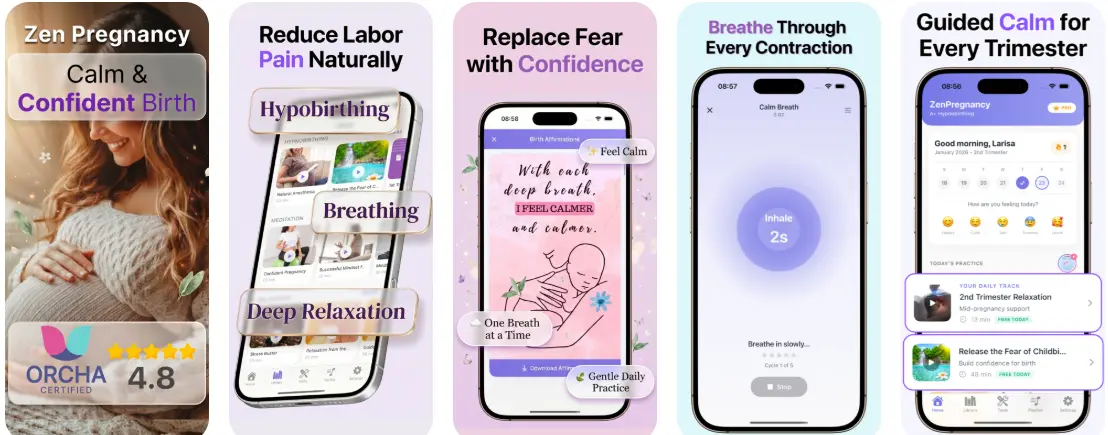
Hypnobirthing results after 90 days typically include deeper familiarity with breathing techniques, stronger confidence about birth, and noticeably lower anxiety, though outcomes vary by practice frequency, birth setting, and individual factors. Most people who stick with daily sessions for three months report feeling calmer and more in control, not necessarily pain-free. A 2024 peer-reviewed study found that hypnobirthing training reduced labor pain, fear of childbirth, and postpartum depression in first-time mothers compared with a control group, but this is one study rather than settled proof (SOURCE URL).
Definition: Hypnobirthing is a birth-preparation method that uses guided breathing, relaxation, affirmations, and visualization to reduce fear and improve coping before and during labor.
TL;DR
- After 90 days, the clearest gains are lower anxiety and higher confidence, not guaranteed pain-free labor.
- Consistency matters more than session length, because daily short practice outperforms occasional long sessions.
- Hypnobirthing complements medical care but does not replace evidence-based prenatal support.
- Research is promising but limited; more high-quality trials are needed for strong universal claims.
- App-based practice helps build habit, but rehearsing techniques under realistic stress is essential.
What Hypnobirthing Results After 90 Days Actually Look Like
After 90 days of consistent hypnobirthing practice, the most realistic results are lower fear, better breath control, and more confidence using relaxation cues under pressure. The goal is improved coping, not a promise that labor will be painless.
By this stage, many people stop “trying to remember” the release breath and start using it automatically. Shoulders drop faster. The jaw unclenches sooner. A birth affirmation that felt awkward in week one may begin to sound like a useful anchor phrase instead of a line from a script.
I often see the shift around the moment someone says, “I know what to do with my breath now.” That sentence matters. It means the practice has moved from information into muscle memory.
Pain-free labor is not guaranteed. For anxious first-time parents, daily hypnobirthing is often easier to maintain than a large weekend course because repetition turns each technique into a familiar response.
Five Facts About 90 Days Hypnobirthing Practice
- Hypnobirthing uses four main tools: breathing, relaxation, birth affirmations, and guided imagery. Together, they aim to reduce fear and improve coping before and during labor.
- The most likely 90-day result is confidence. People usually report feeling calmer about birth and more familiar with labor breathing, rather than expecting a pain-free delivery.
- Research suggests possible labor benefits, but the evidence is limited. Some studies report lower pain, fewer interventions, shorter labor, or reduced fear scores. A 2021 Cochrane review found too few well-designed trials for strong universal claims (SOURCE URL).
- Results depend on how you practice. Frequency, technique use during labor, partner support, and the birth environment all shape outcomes. A dimmed lamp in the living room helps during rehearsal, but triage feels different.
- Hypnobirthing is one tool, not the whole plan. It should sit beside prenatal care, medical guidance, and flexible decision-making. The broader hypnobirthing benefits are strongest when practice is realistic.
How Hypnobirthing Long Term Practice Works

Hypnobirthing long term practice works by interrupting the fear-tension-pain cycle and building conditioned relaxation responses through repetition. In plain language, your body learns a familiar route back toward calm.
Fear can increase muscle tension. Tension can make sensations feel sharper. Sharper sensations can create more fear. Hypnobirthing practice uses a release breath, soft shoulders, guided imagery, and anchor phrases to lower that loop before it gathers speed.
There is also a neuroplasticity angle. Repeated breathing and visualization strengthen the brain’s association between a cue and a calmer body state. The parasympathetic nervous system, often called the rest-and-digest system, helps reduce adrenaline and supports slower breathing.
Ninety days is meaningful because habits need repetition across ordinary days, not just motivated ones. The bathroom mirror affirmation at 2 a.m. counts. So does the 12-minute track with one earbud in while lying on your left side.

How To Practice Hypnobirthing Daily For 90 Days
A good 90 days hypnobirthing routine is short, repeatable, and tied to something you already do. Good hypnobirthing apps deliver guided repetition, breathing cues, and affirmations, not control over how labor will unfold.
- Set a fixed daily time slot. Pair practice with brushing teeth, getting into bed, or your lunch break so it is not left to motivation.
- Start with guided breathing for 5-10 minutes. Keep the first two weeks simple: release breath, soften your shoulders, unclench your tongue.
- Layer in affirmations and visualization after week two. Add one birth affirmation and one calm birth environment image per session.
- Log each session to track consistency. A basic streak note is enough; perfection is not the point.
- Rehearse techniques under mild stress cues before labor. Practice while walking, during a Braxton Hicks tightening, or after a rushed appointment.
A guided audio app can help keep the routine visible when pregnancy brain is very real, but it should not be treated as medical advice or a substitute for your care team.
Method We Used To Track Hypnobirthing Results
We assessed hypnobirthing results using three practical signals: self-reported anxiety, self-reported confidence, and session completion patterns. This is useful for noticing trends, but it is observational data, not a controlled clinical trial.
User feedback was grouped around questions like, “Do you feel more confident using breathing during stress?” and “Does your birth anxiety feel lower than when you started?” Session completion data was used as a rough proxy for consistency, because completed practice sessions show daily repetition better than intention does.
External research, including the 2024 study and the 2021 Cochrane review, helped frame what user feedback can and cannot prove. Practice apps can show patterns such as completed sessions, repeated tracks, and self-reported confidence. They cannot verify delivery-room outcomes.
Common Patterns In 90 Days Hypnobirthing Practice
Most 90-day hypnobirthing practice follows a clear arc: awkward learning first, smoother automatic breathing next, then stronger confidence before birth. A 2024 peer-reviewed study also reported lower fear of childbirth scores in the hypnobirthing group than in the control group.
Early Weeks: Building the Breathing Habit
Weeks 1-3 are often clumsy. People forget the rhythm, get distracted, or wonder if they are “doing it right.” That is normal. The win is returning to the track again tomorrow.
Mid-Practice: Automatic Relaxation Response
Weeks 4-8 usually feel less forced. Breathing becomes easier to start, and affirmations sound less strange. A partner whispering a relaxation cue may begin to feel useful rather than theatrical.
Weeks 9-12: Confidence Before Birth
By weeks 9-12, many people notice calm outside practice sessions too. The full hypnobirthing benefits timeline often shows this shift from learning a technique to trusting it under stress.
What Hypnobirthing Results After 90 Days Do Not Show
Hypnobirthing results after 90 days do not predict your delivery type, intervention needs, or exact pain level in labor. Practice confidence is real, but it is not a crystal ball.
Feeling calm during a guided track does not mean labor will feel identical. A quiet bedroom, headphones tucked into a gown pocket, and a contraction pattern on the monitor are different conditions. The body knows the difference.
App-based data also cannot capture what happens in the delivery room. It can show whether sessions were completed, which tracks were repeated, and whether confidence improved before birth. It cannot measure fetal position, blood pressure changes, staffing, induction needs, or emergency decisions.
Individual medical factors override technique in complex births. The most useful comparison is often hypnobirthing before and after confidence, not a promised birth outcome.
When To Contact Your Midwife Or Clinician
Contact your midwife, doctor, or maternity unit promptly if something feels medically worrying or different from your usual pattern. Hypnobirthing can help you stay steady while you seek help, but it should never replace individualized prenatal advice.
Use your care team as part of the plan, not a last resort. That includes emotional safety as well as physical symptoms: anxiety, panic, previous trauma, or intense fear of birth are all valid reasons to ask for support before labor begins.
- Call promptly for urgent symptoms. Bleeding, reduced fetal movement, a severe headache, sharp or concerning pain, or anything that feels wrong deserves immediate professional guidance.
- Tell your team about mental health history. Share panic symptoms, trauma triggers, intrusive worries, or birth fear so your plan can include practical support.
- Ask how techniques fit your medical options. Check how breathing, visualization, and partner cues can work with induction, continuous monitoring, an epidural, or a planned or unplanned C-section.
- Keep hypnobirthing in its lane. Use it to support calm coping and communication, while letting clinical advice guide decisions about you and your baby.
Limitations
Hypnobirthing has real limits, especially when claims stretch beyond what research can support. A 2021 Cochrane review found that only a small number of well-designed studies have tested self-hypnosis during labor, and more high-quality trials are needed.
- Hypnobirthing is not a guaranteed fix for labor pain, anxiety, or intervention rates.
- Some people see little benefit, even with regular 90-day practice.
- Research findings are mixed, with too few large trials for strong universal claims.
- App-based practice alone may not be enough if you never rehearse under stress.
- Labor can become medically complex, urgent, or highly intervention-heavy.
- Calm thinking does not determine cervical change, fetal position, or surgical need.
- Marketing claims can overstate pain reduction and understate individual variation.
- Medical pain relief, induction, monitoring, or C-section birth may still be needed.
Clinicians typically recommend that birth preparation supports, rather than replaces, prenatal care and medical decision-making. Reset the plan. That flexibility is part of calm birth preparation, too, and it is central to find calm birth preparation.
See also: Hypnobirthing Side Effects.
Read more
- About HypnoBirth App: Calm Birth Support
- Are Hypnobirthing Apps Regulated
- Are Hypnobirthing Apps Safe
- Birth Partner Hypnobirthing App Guide
- App for Natural Birth Preparation: What to Choose
- Best Birth Meditation App for Calm Labor
- Best Contraction Timer App for iPhone: 2026 Guide
- Best Hypnobirthing App 2026: Top Picks
- Does Hypnobirthing Work for First Births? Guide
- Free Hypnobirthing App for iPhone: Calm Birth
- How to Start Hypnobirthing: Beginner Guide
- Hypnobirthing for C Section Prep: Calm Cesarean
Best Hypnobirthing App for 90 Days of Consistent Practice
HypnoBirth App supports steady hypnobirthing practice with free breathing, relaxation audio, and affirmation tools you can return to throughout pregnancy. After 90 days, many users may feel more familiar with the techniques and more confident using them as part of their birth preparation.
Best for
- Building a simple daily hypnobirthing routine
- Practising breathing, audio tracks, and affirmations over time
Limitations
- Results vary from person to person and depend on consistency
- The app is educational support and not a replacement for medical advice
Frequently Asked Questions
What results can I expect after 90 days of hypnobirthing practice?
After 90 days of hypnobirthing practice, many people feel more familiar with breathing techniques, relaxation audio, affirmations, and birth preparation routines. This consistency can make the tools feel easier to use during late pregnancy and labour. Results vary, and hypnobirthing does not guarantee a pain-free or complication-free birth.
Is 90 days enough time to learn hypnobirthing?
Yes, 90 days is generally enough time to build a steady hypnobirthing routine. Practising over three months gives you time to repeat breathing exercises, listen to tracks, and become more confident with relaxation cues. Short, regular sessions are usually more helpful than occasional long sessions.
Can I start hypnobirthing at 38 weeks pregnant?
Yes, you can start hypnobirthing at 38 weeks pregnant. Even late practice can help you learn calming breathing, guided relaxation, and simple affirmations for labour. Focus on short daily sessions and speak with your midwife or doctor if you have any concerns about your birth plan.
Does hypnobirthing help with pregnancy anxiety?
Hypnobirthing can help some people manage pregnancy anxiety by giving them structured relaxation and breathing tools. The practice encourages calmer thinking, body awareness, and preparation for labour scenarios. If anxiety feels severe, persistent, or overwhelming, contact a midwife, GP, therapist, or other qualified healthcare professional.
Can hypnobirthing be used with an epidural?
Yes, hypnobirthing can be used with an epidural. The techniques are not limited to unmedicated birth and can support breathing, relaxation, decision-making, and calm communication in a medical setting. Pain relief choices should be discussed with your maternity care team.
Is hypnobirthing useful for first-time moms?
Yes, hypnobirthing is useful for many first-time mums because it explains labour in a calm and practical way. It can help you understand breathing, positions, relaxation, and how to prepare your birth preferences. First births are individual, so hypnobirthing should be seen as preparation rather than a promise of a specific outcome.
Is a hypnobirthing app as good as a class?
A hypnobirthing app can be a good option if you want flexible, self-paced practice. A class may offer more personal feedback, live questions, and partner involvement, while an app can make daily repetition easier. Many people use both, depending on budget, schedule, and learning style.
How often should I practise hypnobirthing for the best results?
Daily practice is usually the most effective way to build familiarity with hypnobirthing. Even 10 to 20 minutes a day can help breathing, audio tracks, and affirmations feel more natural over time. Consistency matters more than perfection.
What are realistic hypnobirthing results after three months?
Realistic hypnobirthing results after three months include better recall of techniques, improved relaxation habits, and more confidence using birth preparation tools. Some people also feel calmer when thinking about labour or appointments. Hypnobirthing cannot control labour length, pain level, or medical outcomes.
Can hypnobirthing reduce labour pain?
Hypnobirthing can change how some people cope with labour sensations, but it does not guarantee reduced pain. Breathing, relaxation, and guided imagery may support a calmer response to contractions. You can still choose medical pain relief if you want or need it.
Do I need a birth partner for hypnobirthing to work?
No, you do not need a birth partner for hypnobirthing to be useful. A partner can help by playing audio, reminding you of breathing techniques, and supporting your preferences, but solo practice can still be effective. If you have a partner, involving them early can make the techniques feel more familiar on the day.
When should I start hypnobirthing during pregnancy?
The second or early third trimester is a common time to start hypnobirthing. Starting around 20 to 30 weeks gives you plenty of time to practise gradually before birth. Later starts can still be worthwhile, especially if you focus on simple breathing and relaxation routines.