 Hypno
HypnoWhen Does Hypnobirthing Get Easier With Regular Practice
200,000+ moms • ORCHA NHS Certified • Free on iOS & Android
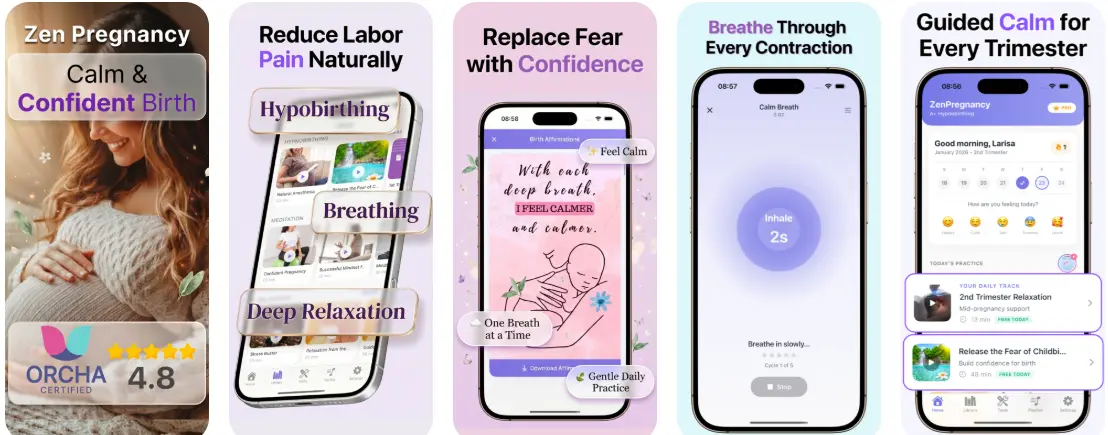
If you're wondering when does hypnobirthing get easier, many people notice a clear shift after 2–4 weeks of consistent daily or near-daily practice, often in the late second or early third trimester. The techniques usually start feeling less forced once breathing, audio cues, and visualisation become familiar through short repeated sessions.
> Definition: Hypnobirthing is a structured preparation method that uses guided relaxation, controlled breathing, and visualisation to reduce fear and improve coping during labour and birth.
TL;DR
- Expect the techniques to feel awkward for the first 1–2 weeks; a noticeable “click” typically arrives after 2–4 weeks of daily practice.
- Practising in varied positions and with background noise makes hypnobirthing more effective during real labour, not just in quiet rooms.
- A 2021 meta-analysis of 11 RCTs found hypnobirthing linked to significantly lower labour pain intensity and higher birth satisfaction.
- Consistency matters more than session length. 10-minute daily sessions outperform sporadic 40-minute ones.
- A guided-audio routine can support the learning curve with reminders, progressive tracks, and visible practice history.
What the Hypnobirthing Learning Curve Looks Like Over 4 Weeks
- Week 1 often feels clumsy. Your mind wanders, the breathing feels staged, and you may wonder if you are “doing it right.”
- Week 2 usually brings recognition. The same relaxation cue starts to feel familiar, even if your body is not fully settled yet.
- Weeks 2–4 are where the rhythm often clicks. Many parents can slow their breath without counting every inhale.
- After week 4, calm may become easier to access. Some people can “drop in” within a minute by softening the jaw, unclenching the tongue, and lowering the shoulders.
- Late second trimester or early third trimester is a common comfort zone. There is enough time to repeat the skills before labour.
Awkwardness is not failure. It is the first layer of the hypnobirthing learning curve, especially if you are used to staying busy rather than still.
How Hypnobirthing Practice Progress Works in Your Brain and Body
How hypnobirthing practice progress works is simple: repeated breath patterns teach your nervous system to associate certain cues with settling. The parasympathetic nervous system, often called the rest-and-digest system, becomes easier to access when the same release breath is practised often.
That pairing is called a conditioned relaxation response. In plain language, your body learns, “When this guided track starts, I soften.” Short daily repetitions help because they build habit loops: cue, practice, reward. A 12-minute track with one earbud in while lying on your left side can do more than a long session you only manage once a week.
According to a 2021 meta-analysis of 11 randomized trials, hypnosis or hypnobirthing was linked with lower labour pain intensity and higher birth satisfaction. The most common medically supported way to build hypnobirthing skill is repeated relaxation practice combined with realistic birth support.
What You Need Before Starting Hypnobirthing Practice

You need a repeatable 10-minute window, a guided audio source, and expectations that match real birth. The goal is better coping, not a guaranteed pain-free or intervention-free labour.
Start with a time you already remember. After brushing teeth works better than “sometime tonight.” Choose an app, course, class recording, or saved track so you are not searching while tired. If anxiety is the main barrier, a short pregnancy anxiety meditation can be a gentler first step.
A partner is optional, but helpful. They can practise an anchor phrase, read a birth affirmation, or notice when your shoulders creep toward your ears. A guided-audio app or class recording can give structure through tracks and reminders, but the learning still comes from daily repetition.

How to Practice Hypnobirthing So It Gets Easier
Use a simple, repeatable practice structure, not a promise that birth will follow a script. The aim is to make breathing, guided audio, and relaxation cues familiar enough that you can reach them under pressure.
- Set a daily reminder for the same practice time, such as after brushing teeth.
- Start with a 5–10 minute guided breathing track before adding longer relaxation sessions.
- Log each session and track your streak so progress is visible on tired days.
- Move to visualisation and birth affirmation tracks after week 2 when breathing feels less mechanical.
- Practise in varied conditions from week 3, including upright positions, mild background noise, or a birth ball.
- Review your practice progress weekly and adjust session length before it becomes another chore.
Headphones in the hospital bag help, but the real work happens earlier through consistent, low-pressure repetition.
Common Mistakes That Stall Hypnobirthing Practice Progress
The biggest mistake is only practising in ideal quiet. Labour is not usually a dark bedroom with perfect timing, so your practice should eventually include interruptions, different positions, and ordinary noise.
Skipping five days and then doing one long catch-up session also slows progress. Your brain learns from repetition, not guilt. If your mind wanders, label it as normal and return to the next release breath. That is still a completed practice session.
Waiting until the third trimester can still work, but it gives you fewer chances to rehearse calm before the pressure rises. If fear is already strong, fear of childbirth hypnobirthing support may help you build steadier cues.
An app cannot replace effort. It can only make the next small practice easier to start.
How to Tell Hypnobirthing Practice Is Getting Easier
Hypnobirthing is getting easier when your body responds before your thinking mind has to manage every step. You may notice your breathing slowing within three or four breaths, without counting.
Another sign is audio familiarity. The narrator begins a relaxation cue, and your shoulders drop before the sentence finishes. Your birth partner may notice visible softening in your face, hands, or belly before you do.
Real progress also shows up when a door closes, a dog barks, or someone walks into the room and you do not lose the whole session. Small disruptions become practice, not proof that you failed. According to the same 2021 review, people using hypnosis techniques reported higher childbirth satisfaction than standard-care groups, though satisfaction is shaped by many birth factors.
Evidence That Consistent Hypnobirthing Practice Improves Birth Outcomes
- Pain intensity: A 2021 systematic review and meta-analysis of 11 randomized controlled trials found hypnosis or hypnobirthing associated with lower labour pain intensity (source: https://doi.org/10.1016/j.ctcp.2021.101477).
- Birth satisfaction: The same review reported higher childbirth satisfaction among women using hypnosis techniques in labour.
- Pain relief use: A Cochrane review found women using hypnosis were less likely to use pharmacological pain relief, although evidence quality was low to moderate (source: https://www.cochrane.org/CD009356/PREG_hypnosis-pain-management-during-labour-and-childbirth).
- Epidural rates: An Australian randomized trial of 680 women found epidural use fell from 36.5% with usual care to 27.9% with self-hypnosis training (source: https://pubmed.ncbi.nlm.nih.gov/23489258/).
- Fear and mood: Mindfulness-based childbirth education, which overlaps with breathing and relaxation practice, has been linked with reduced childbirth fear and depressive symptoms.
Clinicians typically recommend discussing hypnobirthing alongside your wider birth plan, especially if you have medical risks. For labour-specific tools, an app to help me stay calm during labor may support practice, but it should not replace clinical care.
When to Get Extra Support With Hypnobirthing Practice
Get extra support if hypnobirthing practice makes you feel more anxious, detached, panicky, or unsafe. The techniques should help you build steadier coping; they should not leave you pushing through distress alone.
- Pause the track if breathing, visualisation, or body-scanning increases panic, dread, or a sense that you cannot settle.
- Contact your midwife or doctor if anxiety rises repeatedly during practice, especially if it affects sleep, eating, appointments, or daily functioning.
- Seek trauma-informed support if birth images, relaxation scripts, touch cues, or visualisation bring up flashbacks, dissociation, numbness, or strong distress.
- Discuss your plans with your care team if induction, caesarean birth, previous complications, twins, high blood pressure, diabetes, reduced movements, or another risk factor is part of your pregnancy.
- Use hypnobirthing as coping support alongside clinical monitoring, not instead of it. Breathing can help you stay grounded while you ask questions, consent to care, or move through a change in the birth plan.
A good practice plan should feel adaptable, not like a test you have to pass.
Limitations
Hypnobirthing is useful, but it has boundaries. It is a coping skill, not a medical safety plan.
- Research does not define an exact “dose” of practice that works for everyone.
- Hypnobirthing cannot override severe complications or guarantee avoidance of induction, assisted birth, caesarean birth, or emergency care.
- People with trauma history, panic symptoms, dissociation, or certain mental health conditions may need tailored professional support.
- Benefits such as shorter labour or dramatically reduced pain are not shown consistently across studies.
- Without structured, consistent practice, the techniques often feel unavailable during labour stress.
- The Cochrane review rated some hypnosis evidence as low to moderate quality.
- If practice increases anxiety, stop the track and speak with your midwife, doctor, therapist, or childbirth educator.
If you are comparing tools, it is reasonable to ask are hypnobirthing apps safe before making them part of your routine.
See also: Can Hypnobirthing Replace Pain Relief.
Read more
- About HypnoBirth App: Calm Birth Support
- Are Hypnobirthing Apps Regulated
- Are Hypnobirthing Apps Safe
- Birth Partner Hypnobirthing App Guide
- App for Natural Birth Preparation: What to Choose
- Best Birth Meditation App for Calm Labor
- Best Contraction Timer App for iPhone: 2026 Guide
- Best Hypnobirthing App 2026: Top Picks
- Does Hypnobirthing Work for First Births? Guide
- Free Hypnobirthing App for iPhone: Calm Birth
- How to Start Hypnobirthing: Beginner Guide
- Hypnobirthing for C Section Prep: Calm Cesarean
Best Hypnobirthing Practice App for Building Confidence Over Time
HypnoBirth App is designed to make regular hypnobirthing practice feel simple, familiar, and easy to return to. With free guided hypnobirthing tracks and a calm structure used by 200k+ users, it can help you build confidence through short, repeatable sessions at your own pace.
Best for
- Parents who want to practise hypnobirthing little and often
- Anyone wondering when hypnobirthing starts to feel more natural
- Building familiarity with breathing, relaxation, and audio cues
Limitations
- Progress can feel different for every person and pregnancy
- It supports preparation but does not replace medical advice or birth care
Frequently Asked Questions
When does hypnobirthing get easier with regular practice?
Hypnobirthing often gets easier after 1 to 2 weeks of regular practice. Repetition helps your mind recognise the breathing, relaxation cues, and audio tracks more quickly. Short daily sessions are usually more effective than occasional long sessions.
How often should I practise hypnobirthing for it to feel easier?
Daily practice is the best way to make hypnobirthing feel easier. Even 10 to 15 minutes a day can build familiarity and confidence over time. Longer sessions can be useful, but consistency matters more than perfection.
Can I start hypnobirthing at 38 weeks pregnant?
Yes, you can start hypnobirthing at 38 weeks pregnant. You may not have as much time to build a deep routine, but breathing techniques, guided relaxations, and positive birth preparation can still be helpful. Focus on simple tools you can repeat often before labour begins.
Is hypnobirthing useful for pregnancy anxiety?
Yes, hypnobirthing can be useful for managing pregnancy anxiety. It teaches breathing, relaxation, visualisation, and calming responses that may help you feel more in control. If anxiety feels severe, overwhelming, or affects daily life, speak to your midwife, GP, or mental health professional.
Does hypnobirthing get easier if I listen to the same audio every day?
Yes, listening to the same hypnobirthing audio regularly can make it feel easier. Familiar words, music, and breathing cues may help your body relax faster because it knows what to expect. Repetition is a key part of building a calm response.
What should I do if hypnobirthing does not feel easy at first?
Keep practising gently if hypnobirthing does not feel easy at first. Many people find their mind wanders or they feel unsure in the early sessions. Start with short practices, remove distractions where possible, and treat each session as preparation rather than a test.
Does hypnobirthing work for first-time mums?
Yes, hypnobirthing can be helpful for first-time mums. It gives practical tools for understanding labour, reducing fear, and practising calm breathing before birth. It does not guarantee a particular type of birth, but it can support confidence and decision-making.
Can I use hypnobirthing if I plan to have an epidural?
Yes, you can use hypnobirthing if you plan to have an epidural. Hypnobirthing is compatible with many birth choices because it focuses on relaxation, breathing, communication, and feeling informed. Your midwife or doctor can advise on pain relief options for your individual situation.
Is a hypnobirthing app as good as a hypnobirthing class?
A hypnobirthing app can be a good option, but it is not exactly the same as a live class. An app offers flexible daily practice, guided audios, and easy repetition at home. A class may provide personalised support, partner involvement, and the chance to ask questions.
How long should a hypnobirthing practice session be?
A hypnobirthing practice session can be as short as 10 minutes. Short, regular sessions help you build a habit without feeling pressured or overwhelmed. You can add longer relaxations when you have more time or want deeper practice.
Why does hypnobirthing feel easier after repetition?
Hypnobirthing feels easier after repetition because your brain and body learn the routine. Familiar breathing patterns, scripts, and affirmations can become quicker to access when you feel tense. This practice helps create a calmer response, although birth experiences still vary.
Can hypnobirthing help if I feel nervous about labour?
Yes, hypnobirthing can help if you feel nervous about labour. It can reduce fear by giving you practical techniques for breathing, relaxation, and staying focused during contractions. If your worries are intense or linked to trauma, ask your maternity team for extra support.