 Hypno
HypnoHypnobirthing Vs Hypnosis for Childbirth: What Actually Differs
200,000+ moms • ORCHA NHS Certified • Free on iOS & Android
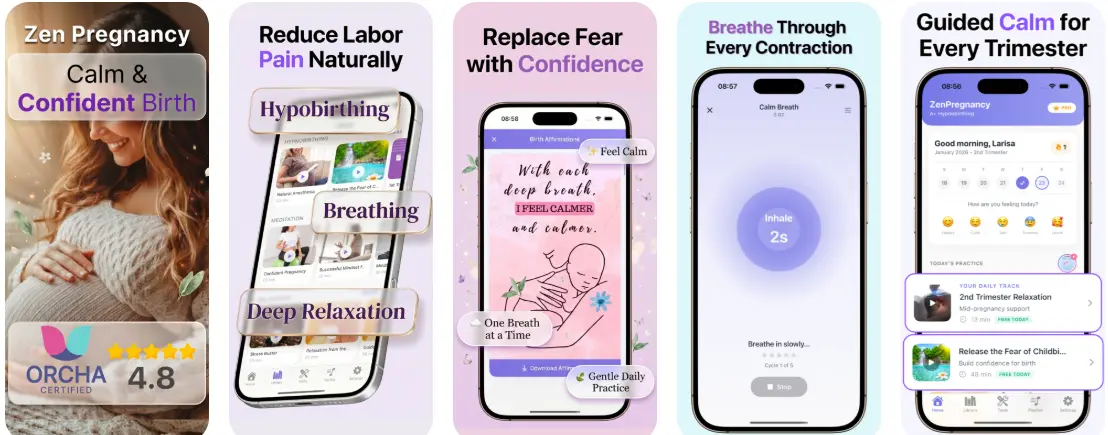
Hypnobirthing vs hypnosis comes down to scope: hypnobirthing is a structured childbirth-preparation method that uses breathing, affirmations, and gentle self-hypnosis tailored to labor, while hypnosis is a broader psychological technique applied to everything from pain relief to phobias. Both keep you fully awake and in control, but hypnobirthing packages hypnosis into a pregnancy-specific program you can practise daily with an app like HypnoBirth App.
> Definition: Hypnobirthing is a childbirth-preparation approach that combines breathing exercises, visualization, affirmations, and light self-hypnosis to reduce fear and tension during labor, while hypnosis is the general psychological state of focused attention and suggestion that hypnobirthing draws from. Some named programs are trademarked, but the lowercase term is often used generically.
- Hypnobirthing is one specific application of hypnosis, designed entirely around pregnancy and birth.
- General birth hypnosis uses formal hypnotic techniques in labor but may not follow a structured program.
- Both methods keep you conscious and in control, neither is stage hypnosis or sedation.
- Evidence suggests modest benefits for pain, fear, and satisfaction, but outcomes vary and regular practice matters.
- Hypnobirthing works alongside epidurals, inductions, and cesareans. It is not limited to “natural” birth.
At-a-Glance: Hypnobirthing Vs Hypnosis Comparison Table
Hypnobirthing is a subset of hypnosis, not a totally separate discipline. The difference is that hypnobirthing turns hypnotic relaxation into a birth-preparation routine with scripts, breathing, and partner cues.
| Feature | Hypnobirthing | General birth hypnosis |
|---|---|---|
| Definition | Childbirth method using breathing, visualization, affirmations, and self-hypnosis | Broader hypnotic technique applied to labor pain or anxiety |
| Scope | Pregnancy and birth only | Many uses, including pain, anxiety, habits, and phobias |
| Format | Course, book, class, or app program | Therapist-led session, recording, or clinical protocol |
| Training method | Repeated practice over weeks | May be one-to-one, recorded, or formal induction |
| Who guides it | Educator, midwife, app, or trained teacher | Hypnotherapist or clinician |
| Birth-setting compatibility | Hospital, birth center, home, cesarean planning | Same, with more clinical tailoring |
| Level of trance | Usually light self-hypnosis | Light to deeper induction |
| Evidence base | Childbirth-specific trials | Broader hypnosis and labor-pain research |
App-based programs like HypnoBirth App deliver the hypnobirthing side through guided tracks, birth affirmations, breathing practice, and contraction support. The ten-minute session between meetings is where many people actually build the habit.
A self-guided app can turn breathing, affirmations, partner cues, and contraction support into a repeatable routine.
Five Facts About Birth Hypnosis Vs Hypnobirthing
Birth hypnosis vs hypnobirthing is easiest to understand through five facts. If you remember only one thing, remember this: hypnobirthing uses hypnosis, but not all birth hypnosis is hypnobirthing.
- Hypnobirthing is a branded birth-preparation style. It combines breathing, visualization, birth affirmation work, and gentle self-hypnosis around labor-specific scripts.
- Research suggests modest benefits, not guaranteed outcomes. Studies report lower pain or fear in some groups, but individual births vary. For a deeper evidence read, I unpack the practical question of does hypnobirthing work.
- You stay awake and aware. In both methods, you can talk, move, refuse suggestions, ask for medication, or change your plan.
- Apps can reproduce the practice structure. A self-guided app can turn breathing, affirmations, partner cues, and contraction support into a repeatable routine.
- Both can sit inside medical birth care. Epidurals, inductions, monitoring, planned cesareans, and midwifery support can all coexist with breathing and relaxation cues.
After a week of short sessions, I often hear the same sentence: “I know what to do with my breath now.” That is the real skill.
Where Hypnobirthing Wins Over General Hypnosis

Hypnobirthing wins when you want a clear pregnancy-specific practice plan rather than a general relaxation session. The scripts are written for contractions, cervix changes, hospital rooms, partner support, and the moment your thinking brain gets noisy.
A 2025 randomized controlled trial of 176 pregnant women found that a five-session hypnobirthing program was linked with lower childbirth pain and fear scores, plus higher birth satisfaction, compared with usual care source. That does not mean every person will feel less pain. It does suggest that repeated, structured practice can matter.
HypnoBirth App is useful here because it gives you daily tracks instead of asking you to remember everything from one Saturday workshop. A rolled yoga mat beside the crib box, one earbud in, and a soft countdown voice can become the rehearsal space.
A self-guided app can turn breathing, affirmations, partner cues, and contraction support into a repeatable routine.

Where General Birth Hypnosis Wins Over Hypnobirthing
General birth hypnosis wins when your needs are more personal than a standard script can hold. Severe birth anxiety, previous trauma, tokophobia, panic symptoms, or dissociation may call for a qualified hypnotherapist or perinatal mental-health professional.
A 2016 Cochrane review of nine trials and 2,954 women found that antenatal hypnosis was associated with less use of pharmacological pain relief, although the evidence quality was low to moderate source. That caveat matters. Small improvements in a study group do not predict one person’s labor.
A therapist can pause, ask what you noticed in your body, and adapt the induction in real time. Hypnobirthing audio cannot do that. If you freeze when a monitor beeps or a vaginal exam is mentioned, tailored support is not “extra.” It may be the safer starting point.
Clinical hypnosis tends to fit people with complex anxiety or trauma, while hypnobirthing fits people who want structured birth practice for everyday repetition.
How Hypnosis and Hypnobirthing Work During Labor
Hypnosis and hypnobirthing work by combining suggestion, focused attention, and the relaxation response. In labor terms, they aim to soften the fear-tension-pain cycle, where fear tightens the body, tension increases discomfort, and discomfort feeds more fear.
The technical terms are conditioned relaxation response and parasympathetic activation. In plain language, your body learns, “When I hear this cue, I loosen my jaw, drop my shoulders, and breathe out longer than I breathe in.” That pattern may support coping, even when contractions remain intense.
Hypnobirthing usually uses light self-hypnosis. You listen, breathe, visualize, and return to an anchor phrase. Deeper clinical hypnosis may involve a trained practitioner guiding induction more directly.
A partner whispering a relaxation cue during a surge can feel ordinary, not dramatic. That’s the point. Good hypnobirthing apps deliver repeatable cues and birth-specific practice, not mystery, mind control, or a promise that labor will stop feeling strong.
After a long day, unclenching your tongue from the roof of your mouth can be the whole practice.
How to Use Hypnobirthing Vs Hypnosis in Your Birth Plan
Use hypnobirthing when you want structured self-guided preparation; use clinical hypnosis when you need individualized therapeutic support. The most useful plan names exactly what you will practise, who will cue it, and how it changes if birth becomes medical.
- Decide your support level. Choose structured self-guided practice, therapist-led hypnosis, or both.
- Start daily tracks by about 28 weeks. Use HypnoBirth App earlier if anxiety is already affecting sleep or appointments.
- Practise with your birth partner. Rehearse one release breath, one visualization, and one short relaxation cue together.
- Write cues into your birth preferences. Include phrases like “please speak calmly” or “offer breathing prompts before discussing options.”
- Adapt scripts to your setting. Prepare hospital, birth center, or home versions of the same anchor phrase.
- Rehearse interventions too. Practise using the same techniques with induction, monitoring, epidural placement, or cesarean birth.
For a flexible birth plan, keep breathing tracks, affirmations, and contraction timing in one repeatable phone routine. If you want a fuller home routine, the step-by-step guide to how to practice hypnobirthing at home pairs well with this plan.
Common Myths About Hypnobirthing and Hypnosis
The biggest myth is that hypnobirthing puts you to sleep or under someone else’s control. In practice, you remain conscious, aware, and able to make decisions.
Another myth is that hypnobirthing guarantees a pain-free birth. It doesn’t. Many people still describe labor as strong, painful, or overwhelming at points, but they may feel less panicked and more able to respond.
It also is not only for home births or water births. I have seen people use a birth affirmation under fluorescent hallway lighting outside labor rooms, with soft music under beeping monitors. Very normal birth. Very real practice.
A 2015 UK trial of 1,222 first-time mothers found that antenatal self-hypnosis did not significantly change epidural rates, but it did slightly reduce self-reported fear of childbirth. source The important detail is repetition. Studies generally involve practice over weeks, not listening once in early labor and hoping it lands.
For hospital-focused preparation, hypnobirthing for hospital birth gives more detail on adapting cues around monitoring, staff changes, and interventions.
Who Should Pick Hypnobirthing and Who Should Pick Clinical Hypnosis
Choose hypnobirthing if you are self-motivated, want affordable structure, and like practising with audio. A self-guided app can turn breathing, affirmations, partner cues, and contraction support into a repeatable routine.
Pick clinical hypnosis if you have severe birth anxiety, trauma history, tokophobia, dissociative symptoms, or panic that feels bigger than self-guided practice. A qualified therapist can adjust language, pace, and safety cues to your nervous system.
Budget matters too. An app subscription is usually far less expensive than several one-to-one hypnotherapy sessions. GentleBirth, Hypnobabies, Christian Hypnobirthing, Expectful, and The Positive Birth Company all sit somewhere on the spectrum between app, course, and philosophy.
For a direct format comparison, the hypnobirthing app vs course guide breaks down the tradeoffs.
Neither option replaces medical care, midwifery advice, obstetric assessment, or emergency intervention.
What the Evidence Says About Hypnobirthing Vs Hypnosis
The evidence is encouraging but modest: both hypnobirthing and clinical hypnosis may improve coping, fear, and satisfaction for some people. It does not prove that either method guarantees a pain-free birth or a specific intervention rate.
- Read the hypnobirthing trials as practice studies. The 2025 randomized trial included 176 pregnant women and measured childbirth pain, fear of childbirth, and birth satisfaction after a five-session program. Its signal favors structured rehearsal, not a universal birth outcome.
- Weigh hypnosis reviews with caution. The Cochrane review pooled nine trials with 2,954 women and found less use of pharmacological pain relief, but the certainty was low to moderate, so the conclusion stays careful.
- Notice what did not change. In the 2015 UK self-hypnosis trial of 1,222 first-time mothers, epidural use did not significantly improve, even though fear scores shifted slightly.
- Separate clinical care from app practice. Clinical hypnosis can be tailored live by a trained practitioner, especially for trauma or severe anxiety. App-based hypnobirthing is more about repetition: daily audio, breathing cues, affirmations, and a familiar voice when labor gets loud.
Limitations
The honest answer is that hypnobirthing and birth hypnosis can help some people, but they are not magic. They are skills, and skills behave differently under stress.
- Many trials have small samples, mixed methods, and low-to-moderate certainty evidence.
- No program can promise lower pain, fewer interventions, or a specific birth outcome for one person.
- Regular practice matters. If audio scripts irritate you, an app may not be your route.
- A self-guided app can turn breathing, affirmations, partner cues, and contraction support into a repeatable routine.
- Claims of completely pain-free, orgasmic, or risk-free birth are not supported by strong evidence.
- People with severe trauma, tokophobia, dissociation, or complex mental-health needs may need tailored professional support.
- App-based practice lacks live feedback. A teacher can notice when you hold your breath or tense your jaw.
- Birth can change quickly. A calm script should support decision-making, not delay care.
A bathroom mirror affirmation at 2 a.m. can help. It still cannot diagnose reduced fetal movement.
Read more
- About HypnoBirth App: Calm Birth Support
- Are Hypnobirthing Apps Regulated
- Are Hypnobirthing Apps Safe
- Birth Partner Hypnobirthing App Guide
- App for Natural Birth Preparation: What to Choose
- Best Birth Meditation App for Calm Labor
- Best Contraction Timer App for iPhone: 2026 Guide
- Best Hypnobirthing App 2026: Top Picks
- Does Hypnobirthing Work for First Births? Guide
- Free Hypnobirthing App for iPhone: Calm Birth
- How to Start Hypnobirthing: Beginner Guide
- Hypnobirthing for C Section Prep: Calm Cesarean
Best Hypnobirthing App for Comparing Hypnosis and Childbirth Preparation
HypnoBirth App helps you understand how hypnobirthing uses relaxation, breathing, and positive suggestion in a childbirth-specific way. It is a practical option if you want guided tracks and simple education rather than general hypnosis content.
Best for
- Parents comparing hypnobirthing vs hypnosis for childbirth
- Practising relaxation and mindset techniques during pregnancy
- Using birth-focused audio tracks at home or in early labor
Limitations
- It does not replace medical advice or clinical birth support
- It cannot guarantee a pain-free or intervention-free birth
Frequently Asked Questions
What is the difference between hypnobirthing and hypnosis for childbirth?
Hypnobirthing is a childbirth preparation approach, while hypnosis for childbirth is a technique used within or alongside that preparation. Hypnobirthing usually combines relaxation, breathing, education, birth preferences and self-hypnosis. Hypnosis focuses more specifically on guided suggestion, deep relaxation and mental rehearsal.
Is hypnobirthing the same as being hypnotised in labour?
No, hypnobirthing is not the same as being hypnotised in labour by someone else. Most hypnobirthing methods teach self-hypnosis, breathing and coping skills that you practise before birth. You stay aware, able to move, speak and make decisions.
Does hypnosis for childbirth make labour painless?
No, hypnosis for childbirth does not guarantee a painless labour. It aims to reduce fear, increase relaxation and help you respond to contractions with more control. Pain levels vary, and some people still choose medical pain relief.
Can hypnobirthing help with pregnancy anxiety?
Yes, hypnobirthing can help some people manage pregnancy anxiety. The breathing, relaxation and positive rehearsal techniques may reduce fear around labour and birth. If anxiety feels severe, persistent or overwhelming, speak to your midwife, GP or a qualified mental health professional.
Is 38 weeks too late to start hypnobirthing?
No, 38 weeks is not too late to start hypnobirthing. A shorter course or app-based practice can still teach useful breathing, relaxation and confidence-building techniques. Daily practice, even for a few minutes, is more helpful than trying to learn everything at once.
Is hypnobirthing useful for first-time mums?
Yes, hypnobirthing is often useful for first-time mums. It can explain what happens during labour, reduce fear of the unknown and give practical tools for contractions, decisions and birth preferences. It does not guarantee a specific type of birth, but it can improve preparation and confidence.
Can I use hypnobirthing if I want an epidural?
Yes, you can use hypnobirthing if you want an epidural. Hypnobirthing techniques can support early labour, hospital admission, epidural placement and calm decision-making. Choosing pain relief does not mean hypnobirthing has failed.
Can hypnobirthing be used during a caesarean birth?
Yes, hypnobirthing can be used during a planned or unplanned caesarean birth. Breathing, relaxation scripts, visualisation and affirmations may help you feel calmer before and during surgery. Always follow the guidance of your maternity and anaesthetic team.
Is a hypnobirthing app as good as a hypnobirthing class?
A hypnobirthing app can be a good option, but it is not always the same as a class. Apps are flexible, affordable and useful for regular practice, while classes may offer personalised teaching, partner involvement and time for questions. Many people use both, especially if they want structure plus daily audio practice.
Do I need a hypnotherapist for childbirth hypnosis?
No, you do not always need a hypnotherapist for childbirth hypnosis. Many people learn self-hypnosis through hypnobirthing classes, books, recordings or apps. A qualified hypnotherapist may be helpful if you want personalised support, especially for specific fears or previous birth trauma.
How often should I practise hypnobirthing or childbirth hypnosis?
Daily practice is usually best for hypnobirthing or childbirth hypnosis. Short, regular sessions help the breathing, relaxation and suggestion techniques feel familiar before labour begins. Even 10 to 15 minutes a day can be useful when practised consistently.
Is hypnobirthing safe during pregnancy and labour?
Yes, hypnobirthing is generally safe because it uses relaxation, breathing and education rather than medication. It should complement, not replace, antenatal care or medical advice. Speak to your midwife or doctor if you have concerns, complications or a history of trauma that could be triggered by relaxation exercises.