 Hypno
HypnoWhen To Call Hospital During Labor Instead Of Relying On An App
200,000+ moms • ORCHA NHS Certified • Free on iOS & Android
Knowing when to call hospital during labor depends on red-flag symptoms, bleeding heavier than a bloody show, reduced baby movement, waters breaking, fever, or contractions you cannot talk through at 3 to 5 minutes apart for an hour, not on what any contraction-timer app displays. If something feels wrong, call maternity triage immediately; they would rather hear from you early than have you wait at home and miss a complication.
> Definition: Knowing when to call hospital during labor means recognising the point where contractions, waters breaking, bleeding, or changes in baby's movements require professional maternity triage assessment rather than continued home monitoring.
TL;DR
- Call maternity triage for any red flag, bleeding, reduced movement, waters breaking, fever, or preterm contractions, regardless of contraction spacing.
- The 5-1-1 or 3-1-1 contraction rule is a rough guide, not a universal threshold; some labors escalate far faster.
- Hypnobirthing techniques help you cope but can mask urgency; always call if your instinct says something is off.
- No app can diagnose true labor or detect emergencies, only a midwife or doctor on the phone can triage you.
- Have your hospital number saved and a short script ready so you can call even from a deeply relaxed state.
What "When To Call Hospital During Labor" Actually Means
Knowing when to call hospital during labor means knowing when home coping stops being enough and maternity triage needs to assess you. It is not a test of pain tolerance, calm breathing, or whether you “seem far enough along.”
In the United States, about 98.4% of births happen in hospital settings, according to CDC birth data from 2022 source. That makes hospital-based escalation guidance relevant for most pregnant people.
Maternity triage is usually the right first call when you are far enough along for labor and delivery care. The ER may be used for emergencies, early pregnancy concerns, or if your hospital tells you to go there. Policies vary, so save the exact number your care team gave you.
The phone matters before the car keys.
This matters even if you use hypnobirthing tools, because calm coping can hide how quickly labor is changing. If you want the wider safety context, the question of are hypnobirthing apps safe is separate from when to call a clinician.
5 Must-Know Facts About Labor Red Flags And Hospital Calls
- Call immediately if your waters break, bleeding is more than a small bloody show, or baby’s movements are reduced. Do this even if contractions are mild or irregular.
- For a first baby, many hospitals use contractions every 3 to 5 minutes, lasting about 60 seconds, for 1 hour as a call threshold. Clinicians typically recommend combining timing with whether contractions are stronger, closer together, and hard to talk through.
- Red flags include severe constant abdominal pain, contractions lasting longer than 2 minutes, 6 or more contractions in 10 minutes, or labor symptoms before 37 weeks. Uterine tachysystole is commonly defined as more than 5 contractions in 10 minutes and is treated as urgent because it can affect fetal heart patterns. For fetal movement concerns, ACOG advises contacting a clinician when movement is reduced or concerning source; for preterm labor symptoms before 37 weeks, ACOG lists regular contractions, fluid leakage, bleeding, and pelvic pressure as reasons to seek care source.
- Hypnobirthing can change how pain feels, but it cannot replace medical advice. A person breathing quietly in non-slip socks on cool tile may still need assessment.
- Maternity triage prefers an uncertain call over silence. The most common medically supported way to decide whether to leave for hospital is to report symptoms to maternity triage, combined with contraction timing and baby movement checks.
How Maternity Triage Assessment Works When You Call
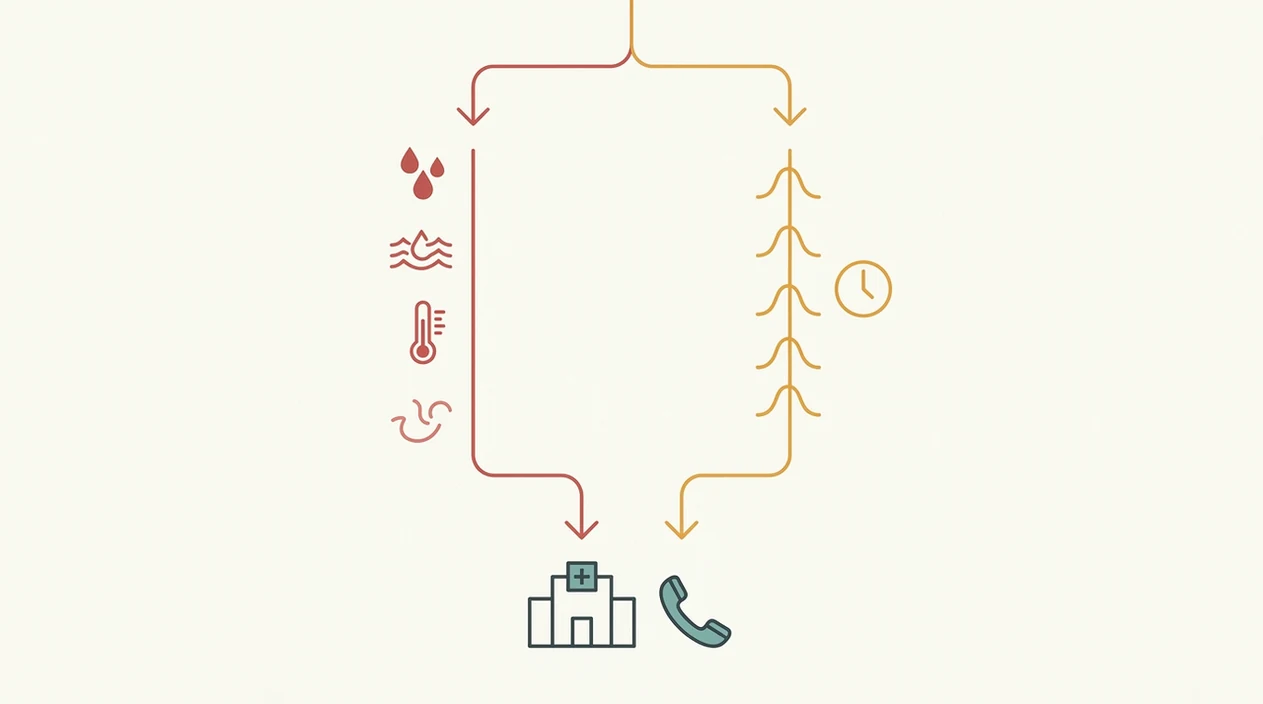
Maternity triage assessment works by turning your description into an urgency decision. A midwife or nurse usually asks about contraction pattern, waters, bleeding, baby movement, gestational age, and known risk factors.
They are listening for clinical thresholds, not just how distressed you sound. Hypnobirthing, breathing, and birth hypnosis can lower pain perception, so say what is happening in measurable terms. “Every 4 minutes, lasting 70 seconds, for 90 minutes” is more useful than “I’m coping.”
Possible answers are simple: come in now, wait at home and call back, or self-monitor with specific instructions. Phone triage cannot check your cervix, fetal heart rate, temperature, or blood pressure cuff reading. It depends on what you report.
Keep your maternity notes nearby. Have your hospital number saved under a name your birth partner can find fast, even at 3 a.m. with the contraction timer app pinging in early labor.

Call Now Or Wait: A Binary Decision Guide For Labor Symptoms
If you are unsure, call now. No symptom is too minor for maternity triage if it worries you, and hypnobirthing relaxation can make urgent contractions feel surprisingly manageable.
| Call maternity triage now | Monitor at home, unless something changes |
|---|---|
| Waters broken, any colour | Irregular Braxton Hicks that stop with rest |
| Green, brown, pink, or bloody fluid | Mild period-like cramps with no clear pattern |
| Bleeding beyond a normal bloody show | Normal bloody show or mucus plug only |
| Reduced or changed baby movements | Baby moving normally today |
| Fever, chills, or feeling unwell | Mild tightening that eases with hydration and rest |
| Contractions before 37 weeks | Early labor signs at term with no red flags |
| Severe constant abdominal pain | |
| 6 or more contractions in 10 minutes | |
| Contractions lasting longer than 2 minutes | |
| Gut feeling something is wrong |
A contraction timer can support your call, but it cannot decide the call. The limits are covered more directly in can contraction timer tell labor.
How Hypnobirthing Can Mask Maternity Triage Timing
Hypnobirthing can reduce pain perception, which is useful, but that same benefit can delay a hospital call. If you feel calm, still check the objective signs: spacing, duration, fluid colour, bleeding, temperature, and baby movement.
Apps show numbers. They do not see pads, fluid on underwear, or whether the baby has gone quiet.
A birth partner can help by watching the pattern while the birthing person stays relaxed. Ask them to note contraction start times, offer a straw cup between surges, and call triage if the agreed threshold is reached. Good hypnobirthing apps deliver breathing support and guided practice, not diagnosis, fetal monitoring, or permission to ignore red flags.
Relaxation tools can support calmer preparation, but escalation always belongs to clinical guidance. Treat breathing tracks, affirmations, and contraction timers as comfort aids, not triage tools.
What To Say When You Call Maternity Triage During Labor
Say the important details first. A short script helps when you are in pain, deeply relaxed, or trying not to answer five questions during one contraction.
Use this:
- State your name, due date, gestational weeks, and hospital number.
- Describe contractions: how far apart, how long, how strong, and whether you can talk through them.
- Report waters: whether they have broken, when it happened, and the fluid colour, clear, pink, green, brown, or bloody.
- Report bleeding: amount, colour, clots, and whether it is more than a bloody show.
- Describe baby’s movements today: normal, reduced, changed, or absent.
- Mention risk factors: VBAC, twins or multiples, hypertension, GBS-positive, previous cesarean, or anything your doctor flagged.
Save the script in your phone notes. Better yet, have your birth partner read it from the sofa while you keep breathing.
Specific Guarantees For Labor Triage Guidance
This page gives general escalation guidance based on widely published clinical thresholds. It is meant to help you call sooner and speak clearly, not to replace your birth preferences, local hospital protocol, or your midwife’s specific instructions.
A hypnobirthing or pregnancy-relaxation app is not a medical device or diagnostic tool. It may help with guided meditation, labor breathing, and birth affirmations, but it cannot assess you or your baby.
Follow your care provider’s individual advice over any online resource. That is especially true if you have a VBAC plan, high blood pressure, multiples, reduced growth, or any instruction to call earlier than standard guidance.
Your own plan wins here.
Medical Sources And Review Process For This Labor Guidance
This labor guidance is based on public clinical information from ACOG, CDC birth data, NHS and NICE-style maternity triage principles, and common hospital labor-and-delivery instructions. It is educational support for deciding when to call, not a diagnosis or personalised medical advice.
Local hospital instructions always override this page. If your midwife, obstetrician, birth centre, trust, or labor ward gave you a different number or an earlier call threshold, use that plan first.
- Use contraction spacing, duration, and the 3-5-1 or 5-1-1 pattern as general timing thresholds, especially when contractions are stronger, closer together, and hard to talk through.
- Treat reduced or changed baby movement, waters breaking, green or brown fluid, bleeding beyond a bloody show, fever, severe constant pain, preterm labor symptoms, or a gut feeling something is wrong as reasons for immediate triage.
- Report individual risk factors such as VBAC, twins, hypertension, previous cesarean, GBS-positive status, or reduced growth because they can change the safest threshold.
- Check the review note: this page was editorially fact-checked against the sources above and last updated May 22, 2026.
Limitations
This guidance has real limits, and they matter during labor.
- The 3-5-1 and 5-1-1 rules are rough guides. Some labors move faster, especially after a first baby, and some stay slow for many hours.
- Phone triage depends on what you report. Hypnobirthing techniques can change pain perception, so include timing and visible signs.
- No app can reliably distinguish true labor from false labor or detect emergencies. Use app data only as extra information for your triage call.
- Individual risk factors change thresholds. VBAC, hypertension, multiples, previous cesarean, GBS-positive status, or reduced fetal growth may mean you call earlier.
- Subtle warning signs can be easy to miss at home. Early infection, gradual movement changes, or slow fluid leakage may not feel dramatic.
- Regional protocols vary. Labor and delivery, maternity triage, and emergency department pathways differ by country, hospital, and trust.
- Privacy also matters when apps store sensitive birth details. Read more about pregnancy app privacy before logging medical information.
Read more
- About HypnoBirth App: Calm Birth Support
- Are Hypnobirthing Apps Regulated
- Are Hypnobirthing Apps Safe
- Birth Partner Hypnobirthing App Guide
- App for Natural Birth Preparation: What to Choose
- Best Birth Meditation App for Calm Labor
- Best Contraction Timer App for iPhone: 2026 Guide
- Best Hypnobirthing App 2026: Top Picks
- Does Hypnobirthing Work for First Births? Guide
- Free Hypnobirthing App for iPhone: Calm Birth
- How to Start Hypnobirthing: Beginner Guide
- Hypnobirthing for C Section Prep: Calm Cesarean
Best Labor Support App for Staying Calm While Knowing When to Call the Hospital
HypnoBirth App can support calm breathing, relaxation, and focus during early labor, but it should never replace medical guidance or your hospital’s advice. If you have bleeding, reduced baby movement, fever, severe pain, waters breaking with concerns, or any urgent worry, call your maternity unit or healthcare provider instead of relying on an app timer.
Best for
- Using hypnobirthing audio and breathing tools between contractions
- Feeling calmer while following your hospital or midwife’s labor guidance
Limitations
- Does not diagnose labor progress or medical warning signs
- Should not be used instead of calling your hospital, midwife, or emergency services when concerned
Frequently Asked Questions
When should I call the hospital during labour?
Call the hospital or maternity unit when contractions are regular and getting stronger, or sooner if you have any warning signs. Warning signs include heavy bleeding, reduced baby movements, waters breaking with green or brown fluid, fever, severe pain, or feeling that something is wrong. If you are unsure, call for advice rather than relying only on an app timer.
Should I call the hospital if my contraction app says labour has started?
Yes, call the hospital if your contractions are regular, strong, and close together, but do not rely on the app alone. Apps can help you notice a pattern, but they cannot assess bleeding, baby movements, your waters, fever, pain level, or your medical history. A midwife or clinician can tell you whether to stay home, come in, or seek urgent help.
What is the 5-1-1 rule for calling the hospital in labour?
The 5-1-1 rule means contractions are about 5 minutes apart, last around 1 minute, and continue for 1 hour. This is a common guide, especially for first-time mums, but your hospital may give different advice. Call earlier if you have complications, reduced movement, bleeding, waters breaking, or strong concern.
When should first-time mums call the hospital during labour?
First-time mums should usually call when contractions are regular, increasingly intense, and hard to talk through, or when their maternity team’s timing guidance is met. First labours can be long, so the hospital may advise you to stay home a little longer if all is well. Call immediately for heavy bleeding, reduced baby movement, fever, waters breaking with an unusual colour or smell, or urgent concern.
Should I call the hospital if I am 38 weeks pregnant and contractions start?
Yes, call your maternity unit if you are 38 weeks pregnant and contractions become regular, painful, or closer together. At 38 weeks, labour may be beginning, but cramps and practice contractions can also happen. Call straight away if your waters break, you have bleeding, reduced baby movements, fever, or you feel unsafe.
Should I call the hospital if my waters break before contractions start?
Yes, call the hospital or maternity unit when your waters break, even if contractions have not started. They will ask about the colour, smell, amount of fluid, your baby’s movements, and your pregnancy details. Seek urgent advice if the fluid is green, brown, bloody, foul-smelling, or if you feel unwell.
Should I call the hospital for reduced baby movement during labour or late pregnancy?
Yes, call the hospital immediately for reduced, changed, or absent baby movements. Do not wait for contractions, use an app timer, or try to provoke movement as a substitute for medical advice. Your maternity team can advise monitoring or assessment based on your situation.
Should I call the hospital if I have bleeding during labour?
Yes, call the hospital immediately if you have bleeding in labour or late pregnancy. A small mucus plug or bloody show can be normal, but heavy bleeding, bright red bleeding, clots, or bleeding with pain needs urgent advice. If bleeding is heavy or you feel faint or unwell, seek emergency help.
Should I call the hospital if I have a fever during labour?
Yes, call the hospital if you have a fever, chills, or feel flu-like during labour or after your waters break. Fever can be a sign that you or your baby need assessment. Do not rely on contraction timing if you feel unwell.
Can pregnancy anxiety be a reason to call the hospital during labour?
Yes, call the hospital if pregnancy anxiety is making you feel unsafe, panicked, or unsure what to do. Maternity teams expect calls from parents who need reassurance or guidance, especially during early labour. If you have chest pain, thoughts of harming yourself, or feel unable to cope, seek urgent help immediately.
When should I call the hospital if I want an epidural?
Call the hospital when contractions are strong and regular, and mention that you are considering an epidural. Timing matters because an epidural usually requires hospital assessment, monitoring, fluids, and an anaesthetist. Availability and suitability vary, so ask your maternity unit for advice rather than waiting too long at home.
Is a contraction app better than a hypnobirthing class for knowing when to call the hospital?
No, a contraction app is not better than personalised medical advice or birth preparation for knowing when to call. An app can time contractions, while a hypnobirthing class can help you understand labour signs, stay calm, and make informed decisions. Neither replaces calling your midwife, maternity unit, or emergency services when warning signs appear.