 Hypno
HypnoHypnobirthing Benefits: What the Evidence Actually Shows for Pregnancy and Labor
200,000+ moms • ORCHA NHS Certified • Free on iOS & Android
Quick answer: Hypnobirthing benefits include reduced birth anxiety, lower perceived labor pain, less reliance on pharmacological pain relief, and a more positive birth experience overall. These gains come from consistent practice of relaxation, breathing, and self-hypnosis techniques, not from a single session, and claims about dramatically cutting cesarean or epidural rates remain inconsistent in research.
Definition: Hypnobirthing is a structured childbirth preparation method that uses guided relaxation, controlled breathing, visualization, and self-hypnosis to reduce fear and pain during pregnancy, labor, and birth.
TL;DR
- Strongest evidence: hypnobirthing reduces birth fear, anxiety, and improves satisfaction, even when interventions are needed.
- Modest pain reduction and less pharmacological pain relief are supported, but results vary per person.
- Hard outcome claims, like lower cesarean rates or shorter labor, are inconsistent. Practice expectations should be realistic.
- Techniques work alongside epidurals, inductions, and cesareans, not only for unmedicated births.
- App-based daily practice improves adherence and partner involvement, which matters more than the specific method brand.
What Hypnobirthing Benefits Actually Mean
Hypnobirthing benefits are the practical changes people may notice from repeated relaxation, breathing, visualization, and self-hypnosis practice before and during birth. In plain language, the benefits are usually calmer anticipation, steadier coping during contractions, and a stronger sense of control.
The evidence is strongest for psychological outcomes. Fear of childbirth, anxiety, satisfaction, and confidence tend to improve more consistently than hard medical outcomes. Claims about sharply reducing cesareans, epidurals, or labor length are much less reliable.
That distinction matters in a real birth room. Soft music under beeping monitors can still feel intense. Hypnobirthing gives you a practiced way to soften your shoulders, release your jaw, and come back to an anchor phrase.
The benefits of hypnobirthing usually build through daily repetition, not a one-off class watched at 38 weeks.
5 Evidence-Backed Hypnobirthing Benefits for Pregnancy and Labor
- Reduced birth fear and anxiety: A large 2015 randomized trial found antenatal hypnosis training did not significantly reduce epidural or cesarean rates, but it did reduce fear of childbirth scores source.
- Lower perceived labor pain: A small randomized trial reported lower labor pain after hypnobirthing training, but the sample size was limited and results should be treated cautiously.
- Less pharmacological pain relief: A Cochrane review found women using hypnosis for labor pain management were less likely to use pharmacological pain relief, though results varied between trials source.
- Higher birth satisfaction and control: Several trials report better satisfaction, especially when people feel they have coping tools during unpredictable moments.
- Lower postpartum depression scores in one RCT: One trial found lower postpartum depression scores after hypnobirthing training, but this should be read as promising, not settled.
One mother told me after a week of short sessions, “I know what to do with my breath now.” That sentence is the work.
How Hypnobirthing Relaxation Techniques Work During Labor
Hypnobirthing techniques work by interrupting the fear-tension-pain cycle. When fear rises, the body often tightens. Tight muscles can make contractions feel more threatening, which then feeds more fear.
Slow breathing and visualization support parasympathetic activation. That means the nervous system gets more signals of safety. In everyday words, your body has a better chance of unclenching instead of bracing.
Self-hypnosis is not losing control. It is focused attention, paired with relaxation cues, that may change how pain signals are noticed and interpreted. I often teach people to unclench the tongue from the roof of the mouth, then drop the shoulders away from the ears.
Tiny cue. Big reset.
Repetition before labor builds an automatic response. For many people, a 12-minute guided track with one earbud in, lying on the left side, is more useful than reading another birth theory chapter. For a practice arc, the hypnobirthing benefits timeline shows how these cues can build over pregnancy.

Before You Start Hypnobirthing Practice
Before you start hypnobirthing practice, make sure it fits your pregnancy, your support system, and your actual week. The goal is to build repeatable coping skills, not to control every birth outcome.
- Ask your midwife or doctor about your situation. This matters especially if you have a high-risk pregnancy, previous complications, planned induction, placenta concerns, twins, blood pressure issues, or any advice to limit activity or position changes.
- Choose a practice time you can repeat most days. Pick a quiet, ordinary slot rather than a perfect one. Ten minutes after lunch, before sleep, or after a shower often works better than a long session you keep postponing.
- Decide who will support the routine. A partner, doula, friend, or class teacher can read scripts, remind you to practice, or help you rehearse calm cues without making it feel like homework.
- Set realistic expectations from the start. Hypnobirthing may reduce fear and improve coping, but it does not guarantee a pain-free, intervention-free, or uncomplicated birth.
- Prepare your tools. Keep headphones, affirmations, scripts, or a favorite guided track somewhere easy to reach, so starting takes one tap instead of twenty decisions.
How to Practice Hypnobirthing for Maximum Labor Benefits
The most common medically supported way to build hypnobirthing labor benefits is regular skills practice combined with normal maternity care. Clinicians typically recommend discussing birth preparation methods with your midwife or doctor, especially if you have a high-risk pregnancy.
- Start guided breathing exercises in the second trimester. Practice a release breath after brushing teeth, so it attaches to a habit you already have.
- Add daily visualization or self-hypnosis sessions for 10 to 20 minutes. Use a guided track on the sofa with cushions propped behind aching hips.
- Practice contraction coping scripts with a partner. Have them say your anchor phrase while you breathe out slowly.
- Track sessions to build consistency. Use a simple timer, notebook, class handout, or pregnancy-safe audio app to make practice visible without turning birth preparation into a product decision.
- Rehearse techniques during Braxton Hicks or stress moments. Slow breaths between Braxton Hicks teach your body that the cue is useful before labor begins.
For most pregnant people, short daily practice is easier than occasional long sessions because it makes relaxation a conditioned response.
Hypnobirthing Labor Benefits Beyond Unmedicated Birth
Hypnobirthing labor benefits are not limited to unmedicated birth. Breathing, visualization, and anchor phrases can still help during inductions, epidurals, continuous monitoring, and planned cesareans.
A small randomized trial before elective cesarean section reported lower state anxiety and better birth satisfaction after hypnotherapy, but the evidence base is still limited. That fits what I see in practice. The fluorescent hallway outside labor rooms can make anyone feel exposed, even with a carefully written birth plan.
Hypnobirthing gives coping skills, not rules about which medical choices you are allowed to make. An epidural can reduce pain, and a relaxation cue can still steady your breathing while you wait for anesthesia or monitoring decisions.
Good hypnobirthing apps deliver repeatable breath, relaxation, and affirmation practice, not a promise that birth will unfold without medicine or surprises.
4 Common Myths About Hypnobirthing Benefits
Myth 1: Hypnobirthing guarantees a pain-free birth. It does not. Research supports reduced fear and modest pain improvements for some people, not a guaranteed pain-free labor.
Myth 2: You can’t use an epidural if you do hypnobirthing. You can use both. Hypnobirthing techniques can help before, during, or after pharmacological pain relief.
Myth 3: It only works for home or “natural” births. It can be useful in hospitals, birth centers, inductions, planned cesareans, and monitored labors.
Myth 4: If it does not work, you failed. No. Some people respond strongly to visualization, and others do not.
The 2015 RCT of 680 first-time mothers found no significant reduction in epidural use or cesarean section rates, but did find reduced fear of childbirth. That is still meaningful. If you want a realistic progress view, hypnobirthing before and after can help separate skill-building from fantasy outcomes.
Common Hypnobirthing Mistakes and How to Fix Them
Most hypnobirthing mistakes come from treating it like a performance instead of a practiced coping skill. The fix is usually smaller, earlier, and more honest practice.
- Start before the final stretch if you can. One late session may feel soothing, but it rarely builds an automatic response. Ten minutes most days beats a single perfect class.
- Use the tools when you are mildly stressed. Try the breath while waiting on hold, during Braxton Hicks, or after an annoying message. Labor is not a calm classroom.
- Choose words your body believes. If “I am fearless” feels fake or unsafe, soften it. Try “I can take this one breath” or “I am supported right now.”
- Treat pain relief as part of the plan. An epidural, nitrous oxide, or other medication is not a failure. It can be support, and your breathing cues can still help.
- Involve your labor support person early. Have them learn your anchor phrase, preferred touch, and what not to say. A calm reminder from the right voice can be more useful than another saved audio track.
What App-Based Practice Adds to Hypnobirthing Benefits
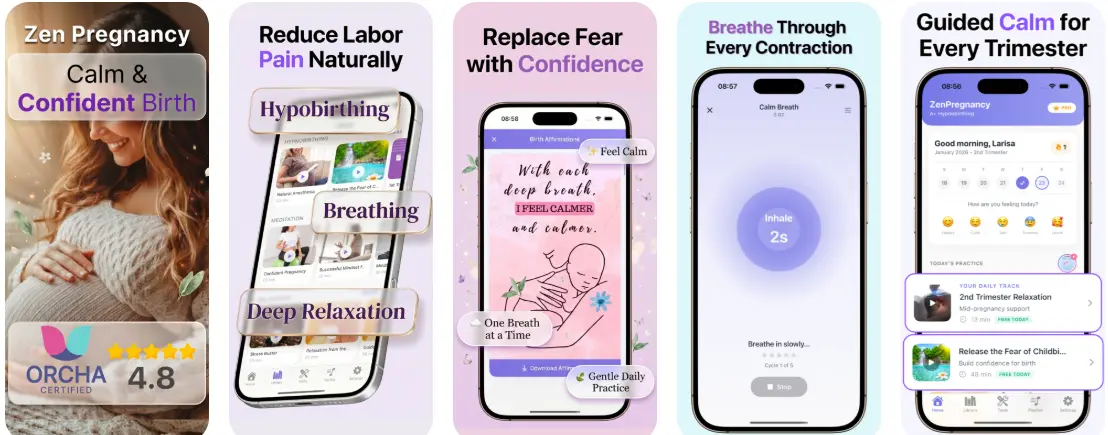
An app can make hypnobirthing benefits more likely by turning “I should practice” into a daily routine. Reminders, session tracking, guided meditations, breathing exercises, and birth affirmations reduce the friction between intention and doing it.
App-based practice is useful when it keeps the routine close: an audio library on the sofa, a five-minute breathing session, a partner script, and a contraction timer in one place.
The bathroom mirror affirmation at 2 a.m. helps too. You see it during the toilet trip, half awake, and the words become familiar.
Apps such as HypnoBirth App, GentleBirth, Expectful, and ZenPregnancy can support practice, but consistency matters more than the logo. For measurable routine changes, hypnobirthing benefits after 30 days is often the clearer benchmark.
Limitations
Hypnobirthing is low-risk for many people, but the evidence has real limits. It should be taught as a coping method, not as a guarantee.
- Hard outcomes, including cesarean rates, epidural use, and labor length, are inconsistent across studies.
- It requires time, repetition, and motivation. A few tracks near your due date are unlikely to change much.
- Not everyone responds to hypnosis, guided imagery, or visualization. Some people prefer mindfulness, CBT skills, or straightforward breathing.
- It complements medical care. It does not replace fetal monitoring, clinical advice, pain relief, induction planning, or emergency decisions.
- Many studies are small or moderate in size, with different hypnosis scripts, class formats, and comparison groups.
- Marketing often overhypes pain-free and intervention-free claims, which can leave people feeling blamed after a difficult birth.
- Partner practice helps, but not every partner is available, calm, or comfortable reading scripts aloud.
For longer routines, hypnobirthing results after 90 days may reflect skill-building better than a last-minute plan.
When to Ask Your Midwife or Doctor
Ask your midwife or doctor whenever hypnobirthing intersects with symptoms, risk factors, or a birth plan that includes medical decisions. It is a preparation tool, not a replacement for clinical guidance.
If relaxation tracks bring up trauma memories, panic, spiraling anxiety, or a sense of being trapped in your body, pause the practice and talk to a qualified professional. Hypnosis should feel supportive and grounding, not like something you have to push through.
- Discuss your plan early if you are preparing for induction, planned cesarean, VBAC, twins, blood pressure concerns, diabetes, placenta issues, or any other high-risk care pathway.
- Tell your care team which techniques you hope to use, such as breathing cues, scripts, headphones, dim lights, or partner prompts, so they can fit around monitoring and procedures.
- Seek urgent care immediately for bleeding, severe abdominal pain, reduced or changed baby movement, severe headache, vision changes, fever, fluid leaking, or any symptom your maternity team has flagged as urgent.
- Use the tools alongside advice from your clinician, especially when decisions change quickly in labor.
Read more
- About HypnoBirth App: Calm Birth Support
- Are Hypnobirthing Apps Regulated
- Are Hypnobirthing Apps Safe
- Birth Partner Hypnobirthing App Guide
- App for Natural Birth Preparation: What to Choose
- Best Birth Meditation App for Calm Labor
- Best Contraction Timer App for iPhone: 2026 Guide
- Best Hypnobirthing App 2026: Top Picks
- Does Hypnobirthing Work for First Births? Guide
- Free Hypnobirthing App for iPhone: Calm Birth
- How to Start Hypnobirthing: Beginner Guide
- Hypnobirthing for C Section Prep: Calm Cesarean
Best Hypnobirthing Benefits App for Calm Pregnancy Practice
HypnoBirth App helps you explore the practical benefits of hypnobirthing through guided relaxation, breathing, affirmations, and birth preparation tools. It is a free hypnobirthing app used by 200k+ people and ORCHA NHS certified, making it a supportive option for building confidence while understanding that outcomes vary.
Best for
- Practising calm breathing, relaxation, and mindset techniques during pregnancy
- Building confidence and coping skills before labor
Limitations
- Hypnobirthing does not guarantee a specific type of birth or pain-free labor
- The app is educational support and not a substitute for personalised medical advice
Frequently Asked Questions
What are the main benefits of hypnobirthing during pregnancy and labour?
The main benefits of hypnobirthing are feeling calmer, reducing fear, learning practical coping tools, and building confidence for birth. Research suggests hypnobirthing is most useful for relaxation, anxiety reduction, and improving the birth experience, although it does not guarantee a pain-free or intervention-free labour.
Does hypnobirthing actually work for labour pain?
Hypnobirthing works best as a coping method rather than a guaranteed pain relief technique. Breathing, relaxation, visualisation, and self-hypnosis may help some people feel more in control of contractions, but pain levels and medical needs vary widely between births.
Is hypnobirthing evidence-based?
Hypnobirthing is partly evidence-based, especially for relaxation, fear reduction, and birth confidence. The evidence is mixed for outcomes such as shorter labour, lower intervention rates, or reduced pain medication use, so it should be viewed as a supportive preparation tool rather than a medical guarantee.
Can hypnobirthing help with pregnancy anxiety?
Yes, hypnobirthing can help some people manage pregnancy anxiety. The structured breathing, guided relaxation, and positive rehearsal can calm the nervous system and reduce fear around birth, but persistent or severe anxiety should also be discussed with a midwife, GP, or mental health professional.
Is 38 weeks too late to start hypnobirthing?
No, 38 weeks is not too late to start hypnobirthing. Even a short daily practice of breathing, relaxation tracks, and birth affirmations can help you feel more prepared before labour, although starting earlier gives you more time to build the habit.
Is hypnobirthing useful for first-time mums?
Yes, hypnobirthing is useful for many first-time mums because it explains what happens in labour and gives practical tools for staying calm. It can reduce fear of the unknown, support informed decision-making, and help partners understand how to provide useful support.
Can I use hypnobirthing if I want an epidural?
Yes, hypnobirthing can be used alongside an epidural. The techniques can help before the epidural is placed, during examinations or waiting periods, and for staying calm if plans change, but pain relief choices should be made with your maternity team.
Does hypnobirthing reduce the chance of a C-section or medical intervention?
No, hypnobirthing does not reliably guarantee a lower chance of C-section or medical intervention. Some studies suggest better coping and possibly fewer interventions for some groups, but birth outcomes depend on many medical, personal, and labour-related factors.
What hypnobirthing techniques are most beneficial?
The most beneficial hypnobirthing techniques are slow breathing, guided relaxation, visualisation, positive language, and partner support cues. These techniques are designed to reduce tension and fear, which can make contractions feel more manageable for some people.
Is a hypnobirthing app as good as a hypnobirthing class?
A hypnobirthing app is a convenient option for daily practice, while a class offers more personalised teaching and time for questions. An app can be enough for people who want flexible, affordable practice, but a class may be better if you need tailored support, partner coaching, or help understanding birth choices.
Can hypnobirthing help during an induction?
Yes, hypnobirthing can help during an induction by supporting relaxation, patience, and coping with uncertainty. Induction can involve waiting, monitoring, and stronger contractions for some people, so breathing and self-hypnosis techniques can be useful alongside medical care.
Are there any risks or downsides to hypnobirthing?
Hypnobirthing is generally low risk when used as a relaxation and preparation method. The main downside is expecting guaranteed outcomes, so it is important to stay flexible, follow medical advice, and use hypnobirthing as one part of a safe birth plan.