 Hypno
HypnoDiscover Positive Birth Confidence Through Daily Practice
200,000+ moms • ORCHA NHS Certified • Free on iOS & Android
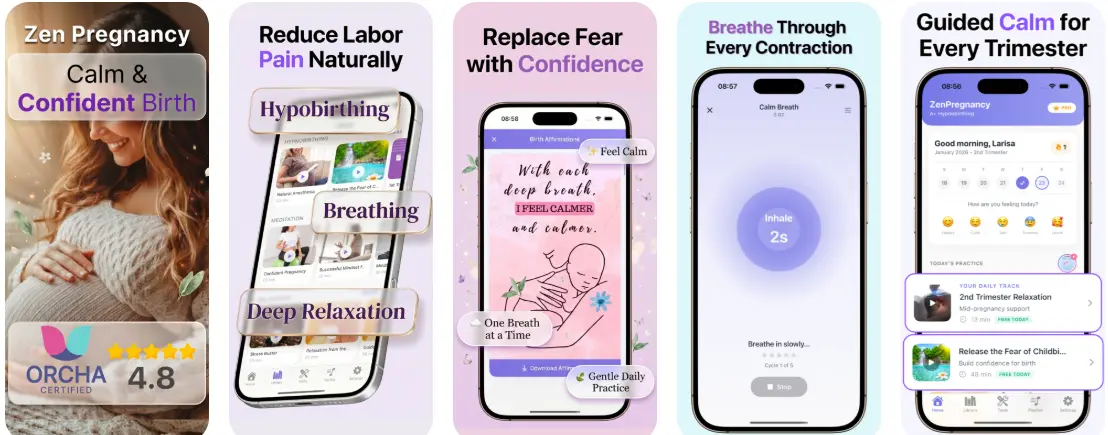
You can discover positive birth confidence by combining daily breathing exercises, guided relaxation, birth affirmations, and flexible birth planning into a consistent routine. Confidence grows from repeated practice and realistic preparation, not from a single class, checklist, or late-night video binge.
Definition: Positive birth confidence is the feeling of being informed, supported, and mentally prepared for labor and delivery, built through consistent practice of relaxation, breathing, and birth education, not the expectation of a pain-free or intervention-free birth.
TL;DR
- Birth confidence comes from repeated daily practice, not a one-time course or video.
- The best birth confidence apps combine guided relaxation, breathing exercises, affirmations, and flexible birth planning, not just feel-good mantras.
- Confidence means feeling prepared for any outcome, including cesarean delivery or medical interventions.
- Birth partners who learn the same tools provide stronger support during labor.
- HypnoBirth App structures these evidence-based techniques into a daily practice routine on your phone.
What Positive Birth Confidence Actually Means
Positive birth confidence means feeling informed, supported, and mentally ready for birth, even when labor does not follow the plan. It is not the belief that birth will be easy, pain-free, or free of medical decisions.
A confident person can still ask for an epidural, agree to monitoring, transfer rooms, or have a cesarean. Per the CDC, 32.4% of U.S. births were cesarean deliveries in 2023, so real preparation has to include more than one version of birth: https://www.cdc.gov/nchs/fastats/delivery.htm. I have sat beside people who kept breathing steadily while gown snaps were opened at the shoulder for surgical prep. That counted.
Hypnobirthing is not mind control. It uses breathing, guided relaxation, focus cues, and birth affirmations to reduce fear and support coping. Evidence-based support is different from marketing that promises one “right” outcome. For a broader look at what hypnobirthing can and cannot do, the hypnobirthing benefits guide is a useful next step.
At a Glance: Five Facts About Building Birth Confidence
- Repeated practice is the mechanism. Birth confidence grows when breathing and relaxation become familiar before contractions start, not when someone hears the idea once.
- Continuous labor support is linked with better outcomes. A Cochrane review found that continuous support was associated with more spontaneous vaginal births and less use of pain medication: https://www.cochranelibrary.com/cdsr/doi/10.1002/14651858.CD003766.pub6/full.
- Respectful care matters. WHO guidance emphasizes respectful, continuous care during labor as part of a better childbirth experience, especially when people feel heard: https://www.who.int/publications/i/item/9789241550215.
- Birth partners need the same practice. A partner who knows the breathing cue, hip squeeze, and BRAIN questions can support without asking, “What do you need?” every two minutes.
- Generic tools are not enough for everyone. Trauma, severe anxiety, high-risk pregnancy, or prior birth complications may need a clinician, therapist, or specialist birth worker involved.
The room gets quieter when everyone knows their job.
How Positive Birth Confidence Practice Works

Positive birth confidence practice works by pairing repeated calming cues with realistic birth education. Over time, the body starts to recognize breathing, relaxation audio, and affirmations as signals to settle instead of brace.
The light technical term is parasympathetic activation. In plain language, that means helping the body shift toward rest, steadiness, and slower breathing. It does not turn labor into sleep. It gives the nervous system a practiced route back from panic. The most common medically supported way to build labor coping is repeated relaxation practice combined with continuous human support.
Breathing and Parasympathetic Response
Slow breathing gives the birth partner something concrete to coach during early labor. I like simple cues: “Drop your shoulders,” “long exhale,” “one contraction at a time.” When the contraction timer app pings, the cue starts again.
Affirmations and Cognitive Reframing
Affirmations work best when they sound believable. “I can meet this next contraction” is more useful than pretending nothing hurts. Flexible birth planning also lowers panic when plans change.

How to Use a Birth Confidence App for Daily Practice
A birth confidence app works best when you use it as a small daily rehearsal, not as background noise. Tools like HypnoBirth App can structure the routine so breathing, relaxation, affirmations, and partner support stay in one place.
- Set a daily 10 to 15 minute practice window. Put it after a habit you already have, like brushing your teeth or getting into bed.
- Start with a guided breathing exercise. Use the same breath count often enough that your body recognizes it later.
- Listen to a guided relaxation or meditation session. Keep the volume low enough that you can soften your jaw and still hear your room.
- Review birth affirmations aloud or silently. Choose lines you would actually accept during labor.
- Log how you feel after each session. Track anxiety, confidence, sleep, or tension in simple words.
- Share the routine with your birth partner. They need to know the cue before the hospital room gets busy.
Three Birth Confidence Practice Patterns We Track
These patterns do not promise a certain birth outcome. They show how repeated practice can change what people reach for when stress rises.
Daily Practice From 28 Weeks: A First-Time Parent
One first-time parent began 12-minute daily sessions at 28 weeks. By labor, she still felt pain and uncertainty, but she knew her breathing pattern. Her phone glowed beside a water bottle most nights while she practiced one hand resting on her bump. The guided relaxation feature mattered because it removed the “what do I do tonight?” decision.
Cesarean Preparation: Breathing Before Surgery
Another parent used breathing tracks before a planned cesarean. The goal was not avoiding surgery. It was walking into the operating room with a steadier body. Birth affirmations helped her keep the story clear: this was still birth.
Birth Partner as Confidence Coach
A partner practiced the same cues and learned when to offer counterpressure instead of commentary. During back labor, tennis balls pressed into the lower back did more than another pep talk. Partner features helped turn support into action.
Common Patterns in Positive Birth Confidence Routines
The strongest birth confidence routines are usually short, repeated, and shared with a support person. Consistency beats intensity because labor coping depends on recall under stress.
Most people do better with 10 to 20 minutes daily than with one long weekly session they dread. Combining breathing, guided relaxation, birth education, and affirmations is more useful than repeating mantras alone. Good hypnobirthing apps deliver daily rehearsal, breathing cues, affirmations, and labor tools, not a guarantee of a calm or intervention-free birth.
Support matters too. A Cochrane review linked continuous labor support with better outcomes, including more spontaneous vaginal births and less pain medication use. That does not mean support controls birth. It means coaching can help. For people who want to understand how change builds over time, the hypnobirthing benefits timeline explains why gradual practice matters.
Is There a Birth Confidence App That Combines All These Tools?
Is there a birth confidence app that combines guided meditation, breathing exercises, contraction timing, and birth affirmations? Yes. A good birth confidence app brings those tools together for daily hypnobirthing practice and labor preparation.
The goal is repeated use, not one-off reassurance. A structured routine helps you practice before labor, then return to familiar cues when contractions begin. Partner support also matters when someone needs to time contractions, offer a straw cup, or remind you to change positions.
HypnoBirth App sits under the ZenPregnancy family and focuses on realistic hypnobirthing, not false promises. It does not replace prenatal care, clinical advice, or emergency support.
What Positive Birth Confidence Practice Does Not Show
Positive birth confidence practice does not show whether you will have a vaginal birth, shorter labor, or no pain. It also does not prove that you will feel calm during every contraction.
That distinction matters. Someone can practice daily and still shake during transition, cry before a cervical check, or need medication. None of that means the practice failed. It may still help them breathe, ask a clear question, or reset after a plan change.
App-based tools cannot replace individual clinical care, trauma therapy, or high-risk pregnancy planning. One-off sessions rarely change how someone feels in labor because the body needs repetition. Results vary by person, birth setting, care team, baby position, fatigue, and support. The hypnobirthing before and after comparison shows this shift more honestly than simple success stories.
When to Seek Professional Birth Support
Seek professional birth support whenever symptoms feel urgent, unusual, or outside your care plan. Breathing tools can steady you, but they should sit beside medical guidance, not in front of it.
If you notice bleeding, severe abdominal pain, fever, fluid concerns, or reduced baby movement, contact your maternity team promptly. If symptoms feel like an emergency, use local emergency services rather than opening an app, replaying an audio track, or waiting for reassurance from a forum. The calmest choice is often the fastest one.
- Call your maternity unit, midwife, or obstetric office when you have concerning symptoms or a clear change from your usual pattern.
- Use emergency services for heavy bleeding, severe pain, fainting, trouble breathing, seizure symptoms, or anything your care team has named as urgent.
- Ask for trauma-informed care if previous birth, loss, assault, surgery, or medical treatment starts to feel intrusive or frightening in pregnancy or labor.
- Involve a clinician early if you have a high-risk pregnancy, preeclampsia concerns, diabetes, complex monitoring needs, or planned cesarean care.
- Keep using slow breathing while you wait for instructions or transport, as support for your nervous system, not as a substitute for care.
Limitations
Positive birth confidence tools are supportive, not medical treatment. They can help with coping and preparation, but they cannot monitor a baby, treat bleeding, manage preeclampsia, or replace an obstetric team.
- Relaxation routines do not replace prenatal care, fetal monitoring, emergency obstetric treatment, or medical decision-making.
- Claims that any app shortens labor, prevents cesarean birth, or eliminates pain for everyone are overstated.
- Hypnobirthing and mindfulness require consistent practice. One-off listening is usually not enough.
- These tools are not proven to remove fear for every person or in every birth setting.
- People with trauma, severe anxiety, prior birth injury, or high-risk pregnancies may need individual clinician or therapist support.
- The U.S. maternal mortality rate was 18.6 deaths per 100,000 live births in 2023, per the CDC, which is one reason apps must stay in a support role.
- Emotional and physical birth outcomes are shaped by baby position, medical history, staffing, hospital policy, luck, and timing.
Sticky socks. Bright lights. Real decisions. Practice helps, but it does not control the room.
See also: Download Hypnobirthing App.
Read more
- About HypnoBirth App: Calm Birth Support
- Are Hypnobirthing Apps Regulated
- Are Hypnobirthing Apps Safe
- Birth Partner Hypnobirthing App Guide
- App for Natural Birth Preparation: What to Choose
- Best Birth Meditation App for Calm Labor
- Best Contraction Timer App for iPhone: 2026 Guide
- Best Hypnobirthing App 2026: Top Picks
- Does Hypnobirthing Work for First Births? Guide
- Free Hypnobirthing App for iPhone: Calm Birth
- How to Start Hypnobirthing: Beginner Guide
- Hypnobirthing for C Section Prep: Calm Cesarean
Best Positive Birth Confidence App for Daily Hypnobirthing Practice
HypnoBirth App helps you build positive birth confidence with short, realistic hypnobirthing sessions you can use every day. With breathing practice, affirmations, relaxation tracks, and flexible birth planning support, it is designed to fit into pregnancy without pressure.
Best for
- Building calm confidence through regular hypnobirthing practice
- Using breathing, affirmations, and relaxation tools at home or on the go
Limitations
- It does not replace personalised medical advice from your midwife or doctor
- Confidence grows with practice, so it works best when used consistently
Frequently Asked Questions
What is positive birth confidence in pregnancy?
Positive birth confidence is the belief that you can meet labour with practical tools, support, and informed choices. It does not mean expecting a perfect or pain-free birth; it means building calm, flexible confidence through practice, breathing, education, and preparation.
How can I build confidence for labour every day?
You can build confidence for labour by practising small, repeatable techniques daily. A few minutes of calm breathing, listening to a relaxation track, using affirmations, and visualising your birth preferences can help your mind and body become familiar with feeling steady.
Can hypnobirthing help with pregnancy anxiety?
Yes, hypnobirthing can help some people manage pregnancy anxiety by teaching calming techniques and reducing fear around birth. Breathing, relaxation, positive suggestions, and clear preparation can support a calmer mindset, but severe or persistent anxiety should also be discussed with your midwife, GP, or mental health professional.
Is 38 weeks too late to start hypnobirthing practice?
No, 38 weeks is not too late to start hypnobirthing practice. Even short daily sessions of breathing, relaxation, and birth affirmations can help you feel more prepared before labour begins.
Does positive birth confidence mean I have to avoid pain relief?
No, positive birth confidence does not mean you have to avoid pain relief. Hypnobirthing and birth preparation can be used alongside gas and air, an epidural, water, movement, massage, or other options that are safe and available for you.
Can I use hypnobirthing if I want an epidural?
Yes, you can use hypnobirthing if you want an epidural. Breathing, relaxation, and decision-making tools can support you before the epidural, while it is being placed, and during the rest of your labour.
Is positive birth preparation useful for first-time mums?
Yes, positive birth preparation is especially useful for first-time mums. It can explain what labour may feel like, introduce coping tools, and help you make informed decisions without relying only on fear-based stories or uncertainty.
How long should I practise hypnobirthing each day?
A useful daily hypnobirthing practice can be as short as 5 to 10 minutes. Consistency matters more than length, so regular breathing practice, affirmations, or guided relaxation can be more effective than occasional long sessions.
What are the best affirmations for positive birth confidence?
The best birth affirmations are short, believable, and personal to you. Examples include “I can take one breath at a time,” “My body and baby are working together,” and “I can ask for support and make informed choices.”
Is a hypnobirthing app better than a class?
A hypnobirthing app is better for flexible daily practice, while a class may be better for live teaching and personalised questions. Many parents use both: an app for repetition at home and a class for deeper education, partner involvement, and confidence.
Can hypnobirthing help if my birth plan changes?
Yes, hypnobirthing can help you stay calmer if your birth plan changes. Techniques such as slow breathing, positive anchors, and decision frameworks can support flexible thinking during induction, assisted birth, caesarean birth, or unexpected changes.
When should I speak to a midwife about fear of birth?
You should speak to a midwife about fear of birth whenever the fear feels persistent, overwhelming, or affects sleep, daily life, or decision-making. Midwives can discuss your options, refer you for extra support if needed, and help you create a safe, realistic birth plan.