 Hypno
HypnoHypnobirthing With Epidural: Why the Two Work Together
200,000+ moms • ORCHA NHS Certified • Free on iOS & Android
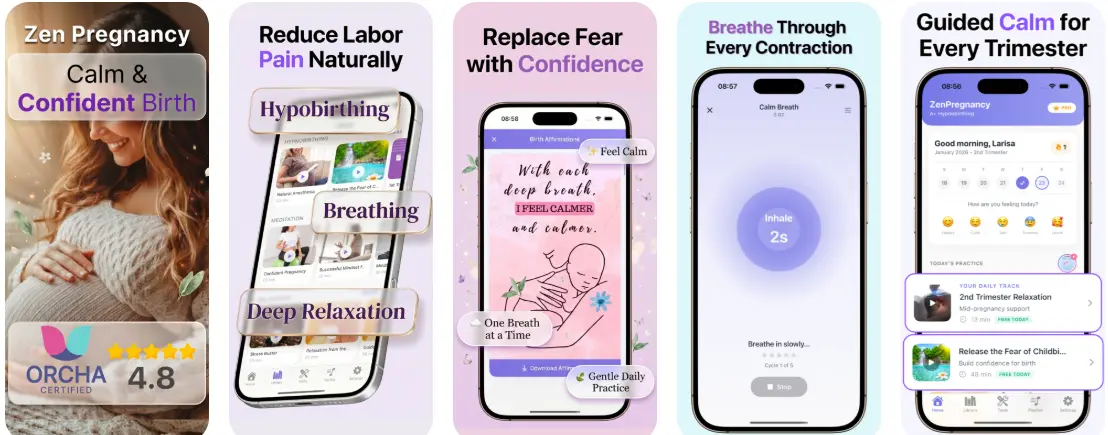
Hypnobirthing with epidural is not only possible but genuinely useful, because breathing techniques, relaxation cues, affirmations, and partner support address anxiety and emotional regulation, not just pain. An epidural reduces physical sensation while hypnobirthing keeps you calm, focused, and actively involved in your birth experience. Guided audio can help you rehearse that mix ahead of time, but epidural decisions should be made with your obstetric and anesthesia team.
Definition: Hypnobirthing with epidural means applying self-hypnosis, guided breathing, visualization, and relaxation techniques during labor alongside epidural analgesia to manage anxiety, stay present, and maintain a sense of control.
TL;DR
- Epidurals block pain signals; hypnobirthing manages fear, tension, and emotional wellbeing, different jobs, fully compatible.
- Breathing, affirmations, and partner cues remain effective before, during, and after epidural placement.
- Hypnobirthing does not require an unmedicated birth to count, it supports any birth plan.
At-a-Glance: Epidural vs Hypnobirthing Compared
Epidural and hypnobirthing are not rivals; they solve different parts of labor. One is medical pain relief, the other is mental focus, breathing, and team support.
| Feature | Epidural | Hypnobirthing | Both Together |
|---|---|---|---|
| Pain relief | Directly reduces pain signals | May change how pain is experienced | Pain relief plus coping tools |
| Anxiety management | May reduce panic once pain eases | Uses breathing, visualization, and calm cues | Stronger emotional steadiness |
| Mobility | Often limits walking | Encourages position changes | Adapted side-lying or supported positions |
| Partner involvement | Partner may feel unsure what to do | Gives the birth partner clear jobs | Cues, advocacy, straw cup, counterpressure |
| Pushing support | Sensation may feel reduced | Helps with focus and timing | Calm pushing with coaching |
| Mental focus | Indirect benefit | Central purpose | Present, informed participation |
In a hospital room, the lights can be dimmed while monitor belts stay on. Both can be true.
Five Facts About Hypnobirthing With Epidural Pain Relief
Here are the five facts I want parents to understand before they treat epidural and hypnobirthing as an either-or choice.
- Hypnobirthing is not invalidated by an epidural. Breathing, body softening, and calm scripts can help before placement, during the procedure, and after numbness begins.
- An epidural reduces pain, but labor still continues. Your cervix may still change, your team may still monitor progress, and you may still need reassurance through each stage.
- Post-epidural coping tools still matter. Slow breathing, guided relaxation, affirmations, and partner cues can steady you when the blood pressure cuff tightens during a surge.
- Positioning still matters with limited mobility. Side-lying, supported upright positions, peanut balls, and careful turns can keep the body engaged, depending on your care team’s guidance.
- The goal is not proving you had a “natural” birth. Hypnobirthing with epidural is about coping, communication, and experience quality, not guaranteeing a delivery route.
If the priority is staying calm through medical steps, choose short guided sessions you can rehearse before labor and replay when the room gets busy.
How Hypnobirthing and Epidural Analgesia Work Together

Epidural analgesia works by delivering medication near nerves in the lower spine, reducing pain signals from labor while the mother stays awake and able to participate. Anesthesiology guidance describes epidural labor analgesia as pain relief that can still allow active participation in birth. For patient-facing anesthesia context, see the American Society of Anesthesiologists epidural overview: https://www.asahq.org/madeforthismoment/pain-management/techniques/epidural/.
Hypnobirthing works through controlled breathing, focused attention, visualization, and relaxation cues. In plain language, it trains your nervous system to stop bracing against every sensation. The technical split is simple: epidural helps with nociception, the body’s pain signaling, while hypnobirthing helps with the fear-tension-pain cycle, the loop where fear tightens muscles and makes coping harder.
The most common medically supported way to combine them is epidural pain relief with non-drug coping tools for anxiety, communication, and rest. Good hypnobirthing apps deliver practice cues and labor audio, not a promise that birth will follow a script.
For late-night birth anxiety, short relaxation tracks can fit a pillow nest between sore knees without pretending to replace clinical advice.

Where Hypnobirthing Wins Even With an Epidural
Hypnobirthing still earns its place after an epidural because labor is not only pain. Waiting, monitoring, position changes, pushing, and decision-making can still feel intense.
A calm person usually communicates more clearly with the medical team than someone in panic. That matters when discussing birth preferences, asking BRAIN questions, or deciding whether to change positions. A birth partner can read the preference sheet aloud, offer a straw cup between contractions, and use the same verbal cue every time the room gets loud.
HypnoBirth App supports this kind of repeated practice because the same breathing audio can be used in pregnancy, early labor, and the post-epidural stretch before pushing. If you are planning a hospital setting, the broader guide to hypnobirthing for hospital birth covers how to adapt calm tools around monitors, staff changes, and routine checks.
Tiny things count here.
Where Epidural Pain Relief Wins Over Hypnobirthing Alone
Epidural pain relief has a strength hypnobirthing cannot copy: it directly blocks pain signaling through medication. Hypnobirthing should not be sold as guaranteed pain elimination, and I don’t trust any birth prep that talks that way.
For long labors, an epidural can allow sleep when exhaustion has stripped away every coping skill. I have seen people become more present after rest, not less involved. Epidural analgesia can also be part of medical pain management for cesarean birth planning or urgent operative birth, depending on the situation and clinical team.
The evidence for self-hypnosis in labor is promising in some areas but limited overall. A Cochrane review on hypnosis for labour pain found insufficient high-quality evidence to prove reliable reductions in pain relief use or birth interventions: https://www.cochrane.org/CD009356/PREG_hypnosis-pain-management-during-labour-and-childbirth. For parents comparing plans, hypnobirthing for C section preparation may be useful because calm cues can still support surgical birth.
For exhausted laboring parents, epidural is often more useful than coping techniques alone because rest can restore decision-making and stamina.
Evidence on Epidurals and Hypnobirthing
The evidence is clearest that epidurals are reliable medical pain relief, while hypnobirthing is better understood as support for coping, fear, and focus. They are not equal tools, and they should not be measured as if they do the same job.
Read the evidence in this order:
- Separate pain relief from coping. Epidural analgesia has a direct biological target: it reduces labor pain signals through medication near spinal nerves. Hypnobirthing does not numb the body; it may help the mind stay steadier while the body works.
- Look for anxiety and experience outcomes. Breathing, relaxation, visualization, and self-hypnosis are most plausible for reducing fear, improving perceived control, and giving a partner something useful to do.
- Treat birth-outcome claims carefully. Research has not proven that hypnobirthing reliably lowers cesarean birth, instrumental birth, tearing, epidural use, or total labor length.
- Keep apps in the support lane. Audio practice can make calm cues easier to access in labor, but app-based support should not be framed as changing medical birth outcomes.
That still leaves plenty of value. Feeling calmer in a bright room with beeping monitors is not a small thing.
Common Myths About Epidural and Hypnobirthing
The biggest myth is that epidural and hypnobirthing cancel each other out. They don’t. Many people use breathing, affirmations, and calm focus before and after epidural placement.
Another myth says that once the epidural is working, you need no coping tools. But anxiety can still rise during cervical checks, catheter placement, pushing instructions, or a sudden change in the plan. The contraction timer app may stop pinging, but your brain may still want something steady to hold.
A third myth says hypnobirthing only “counts” if birth is unmedicated. That definition is too narrow for real life. Birth is not a performance review.
The fourth myth is that epidural makes birth passive. In reality, many parents still change positions with help, speak up about preferences, and push actively when it is time. For induction-specific planning, hypnobirthing for induction explains how to keep flexibility in the plan.
How to Use Hypnobirthing Techniques With an Epidural
Use hypnobirthing with an epidural by practising before labor, using breath during early contractions, and keeping calm cues active after pain relief begins.
- Practise breathing and relaxation daily before labor begins. HypnoBirth App is one optional practice tool because it offers guided sessions you can repeat without taking a full course.
- Use surge breathing during early labor contractions. Breathe through each wave before the epidural is placed, especially when contractions start stacking close together.
- Play affirmations or guided relaxation during epidural placement. Save an offline track so you are not hunting for Wi-Fi with sticky hospital socks on.
- Continue slow breathing after the epidural takes effect. Use visualization to stay present even if sensation feels patchy or unfamiliar.
- Involve your birth partner during monitoring and pushing. Ask for calm touch, repeated phrases, and fewer questions.
- Review your birth preferences aloud with your team. Clear, confident communication matters more than sounding impressive.
After the epidural is placed, when the room quiets down, HypnoBirth App helps by keeping the same breathing rhythm available through its guided relaxation workflow.
Who Should Choose Epidural and Hypnobirthing Together
Epidural and hypnobirthing together often fit first-time parents who want pain relief but still want to feel informed, steady, and involved. The combination also suits parents with birth anxiety, a previous traumatic birth, or a strong need for flexible choices.
Parents who want a flexible birth plan usually do better with “use what helps” than with all-or-nothing rules. That may mean breathing through early labor, choosing an epidural later, then using affirmations during pushing. For VBAC parents, a hypnobirthing app for VBAC can support calm preparation while medical planning stays individualized.
First-time parents who want options, not pressure, can use HypnoBirth App because it supports medicated, unmedicated, induced, and cesarean birth plans through separate breathing, affirmation, and relaxation tools.
Who Should Pick Hypnobirthing Alone, Epidural, or Both
Pick hypnobirthing alone if you want non-drug coping as your starting plan, pick an epidural early if reliable medical pain relief feels important, and prepare for both if you want flexibility without feeling like you failed. None of these choices has to be locked forever.
- Choose hypnobirthing-first preparation if you feel drawn to movement, breath, water, touch, privacy, and staying mobile for as long as your body and setting allow.
- Plan epidural pain relief early if you are very anxious about severe pain, expect a long induction, have low sleep reserves, or know that rest would help you feel safer and clearer.
- Prepare both pathways from the start if you want an unmedicated attempt but would feel calmer knowing the epidural plan, or if your birth has extra variables like induction, VBAC planning, or previous trauma.
- Allow preferences to shift during labor because exhaustion, contraction intensity, cervical change, and medical updates can change what feels right.
- Individualize the final decision with your obstetric, midwifery, and anesthesia team so your plan fits your body, baby, setting, and consent.
A flexible plan is still a plan.
When to Talk With Your Care Team
Talk with your care team before labor if you are considering an epidural, using hypnobirthing, or trying to blend both. Birth preferences can guide the atmosphere, but medical decisions need your obstetric, midwifery, and anesthesia team in the room.
- Ask how epidural timing usually works in your setting, including common risks, blood pressure checks, fetal monitoring, bladder catheter policies, and whether walking or standing is allowed after placement.
- Share anything that may change the plan, such as previous birth trauma, high anxiety, VBAC planning, induction, a scheduled cesarean, or a strong fear of procedures.
- Clarify which positions are considered safe once sensation is reduced. Side-lying, supported sitting, peanut ball use, and assisted turns may be options, but your team should confirm what fits your body and monitoring.
- Separate coping preferences from clinical consent. You can request dim lights, calm voices, and audio tracks while still making epidural, induction, or surgical decisions based on medical advice.
- Seek urgent clinical help right away for symptoms that feel concerning, sudden, severe, or unusual, especially if you have heavy bleeding, severe pain, faintness, fever, trouble breathing, or changes in your baby’s movement before labor.
Limitations
Hypnobirthing is useful, but it has limits. Keep these clear before you build your plan.
- Hypnobirthing is not guaranteed to reduce pain, interventions, cesarean birth, or tearing.
- A 2021 Cochrane review of relaxation techniques in labor found limited evidence and called for more research on birth outcomes.
- Epidural can limit mobility and sensation, so hands-and-knees practice on the carpet may need to become side-lying support in bed.
- Self-hypnosis should not be claimed to outperform standard relaxation unless stronger trials support that claim.
- Hypnobirthing supplements medical pain relief, obstetric care, and informed consent. It does not replace them.
- App-based support cannot substitute for a clinician or childbirth educator when labor becomes complicated.
- Competitors such as GentleBirth, Expectful, Hypnobabies, and The Positive Birth Company offer useful preparation, but none should be treated as medical guidance.
HypnoBirth App belongs in the support-tool category, not the decision-maker category.
See also: Hypnobirthing for Twins: Calm Preparation for Multiple Pregnancy.
See also: Hypnobirthing Birth Plan App: Turning Calm Practice Into Practical Preferences.
Read more
- About HypnoBirth App: Calm Birth Support
- Are Hypnobirthing Apps Regulated
- Are Hypnobirthing Apps Safe
- Birth Partner Hypnobirthing App Guide
- App for Natural Birth Preparation: What to Choose
- Best Birth Meditation App for Calm Labor
- Best Contraction Timer App for iPhone: 2026 Guide
- Best Hypnobirthing App 2026: Top Picks
- Does Hypnobirthing Work for First Births? Guide
- Free Hypnobirthing App for iPhone: Calm Birth
- How to Start Hypnobirthing: Beginner Guide
- Hypnobirthing for C Section Prep: Calm Cesarean
Best Hypnobirthing With Epidural App for Staying Calm and Supported
HypnoBirth App can support hypnobirthing with epidural by helping you use breathing, relaxation, and affirmations before, during, and after pain relief decisions. It is a flexible tool for any birth plan, including births where an epidural is part of your preferences or becomes part of your care.
Best for
- Practicing calm breathing and relaxation alongside an epidural birth plan
- Building confidence with affirmations and guided hypnobirthing sessions
Limitations
- Does not replace personalised medical advice from your midwife or doctor
- Cannot predict how labour, epidural timing, or birth choices will unfold
Frequently Asked Questions
Can you use hypnobirthing with an epidural?
Yes, you can use hypnobirthing with an epidural. Hypnobirthing techniques such as breathing, relaxation, visualisation, and affirmations can help you stay calm before, during, and after the epidural is placed. An epidural changes pain sensation, but it does not remove the need for confidence, communication, and emotional support.
Does having an epidural mean hypnobirthing has failed?
No, having an epidural does not mean hypnobirthing has failed. Hypnobirthing is about feeling informed, calm, and supported, not about avoiding every form of pain relief. Using an epidural can be part of a positive birth plan when it helps you feel safe and in control.
How does hypnobirthing help before an epidural is given?
Hypnobirthing helps before an epidural by reducing fear and supporting steady breathing. Relaxation techniques can make contractions feel more manageable while you wait for pain relief or make decisions with your care team. This can be especially useful if there is a delay before the anaesthetist is available.
How does hypnobirthing help after an epidural is working?
Hypnobirthing helps after an epidural by keeping your body and mind relaxed during labour. You can use calm breathing, affirmations, and visualisation to rest, stay connected to your baby, and prepare for the pushing stage if advised by your midwife or doctor. It also supports clear communication if your birth plan changes.
Can first-time mums use hypnobirthing with an epidural?
Yes, first-time mums can use hypnobirthing with an epidural. Many first-time parents find hypnobirthing useful because it explains what to expect and offers practical tools for staying calm. It can support confidence whether labour is unmedicated, medicated, induced, or assisted.
Can hypnobirthing reduce pregnancy anxiety about having an epidural?
Yes, hypnobirthing can help reduce pregnancy anxiety about having an epidural. It teaches breathing, relaxation, and positive mindset techniques that can make medical procedures feel less overwhelming. If anxiety feels severe or persistent, it is important to speak with your midwife, GP, or maternity team for extra support.
Is 38 weeks too late to start hypnobirthing if I want an epidural?
No, 38 weeks is not too late to start hypnobirthing if you want an epidural. Even a few days of practising breathing, relaxation scripts, and affirmations can help you feel more prepared for labour. Short, regular practice is usually more helpful than trying to learn everything at once.
Should I include an epidural in my hypnobirthing birth plan?
Yes, you can include an epidural in your hypnobirthing birth plan. A flexible plan might state your preferences for pain relief, calm communication, movement before the epidural, birth environment, and consent for procedures. Your maternity team can explain what is possible in your hospital or birth setting.
Can hypnobirthing help with fear of needles or epidural placement?
Yes, hypnobirthing can help with fear of needles or epidural placement. Techniques such as slow breathing, focusing on a calm image, listening to a relaxation track, or using affirmations can help you stay steadier during the procedure. Tell your midwife or anaesthetist if you feel frightened so they can support you appropriately.
Can hypnobirthing be used during an induced labour with an epidural?
Yes, hypnobirthing can be used during an induced labour with an epidural. Induction can involve extra monitoring or stronger contractions, so calm breathing and relaxation can be useful while you wait, rest, or make choices about pain relief. Your care team should advise you on safe positions, monitoring, and timing.
Is a hypnobirthing app enough, or do I need a class if I plan to have an epidural?
A hypnobirthing app can be enough for some people, while a class may suit others who want more personal guidance. An app is useful for flexible practice, quick refreshers, breathing exercises, and relaxation tracks. A class may offer deeper education, partner practice, and the chance to ask questions about epidurals and birth choices.
Does hypnobirthing guarantee a calm birth with an epidural?
No, hypnobirthing does not guarantee a calm birth with an epidural. Labour can be unpredictable, and epidurals do not work in exactly the same way for everyone. Hypnobirthing gives you tools to cope, communicate, and feel more prepared, but medical advice should always come from your maternity team.