 Hypno
HypnoHypnobirthing App Features for Calm Birth Preparation
200,000+ moms • ORCHA NHS Certified • Free on iOS & Android
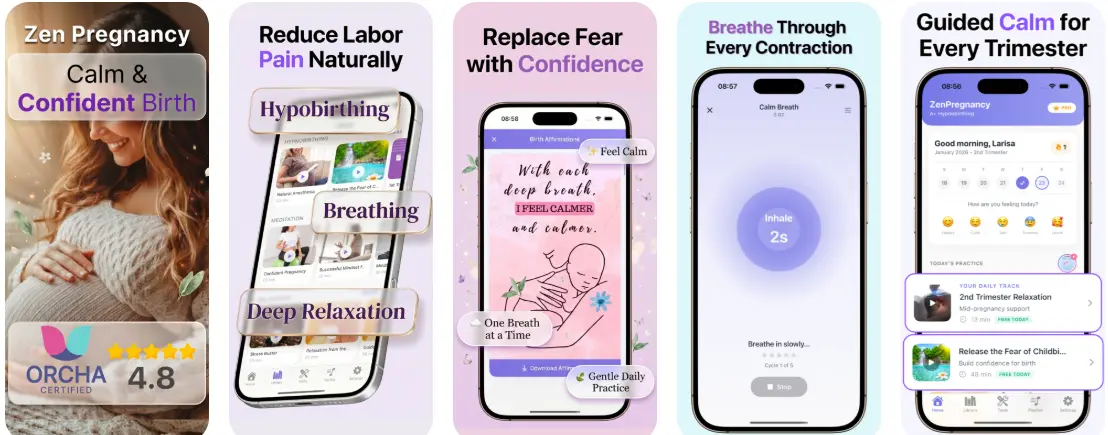
The core hypnobirthing app features include guided meditation tracks, breathing exercises, positive birth affirmations, contraction timing, and birth-bag checklists, all designed to reduce fear and build confidence before and during labor. HypnoBirth App bundles these tools into one place so you can practice your mind-body skills and manage birth logistics without jumping between five apps.
> Definition: HypnoBirth App is a hypnobirthing app that provides guided meditation, breathing exercises, contraction timing, and birth affirmations for pregnant women preparing for calmer birth.
TL;DR
- Audio tools, including relaxation, hypnosis, affirmations, and breathing, condition your mind and body to stay calm before and during labor.
- Practical features like contraction timers, birth-bag checklists, and contact storage let you manage mindset and logistics together.
- Regular daily practice throughout pregnancy, not last-minute use, is what makes these features effective.
At a Glance: Every Hypnobirthing App Feature in HypnoBirth App
HypnoBirth App includes audio, breathing, timing, planning, and personalization tools that work together as a birth preparation system. Good hypnobirthing app features train calm before labor, then reduce decision load once contractions begin.
- Guided meditation: short tracks help you rehearse relaxation when your body is not under pressure.
- Pregnancy hypnosis: focused audio supports conditioned calm, not unconsciousness.
- Breathing exercises: paced guidance gives your birth partner something specific to cue.
- Birth affirmations: repeated phrases replace panic thoughts with steadier language.
- Contraction timer: tracks frequency, duration, and intensity during early labor.
- Birth-bag checklist: keeps socks, chargers, notes, and baby clothes from becoming last-minute chaos.
- Contact storage: saves your provider, doula, hospital, and backup support numbers.
- Sleep meditations: help when baby kicks under the duvet and your brain starts rehearsing every possible outcome.
- Personalization settings: adapt practice by birth route, tone, content style, and stage of pregnancy.
If the priority is calm daily preparation, the strongest feature set is one that combines meditation, breathing, affirmations, and labor timing in one routine instead of scattering those tools across separate screens.
How Hypnobirthing App Tools Work: The Fear-Tension-Pain Cycle
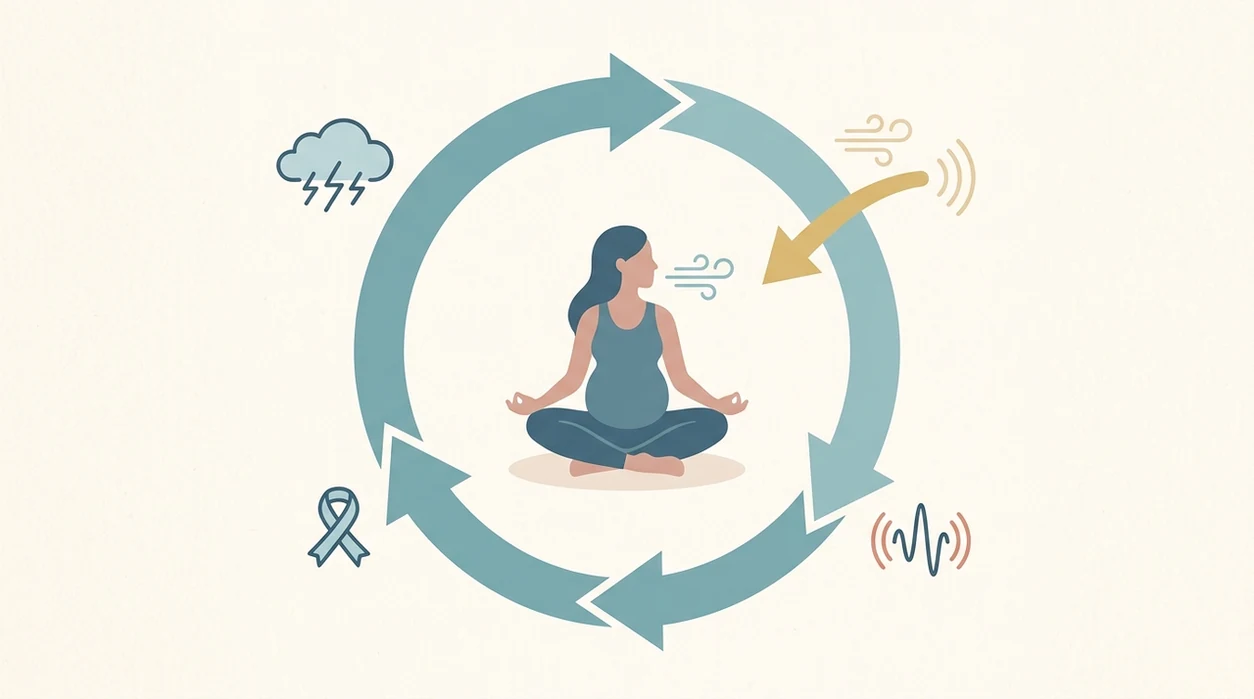
Hypnobirthing app tools work by interrupting the fear-tension-pain cycle: fear can trigger muscle tension, tension can make pain feel sharper, and pain can feed more fear. The most useful birth app features do practical work, not vague positivity.
> Evidence snapshot: A 2013 meta-analysis found childbirth hypnosis was associated with reduced use of pharmacological pain relief, with a risk ratio of 0.73. A 2011 randomized trial reported lower labor pain scores in the hypnosis group, 5.38 versus 7.16 on a 10-point scale. These findings are promising, but not a guarantee. Source: Madden et al., Cochrane Database of Systematic Reviews, 2016 update on hypnosis for pain management during labour, https://www.cochranelibrary.com/cdsr/doi/10.1002/14651858.CD009356.pub3/full; Abbasi et al., randomized trial on hypnosis and labor pain, https://pubmed.ncbi.nlm.nih.gov/21916874/.
Conditioned Relaxation and Hypnosis Tracks
Guided hypnosis and meditation use conditioned relaxation responses. That means your body learns, through repetition, to soften the jaw, drop the shoulders, and breathe slower when a familiar cue starts. I like practice tracks that still work with monitor belts on and gown snaps at the shoulder. Real labor is not a spa.
Parasympathetic Breathing Activation
Breathing exercises can support parasympathetic activation, the body’s rest-and-digest branch. In plain language, slower breathing can help the nervous system stop acting like every contraction is an emergency. Affirmations add cognitive reframing by replacing “I can’t do this” with one contraction at a time. A contraction timer helps too, because objective timing data often feels less frightening than guessing in the dark.
How to Use Hypnobirthing App Features Daily
Use hypnobirthing app features daily so the cues feel familiar before labor starts. Ten steady minutes most days usually matters more than a long session that only happens once.
- Set your birth preferences and due date during onboarding so the practice plan matches your stage of pregnancy.
- Schedule a 10-minute guided meditation or hypnosis track each morning or evening, before the day gets loud.
- Practice one breathing exercise during a commute, lunch break, or parked-car pause for 2 to 3 minutes.
- Listen to affirmations before sleep to reinforce calmer birth thoughts when anxiety tends to spike.
- Log contraction patterns during Braxton Hicks practice so the timer feels normal before real early labor.
- Review your birth-bag checklist and emergency contacts weekly so your birth partner knows where to find them.
On days your body feels heavy and the sofa wins, HypnoBirth App still covers the minimum because a short breathing track is easier to finish than a full lesson. The five-minute version counts.
For pregnant users who practice in small pockets of time, an app-based routine is often easier than a course workbook because the cue, audio, and timer stay on the same phone.

Guided Meditation and Pregnancy Hypnosis App Tools
Pregnancy hypnosis app tools usually include deep relaxation, visualization, sleep meditations, and labor-specific hypnosis tracks. In HypnoBirth App, the audio library is built for repeat practice, not just one nervous listen during week 39.
Sleep Meditations for Third Trimester
Third-trimester sleep tracks help when your hips ache, the bassinet box is still in the hallway, and your mind starts counting every unknown. According to a Cochrane review, relaxation methods in pregnancy, including hypnosis and music, may reduce maternal anxiety in late pregnancy and early labor, though the evidence quality was low to moderate.
Personalized Birth-Route Audio Tracks
Personalization matters. HypnoBirth App can offer vaginal birth tracks, cesarean-focused preparation, secular language, faith-sensitive options, and gestation-week-appropriate sessions. Some users also want to add oxytocin-friendly images or calming music, such as a family photo or a quiet playlist. A 2016 survey found 92% of people who used childbirth hypnosis techniques would recommend them, but that study relied on self-report.
Pregnant people preparing for either vaginal or cesarean birth usually need audio that matches birth route, tone, and practice stage rather than one generic relaxation track.
Birth App Features: Contraction Timer, Checklist, and Contacts
Birth app features belong beside mindset tools because labor is both emotional and logistical. A calm track helps, but someone still needs to know when contractions started and where the hospital notes are.
> Evidence context: In a 2015 randomized trial of 680 first-time mothers, antenatal group hypnosis education reduced epidural use, 36.5% versus 47.8%, and reduced other pharmacological analgesia, 26.9% versus 33.3%, compared with standard care. That does not mean everyone should avoid pain relief. It shows why calm preparation is worth taking seriously. Source: Werner et al., BJOG randomized controlled trial of antenatal hypnosis training, https://pubmed.ncbi.nlm.nih.gov/25377220/.
HypnoBirth App includes a contraction, or wave, timer that records frequency, duration, and intensity. A birth partner can watch the pattern while offering a straw cup between contractions instead of asking too many questions. The birth-bag checklist covers pre-loaded essentials with space for custom items. Contact storage keeps the midwife, OB office, doula, hospital, and childcare backup easy to find.
If your priority is staying organized in early labor, HypnoBirth App earns its spot because the contraction timer, contact list, and checklist sit beside the breathing cues.
Breathing Exercises and Birth Affirmations in HypnoBirth App
Breathing exercises and birth affirmations in HypnoBirth App give you something concrete to do before, during, and after contractions. They are simple tools, but simple is exactly what works when the contraction timer app pings at 3:12 a.m.
Early labor breathing uses slow inhales and longer exhales to keep the body from bracing too soon. Surge breathing supports active labor by giving the breath a steady rhythm through each wave. Calm recovery breathing helps between contractions, especially after a position change or a bathroom trip.
HypnoBirth App can guide breathing with audio cues or let you use a self-paced mode when voices feel like too much. Affirmations work through repetition. They help replace catastrophic thoughts with prepared ones: “My body can soften,” “I can ask questions,” or “I can take this one contraction at a time.”
Hypnosis in birth means focused relaxation, not losing control. You remain awake, aware, and able to make decisions.
Hypnobirthing App Features vs Competitor Alternatives
HypnoBirth App differs from many competitor alternatives by connecting each feature to a labor coping job. General birth apps, meditation-only apps, and standalone contraction timers can be useful, but they often split mindset and logistics.
| Option | Audio library depth | Contraction timer | Personalization | Birth-route options | Secular or faith-based | Price model |
|---|---|---|---|---|---|---|
| --- | ---: | ---: | ---: | ---: | ---: | --- |
| HypnoBirth App | Deep pregnancy hypnosis and meditation | Yes | High | Vaginal and cesarean | Flexible content styles | App-based access |
| Expectful-style meditation apps | Strong meditation focus | Usually limited | Moderate | Often broader pregnancy focus | Mostly secular | Subscription |
| Christian Hypnobirthing-style apps | Faith-centered audio | Varies | Faith-specific | Varies | Faith-based | App purchase or subscription |
| Standalone contraction timers | None or minimal | Strong | Low | Not usually included | Neutral | Often free or low cost |
| In-person Hypnobabies-style courses | Structured training | Not app-first | High support | Course-dependent | Varies | Higher course cost |
A good hypnobirthing app delivers repeatable practice, birth-route fit, and labor-day utility, not a promise of a pain-free or intervention-free birth.
Some users will still prefer a standalone timer, a meditation subscription, or an in-person class. That is reasonable. However, HypnoBirth App is stronger for people who want the breathing plan, affirmations, checklist, and timer in the same labor workflow.
Related HypnoBirth App Features Worth Exploring
HypnoBirth App also connects well with adjacent preparation tools. The birth preferences builder helps you write choices clearly before a provider visit, especially if your notes are already highlighted in yellow. Week-by-week mindset training gives you small practice prompts instead of a giant to-do list at 38 weeks.
Partner support tools are worth exploring too. A good birth partner needs cues, not a lecture, such as when to offer counterpressure, start the contraction timer, or stop talking.
If you want to test the audio library first, start with the free hypnobirthing app option. For platform setup, use the download hypnobirthing app guide before you pack the bag.
Limitations
Hypnobirthing app tools can be useful, but they have limits. I say this as someone who has watched a partner press tennis balls into a lower back during back labor while the original plan changed fast.
- Evidence for childbirth hypnosis is promising but limited by study size, methods, and mixed results.
- Features rely on regular self-practice; last-minute use during active labor is unlikely to feel natural.
- No app can predict or prevent complications, emergency interventions, induction, assisted birth, or cesarean birth.
- Never delay calling your provider because an app suggests you seem calm.
- Some users may dislike the audio voice, language, pacing, or belief framing, which can reduce benefit.
- App-based meditation is not a substitute for mental health treatment for severe anxiety, trauma, panic, or perinatal mood disorders.
- A hypnobirthing app does not replace childbirth education, midwife or OB care, triage advice, or emergency support.
- Using HypnoBirth App and still choosing an epidural, medication, or surgical birth is not a failure.
Some people may prefer Expectful, GentleBirth, Positive Birth Company, or an in-person class because they want a different teaching style.
Read more
- About HypnoBirth App: Calm Birth Support
- Are Hypnobirthing Apps Regulated
- Are Hypnobirthing Apps Safe
- Birth Partner Hypnobirthing App Guide
- App for Natural Birth Preparation: What to Choose
- Best Birth Meditation App for Calm Labor
- Best Contraction Timer App for iPhone: 2026 Guide
- Best Hypnobirthing App 2026: Top Picks
- Does Hypnobirthing Work for First Births? Guide
- Free Hypnobirthing App for iPhone: Calm Birth
- How to Start Hypnobirthing: Beginner Guide
- Hypnobirthing for C Section Prep: Calm Cesarean
Best Hypnobirthing App for Calm Birth Preparation
HypnoBirth App brings key hypnobirthing features into one simple place, including guided relaxation, birth affirmations, breathing practice, and tools to support labor preparation. It is free to download, used by 200k+ parents, and ORCHA NHS certified, making it a practical companion for building confidence before birth.
Best for
- Practicing hypnobirthing techniques at home or on the go
- Using guided audio, affirmations, breathing, and contraction timing in one app
Limitations
- It does not replace care from your midwife, doctor, or birth team
- Some features may feel more useful if practiced regularly before labor
Frequently Asked Questions
What features should a hypnobirthing app include?
A good hypnobirthing app should include guided relaxations, breathing practices, birth affirmations, visualisations, and simple education for labour preparation. Many also include contraction timing, playlists, partner guidance, and short sessions for daily practice. The best features are easy to use quickly, especially in late pregnancy or early labour.
Can a hypnobirthing app help with pregnancy anxiety?
Yes, a hypnobirthing app can help many people manage pregnancy anxiety by offering calming audio, breathing techniques, and reassurance-focused practice. It is not a substitute for medical or mental health support if anxiety feels overwhelming or persistent. Speak to your midwife, GP, or healthcare provider if you are struggling to cope.
Is it too late to start hypnobirthing at 38 weeks?
No, it is not too late to start hypnobirthing at 38 weeks. Short daily sessions can still help you learn breathing, relaxation, and confidence-building techniques before labour begins. Focus on the most practical tools first, such as labour breathing, affirmations, and a calm birth plan.
Does a hypnobirthing app work for first-time mums?
Yes, a hypnobirthing app can be especially useful for first-time mums who want clear, calm guidance for birth preparation. It can explain what to expect, teach relaxation techniques, and help build confidence through repetition. First-time parents may also benefit from using the app with a birth partner.
Can I use a hypnobirthing app if I want an epidural?
Yes, you can use a hypnobirthing app if you want or need an epidural. Hypnobirthing techniques can support calm breathing, decision-making, and relaxation before, during, or after pain relief. It does not require an unmedicated birth and should work alongside your medical care.
Is a hypnobirthing app as good as a hypnobirthing class?
A hypnobirthing app is a flexible alternative to a class, but it is not always the same experience. An app is useful for practising at home, repeating sessions, and accessing tools during labour, while a class may offer live teaching and personalised questions. Many parents use both for extra support.
How does a hypnobirthing app help during labour?
A hypnobirthing app helps during labour by giving quick access to breathing exercises, relaxation tracks, affirmations, and sometimes a contraction timer. These tools can support focus and calm during surges. Always follow guidance from your midwife or healthcare team during labour.
What is a contraction timer in a hypnobirthing app?
A contraction timer is a tool that records how often contractions happen, how long they last, and the gaps between them. This can help you notice patterns and share clearer information with your maternity team. Contact your midwife or hospital according to your local guidance, especially if you are unsure.
How often should I use a hypnobirthing app during pregnancy?
Daily practice is usually best for hypnobirthing, even if sessions are short. Ten to twenty minutes a day can help breathing, relaxation, and affirmations feel more natural by the time labour begins. Consistency matters more than doing long sessions occasionally.
Are hypnobirthing app affirmations useful for birth preparation?
Yes, hypnobirthing affirmations can be useful for building confidence and reducing fear around birth. Repeating positive, realistic statements may help you stay focused and calm during pregnancy and labour. They work best when combined with breathing, relaxation, and informed birth preparation.
Can my birth partner use a hypnobirthing app with me?
Yes, a birth partner can use a hypnobirthing app with you to learn prompts, breathing support, and calming techniques. This helps them feel more prepared and gives them practical ways to support you in labour. Partner practice can also make the tools feel more familiar on the day.
Is a hypnobirthing app safe to use in pregnancy?
Yes, a hypnobirthing app is generally safe to use in pregnancy for relaxation, breathing practice, and education. Use it as a support tool, not as a replacement for medical advice, antenatal care, or urgent help. If you have concerns about symptoms, your baby’s movements, or your mental health, contact your healthcare provider.