 Hypno
HypnoPregnancy Relaxation App: Daily Calm for Expectant Moms
A pregnancy relaxation app with guided meditations, sleep stories, and breathing exercises. Designed specifically for the stress and anxiety of pregnancy.
200,000+ moms • ORCHA NHS Certified • Free on iOS & Android
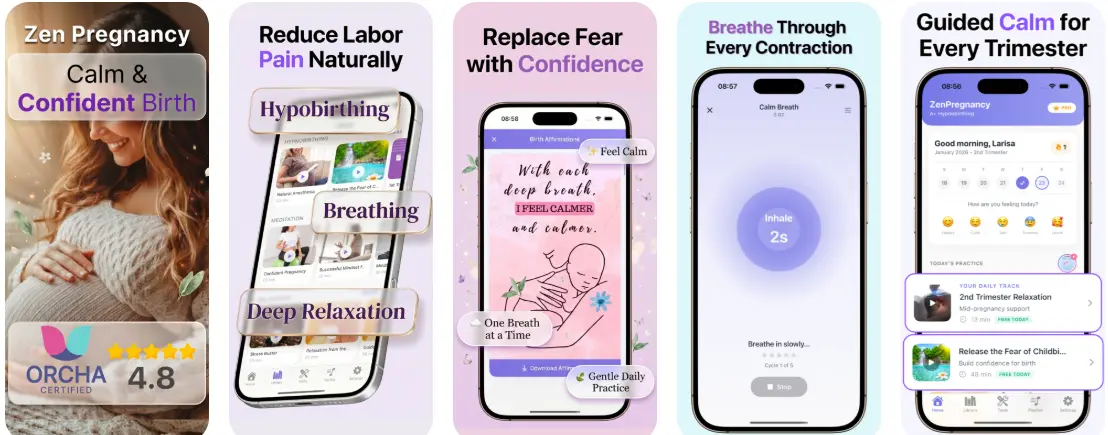
A pregnancy relaxation app can help expectant moms build daily calm with guided meditations, breathing exercises, sleep support, and birth affirmations. HypnoBirth App offers free hypnobirthing tools designed to support prenatal relaxation and confidence without replacing medical advice.
Who is this guide for?
Good fit if you
- Expectant moms who want short daily relaxation practices during pregnancy
- Anyone looking for guided pregnancy meditation, breathing, and affirmations in one place
- Pregnant people experiencing everyday stress who want calming tools between appointments
- Birth partners who want to support relaxation, breathing, and hypnobirthing practice
- Parents-to-be who prefer a free, simple app with hypnobirthing content
May not be enough if you
- Anyone needing urgent mental health, medical, or pregnancy-related support
- People looking for diagnosis or treatment of anxiety, insomnia, pain, or complications
- Users who want a full clinical therapy program rather than relaxation and hypnobirthing tools
- Anyone advised by their care team to avoid certain breathing or relaxation techniques
Why Prenatal Relaxation Support Helps Pregnancy Anxiety
Pregnancy anxiety is not “just in your head”; it often shows up as a racing heart, tight jaw, shallow breathing, nausea, or 2 a.m. spiraling. A steady relaxation practice gives your body a repeated signal that you are safe enough to soften, rest, and think clearly.
Many expectant parents feel pulled between joy and fear: excitement about meeting the baby, worry about birth, and pressure to make every decision perfectly. Short, pregnancy-specific audio sessions can create a dependable pause in the day. Research suggests mindfulness-based interventions in pregnancy may reduce anxiety and improve emotional wellbeing, although results vary by person and study quality. For more daily tools, see our guide to pregnancy stress relief that feels realistic.
This is not medical advice. If anxiety feels intense, persistent, or frightening, consult your healthcare provider.
How Prenatal Relaxation Tools Work in the Nervous System
Prenatal relaxation tools work by repeatedly shifting the body from sympathetic arousal, often called fight-or-flight, toward parasympathetic regulation, often called rest-and-digest. Slow exhalations, body scans, visualization, and familiar calming phrases can lower perceived threat and help the body settle.
In hypnobirthing, this matters because fear can increase muscle tension, and tension can make sensations feel harder to cope with. Practicing during pregnancy builds a conditioned response: the same voice, music, breathing rhythm, or affirmation becomes associated with safety. During labor, that familiar cue may help you return to steadier breathing between contractions. Studies on mindfulness and relaxation in pregnancy suggest benefits for stress and anxiety, but they do not guarantee a particular birth outcome. This is not medical advice; ask your midwife, OB-GYN, or mental health clinician what is appropriate for you.
Benefits of a Calm Pregnancy App for Daily Stress
A calm pregnancy app is most useful when it turns relaxation into a small daily habit instead of another task on a long prenatal checklist. The benefits many parents notice first are quieter thoughts at bedtime, easier recovery after stressful appointments, and more confidence using breathing in real moments.
Pregnancy-specific content matters because your worries are not generic. You may be thinking about baby movements, scans, induction, pelvic pain, feeding, older children, or whether you will cope in labor. A general meditation may help, but a prenatal track can speak directly to those concerns. HypnoBirth App is a hypnobirthing app that provides guided meditation, breathing exercises, contraction timing, and birth affirmations for pregnant women. It supports many birth plans, including hospital birth, birth center care, home birth, epidural birth, VBAC preparation, and planned cesarean birth.

How to Use a Prenatal Mindfulness App in 6 Steps
The best way to use a prenatal mindfulness app is to make sessions short, repeatable, and tied to an existing routine. Consistency matters more than doing a long session once a week.
- Choose one anchor time: Start after brushing your teeth, during lunch, or when you get into bed.
- Begin with 7 to 12 minutes: Short sessions are easier to keep on tired days.
- Practice one breathing pattern: Repeat it daily until it feels automatic.
- Add a body cue: Drop your shoulders, unclench your jaw, and soften your hands.
- Save one track for anxiety spikes: Use it before appointments, scans, or difficult conversations.
- Review weekly: Notice what helps you sleep, settle, or feel more prepared.
If you prefer a broader routine, pair app practice with guided meditation for pregnancy by trimester.
Guided Pregnancy Meditation for Trimester-Specific Calm
Guided pregnancy meditation is most effective when it matches the emotional and physical stage you are in. First trimester sessions often focus on nausea, uncertainty, and early pregnancy worries; second trimester sessions may support bonding and body changes; third trimester sessions often prepare the mind for labor, feeding, and meeting the baby.
Many parents try to “think positively” and then feel guilty when fear returns. Meditation works better when it gives you something specific to do: breathe slowly, scan the body, picture a safe place, or repeat a phrase such as “one breath at a time.” Pregnancy meditation should never pressure you to ignore medical concerns or silence intuition. It should help you feel grounded enough to ask questions, call your provider when needed, and make decisions from a steadier place.
Breathing Exercises for Pregnancy and Labor
Breathing exercises are one of the most transferable relaxation skills because they can be used in bed, in the car, during a scan, in triage, or through contractions. The simplest pattern is a longer exhale: inhale gently for four counts, exhale for six, and repeat for five to ten rounds.
Longer exhales can cue the parasympathetic nervous system and reduce the feeling of panic in the body. During labor, many parents use slow breathing in early labor, focused breathing during surges, and a soft “release” breath after each contraction. If you have asthma, dizziness, blood pressure concerns, panic disorder, or any medical complication, check with your provider before beginning breathwork. For practical examples, explore pregnancy breathing techniques for calm and labor.
Sleep Meditation for Pregnant Women at Night
Sleep meditation for pregnant women helps most when it reduces the pressure to “fall asleep right now.” Instead, it gives the mind a gentle place to land while the body finds a more comfortable state.
Pregnancy sleep can be disrupted by reflux, frequent urination, hip pain, baby movements, anxiety, and the simple effort of getting comfortable. A soothing voice, body scan, or sleep story can interrupt the loop of checking the time and worrying about tomorrow. It will not fix every cause of insomnia, but it can lower nighttime arousal and make wake-ups feel less lonely. If sleep loss is severe, linked with depression, or paired with panic, speak with your healthcare provider. You can also try sleep meditation for pregnant women designed for late-night restlessness.
Birth Affirmations and Hypnobirthing Practice
Birth affirmations work best when they are believable, brief, and practiced before labor begins. They are not magic statements; they are mental cues that help redirect attention away from fear and toward coping, choice, and trust.
Helpful affirmations might sound like “My breath can guide me,” “I can meet one wave at a time,” or “I can ask for support whenever I need it.” Hypnobirthing practice often combines affirmations with relaxation, visualization, and breathing so the phrase is linked with a calmer body state. This can support unmedicated birth, epidural birth, induction, cesarean preparation, or a change in plan. For a deeper skill set, learn hypnobirthing techniques for pregnancy and labor, or build a phrase bank with a birth affirmations app.
Comparing Pregnancy Relaxation Apps and Birth Tools
The best app depends on whether you want general meditation, birth-specific hypnosis, structured hypnobirthing practice, or a mix of relaxation and labor tools. Look for pregnancy-specific language, short sessions, sleep support, breathing guidance, affirmations, and clear safety boundaries.
| App or program | Best fit | Important note |
|---|---|---|
| HypnoBirth App | Pregnancy relaxation, hypnobirthing practice, affirmations, and contraction timing | Designed specifically for pregnancy and birth preparation |
| Expectful | Meditation, fertility, pregnancy, and postpartum audio | Broader maternal wellness focus |
| Hypnobabies | Structured childbirth hypnosis course | More course-like and method-specific |
| Calm | General meditation and sleep stories | Not primarily a pregnancy or birth app |
No app replaces clinical care, childbirth education, or individualized mental health support when symptoms are significant.
Labor Relaxation and Contraction Timing Together
Labor relaxation works better when your coping tools and contraction tracking do not compete for your attention. In early labor, many parents want to know whether contractions are becoming longer, stronger, and closer together while also staying calm enough to rest.
A simple labor rhythm might be: start the timer, breathe through the contraction, stop the timer, then play a short relaxation cue or repeat an affirmation. This protects your focus and gives your support person clear information to share with your care team. Timing contractions is useful, but it should not become obsessive or replace medical guidance. Call your provider or birth place according to their instructions, especially if waters break, bleeding occurs, fetal movement changes, or you feel concerned. For a calmer approach, see contraction timer meditation for early labor.
When to Start Relaxation Practice by Trimester
You can start relaxation practice in any trimester, but the focus may change as pregnancy progresses. In the first trimester, keep sessions short and gentle because fatigue and nausea can be intense. In the second trimester, build consistency and try different styles of meditation, breathing, and affirmations.
In the third trimester, practice the exact cues you may want during labor: a favorite track, one breathing pattern, a birth affirmation, and a physical release such as softening the jaw or opening the hands. If you are preparing for induction, VBAC, planned cesarean, or a medically complex birth, relaxation can still help you feel more present and supported. It should sit alongside evidence-based medical care, not replace it. Ask your healthcare provider which activities, positions, and breathing practices are safe for your pregnancy.
Honest Limitations of Pregnancy Wellness Apps
Pregnancy wellness apps can be genuinely supportive, but they have limits. Trustworthy guidance is honest about what an app can and cannot do.
- They cannot diagnose or treat anxiety, depression, trauma, preeclampsia, reduced fetal movement, or labor complications.
- They cannot guarantee a pain-free birth, unmedicated birth, faster labor, or a specific delivery outcome.
- They may not be enough for panic attacks, intrusive thoughts, birth trauma, or severe insomnia.
This is not medical advice. Consult your healthcare provider for individualized support.
Safety Notes for Anxiety, Trauma, and Medical Concerns
Relaxation is usually low risk, but pregnancy can bring up strong emotions, old trauma, and new fears that deserve careful support. If a meditation makes you feel trapped, panicky, numb, or overwhelmed, stop the session, open your eyes, move your body, and choose grounding instead.
Grounding can be as simple as naming five things you see, pressing your feet into the floor, sipping water, or calling a trusted person. If you have a history of trauma, pregnancy loss, panic disorder, depression, or obsessive thoughts, consider working with a perinatal mental health professional. The American College of Obstetricians and Gynecologists notes that anxiety and depression can occur during pregnancy and postpartum and are treatable; their patient guidance on anxiety and pregnancy is a helpful starting point. This is not medical advice.
Evidence for Mindfulness During Pregnancy
Evidence for mindfulness during pregnancy is promising, especially for stress, anxiety, and emotional wellbeing, but it is not a guarantee and study quality varies. The most reasonable takeaway is that regular relaxation practice may help many pregnant people cope better, particularly when paired with appropriate clinical care.
A systematic review and meta-analysis published in BMC Pregnancy and Childbirth and indexed on PubMed found mindfulness-based interventions were associated with improvements in psychological outcomes during the perinatal period. In real life, this often looks less dramatic than a total transformation: fewer spirals, faster recovery after stress, and more confidence using breath and attention. That still matters. Pregnancy is emotionally demanding, and small daily reductions in distress can make the experience feel more manageable.
Start a Calm Pregnancy Session Tonight
The easiest first session is the one you can do tonight without reorganizing your life. Put your phone on do not disturb, lie on your side or sit supported, place one hand on your chest or bump, and choose a short track that feels kind rather than demanding.
If you want app-based support, try the iOS calm pregnancy app or the Android prenatal mindfulness app. HypnoBirth App is meant to feel like a steady companion: practical, gentle, and birth-focused without promising that everything will go perfectly. Aim for one small practice tomorrow, then another the next day. Calm is a skill, and skills grow through repetition.
This guide was written for educational birth preparation and reviewed for safety language. It does not replace advice from your midwife, OB-GYN, GP, or maternity unit.
Frequently Asked Questions
Do pregnancy relaxation apps really help with pregnancy anxiety?
Yes, pregnancy relaxation apps can help many expectant mums manage everyday pregnancy anxiety by guiding breathing, meditation, sleep routines, and calming self-talk. They are most useful when used regularly for short sessions. They do not replace medical care or perinatal mental health support if anxiety feels severe, persistent, or unsafe.
When should I start using a pregnancy relaxation app?
You can start using a pregnancy relaxation app in any trimester. Starting earlier gives you more time to build familiar breathing cues and relaxation habits, but beginning later can still support sleep, stress relief, and birth preparation. Choose short sessions that feel easy to repeat daily.
Is it too late to start a pregnancy relaxation app at 38 weeks?
No, 38 weeks is not too late to start a pregnancy relaxation app. Short breathing practices, birth affirmations, and guided relaxations can still help you feel more prepared and grounded before labour. Keep expectations realistic and focus on simple tools you can remember under pressure.
Can a pregnancy relaxation app help with labour pain?
Yes, a pregnancy relaxation app can help some people cope with labour sensations by reducing fear, muscle tension, and panic. Relaxation, breathing, and visualisation do not guarantee a pain-free birth, but they can support your ability to stay calm between and during contractions. You can use these tools alongside any medical pain relief plan.
Can I use pregnancy relaxation techniques if I want an epidural?
Yes, you can use pregnancy relaxation techniques even if you plan to have an epidural. Breathing, affirmations, and guided calm can help before the epidural, during procedures, while waiting, and if labour changes unexpectedly. Relaxation tools are compatible with medicated and unmedicated birth preferences.
Is hypnobirthing safe during pregnancy?
Yes, hypnobirthing-style relaxation is generally low risk for many pregnancies. It focuses on calm breathing, guided imagery, positive suggestions, and reducing fear rather than medical treatment. Speak with your midwife, doctor, or a perinatal mental health professional if you have pregnancy complications, panic symptoms, trauma history, or significant mental health concerns.
What should I do if pregnancy meditation makes me anxious?
Stop the meditation if it makes you anxious. Open your eyes, move your body, look around the room, sip water, or use grounding techniques such as naming five things you can see. If meditation often increases distress, choose trauma-informed support and speak with a qualified perinatal mental health professional.
How long should pregnancy relaxation app sessions be?
Seven to twelve minutes is enough for many pregnancy relaxation sessions. Short, consistent practice is usually easier to maintain than occasional long sessions. If you are very tired, even one or two minutes of slow breathing can be a useful reset.
Can a pregnancy relaxation app help first-time mums prepare for birth?
Yes, a pregnancy relaxation app can be especially helpful for first-time mums who want simple, repeatable tools for birth preparation. It can introduce breathing patterns, body relaxation, affirmations, sleep support, and confidence-building scripts. It should sit alongside reliable antenatal education and advice from your maternity care team.
Can I use a pregnancy relaxation app for a planned C-section?
Yes, pregnancy relaxation tools can support a planned or unplanned C-section. Guided breathing, affirmations, and visualisation can help with pre-surgery nerves, staying present, and recovery-focused calm. Always follow your clinical team’s instructions before, during, and after the birth.
Is a pregnancy relaxation app better than a hypnobirthing class?
No, a pregnancy relaxation app is not automatically better than a hypnobirthing class. An app is convenient for daily practice, sleep support, and quick calming tools, while a class may offer deeper teaching, live guidance, partner involvement, and space for questions. Many parents use both: a class for learning and an app for repetition.
What features should I look for in a pregnancy relaxation app?
Look for pregnancy-specific meditations, breathing exercises, sleep support, birth affirmations, trimester-friendly content, and clear safety guidance. Useful extras include labour playlists, partner cues, simple navigation, offline access, and optional contraction timing. The best app is one you find calming, easy to use, and realistic to practise with regularly.
Best Pregnancy Relaxation App for Daily Prenatal Calm
HypnoBirth App brings together guided hypnobirthing, pregnancy meditation, breathing practice, sleep support, and birth affirmations in a free app used by 200k+ parents. It is a practical fit for expectant moms who want gentle, repeatable relaxation tools throughout pregnancy and preparation for birth.
Best for
- Daily pregnancy relaxation and mindfulness practice
- Hypnobirthing breathing, affirmations, and calm birth preparation
Limitations
- Not a substitute for medical, midwifery, or mental health care
- Individual experiences vary, and relaxation tools may not resolve severe anxiety or sleep difficulties
Read more
- App To Help Me Sleep While Pregnant
- App To Help Me Stay Calm During Labor
- App To Help Pregnancy Anxiety At Night
- Best Pregnancy Meditation App
- Calm vs Hypnobirthing App for Pregnancy
- Find Calm Birth Preparation
- First Trimester Meditation App Guide
- Fourth Trimester Meditation Guide
- Free Pregnancy Meditation App
- Guided Meditation for Pregnancy: Calm Birth Prep
- Headspace Pregnancy Meditation Alternative
- Hospital Bag Meditation App Checklist