 Hypno
Hypnobirthing tracks for pregnancy and labor
Learn what each type of audio does, when to practice and how to choose recordings without getting pulled in by big promises.


200,000+ parents • 4.8 stars • ORCHA-reviewed • Free to download on iOS & Android
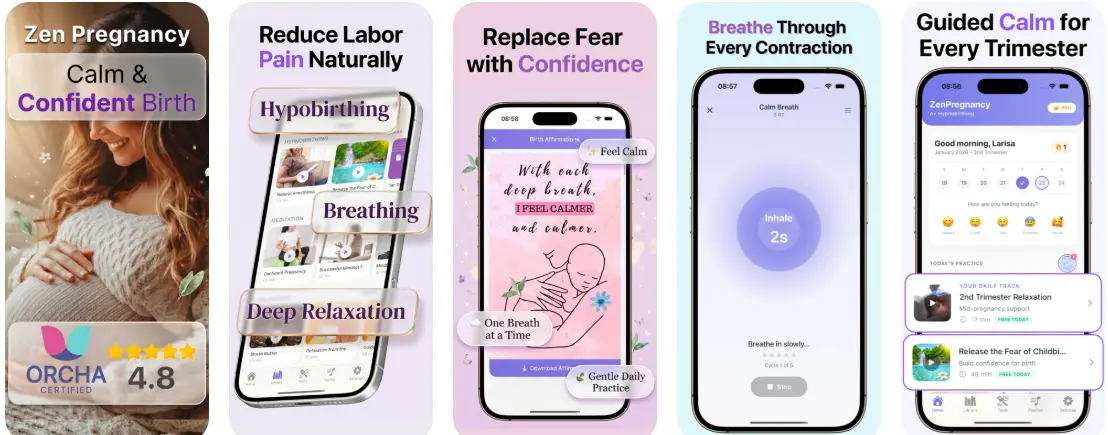
Hypnobirthing tracks are audio recordings that guide relaxation, breathing, visualization, affirmations or self-hypnosis during pregnancy and labor. No single track type, starting week or session length has been proven best, so choose audio that feels comfortable, practice before labor and keep all medical and pain-relief options open.

What are hypnobirthing tracks?
Hypnobirthing tracks are spoken or music-based recordings designed to support relaxation and coping during pregnancy or labor. They often combine slow breathing, guided imagery, self-hypnosis and positive statements. Hospital guidance describes hypnobirthing in similar terms, using deep relaxation, breathing and visualization.
The word hypnosis can sound more dramatic than the practice. You remain awake and can stop the recording, move, speak or change your mind. If that distinction feels fuzzy, our guide to hypnobirthing versus hypnosis explains it in plain English.
Tracks are coping tools. They cannot guarantee a pain-free labor, prevent interventions or promise a vaginal birth. They also do not lock you into an unmedicated birth. You can use hypnobirthing audio alongside nitrous oxide, IV medication, an epidural, induction or a C-section when those options are wanted or medically appropriate.
What types of hypnobirthing audio are available?
The main types are relaxation, breathing, affirmation, fear-release, birth-visualization and music-only tracks. Some recordings combine several techniques, while others stick to one simple prompt.
| Track type | What you may hear | When it may be useful |
|---|---|---|
| Relaxation | A body scan, progressive muscle release or calm narration | Winding down in pregnancy or resting between contractions |
| Breathing | Paced breaths and reminders to soften the jaw, shoulders and pelvic floor | Practicing a even rhythm or refocusing during labor |
| Affirmations | Short statements about coping, flexibility, support and confidence | Building familiarity with helpful language before birth |
| Fear release | Prompts to notice and reframe fears about labor or birth | Preparing for birth when worries feel manageable enough to explore |
| Birth visualization | Imagined scenes of arriving, laboring, pushing or meeting the baby | Mentally rehearsing parts of the birth experience |
| Music or ambient sound | Instrumental hypnobirthing music without spoken guidance | When words feel distracting or tiring |
| Partner-supported | A script that a partner can play or read aloud | Practicing together and offering familiar prompts during labor |
No good evidence shows that one category, narrator, music style or provider works better than another. That matters. A voice that relaxes your friend may irritate you within ten seconds, and there is no prize for forcing yourself through it. Try a sample and stop if the track makes you tense, dizzy, distressed or disconnected.
If you prefer spoken practice without a full hypnosis script, guided pregnancy meditation and pregnancy breathing techniques cover closely related options.
Do hypnobirthing tracks work for labor pain?
Hypnosis may reduce overall use of pain medication, but the evidence does not show that it reliably prevents epidurals or improves birth outcomes. A 2016 Cochrane review included 9 randomized trials with 2,954 women. It found no clear reduction in epidural use and no clear increase in spontaneous vaginal birth.
The review also found no clear difference in satisfaction with pain relief or the sense of coping with labor. The evidence for important outcomes was low or very low quality, so confident claims go beyond what the studies can support.
Our take is simple. Use a track if it helps you settle, breathe or feel less overwhelmed. Do not treat a difficult contraction, a request for pain medication or a change in the birth plan as failure. Hypnobirthing with an epidural is still hypnobirthing.
Hypnosis has not been shown to start labor. A Cochrane review on hypnosis for induction found no randomized-trial evidence that could establish whether it works. Listening should never delay an induction, assessment or other care recommended by your clinical team.
When should you start listening during pregnancy?
You can start when the audio feels useful because authoritative guidance does not set a required week of pregnancy. Practicing before labor gives you time to find a narrator you like, learn the breathing cues and notice which tracks make you feel calmer rather than trapped or restless.
You do not need a perfect routine. One person may listen while resting after work. Another may use a short breathing track before an OB-GYN appointment or play affirmations while packing a hospital bag. If you are getting started late in pregnancy, our third-trimester hypnobirthing guide offers a simple way in without pretending you need months of preparation.
How long should each session be?
No evidence-based session length or daily minimum has been established. Start with a duration that is comfortable and easy to fit into your day. A track is too long if you regularly avoid it, fall asleep when you need to stay alert or become uncomfortable in one position.
Repetition can make the words and breathing pattern familiar, but more is not automatically better. A short track you willingly use is more practical than a long recording that turns into homework.
How can you use hypnobirthing audio during labor?
During labor, use hypnobirthing audio when it helps and pause it whenever you need to hear, speak, move or make a decision. Some people want a full relaxation track early in labor. Others prefer short breathing prompts during contractions and quiet between them.
- Tell your birth team that you may use hypnobirthing audio.
- Ask about speaker and phone rules at your hospital or birth center.
- Put your chosen tracks in an obvious playlist so no one is searching through menus during a contraction.
- Choose a backup track without spoken words in case narration becomes annoying.
- Keep pain-relief choices available and change course whenever you want.
A partner can handle playback, lower the volume or repeat familiar prompts if you want help. It is worth agreeing on one rule beforehand: if you say stop, the audio stops. Our guide to hypnobirthing for birth partners has more practical ways a partner can support rather than coach.
Call your OB or midwife or go to labor and delivery for bleeding, suspected water breaking, reduced or changed fetal movement, severe or persistent pain, severe headache, vision changes, sudden swelling, fever, breathing trouble or any sense that something is wrong. Call 911 for an emergency.
Should you use headphones or speakers?
Speakers are often more practical in labor because you can still hear your partner, nurses, doctors, monitors and urgent instructions. Research has not shown that headphones are required or that one headphone type is best.
Headphones can still be useful during pregnancy or in a busy waiting area. Keep the volume low enough to stay aware of your surroundings. During labor, one-ear listening may be easier if the hospital allows it, but staff instructions take priority.
Do not listen while driving, walking near traffic, bathing or doing anything that needs your full attention. Deep relaxation and divided attention are a bad combination.
Why does offline access matter?
Hospital Wi-Fi and cell service can be unreliable, so download your chosen tracks before labor if the provider offers offline playback. Test them in airplane mode and pack a charging cable or battery pack. Check access rules too. Some services may limit downloads or place tracks behind a subscription.
Are free hypnobirthing tracks as good as paid ones?
No evidence shows that paid hypnobirthing audio is better than free hypnobirthing tracks. The available studies do not compare individual apps, free recordings, narrators or subscription plans.
A free source may be enough if the recording is clear, the language feels supportive and you can access it when needed. Paid services may offer a larger library, organized programs or offline listening, but check the provider's current features and subscription terms directly. Price does not prove clinical quality.
The HypnoBirth app is one option alongside free recordings, classes and audio from other providers. It is free to download with optional premium and includes hypnobirthing audio, labor breathing exercises, birth affirmations, pregnancy meditations, a contraction timer and a kick counter. Audio plays offline. More than 200,000 parents have used the app, and ORCHA has reviewed it. It is available on the App Store and Google Play.
If cost is the main concern, compare what you can use without paying in our guide to free hypnobirthing apps. Features and access can change, so check the listing before relying on any app for labor.
How do you choose a track without getting misled?
Choose a track with clear language, realistic claims and controls that let you pause or stop easily. The narrator should respect changes in the birth plan rather than treating one type of birth as the only successful outcome.
- Listen to a sample before committing to a long program.
- Avoid promises of a painless birth, guaranteed vaginal birth or freedom from interventions.
- Skip any recording that tells you to ignore symptoms or delay medical assessment.
- Look for language that allows movement, medication, monitoring and changes of plan.
- Check whether the audio works offline and remains available under the current payment terms.
- Ask whether a partner can operate it without opening several screens.
Fear-release tracks deserve extra care. A gentle recording may help you put ordinary worries into words, but audio is not a substitute for mental health care. If a track brings up traumatic memories, intense anxiety or a sense of disconnection, stop it and speak with a clinician or qualified mental health professional. Anyone with a history of psychosis or severe dissociation should ask their treating clinician before using self-hypnosis.
Good hypnobirthing audio leaves room for real birth, including uncertainty. For a broader look at breathing, relaxation and visualization, see our guide to hypnobirthing techniques.
Frequently asked questions
Can hypnobirthing tracks reduce labor pain?
Hypnosis may reduce overall use of pain medication, but the evidence is low quality. It has not clearly been shown to reduce epidural use, improve satisfaction with pain relief or increase spontaneous vaginal birth.
How often should I listen to hypnobirthing audio?
There is no evidence-based number of sessions per day or week. Practice often enough to learn the cues without turning listening into a chore or interfering with sleep, work or medical care.
Can I fall asleep while listening?
Falling asleep during a relaxation track is not proof that you did it wrong. Listen in a safe place where sleep is acceptable, and do not use the audio while driving or doing anything that requires attention.
Can hypnobirthing audio start labor?
No evidence shows that hypnosis can induce labor. It should not delay an assessment, scheduled induction or other care recommended by your OB or midwife.
Can I use hypnobirthing music without a voice?
Yes. Instrumental or ambient tracks may suit you if spoken instructions feel distracting. No evidence shows that music-only recordings are better or worse than guided tracks.
Do I need headphones during labor?
No. Headphones are not required, and speakers may make it easier to hear your birth team and partner. Follow the hospital's rules and pause the audio whenever staff need your attention.
Can my partner play the tracks during labor?
Yes, if you want them to. A partner can manage the playlist, adjust volume or read familiar prompts, as long as this does not interfere with communication or clinical care.
Sources
- Cochrane: Hypnosis for pain management during labor and childbirth
- Cochrane: Hypnosis for induction of labor
- Cochrane: Hypnosis for preventing postnatal depression
Written by the HypnoBirth App team for general information. It does not replace advice from your own doctor or midwife.
Practice with the HypnoBirth app
Download the HypnoBirth app free to try hypnobirthing audio, breathing exercises, affirmations and pregnancy meditations. Optional premium is available, and audio can play offline.