 Hypno
What is hypnobirthing and how does it work?
A plain-English guide to the techniques, evidence, limits, and ways to practice before labor.


200,000+ parents • 4.8 stars • ORCHA-reviewed • Free to download on iOS & Android
Hypnobirthing is a birth preparation method that combines self-hypnosis, breathing, relaxation, visualization, and affirmations. It aims to reduce fear and help you stay focused during labor, but it does not promise a painless birth or replace medical care.

What is hypnobirthing?
Hypnobirthing is a childbirth preparation approach that uses focused relaxation and practiced mental cues to help you cope with labor. Common tools include slow breathing, self-hypnosis audio, visualization, muscle relaxation, and short affirmations.
Despite the name, hypnosis here does not mean being unconscious, asleep, or under someone else's control. You remain aware and can talk, move, make decisions, ask for pain medication, or change your plans. In the studies reviewed by Cochrane, participants usually learned self-hypnosis during pregnancy and then used it themselves during labor.
Hypnobirthing is also not one single standardized program. Different books, teachers, apps, and courses use different language and exercises. Some put more weight on breathing. Others use longer hypnosis recordings or spend more time discussing fear of birth.
The word is often used as a general term, but HypnoBirthing is also a registered trademark associated with the Mongan Method. The HypnoBirth App team is not affiliated with the Mongan Method, Lamaze, or Bradley.
At its most useful, hypnobirthing gives you concrete things to do when labor feels intense. It cannot control how birth unfolds, and any course that promises a painless or intervention-free birth is promising too much.
How does hypnobirthing work?
Hypnobirthing is meant to help you notice fear and physical tension, then respond with breathing, relaxation, and a familiar mental cue. Rehearsing these responses during pregnancy may make them easier to use when contractions begin.
The fear, tension, and pain theory
Many hypnobirthing programs teach a fear, tension, and pain cycle. The idea is that fear may increase stress and muscle tension, which can make labor sensations harder to handle. Feeling more pain may then increase fear, and the cycle continues.
This explanation makes intuitive sense, especially if you have ever clenched your jaw or held your breath when frightened. Still, it is a teaching theory rather than a proven biological account of labor pain. The 2016 Cochrane review did not confirm that breaking this cycle improves birth outcomes.
The practical part matters more than treating the theory as settled science. Hypnobirthing asks you to practice a calmer response: loosen your hands and face, breathe comfortably, focus on one contraction, and return to a chosen image or phrase. Our guide to fear of childbirth and hypnobirthing explores this in more detail.
A calm response does not mean labor will feel calm every minute. Birth can be loud, tiring, medical, emotional, and unpredictable. You can still use the techniques when you feel frightened or when the plan changes.
What hypnobirthing techniques are commonly used?
The main hypnobirthing techniques are breathing, physical relaxation, visualization, affirmations, and self-hypnosis. There is no proven best script, breathing count, or visualization, so choose cues that feel natural rather than forcing language you dislike.
Slow, comfortable breathing
Breathing practice gives you a simple point of focus during a contraction or stressful moment. Most programs encourage slow, comfortable breaths without straining or holding your breath. The available sources do not establish one ideal count or pattern.
Muscle relaxation
You practice releasing tension in areas such as your jaw, shoulders, hands, and pelvic muscles. During labor, a partner can gently remind you to drop your shoulders or soften your hands. You may relax fully between contractions even when relaxing during one feels impossible.
Visualization
Visualization means focusing on a reassuring mental image. You might picture a familiar place, a wave passing, or the body opening. No particular image has been shown to improve clinical outcomes. If flower imagery makes you roll your eyes, skip it.
Affirmations
Affirmations are brief statements used to direct attention and reduce panicked thinking. An example is, "I can meet this contraction one at a time." Specific affirmations have not been proven to change birth outcomes, but some people find them grounding.
Self-hypnosis audio and cues
Repeated audio practice can help you connect a voice, phrase, sound, or breathing pattern with a focused state. Eight of the nine trials in the Cochrane review trained participants in self-hypnosis during pregnancy.
Partner support
A birth partner can learn your preferred cues, offer touch when wanted, start an audio track, protect quiet time, or help explain your preferences to staff. They should also know when you want fewer prompts. Read our full guide to hypnobirthing techniques for practice ideas.
What does the evidence say about hypnobirthing?
The best available review found that hypnosis may reduce overall use of medication for labor pain, but the evidence was very low quality and did not show a clear reduction in epidural use.
A 2016 Cochrane review included nine randomized trials with 2,954 women. Across eight studies with 2,916 women, participants using hypnosis were less likely to use pharmacological pain relief. The reported risk ratio was 0.73, with a 95 percent confidence interval from 0.57 to 0.94.
That number sounds encouraging, but the reviewers rated the evidence for this outcome as very low quality. This means the true effect may be quite different. The trials varied in what they taught and how they delivered the hypnosis.
| Outcome | What the review found |
|---|---|
| Any pharmacological pain relief | Use may be lower, based on very low quality evidence |
| Epidural use | No clear difference |
| Spontaneous vaginal birth | No clear difference |
| Satisfaction with pain relief | No clear difference |
| Perceived ability to cope | No clear difference |
The review did not establish that hypnobirthing shortens labor, prevents complications, guarantees vaginal birth, or removes pain. It also did not prove the proposed fear, tension, and pain mechanism.
So, does hypnobirthing work? It may help some people use less pain medication, but we cannot confidently predict who will benefit or by how much. Coping tools can still have personal value even when the clinical evidence is uncertain. They just deserve honest expectations.
Who might hypnobirthing suit?
Hypnobirthing may suit someone who wants practical coping tools, likes guided audio or repetition, and is willing to practice before labor. It may be less appealing if hypnosis language feels uncomfortable or repeated listening becomes another pregnancy chore.
You do not have to plan an unmedicated vaginal birth. You can use breathing and relaxation during an induction, while waiting for an epidural, during procedures, or before a planned cesarean. Hypnobirthing does not replace anesthesia, fetal monitoring, surgery, or treatment recommended by your maternity team.
For a hospital birth, ask whether you can use headphones or a speaker, move around, dim lights, and have your chosen support person present. Policies vary. Our guides cover hypnobirthing for hospital birth, using hypnobirthing with an epidural, and hypnobirthing for C-section preparation.
It can also suit people who want their partner to have a clear job. A partner cannot make labor predictable, but they can remember the audio track, offer water, reduce unnecessary conversation, and repeat a cue when you are too busy laboring to explain.
Call your OB or midwife or go to labor and delivery for heavy bleeding, severe or persistent pain, trouble breathing, fainting, a seizure, markedly reduced fetal movement, concerning fluid leakage, or any emergency. Follow your maternity team's personal instructions.
How can you learn hypnobirthing?
You can learn hypnobirthing through a book, in-person class, app, audio program, or online course. No authoritative source has shown that one format works better than the others.
- A book. This is flexible and can be inexpensive, but you must organize your own practice. Our hypnobirthing book guide explains what to look for.
- An in-person class. A live teacher can answer questions and involve your partner. Check the schedule, teaching approach, and whether medical pain relief is discussed without judgment.
- An app or audio program. This works well for repeated practice at home or while traveling. Look for clear privacy information and offline playback if hospital internet may be unreliable.
- A virtual class. Live online sessions offer teacher contact without travel, though fixed class times may still be required.
- A self-paced course. An online hypnobirthing course lets you work through lessons on your own schedule. The Cochrane evidence does not evaluate that specific course.
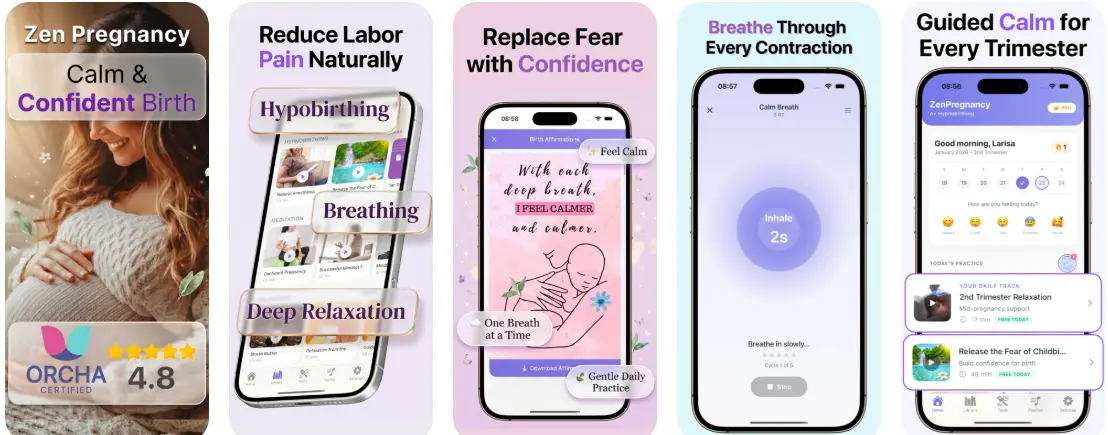
The HypnoBirth app is free to download with optional premium content. It includes hypnobirthing audio, labor breathing exercises, birth affirmations, pregnancy meditations, a contraction timer, and a kick counter. Audio plays offline. The app has been used by more than 200,000 parents and reviewed by ORCHA. It is available on the App Store and Google Play.
Whichever route you choose, avoid programs that treat medication or cesarean birth as failure. Good preparation leaves room for consent, clinical advice, pain relief, and a complete change of plan.
How should you practice before labor?
Practice during pregnancy so the breathing, words, and audio feel familiar before contractions start. The reviewed trials generally taught self-hypnosis before birth, but the evidence does not identify one ideal week to begin.
- Choose a comfortable position where you can breathe without strain.
- Play a short recording or use a familiar relaxation cue.
- Let your jaw, shoulders, and hands loosen as much as they comfortably can.
- Focus on slow breathing and one reassuring image or phrase.
- Ask your partner to practice the prompts, touch, music, or silence you prefer.
- Write these preferences into your birth plan while keeping options for medication and medical care.
A short routine you repeat is more practical than an ambitious plan you avoid. You do not need to reach a perfect trance. Some days you may feel deeply relaxed. On others, you may spend the whole session thinking about snacks and unanswered emails. The repetition still helps you learn the sequence.
Try the routine in different conditions. Practice with headphones, without headphones, sitting up, lying on your side, and with ordinary household noise. Labor rarely matches the setting in a polished audio recording.
If you are late in pregnancy, start with what you can do now rather than deciding you missed the window. Our guide to starting hypnobirthing can help you build a manageable routine.
What common hypnobirthing myths should you ignore?
The biggest hypnobirthing myths promise pain-free labor, guaranteed vaginal birth, or complete control. Birth preparation should make room for uncertainty rather than blaming you when biology or medical needs change the plan.
Myth: Hypnobirthing removes labor pain
Hypnobirthing aims to support relaxation and coping. It does not reliably remove pain, and the evidence does not show that everyone who practices it avoids pain medication.
Myth: Hypnobirthing prevents epidurals
The Cochrane review found no clear difference in epidural use. Choosing an epidural does not erase the breathing or relaxation skills you used before or after it.
Myth: Hypnobirthing guarantees vaginal birth
The review found no clear increase in spontaneous vaginal birth. A cesarean or assisted birth is not evidence that you practiced badly.
Myth: You lose control under hypnosis
The studies mainly involved self-hypnosis learned during pregnancy. You remain aware and able to respond, communicate, and make decisions.
Myth: It is only for uncomplicated birth
The techniques can sit alongside induction, medication, an epidural, or cesarean birth. Evidence does not prove equal benefit in every setting, but the basic tools do not require one specific type of birth.
Is hypnobirthing worth it?
Hypnobirthing may be worth it if you enjoy the techniques, can practice without pressure, and see them as coping tools rather than promises. The evidence for clinical benefits is uncertain, so personal fit matters.
Ask yourself whether the format fits your time, learning style, and budget. A borrowed book and free audio may be enough. Someone who wants feedback may prefer a class. An app may suit frequent short sessions. There is no evidence-based reason to assume that the most expensive option is the best.
It is reasonable to stop or switch methods if a voice, script, or affirmation irritates you. Relaxation is hard when you are annoyed. Keep the pieces that help, such as breathing or partner prompts, and leave the rest.
The fairest expectation is modest. Hypnobirthing may give you familiar ways to respond to fear and intensity. It cannot guarantee the length of labor, pain level, type of birth, or need for medical care.
Frequently asked questions
Does hypnobirthing reduce labor pain?
It may reduce overall use of pharmacological pain relief, but the Cochrane review rated that evidence as very low quality. It found no clear improvement in epidural use or perceived ability to cope.
Can hypnobirthing prevent an epidural?
No reliable prevention effect has been shown. The 2016 Cochrane review found no clear difference in epidural use between hypnosis and control groups.
When should I start hypnobirthing?
Start during pregnancy if you can, since practice helps the cues become familiar before labor. There is no single recommended week to begin, and starting later is still an option.
Can my partner learn hypnobirthing too?
Yes. A partner can learn your breathing cues, preferred affirmations, audio choices, and whether you want touch or quiet. Their role is support, not coaching you toward a particular type of birth.
Can I use hypnobirthing with an epidural?
Yes. You can use breathing, relaxation, and audio before or after an epidural. Hypnobirthing and medical pain relief are not competing choices.
Can hypnobirthing be used for a cesarean birth?
Relaxation and focused breathing can be used before or during cesarean preparation when your medical team says it is appropriate. They do not replace anesthesia, monitoring, surgery, or medical instructions.
Is hypnobirthing the same as hypnosis?
Hypnobirthing uses self-hypnosis as one of several tools, alongside breathing, visualization, and affirmations. It does not involve being unconscious or handing control to someone else.
Sources
- Cochrane: Hypnosis for pain management during labor and childbirth
- Cochrane Library: Hypnosis for pain management during labor and childbirth
Written by the HypnoBirth App team for general information. It does not replace advice from your own doctor or midwife.
Practice hypnobirthing at home
Download the HypnoBirth app for hypnobirthing audio, breathing exercises, affirmations, pregnancy meditations, and practical labor tools. It is free to download with optional premium content.