 Hypno
HypnoHypnobirthing Affirmations: Phrases That Replace Fear with Confidence
Powerful hypnobirthing affirmations for pregnancy and labor. How positive birth statements rewire your mindset and reduce anxiety before delivery.
200,000+ moms • ORCHA NHS Certified • Free on iOS & Android
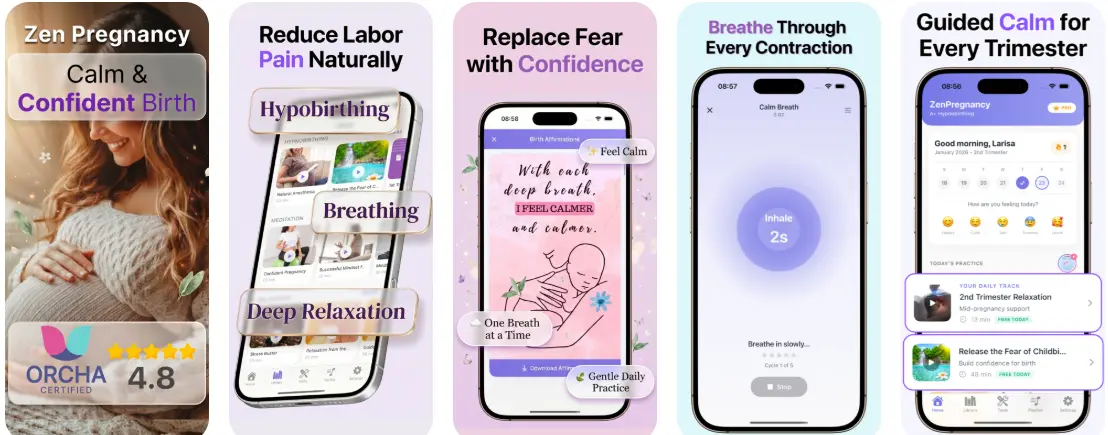
Hypnobirthing affirmations are short, calming phrases used during pregnancy and labor to replace fear-based thoughts with confidence and focus. When practiced with breathing and relaxation, they can help you feel steadier, more prepared, and more in control of your birth mindset.
Who is this guide for?
Good fit if you
- You want simple hypnobirthing affirmations for pregnancy, labor, or birth planning
- You feel anxious about contractions, hospitals, interventions, or the unknown
- You prefer calm, repeatable phrases you can pair with breathing practice
- You want affirmations that feel believable rather than overly perfect or forced
May not be enough if you
- You need medical advice about pregnancy symptoms, complications, or birth options
- You want affirmations to replace professional maternity care or clinical guidance
- You prefer purely clinical birth education with no mindset or relaxation practice
Birth Affirmation Basics for Pregnancy and Labor
Birth affirmations are simple sentences you rehearse before labor so your mind has a calmer script when intensity rises. They work best when they sound believable, personal, and easy to repeat during a contraction, a scan, an induction conversation, or a quiet moment before sleep.
A good affirmation is not toxic positivity. It does not ask you to deny fear, pain, uncertainty, or medical complexity. Instead, it gives your nervous system a clear cue: breathe, soften, ask for support, and take the next step. Many parents use them alongside hospital birth, home birth, birth center care, epidurals, planned cesarean birth, VBAC preparation, or unmedicated labor. If you want a wider phrase bank, this guide pairs well with pregnancy affirmations for each stage of pregnancy.
Why Positive Birth Statements Can Ease Pregnancy Anxiety
Positive birth statements can ease anxiety because fear is not only a thought; it also changes breathing, muscle tension, heart rate, and how safe you feel in your body. When you repeat a steady phrase such as “I can meet this one breath at a time,” you give your brain something concrete to focus on instead of spiraling into worst-case images.
In birth education, this matters because tension and fear often make sensations feel harder to cope with. Studies suggest that hypnosis and relaxation-based approaches may reduce some anxiety and improve satisfaction for certain people, though evidence is mixed and outcomes vary. This is not medical advice. If anxiety feels persistent, frightening, or intrusive, talk with your midwife, OB-GYN, GP, or mental health professional, and consider practical tools for pregnancy stress relief.
How Birth Affirmations Work in the Brain and Body
Birth affirmations work through repetition, attention, and association. When you repeat the same phrase while breathing slowly or listening to a relaxation track, your brain begins to connect the words with a safer body state: lower shoulders, unclenched jaw, longer exhale, and steadier focus.
This is similar to creating a conditioned cue. Later, during labor, the phrase can remind the body to return to that practiced pattern. It does not switch off pain, but it may reduce the fear-tension cycle that makes coping harder. A Cochrane review on hypnosis for labor pain found that evidence is variable, but relaxation and hypnosis remain common non-drug coping options. For best results, pair affirmations with body-based hypnobirthing techniques, not just wishful thinking.

Calming Labor Affirmations That Feel Believable
The best labor affirmations are the ones your body does not reject. If “birth is easy” makes you roll your eyes, choose something more grounded like “I can do hard things with support.” Believable language builds trust faster than phrases that feel forced.
- “I am safe in this moment.”
- “I can do this one breath at a time.”
- “My body and baby are working together.”
- “I soften my jaw, shoulders, belly, and pelvic floor.”
- “Each wave has a beginning, middle, and end.”
- “I can ask questions and make informed choices.”
- “Support is strength.”
- “My birth can be powerful, even if the plan changes.”
Try saying each phrase out loud. Keep the ones that make you exhale; edit or drop the ones that create pressure.
How to Use Birth Affirmations During Pregnancy
Use affirmations daily in short, low-pressure sessions so they become familiar before labor begins. Five minutes a day from the second trimester onward is often more useful than a long session once a week.
- Choose three phrases that feel true enough to repeat.
- Pair each phrase with slow breathing, such as inhaling for four and exhaling for six.
- Practice in ordinary moments: before sleep, after a shower, in the car, or during a Braxton Hicks contraction.
- Record your own voice or listen to a gentle track so the phrases feel familiar.
- Rehearse with your birth partner, doula, or support person so they know what to say when you go quiet.
If you are just beginning, start with how to start hypnobirthing and add guided meditation for pregnancy when you want more structure.
Trimester Birth Mantras for First, Second, and Third Trimester
Birth mantras can change with each trimester because your emotional needs change too. In the first trimester, many parents need phrases that support uncertainty: “Today, I care for myself and my baby” or “I can take this one appointment at a time.”
In the second trimester, affirmations often shift toward connection and trust: “My body is changing with purpose” or “I am learning what helps me feel safe.” In the third trimester, keep phrases practical and labor-ready: “My breath is my anchor,” “I release what I cannot control,” and “I can meet each wave as it comes.” If you are close to birth, combine mantras with position practice, partner prompts, and third-trimester hypnobirthing preparation. Always bring new symptoms, reduced fetal movement, bleeding, severe pain, or urgent concerns to your healthcare provider.
Labor Affirmations for Hospital, Home, Birth Center, and Cesarean Plans
Labor affirmations should support the birth you are actually having, not only the birth you pictured months ago. A parent in a hospital triage room may need “I can ask for time and information,” while someone at home may need “My space is calm, private, and protected.”
For an epidural, try “Rest is part of birth” or “Pain relief is a valid choice.” For induction, try “My body can respond step by step.” For cesarean birth, try “I meet my baby with courage and care.” For VBAC, try “I am prepared, supported, and flexible.” These statements can sit beside medical monitoring, surgical birth, or unexpected decisions. If your plan includes surgery or scar-related questions, read hypnobirthing for C-section prep or hypnobirthing for VBAC and discuss your personal risks with your clinician.
Breathing and Affirmation Practice for Contractions
Affirmations become more effective in contractions when they are linked to a physical action. The simplest pairing is a long exhale: breathe in gently, then say the phrase in your mind as you breathe out, such as “soften” or “open.”
During early labor, use longer phrases: “Each wave brings me closer to my baby.” During active labor, shorten them because thinking gets harder: “Breathe down,” “loose jaw,” or “I am safe.” Your partner can repeat the phrase quietly, match your breathing, or place a hand on your shoulder as a cue. This is especially helpful when contractions are close together and you no longer want coaching. Practice with pregnancy breathing techniques before labor so the words and breathing feel connected.
Birth Affirmation Apps Compared
A birth affirmation app is most useful when it helps you practice often, not when it simply stores a pretty list of quotes. Look for guided audio, short sessions, offline access, breathing support, and language that respects different birth choices.
| App or program | Best fit | Notable difference |
|---|---|---|
| HypnoBirth App | Parents who want free hypnobirthing, meditation, affirmations, breathing, and contraction timing in one place | Designed around pregnancy and labor practice rather than general wellness only |
| Expectful | Parents who want broad fertility, pregnancy, and motherhood meditations | Strong general meditation library, less focused on hypnobirthing tools |
| Hypnobabies | Parents who want a structured, script-based hypnosis course | More formal program style and terminology |
| Freya | Parents who want breathing guidance during contractions | Known for labor breathing and timing support |
If you are comparing options in more detail, see this guide to the best hypnobirthing app for different birth preparation styles.
Daily Practice With a Pregnancy Affirmation App
A daily app can make affirmation practice easier because it removes the “what should I do today?” decision. HypnoBirth App is a hypnobirthing app that provides guided meditation, breathing exercises, contraction timing, and birth affirmations for pregnant women.
For a simple routine, listen to one short track before bed, repeat one phrase during your morning shower, and practice one breathing pattern when you notice tension in your shoulders or jaw. If you want audio-based support, try a birth affirmations app on iPhone or save pregnancy affirmations on Android for daily practice. You can also compare features on the dedicated birth affirmations app page.
Limitations and Safety for Birth Mindset Tools
Affirmations are supportive tools, not medical treatment or a guarantee of a specific birth outcome. They can sit beautifully beside evidence-based care, but they should never be used to ignore symptoms, pressure yourself, or avoid needed support.
- They cannot guarantee a pain-free, unmedicated, vaginal, or intervention-free birth.
- They cannot diagnose or treat anxiety disorders, depression, trauma, preeclampsia, fetal concerns, or labor complications.
- They may feel upsetting if a phrase clashes with past trauma; edit the wording or stop using it.
This is not medical advice. Consult your healthcare provider about your pregnancy, mental health, birth plan, and any symptoms that worry you.
When Birth Fear Needs Extra Support
Extra support is important when fear feels constant, intrusive, or bigger than normal birth nerves. It is common to feel worried before labor, especially after loss, infertility, trauma, a previous difficult birth, or hearing frightening stories, but you do not have to carry it alone.
Speak with your midwife, OB-GYN, GP, therapist, or doula if you have panic symptoms, nightmares, avoidance of appointments, obsessive checking, dread of birth, or thoughts of harming yourself. The NHS guidance on mental health in pregnancy explains that support is available and that asking for help is a sign of care, not failure. Affirmations can still be part of your plan, but trauma-informed care, therapy, medication, or specialist perinatal mental health support may also be needed.
Start a Five-Minute Birth Confidence Routine Tonight
A five-minute routine is enough to begin building a calmer association with birth. Choose one phrase, place one hand on your chest and one on your bump if that feels comfortable, then breathe out slowly while repeating the words in your mind.
Try this: inhale gently, exhale and think “I am safe right now,” then relax your jaw and shoulders. Repeat for five rounds. Finish by asking, “What support would help me feel more prepared this week?” Maybe it is packing your hospital bag, writing questions for your provider, practicing with your partner, or reading hypnobirthing for first-time moms. Small, repeated practice is what makes the phrase available when labor becomes intense.
This guide was written for educational birth preparation and reviewed for safety language. It does not replace advice from your midwife, OB-GYN, GP, or maternity unit.
Frequently Asked Questions
What are hypnobirthing affirmations?
Hypnobirthing affirmations are short, positive statements used to support calm, confidence, and focus during pregnancy and labour. They are often repeated with breathing, relaxation, visualisation, or hypnobirthing audio practice.
Do birth affirmations really work during labour?
Yes, birth affirmations can help some people feel calmer and more focused during labour. They work best when practised before birth, but they do not guarantee less pain, a shorter labour, or any specific birth outcome.
Can birth affirmations help with pregnancy anxiety?
Yes, birth affirmations can support pregnancy anxiety by giving your mind a steady phrase to return to when fear rises. They are not a replacement for professional help if anxiety feels overwhelming, includes panic, trauma symptoms, depression, or affects daily life.
When should I start practising hypnobirthing affirmations?
You can start practising hypnobirthing affirmations at any point in pregnancy. Many people begin in the second trimester or around 28 weeks, but even a few minutes a day in the final weeks can help the phrases feel more familiar.
Is 38 weeks too late to start birth affirmations?
No, 38 weeks is not too late to start birth affirmations. Choose three to five simple phrases, practise them with slow breathing each day, and ask your birth partner to use the same words during labour.
Can I use hypnobirthing affirmations with an epidural?
Yes, you can use hypnobirthing affirmations with an epidural. They can support rest, calm decision-making, and emotional steadiness alongside medical pain relief, monitoring, induction, or assisted birth.
Can hypnobirthing affirmations help first-time mums?
Yes, hypnobirthing affirmations can be helpful for first-time mums who feel unsure about labour. Simple phrases such as “I take this one breath at a time” can make birth preparation feel more manageable without promising a particular type of birth.
What are good labour affirmations that feel believable?
Good labour affirmations are short, realistic, and easy to repeat under pressure. Examples include “I can do this one breath at a time,” “My body knows how to soften,” “I am safe and supported,” and “This surge will pass.”},{
Best Hypnobirthing Affirmations App for Calmer Birth Prep
HypnoBirth App helps you practice birth affirmations alongside free hypnobirthing tracks, breathing, and relaxation tools. With 200k+ users and ORCHA NHS certification, it is a supportive option for building confidence in pregnancy without making medical promises.
Best for
- Practicing calming birth affirmations daily
- Pairing affirmations with breathing and relaxation
- Preparing for hospital, home, birth center, or cesarean birth plans
Limitations
- It does not replace advice from your midwife, doctor, or care team
- Affirmations may need personal wording changes to feel authentic