 Hypno
HypnoPregnancy Meditation App: Calm Birth Preparation That Fits Your Day
200,000+ moms • ORCHA NHS Certified • Free on iOS & Android
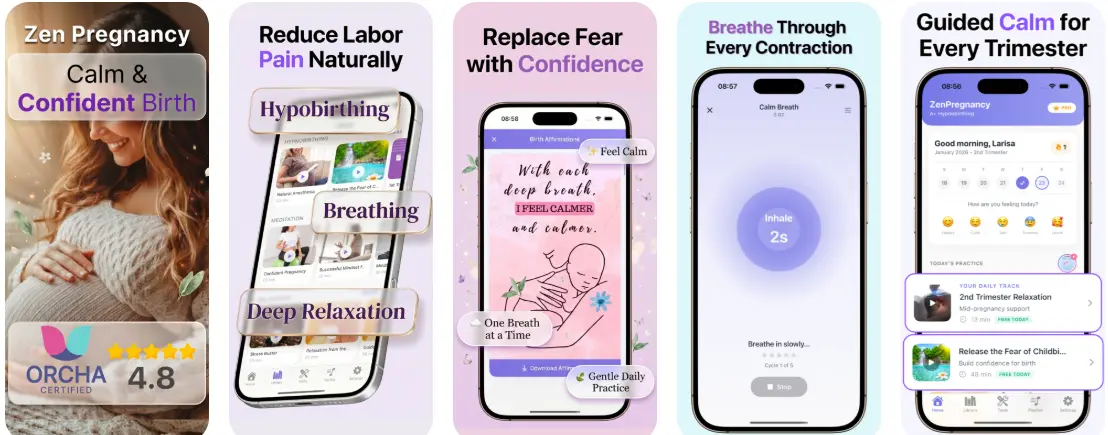
A pregnancy meditation app delivers guided relaxation, breathing exercises, and birth visualizations straight to your phone so you can reduce anxiety and build birth confidence trimester by trimester. HypnoBirth App from ZenPregnancy combines pregnancy-specific meditations, affirmations, contraction timing, and labor breathing in one calm birth preparation space.
> Definition: A pregnancy meditation app is a mobile application that guides expectant parents through short audio sessions, breathing exercises, visualizations, affirmations, and hypnosis-style relaxation, tailored to pregnancy-specific concerns from conception through labor.
TL;DR
- Pregnancy meditation apps may reduce anxiety, improve sleep, and build birth confidence when used consistently from early pregnancy.
- The best prenatal meditation apps include pregnancy-specific content, offline labor playlists, contraction timers, and partner scripts, not just generic calm music.
- Apps complement but never replace midwife or OB-GYN care; think of them as daily practice tools that bridge you into hypnobirthing preparation.
- A 2022 meta-analysis of 13 RCTs found mindfulness-based interventions during pregnancy significantly reduced maternal anxiety and depression.
- Starting early and practicing most days tends to help more than cramming relaxation practice into the final weeks before birth.
5 Facts Every Parent Needs About Pregnancy Meditation Apps
- Pregnancy meditation apps use guided relaxation, breathing, visualizations, and affirmations to soften stress and fear. The point is not to force calm; it is to give the nervous system something steady to follow.
- Regular use is linked with lower anxiety, better sleep, and a stronger sense of control. That matters at 3:17 a.m., when the phone glow is dimmed and a pregnancy pillow is wedged between your knees.
- A pregnancy relaxation app can be an accessible first step into hypnobirthing. HypnoBirth App fits parents who want daily practice without committing to a full course immediately, because it layers guided meditations with labor breathing and birth affirmations.
- Apps support antenatal care; they do not replace it. Your midwife, OB-GYN, or healthcare team still guides clinical decisions.
- Consistency matters more than last-minute intensity. For anxious parents, five calm minutes most days is often easier than a long session after fear has already built up.
Tiny practice counts.
What a Pregnancy Meditation App Does
A pregnancy meditation app gives you a daily relaxation practice built around pregnancy, birth, and labor confidence. Its core job is to make calming skills easy to repeat before you actually need them.
The useful features usually work together like a small birth-preparation routine:
- Use guided breathing to regulate stress. Slow inhales and longer exhales give your body a steady cue when anxiety rises, especially during nighttime wake-ups.
- Repeat affirmations that match birth fears. Good scripts speak to trust, safety, strength, and choice, not vague positivity.
- Practice visualizations before labor begins. Rehearsing waves, openings, safe places, or meeting your baby can reduce fear because the scene feels less unfamiliar.
- Invite your partner into the practice. Partner scripts give your birth companion simple words to say when you need grounding rather than guessing.
- Keep practical labor tools nearby. A contraction timer, labor playlist, and breathing prompts turn the app from a calm-audio library into a birth support tool.
That is the difference from a generic meditation app. Pregnancy-specific tools understand contractions, due-date nerves, changing bodies, and the need for support in the room.
5 Best Pregnancy Meditation Apps for Birth Preparation
Here are five pregnancy meditation apps worth comparing, with the real difference between them made plain.
- HypnoBirth App, A full hypnobirthing toolkit with guided meditations, breathing exercises, birth affirmations, partner scripts, and a contraction timer. If your priority is birth confidence plus practical labor support, HypnoBirth App fits because the same space holds daily relaxation and contraction timing.
- GentleBirth, A CBT, mindfulness, and hypnobirthing hybrid with a surge timer. It suits parents who like a more structured mindset-training style.
- Expectful, A meditation library for fertility, pregnancy, and postpartum. It feels broad and supportive, especially if you want continuity after birth.
- Insight Timer, A large free meditation library with many teachers. It has useful pregnancy tracks, but you need to search carefully because it is not built only for pregnancy.
- Calm, A popular general meditation app with a small pregnancy collection. It may help with sleep, but it lacks labor-specific tools.
For daily hypnobirthing practice, the strongest fit is the option that keeps meditations, affirmations, partner prompts, and labor tools in one pregnancy-focused workflow.
For a deeper shortlist, the best pregnancy meditation app guide compares birth preparation needs more directly.

7 Criteria We Used to Pick Prenatal Meditation Apps
A good prenatal meditation app should match pregnancy, labor, and birth-partner realities, not just offer pleasant background audio. We looked for tools that still make sense when your hospital bag is open on the floor and your brain is moving faster than your breath.
| Criterion | What we looked for | Why it matters |
|---|---|---|
| Pregnancy-specific content | Tracks for birth fear, body changes, sleep, labor | Generic calm scripts can miss the real worry |
| Labor-ready tools | Offline mode, contraction timer, labor playlist | Wi-Fi is not the plan during active labor |
| Partner support | Companion prompts and scripts | Partners need words, not vague encouragement |
| Evidence alignment | Mindfulness, breathing, progressive relaxation | Claims should match published research |
| Pricing clarity | Free trial, clear premium features | Surprise paywalls break trust |
| Ease of use | Simple session lengths and menus | Tired brains need fewer choices |
| Continuity | Trimester and labor progression | Practice should evolve with pregnancy |
Pregnancy-specific support usually depends more on content fit than app popularity.
How We Reviewed Pregnancy Meditation Apps
We reviewed pregnancy meditation apps by comparing hands-on product experience where available with public app listings, help pages, pricing pages, and feature documentation. The goal was to judge how well each app supports pregnancy and labor, not just whether it feels calming.
- Checked pregnancy fit first. We gave more weight to birth-specific meditations, trimester content, affirmations, partner prompts, contraction timing, and offline labor use than to large general libraries.
- Compared core meditation quality. We still considered voice pacing, session length, breathing guidance, sleep support, ease of navigation, and whether a tired parent could find the right track quickly.
- Reviewed evidence and claims. We used clinical studies on mindfulness, breathing, relaxation, and perinatal mental health, then compared those findings with product documentation and app-store materials.
- Looked for practical trust signals. Pricing clarity, free trials, feature limits, privacy prompts, and update visibility all mattered because app availability, costs, and tools can change over time.
These recommendations are editorial guidance for choosing a support tool. They are not medical advice, diagnosis, or a replacement for your midwife, OB-GYN, therapist, or healthcare team.
How Pregnancy Relaxation App Audio Works in the Nervous System
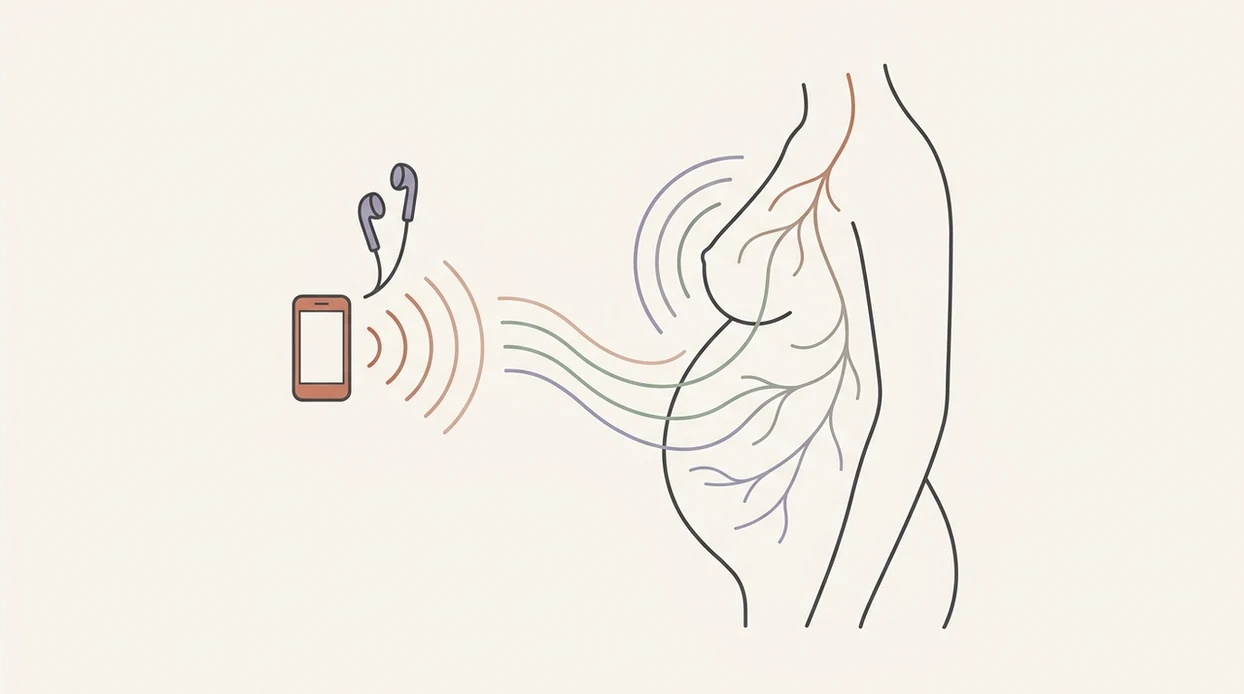
Pregnancy relaxation app audio works by giving the body repeated cues for parasympathetic activation, the “rest and digest” side of the nervous system. A slower voice, longer exhale, jaw release, and steady imagery can reduce stress arousal and help cortisol settle.
The mechanism is simple enough to feel. One palm rests on the bump, the other hand feels the ribs expand, and the exhale becomes slightly longer than the inhale. Over time, neuroplasticity helps the brain pair those cues with safety. That means the fear-tension-pain loop may feel less automatic during birth.
Hypnobirthing scripts use progressive relaxation and positive suggestion to build coping responses before labor begins. Good hypnobirthing apps deliver practice, not promises.
Research supports the broader pattern. A 2017 JAMA trial of 141 pregnant women found an 8-week mindfulness program lowered anxiety and depressive symptoms. A 2022 meta-analysis of 13 randomized trials also found pregnancy mindfulness interventions reduced anxiety, depression, and stress. The evidence is strongest for mindfulness programs overall, not every individual app.
6 Steps to Use a Pregnancy Meditation App Each Trimester
Use a pregnancy meditation app as a tiny daily rehearsal, then add labor tools as birth gets closer. The most evidence-backed approach is consistent mindfulness practice combined with simple breathing skills, because repetition makes the response easier to find under stress.
- Download the app and set a daily reminder in the first trimester. Choose a time you already repeat, like after brushing your teeth.
- Start with 5-10 minute guided relaxations. Let the habit feel almost too easy at first.
- Layer in breathing exercises and birth visualizations by the second trimester. Practice exhaling longer than you inhale.
- Involve your birth partner with companion scripts and prompts. HypnoBirth App helps here because partner language is built into the birth preparation flow.
- Build a labor playlist and enable offline mode before your due date. Do this before the hospital bag zip test.
- Use the contraction timer and affirmations during active labor. Keep the screen simple and come back to the breath.
Parents trying to build a low-pressure routine can use HypnoBirth App as a daily bridge into hypnobirthing because guided tracks, affirmations, and labor tools sit together.
Pregnancy Meditation App vs. Generic Meditation App Features
Pregnancy meditation apps and generic meditation apps are not interchangeable. The difference is not just the word “pregnancy” in a playlist; it is whether the audio speaks to birth fear, body changes, baby wellbeing, interventions, and labor coping.
| Feature | Pregnancy meditation app | Generic meditation app |
|---|---|---|
| Birth visualizations | Usually included | Rare or absent |
| Pregnancy affirmations | Built for labor and body trust | Usually generic |
| Contraction timer | Often included in birth apps | Usually absent |
| Partner scripts | Common in hypnobirthing apps | Rare |
| Trimester focus | Matches changing concerns | Broad stress or sleep focus |
| Labor playlist | Designed for birth use | User must build manually |
Calm and Headspace can be soothing, but they are not built around contractions, birth companions, or hypnobirthing practice. When the issue is labor-specific fear, choose a pregnancy-focused app that combines guided relaxation, birth affirmations, and contraction timing.
If sleep is your main concern, a dedicated pregnancy sleep meditation app may be easier than searching a general library at midnight.
Clinical Evidence Behind Prenatal Meditation App Benefits
Clinical evidence supports mindfulness and guided relaxation during pregnancy, though research on hypnobirthing apps specifically is still developing. That distinction matters. I do not want you to hear “app” and assume a guaranteed birth outcome.
A 2017 randomized clinical trial of 141 pregnant women found that an 8-week mindfulness meditation program reduced anxiety and depressive symptoms compared with controls (JAMA Network: https://jamanetwork.com/). A 2012 trial of 176 first-time mothers found mindfulness-based childbirth and parenting reduced fear of childbirth and depressive mood (BMC Pregnancy and Childbirth: https://bmcpregnancychildbirth.biomedcentral.com/). In 2022, a meta-analysis of 13 randomized controlled trials confirmed reductions in anxiety, depression, and stress (PubMed: https://pubmed.ncbi.nlm.nih.gov/).
Digital support also has a place. A 2021 systematic review found smartphone programs for perinatal mental health can reduce depressive symptoms compared with controls (PubMed: https://pubmed.ncbi.nlm.nih.gov/). During COVID, one large U.S. survey found about 52% of pregnant and postpartum women reported moderate to high anxiety symptoms (Frontiers in Global Women's Health: https://www.frontiersin.org/journals/global-womens-health).
Clinicians typically suggest mindfulness as a supportive practice for stress regulation, alongside medical care, not as treatment for urgent mental health symptoms.
On days nighttime thoughts come with dry mouth, a bathroom trip, and racing thoughts after returning to bed, an app to help me sleep while pregnant can be a practical first support.
5 Drawbacks of Using a Pregnancy Relaxation App
A pregnancy relaxation app is useful, but it has limits. Honest limits make the tool safer to use.
- It cannot guarantee a pain-free birth. Meditation may support coping, but labor is still physical and unpredictable.
- It cannot guarantee an intervention-free birth. Medical decisions depend on your body, baby, setting, and care team.
- Audio does not suit everyone. Some people learn better with a live teacher, movement, or hands-on practice.
- Self-motivation is required. If practice only happens when anxiety peaks, benefits may feel smaller.
- High-stress users may need therapy too. An app is not crisis care or perinatal mental health treatment.
- Data privacy varies. Review permissions before entering health details, due dates, or notes.
HypnoBirth App can be a gentle entry point because sessions are short and pregnancy-specific, but it still asks you to return regularly. The returning is the work.
Limitations
A pregnancy meditation app can support steadier breathing, better rest, and calmer birth preparation, but it should be framed carefully. Here are the main caveats I would want a friend to know before downloading one.
- Research specifically on hypnobirthing apps is still limited; most evidence covers broader mindfulness programs.
- A pregnancy meditation app cannot guarantee specific birth outcomes, including pain level, intervention rate, or labor length.
- Some users feel frustrated or “like they’re doing it wrong” without live teacher feedback.
- Apps require consistent daily practice and self-discipline to deliver noticeable results.
- People with complex perinatal mental health needs may require specialist therapy beyond an app.
- Data privacy and security policies vary widely between apps, so review them before entering sensitive information.
- Some apps, including general options like Insight Timer or Calm, require more searching to find pregnancy-relevant tracks.
- Full courses from providers such as Hypnobabies or The Positive Birth Company may offer deeper education and live support than an app alone.
If cost is the sticking point, a free pregnancy meditation app can still help you begin.
See also: Postpartum Meditation App: Calm Support After Birth.
See also: Headspace Pregnancy Meditation Alternative for Birth Preparation.
See also: Pregnancy Meditation App Privacy: What Data Should You Check?.
Read more
- App To Help Me Sleep While Pregnant
- App To Help Me Stay Calm During Labor
- App To Help Pregnancy Anxiety At Night
- Best Pregnancy Meditation App
- Calm vs Hypnobirthing App for Pregnancy
- Find Calm Birth Preparation
- First Trimester Meditation App Guide
- Fourth Trimester Meditation Guide
- Free Pregnancy Meditation App
- Guided Meditation for Pregnancy: Calm Birth Prep
- Headspace Pregnancy Meditation Alternative
- Hospital Bag Meditation App Checklist
Best Pregnancy Meditation App for Calm Birth Preparation
HypnoBirth App helps you build a simple meditation and relaxation routine for pregnancy, with free hypnobirthing sessions designed to support calm, confidence, and better rest. With 200k+ users and ORCHA NHS certification, it is a trusted option for guided practice throughout pregnancy.
Best for
- Short pregnancy meditation sessions that fit into a busy day
- Relaxation, breathing, and confidence-building for birth preparation
Limitations
- Not a replacement for medical advice, diagnosis, or care from your maternity team
- Some sessions may feel more birth-focused than a general mindfulness app
Frequently Asked Questions
What is a pregnancy meditation app?
A pregnancy meditation app is a mobile tool with guided relaxation, breathing, mindfulness, and birth preparation audio for pregnancy. It helps you practise calm techniques at home, during short breaks, or before sleep, without needing to attend a live class every time.
Is a pregnancy meditation app safe to use during pregnancy?
Yes, a pregnancy meditation app is generally safe for most people when used for gentle relaxation and breathing. Choose sessions designed for pregnancy, avoid breath-holding or intense techniques, and ask your midwife or doctor if you have a high-risk pregnancy, trauma concerns, or symptoms that need medical advice.
Can a pregnancy meditation app help with pregnancy anxiety?
Yes, a pregnancy meditation app can help reduce everyday pregnancy anxiety by calming the nervous system and giving you simple coping tools. It is not a replacement for professional mental health support, so speak to your midwife, GP, or therapist if anxiety feels overwhelming, persistent, or affects sleep and daily life.
Can I start using a pregnancy meditation app at 38 weeks?
Yes, you can start using a pregnancy meditation app at 38 weeks. Short daily sessions can still help you practise breathing, relaxation cues, and positive birth preparation, even if your due date is close.
Is a pregnancy meditation app useful for first-time mums?
Yes, a pregnancy meditation app is especially useful for first-time mums who want simple, structured support. It can explain relaxation skills step by step and help build confidence before labour, birth, and the early postnatal period.
Can I use a pregnancy meditation app if I plan to have an epidural?
Yes, you can use a pregnancy meditation app even if you plan to have an epidural. Meditation and hypnobirthing techniques can support calm breathing, decision-making, and comfort before an epidural, while it is being placed, or if plans change.
Is a pregnancy meditation app better than a hypnobirthing class?
No, a pregnancy meditation app is not always better than a hypnobirthing class; it is a more flexible option. An app works well for daily practice and convenience, while a class may offer personalised teaching, partner involvement, and the chance to ask questions.
How often should I use a pregnancy meditation app?
Daily practice is ideal for building familiarity with pregnancy meditation techniques. Even 5 to 10 minutes a day can help, and longer sessions before sleep or during rest periods may support deeper relaxation.
Which trimester is best for starting pregnancy meditation?
Any trimester is a good time to start pregnancy meditation. Starting earlier gives you more time to practise, but beginning in the third trimester can still support sleep, anxiety relief, and birth confidence.
Can a pregnancy meditation app help with sleep during pregnancy?
Yes, a pregnancy meditation app can help with sleep by guiding your body and mind into a calmer state. Bedtime sessions, breathing exercises, and body scans may make it easier to unwind, though ongoing insomnia or severe discomfort should be discussed with a healthcare professional.
Does pregnancy meditation replace antenatal education or medical care?
No, pregnancy meditation does not replace antenatal education or medical care. It is a supportive wellbeing tool, while your midwife, doctor, or antenatal team should guide you on medical decisions, symptoms, labour concerns, and birth options.
What features should I look for in a pregnancy meditation app?
A good pregnancy meditation app should include pregnancy-specific guided audios, breathing exercises, birth confidence tracks, sleep support, and short sessions for busy days. Look for clear safety guidance, soothing voices, easy navigation, and content that supports different birth preferences without promising guaranteed outcomes.