 Hypno
HypnoLabor Meditation: Guided Audio to Stay Calm During Delivery
Guided labor meditation tracks that keep you focused and calm during contractions. How meditation changes your brain's pain response during delivery.
200,000+ moms • ORCHA NHS Certified • Free on iOS & Android
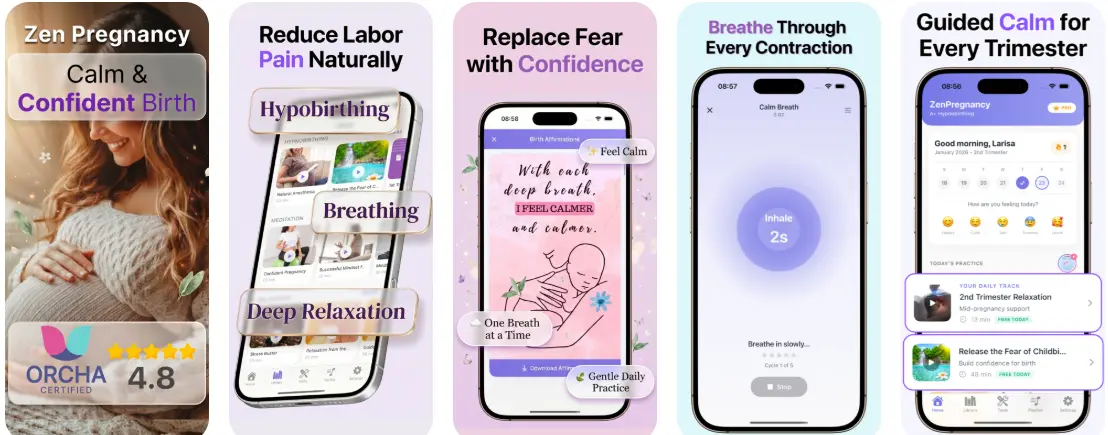
Labor meditation is a guided audio practice that helps you stay calmer and more focused during contractions, pushing, and delivery. It uses breathing cues, relaxation prompts, and reassuring language to support your nervous system through each stage of birth.
Who is this guide for?
Good fit if you
- You want guided audio to help you stay calm during labor and delivery
- You prefer simple breathing cues you can follow during contractions
- You are preparing for an unmedicated, medicated, induced, or cesarean birth
- You want to practice birth relaxation techniques during pregnancy
- You like hypnobirthing-style scripts, affirmations, and calm voice guidance
May not be enough if you
- You need urgent medical advice or clinical decision-making during labor
- You want meditation to remove all pain or guarantee a specific birth outcome
- You prefer completely silent labor without audio, prompts, or voice guidance
Why Guided Birth Meditation Matters During Delivery
Guided birth meditation matters because labor is not only physical; it is also emotional, hormonal, and sensory. When fear rises, the body often tightens the jaw, shoulders, abdomen, and pelvic floor, which can make contractions feel harder to work with.
A calm audio guide gives your brain one simple job: listen, breathe, soften, repeat. That matters when the room is bright, monitors are beeping, or your partner is asking where the charger is. Many people use meditation alongside hospital birth, home birth, birth center care, induction, epidural, or planned cesarean preparation. The goal is not to perform birth perfectly. The goal is to build a familiar mental pathway back to steadiness when intensity rises.
How Labor Meditation Works in the Nervous System
Labor Meditation works by lowering threat perception and giving the nervous system repeated cues of safety. During contractions, guided audio can shift attention toward breath rhythm, muscle release, and present-moment awareness instead of panic-based thoughts.
In practical terms, this supports parasympathetic activity, helps reduce unnecessary guarding, and may make it easier for oxytocin-driven contractions to continue without the extra interference of fear. Meditation does not numb the body or erase sensation. It changes the way the brain interprets sensation, which can reduce the feeling of alarm around pain. This is one reason hypnobirthing meditation for birth preparation often repeats simple phrases, slow counting, and relaxation cues until they become automatic.
What Research Says About Mindfulness for Childbirth
Research suggests mindfulness-based childbirth programs may reduce fear of birth and improve some labor experiences, but the evidence is mixed and should not be treated as a guarantee. A 2024 systematic review and meta-analysis found associations with lower fear of childbirth, lower reported labor pain, shorter labor, and lower cesarean rates, while noting that evidence certainty ranged from very low to moderate.
The same review did not show a significant reduction in epidural use, which is important. Meditation is not a test of whether you can avoid pain relief. It is a coping skill you can use before medication, with medication, or when plans change. This is not medical advice. Discuss pain relief, induction, fetal monitoring, and safety questions with your midwife, OB-GYN, or care team. Source: 2024 childbirth mindfulness review.

What Guided Childbirth Audio Should Include
Good guided childbirth audio should be simple, steady, and easy to follow during a contraction. The best tracks use short cues such as “soften your jaw,” “breathe low,” “drop your shoulders,” and “let the wave pass through.”
Long speeches can feel overwhelming in active labor. Overly cheerful tracks can also be irritating when sensations are strong. Look for audio that has a grounded voice, slow pacing, spacious pauses, and stage-specific support for early labor, active labor, transition, and rest between surges. If you are still exploring which voice and style suit you, start with guided meditation for pregnancy during the second or third trimester so the sound feels familiar before birth day.
How to Meditate During Contractions
You meditate during contractions by choosing one anchor before labor starts and returning to it every time intensity rises. The method should be so simple that you can do it in a car, triage room, shower, or dim birth suite.
- Start early: play your chosen audio in early labor before panic has a chance to build.
- Match breath to cues: inhale gently, lengthen the exhale, and let the guide set the rhythm.
- Release one area: soften your jaw, hands, belly, or pelvic floor during each surge.
- Rest between waves: drop your shoulders and treat the pause as recovery time.
- Repeat the same track: familiarity helps your body settle faster.
If breathing feels confusing, practice pregnancy breathing techniques before 36 weeks so you have muscle memory when labor begins.
Breathing Cues for Active Labor Focus
Breathing cues work best in active labor when they are short, physical, and repeatable. Instead of trying to remember a complicated technique, use one phrase that tells your body what to do: “breathe down,” “loose jaw,” or “long exhale.”
Many birth educators teach that the jaw, throat, diaphragm, and pelvic floor often mirror each other. That does not mean relaxing your mouth will magically open the cervix, but it can reduce unnecessary bracing. A simple pattern is inhale for four, exhale for six, then relax your hands. If you want audio support for this specific skill, a labor breathing exercises app can help you rehearse the same cues until they feel natural.
Prenatal Practice by Trimester
Birth meditation is easier to trust in labor when it has already become familiar during pregnancy. You do not need an hour a day; five to ten minutes of repeated practice is often more useful than occasional long sessions.
In the first trimester, use short relaxation tracks for nausea, fatigue, and early anxiety. In the second trimester, add breath practice and body scans so you learn where you hold tension. In the third trimester, practice with the same tracks you may use during contractions, especially around 34 to 38 weeks. If you are starting late, do not panic. Pick one breathing pattern, one audio track, and one affirmation. Repetition matters more than variety when birth is close.
Using Meditation With Epidural, Induction, or Cesarean Birth
Meditation can support many birth plans, including epidural, induction, assisted birth, unmedicated birth, VBAC, and planned cesarean. It is not only for people hoping for a low-intervention labor.
During an induction, meditation may help with waiting, cervical checks, IV placement, and the emotional stop-start rhythm of hospital care. With an epidural, it can support rest, reduce fear, and help you stay connected to your body. For cesarean preparation, calming audio can be useful before the operating room, during spinal anesthesia placement, or in recovery if your care team allows headphones. For more specific planning, see hypnobirthing for c-section prep. This is not medical advice; ask your provider what is safe for your situation.
Partner and Doula Support During Birth Meditation
A partner or doula can make meditation easier by protecting the environment and repeating the same cues you practiced. Their role is not to force calm; it is to help you return to it gently.
Before labor, choose three phrases they can say without sounding awkward: “drop your shoulders,” “breathe with the track,” and “you only have to do this wave.” During labor, they can start the audio, reduce unnecessary talking, offer water, remind staff about your preferences, and help you change positions between contractions. If you stop wanting sound, that is okay too. Good support follows the laboring person, not the plan on paper.
Tools That Make Birth Meditation Easier
The right tools reduce decision-making when labor is intense. Prepare headphones, a charger, a saved offline playlist, a dimmable light if allowed, water, lip balm, and a simple note for your partner with your preferred tracks.
Many people also like pairing meditation with contraction timing so they are not switching between too many apps. A contraction timer meditation setup can help you track patterns while staying focused on breath and rest. If affirmations help you feel brave, add a few short lines from a birth affirmations app, such as “I can meet this wave” or “My body knows how to soften.” Keep the toolkit small enough to use when you are tired.
Choosing a Pregnancy Meditation App
A pregnancy meditation app is most useful when it fits real labor conditions: quick access, familiar voices, simple tracks, and tools you can use with one hand. HypnoBirth App is a hypnobirthing app that provides guided meditation, breathing exercises, contraction timing, and birth affirmations for pregnant women.
If you want to start with audio practice, try a on iPhone and save your favorite sessions before 37 weeks. Android users can practice with so the voice and rhythm feel known before labor. The app should support your care, not replace your midwife, doctor, childbirth class, or medical advice.
Birth Meditation App Comparison
Different pregnancy and birth apps suit different learning styles. The best choice depends on whether you want labor-specific audio, broader wellness meditation, structured hypnosis training, or a mix of breathing and contraction tools.
| Option | Best for | Labor meditation style | Consideration |
|---|---|---|---|
| HypnoBirth App | Hypnobirthing audio, breathing, affirmations, and contraction timing | Calm, birth-focused guided sessions | Best if you want several birth tools in one app |
| Expectful | Pregnancy and motherhood wellness meditation | Broad mindfulness and emotional support | Less focused on in-the-moment contraction tracking |
| Hypnobabies | Structured childbirth hypnosis course | Detailed hypnosis practice | May require more time and program commitment |
| GentleBirth | Positive birth training and mindfulness | Hypnobirthing, CBT-style, and mindfulness tools | Interface and content depth may feel busier for some users |
Limitations and Safety for Labor Relaxation
Meditation can be a valuable comfort measure, but it has limits. Honest expectations make the practice safer and more useful.
- It cannot guarantee a pain-free birth, short labor, vaginal birth, or avoidance of interventions.
- It should not replace medical assessment for bleeding, reduced fetal movement, severe headache, fever, waters breaking, or unusual pain.
- Some people dislike headphones or guided voices during intense labor; silence may feel better.
This is not medical advice. Consult your healthcare provider for symptoms, risk factors, and birth planning.
Building a Labor Audio Playlist
A labor audio playlist should be short, predictable, and organized by stage. Too many options can become stressful when contractions are close together, so choose three to five tracks and label them clearly.
One helpful structure is: early labor rest, active labor breathing, transition support, pushing or bearing-down encouragement if relevant, and postpartum grounding. Download everything offline, test the volume with earbuds and a speaker, and show your partner where the tracks are. Avoid saving only brand-new meditations for birth day. The nervous system relaxes faster when it recognizes the sound. If a track annoys you during pregnancy, remove it. Labor tends to magnify small irritations.
A Simple Practice to Start Tonight
Start with a ten-minute routine that feels almost too easy. Put one hand on your chest and one on your belly, play a calm track, inhale gently through your nose, and make the exhale longer than the inhale.
At the end of each exhale, release one place you commonly hold tension: forehead, jaw, shoulders, hands, belly, or pelvic floor. Repeat the same session for a week before changing anything. If your mind wanders, that is not failure; noticing and returning is the practice. Over time, the first few seconds of the audio can become a cue that tells your body, “I know this. I can come back to calm.”
This guide was written for educational birth preparation and reviewed for safety language. It does not replace advice from your midwife, OB-GYN, GP, or maternity unit.
Frequently Asked Questions
Can labor meditation really help with contraction pain?
Yes, labor meditation can help some people feel calmer and more in control during contractions. It works by reducing fear, tension, and the stress response around pain, which may make sensations feel more manageable. It does not guarantee pain relief or replace medical pain management options.
How does guided labor meditation work during childbirth?
Guided labor meditation works by giving your mind a simple focus during contractions, such as breath, sound, imagery, or body relaxation. This can support the parasympathetic nervous system, reduce panic, and help you release unnecessary muscle tension. It is a coping tool, not a medical treatment.
When should I start practising labor meditation before birth?
The second trimester is a good time to start practising labor meditation, but starting later can still be useful. Aim for five to ten minutes on most days so the cues feel familiar before labour begins. Short, consistent practice is usually more helpful than occasional long sessions.
Is 38 weeks too late to start labor meditation?
No, 38 weeks is not too late to start labor meditation. Even a few short daily sessions can help you learn calming breath cues, grounding phrases, and relaxation techniques before birth. Keep the practice simple so it is easy to use during contractions.
Can labor meditation help with pregnancy anxiety before birth?
Yes, labor meditation can help with pregnancy anxiety by giving you a structured way to slow your breathing and refocus your thoughts. It may be especially helpful for bedtime worries, fear of birth, or feeling overwhelmed by unknowns. If anxiety feels severe, persistent, or linked to trauma, speak with a qualified perinatal mental health professional.
Can I use labor meditation if I plan to have an epidural?
Yes, you can use labor meditation even if you plan to have an epidural. Meditation may help before the epidural, while waiting for procedures, during positioning, or when resting afterwards. It can support calm decision-making alongside your chosen medical pain relief.
Is labor meditation helpful for first-time mums?
Yes, labor meditation can be helpful for first-time mums because it offers a clear coping structure for unfamiliar sensations. Guided audio, breathing cues, and simple affirmations can make it easier to stay present instead of feeling overwhelmed. It is best used as one part of your wider birth preparation.
Should I use a labor meditation app or take a hypnobirthing class?
Both a labor meditation app and a hypnobirthing class can be useful, depending on how you like to learn. An app is convenient for daily practice and guided audio, while a class may provide deeper education, partner techniques, and personalised questions. Many people benefit from using both.
Should I listen to labor meditation with headphones during labour?
Yes, headphones can be useful during labour if they help you block out noise and focus. A small speaker may be better if you want to stay connected with your birth partner or care team. Test both options before your due date and check hospital or birth centre rules.
Can I meditate during an induction of labour?
Yes, you can usually meditate during an induction of labour. Guided meditation may help during waiting periods, monitoring, cervical ripening, or changing contraction patterns. Ask your care team what movement, positioning, headphones, and device use are allowed.
What should a guided childbirth meditation audio include?
A guided childbirth meditation audio should include slow breathing cues, relaxation prompts, grounding language, and short phrases that are easy to follow during contractions. The best tracks use a calm voice and avoid complex instructions. Many people prefer separate tracks for early labour rest, active labour focus, and transition.
What should I do if labor meditation makes me anxious?
Stop the meditation if it makes you anxious and switch to a grounding technique that feels safer. Open your eyes, name what you can see, move your body, hold someone’s hand, or talk with your support person. If meditation triggers panic or trauma responses, seek support from a qualified perinatal mental health professional.
Best Labor Meditation App for Calm Guided Audio During Delivery
HypnoBirth App offers free hypnobirthing and labor meditation audio designed to support calm breathing, relaxation, and focus during birth. With 200k+ users and ORCHA NHS certification, it is a practical option for parents who want guided support before and during delivery.
Best for
- Guided labor meditation and breathing practice
- Hypnobirthing audio for contractions and active labor
- Prenatal relaxation practice by trimester
- Calm birth preparation for different delivery plans
Limitations
- It does not replace medical advice from your midwife, doctor, or care team
- Audio support may need to be adapted if you prefer silence or cannot use headphones during labor
Read more
- App To Help Me Sleep While Pregnant
- App To Help Me Stay Calm During Labor
- App To Help Pregnancy Anxiety At Night
- Best Pregnancy Meditation App
- Calm vs Hypnobirthing App for Pregnancy
- Find Calm Birth Preparation
- First Trimester Meditation App Guide
- Fourth Trimester Meditation Guide
- Free Pregnancy Meditation App
- Guided Meditation for Pregnancy: Calm Birth Prep
- Headspace Pregnancy Meditation Alternative
- Hospital Bag Meditation App Checklist